

Key Takeaways
Treat not knowing as a choice when evidence was available
Ignorance can be culpable. Wilful blindness is avoiding information that a person could and should know. The legal idea dates to the nineteenth century: someone may be treated as knowing a fact if they deliberately avoid confirming what is obvious. The issue is not simply missing information. It is having a chance and responsibility to learn, then turning away.
Warnings were already there. Before Enron and the banking crisis collapsed, experts and employees had identified serious risks. Yet the familiar story after disaster was that nobody could have predicted it. Heffernan argues that such failures often involve ignored warnings, not an absence of them. The same pattern appears in homes, hospitals, companies, and governments, where people can see enough to act but prefer not to.
The distinction between unavoidable ignorance and avoidable ignorance is crucial. No person can investigate every risk, so responsibility depends partly on role, access, and the cost of checking. A refinery operator, executive, and bystander do not have identical duties. The concept is strongest when it asks what a person could reasonably have learned, rather than treating every bad outcome as proof of prior knowledge. That standard also shifts attention from individual blame to the design of reporting systems: were warnings accessible, credible, and safe to raise?
Seek people and evidence that unsettle your familiar defaults
Similarity feels like safety. Positive assortative mating is the tendency to form close relationships with people much like ourselves. Rebecca and Robert, a couple profiled in the book, shared backgrounds, values, work, and habits. Such affinity brings comfort, but it can also narrow what a person encounters. Familiarity itself can make strangers, ideas, or even arbitrary details feel more appealing.
Personalisation narrows the field. Online dating data from 25 million questionnaires showed that people often seek confirmation, not opposites. Music services similarly recommend tracks resembling what a listener already likes. This is efficient, but it can reduce serendipitous discovery. In political discussions, like-minded groups can move toward more extreme views, while people tend to seek confirming information more often than opposing information.
Affinity is not a flaw to eliminate. Shared language and trust make cooperation possible, and recommendations can help people navigate overwhelming choice. The risk comes when convenience becomes a substitute for exposure to difference. A useful test is not whether a team looks diverse on paper, but whether unfamiliar perspectives can change its decisions. Contact alone does not guarantee understanding. Difference needs a route into discussion, enough status to be heard, and enough time for disagreement to produce insight rather than defensiveness.
Ask what love or loyalty makes too costly to notice
Attachment can blur judgment. People often protect the relationships that anchor their identity and sense of security. Heffernan describes marrying Michael despite knowing about his serious heart condition. Their shared life depended, in part, on behaving as if the condition did not define their future. Research discussed in the book also found that people often idealise partners, and that these positive illusions can support relationship satisfaction.
Protection has limits. In families affected by abuse, dependence, shame, or fear of separation can make warning signs hard to face. A mother may reinterpret a partner's troubling behaviour because acknowledging it could threaten her family, finances, and self-image as a good parent. Love can help people endure hardship, but it can also leave vulnerable people exposed when the truth seems unbearable.
The same mental habit can be protective in one setting and dangerous in another. Positive expectations can give a relationship room to grow, while denial of concrete harm blocks necessary action. The practical distinction is whether an illusion encourages generosity toward an imperfect person or prevents a person from responding to evidence of danger. This matters because calls to simply face facts can underestimate dependency and fear. Support, safety, and trusted outsiders may be needed before someone can confront a truth without losing everything at once.
Make cherished theories answer to evidence that could disprove them
Beliefs recruit the mind. Cognitive dissonance is the discomfort of holding conflicting ideas. People often reduce it by explaining away evidence rather than revising a cherished belief. Epidemiologist Alice Stewart found that children whose mothers had received an X-ray during pregnancy were about twice as likely to die of cancer within ten years. Her findings were checked by later studies, yet doctors continued the practice for decades.
The cost was institutional. Accepting Stewart's evidence meant questioning both the safety of a valued technology and the medical belief that small radiation doses were harmless. In another example, Alan Greenspan's faith in self-correcting markets persisted through repeated financial failures. A useful discipline is to ask what evidence would change a view, and to make sure that evidence is actively sought.
The episode illustrates why falsifiability is more than a scientific ideal. It is a protection against turning a model into a shield for professional identity. At the same time, a single anomalous result should not automatically overturn established practice. Reliable revision needs replication, transparent methods, and serious engagement with competing explanations. The deeper failure in Stewart's case was not that colleagues questioned her data, but that status and investment made questioning asymmetric: established assumptions received protection while the challenger carried the burden of proof.
Protect attention and sleep before safety-critical decisions
Attention has a hard ceiling. In 2005, an explosion at BP's Texas City refinery killed fifteen people. Operator Warren Briggs had worked twelve-hour shifts for twenty-nine days and was getting little sleep. The control room did not display key measures together, and the tower became dangerously overfilled. Investigators noted that fatigue can narrow attention and make unusual conditions harder to interpret.
Focus can hide the obvious. In the famous Invisible Gorilla experiment, about half the viewers counting basketball passes failed to notice a person in a gorilla suit crossing the scene. Inattentional blindness means failing to notice visible information because attention is occupied elsewhere. The lesson applies to busy dashboards, distracted driving, and exhausted teams: looking at more screens or working longer does not guarantee that people see more.
Safety engineering often treats human error as a predictable feature of a system, not a defect in a worker's character. That perspective changes the remedy: improve displays, staffing, rest, and escalation procedures instead of demanding heroic concentration. The chapter's examples also caution against assuming that attention can be divided without cost. However, fatigue is only one contributor to the Texas City disaster. Treating it as the explanation would obscure design, maintenance, and management choices that shaped the conditions in which a tired operator had to work.
Name a conflict early, before silence hardens into the status quo
Avoidance feels easier today. The status quo trap is the pull to leave things unchanged because change appears risky and effortful. Debt advisers described clients who left bank letters unopened until repossession was near. At work, silence can serve the same function. In a study cited by Heffernan, 85 percent of executives said they had at some point felt unable to raise an issue with a boss; only 51 percent felt truly comfortable doing so.
Silence protects the problem. Employees may fear being labelled troublemakers, or believe speaking up will achieve nothing. At Bear Stearns, Pat Lewis developed a way to compare business risks with returns, but the proposal was rejected as too politically difficult. When concerns remain unspoken, leaders can mistake quiet for agreement, and a fixable problem can become an organisational habit.
Silence is not always passive consent. It may be a rational response to retaliation, precarious employment, or a history of ignored complaints. That is why exhorting employees to be brave is weaker than changing the conditions that make speaking dangerous. Leaders need to show, repeatedly, that concerns receive a response and that people who raise them are protected. A useful measure is not how many channels an organisation offers, but whether employees see a concern investigated, answered, and acted on.
Build explicit permission to question orders into the job
Authority changes the question. In Stanley Milgram's obedience experiments, volunteers believed they were delivering electric shocks to another person. Sixty-five percent followed the experimenter's instructions to the highest level. In a hospital study, twenty-one of twenty-two nurses prepared to give a patient an obviously excessive dose after a doctor's phone order. People may focus on doing the assigned task well while losing sight of their independent judgment.
Small steps normalise harm. Walt Pavlo, an MCI executive who later went to prison for fraud, described how he moved from questionable accounting practices to illegal conduct through a series of increments. The steps felt manageable, especially when rewarded or left unchallenged. Clear targets can intensify this problem when leaders communicate that results matter more than how they are achieved.
Organisations need coordination, so eliminating authority is neither realistic nor desirable. The important distinction is between coordinated action and unquestioning compliance. The military approach called mission command, described in the book, relies on trust and shared understanding so people can make decisions when circumstances change. Businesses can learn from that principle by defining when a worker should pause, challenge, or escalate an order. Training helps, but incentives and leaders' reactions matter more: people learn the real rule from what happens after someone says no.
Assign a specific person to act when harm becomes visible
A crowd can dilute responsibility. The bystander effect describes how people become less likely to intervene when others are present. In one smoke-filled-room experiment, most participants alone investigated the smoke, while only one of twenty-four people in a group reported it promptly. People may assume someone else will act, or fear making a scene if they have misread the situation.
Systems can make everyone a bystander. An inquiry estimated that about 1,400 children were sexually exploited in Rotherham from 1997 to 2013. Police, social services, schools, taxi licensing, and other bodies had fragments of knowledge, but responsibility was dispersed. When a problem belongs to every department, it can effectively belong to none. Naming an owner, a deadline, and an escalation route makes action less dependent on guesswork.
The smoke experiment shows that inaction need not reflect cruelty. Ambiguity and the presence of other witnesses can freeze otherwise decent people. That makes role clarity a moral safeguard, not mere administration. The challenge is to assign responsibility without creating a single scapegoat or encouraging others to disengage. Strong systems pair a named lead with shared duties to report and support. In child protection especially, a formal handoff must preserve the human story, not reduce a child to a case number passed between agencies.
Keep human consequences visible when money becomes the score
Money changes what feels important. Experiments described in the book found that reminders of money could make people more self-reliant, less willing to help, and less generous. In a Swiss study about hosting a nuclear waste site, about half of residents initially supported the proposal. When offered substantial annual compensation, support fell by roughly half. Payment did not simply add motivation; it changed how residents understood their relationship to the community.
Incentives can crowd out judgment. At HBOS, sales targets and public rewards helped create pressure to sell products even when staff doubted their ethics. BP training material framed the cost of protecting workers through a fable about pigs and priced a life at $1,000. When decisions are reduced to financial calculations, people can lose sight of whose lives and relationships the numbers represent.
Incentives are not inherently corrupting. Pay can recognise effort, and budgets force choices when resources are limited. The danger is treating financial signals as neutral when they alter attention, identity, and social obligation. A well-designed incentive should be tested for the behaviour it rewards, the behaviour it displaces, and the people whose costs it leaves off the ledger. Moral language alone is insufficient if compensation systems reward the opposite. Numbers become more humane when decision-makers keep the affected people visible alongside them.
Make dissent routine, supported, and capable of changing decisions
Truth-tellers need a system. Heffernan calls people who see danger others ignore Cassandras, after the mythic prophet whose warnings went unheeded. Their examples include nurse Margaret Haywood, who exposed poor care, and Gayla Benefield, whose persistence brought attention to asbestos illness in Libby, Montana. They were not simply born fearless. They kept gathering evidence, finding allies, and insisting that the consequences be seen.
Design openness into the work. Aviation developed a just culture, an approach that treats honest mistakes and near misses as opportunities to learn rather than automatic occasions for punishment. Reports of concerns in the industry grew from about 3,000 in 1980 to 14,000 in 2015. The book also describes Giving Voice to Values, which helps people rehearse how to raise ethical concerns and asks leaders to listen constructively.
Dissent is most useful when it is ordinary, not heroic. Aviation's reporting culture illustrates how a system can convert private unease into shared learning. Rehearsal, safe channels, diverse teams, and visible follow-through all reduce the personal cost of speaking. Still, openness cannot mean that every report is true or that every concern requires the same response. Credible processes must investigate fairly and distinguish good-faith error from misconduct. The aim is not endless suspicion, but reliable ways to test assumptions before harm becomes irreversible.
Analysis
Wilful Blindness is best understood not as a catalogue of bad people, but as an account of how ordinary motives become hazardous when they reinforce one another. Affinity narrows the range of information encountered. Love and ideology make contradictory facts painful. Fatigue reduces the capacity to examine them. Hierarchy and conformity make silence feel prudent. Diffuse responsibility allows each participant to assume another person will act. Financial incentives can then reward the very behaviour that the organisation claims to oppose. The force of the book lies in connecting these mechanisms across intimate relationships, laboratories, hospitals, financial firms, and public institutions.
Its stories also resist a comforting division between knowing and not knowing. Many people in the cases possessed fragments of knowledge, but those fragments were scattered across roles, meetings, and relationships. A warning can be technically available and functionally unusable if nobody can interpret it, raise it safely, or connect it to a decision-maker. This makes blindness partly a property of institutions, not just individuals. The practical question is therefore not only whether people are honest, but whether the organisation can notice, transmit, and act on inconvenient information.
The argument has a limit worth keeping in view. Because the book gathers examples from many domains, the same label can appear to explain very different failures. A spouse avoiding a painful conversation, an executive defending an economic model, and an agency failing to coordinate are not identical processes, and not every failure to act is wilful. Some people lack authority, resources, or reliable information. The concept is most useful when paired with a precise account of what was knowable, who had responsibility, and what made action difficult. That precision preserves the book's moral urgency without turning hindsight into easy accusation. Its central challenge is demanding but practical: create conditions where doubt, evidence, and human consequences can reach the people empowered to respond.
Review Summary
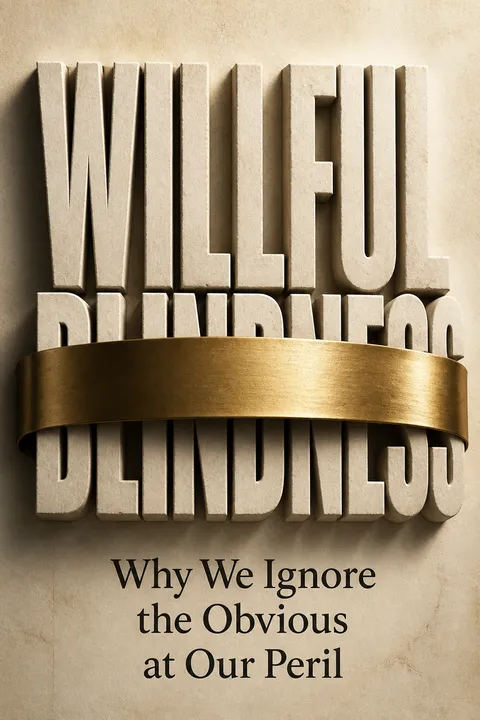
Wilful Blindness receives high praise for its thought-provoking exploration of why people ignore obvious truths. Readers appreciate Heffernan's engaging writing style, diverse examples, and psychological insights. Many find the book eye-opening and relevant to personal and professional life. Some criticize its political bias and repetitiveness. The book challenges readers to confront their own blind spots and consider the consequences of willful ignorance. While some find it uncomfortable, most agree it's a valuable read that offers important perspectives on human behavior and decision-making.
Glossary
Wilful blindness
Avoiding available knowledgeA state in which a person or organisation avoids information that could reasonably be obtained and matters to a responsibility they hold. The term has a legal history: deliberate avoidance can count as knowledge when someone had a clear opportunity and reason to learn a fact. The book uses it to explain both personal denial and institutional failure.
Positive assortative mating
Choosing similar partnersA pattern in which people tend to form long-term relationships with partners who resemble them in characteristics such as background, values, education, or social position. The book uses the research term to show how preference for similarity can create comfort while reducing exposure to different experiences and perspectives.
Cognitive dissonance
Discomfort from conflicting beliefsThe mental discomfort produced when a person holds beliefs or actions that do not fit together. One way to reduce the discomfort is to revise a belief, but people may instead dismiss or reinterpret evidence that challenges it. The book uses this idea to explain resistance to unwelcome scientific and political findings.
Inattentional blindness
Missing what attention excludesFailing to notice a visible event because attention is focused on another task or expectation. In the Invisible Gorilla experiment, viewers asked to count basketball passes often missed a person in a gorilla suit crossing the scene. The concept illustrates why more information or more screens do not necessarily produce better awareness.
Bystander effect
Less intervention in groupsThe tendency for an individual to be less likely to respond to an emergency when other witnesses are present. Research described in the book found that people may hesitate because they expect someone else to act, are uncertain about what is happening, or fear appearing foolish. The effect can occur without conscious indifference.
Diffusion of responsibility
Responsibility spread across peopleA process in which people feel less personally accountable to act because many others share, or appear to share, responsibility. In organisations, several departments may each hold part of the information and assume another group owns the response. The result can be widespread awareness paired with no effective action.
Groupthink
Consensus suppressing critical thoughtA group decision-making failure in which the desire for agreement and belonging discourages independent judgment. Members may neglect warnings, dismiss outside criticism, or fail to plan for alternatives. In the book, groupthink helps explain how cohesive teams can become overconfident and take greater risks than their members might take alone.
Just culture
Learning from honest errorsAn organisational approach, developed in aviation and discussed as a model for healthcare, that encourages reporting mistakes and near misses so systems can improve. It aims to distinguish ordinary human error from deliberate misconduct, rather than punishing every failure automatically. Trust depends on people believing that reports will be handled fairly.
Giving Voice to Values
Rehearsing ethical actionA programme developed by Mary Gentile that focuses on how people can act on values in real workplace situations. Participants recall times they successfully expressed a concern, anticipate objections, and rehearse how to communicate. The approach also asks leaders to listen well, since speaking up alone cannot create change.
Cassandra
Ignored truth-tellerAn allusion to the mythological prophet whose accurate warnings were never believed. The book uses Cassandra for people who notice a danger or wrongdoing that others dismiss, and who try to make it visible. Such truth-tellers may be whistleblowers, but their defining feature is persistent attention to what others avoid seeing.
About the Author
Other books by Margaret Heffernan

Download PDF
Download EPUB
.epub digital book format is ideal for reading ebooks on phones, tablets, and e-readers.








