

Key Takeaways
A wine’s identity comes from five sensory forces, not its prestige label.
Five useful dimensions. Wine Folly makes wine easier to discuss by sorting it into body, sweetness, tannin, acidity, and alcohol. Body describes how light or rich a wine feels, rather than a scientific measurement. Sweetness comes from residual sugar, the grape sugar left after fermentation. Tannin creates bitterness and a drying sensation, acidity makes the mouth water, and alcohol can add warmth and weight. The book ranks each trait on a simple scale, so a drinker can describe a wine without reaching for a critic’s vocabulary.
A map, not a score. The traits interact. Acidity can make a wine seem lighter and less sweet, while tannin and alcohol can make it feel fuller. These dimensions help explain why one person prefers crisp, lean whites while another likes dense, drying reds. They describe style, not quality.
The framework works like a compact sensory dashboard: instead of asking whether a wine is simply good, it helps identify which qualities are present and how they interact. That resembles multidimensional measurement in psychology, where a profile can explain preference better than one overall score. The useful caution is that the ratings are guides, not laboratory readings. Perception depends on food, temperature, expectations, and individual sensitivity, so a number should start a conversation rather than end it.
Taste in four passes: observe, smell, sip, then make a judgment.
A repeatable tasting. Begin by looking at the wine against a pale background. Note its hue, depth of color, and apparent viscosity. Smell before tasting, first with a small sniff and then after swirling; try to name a few fruits, herbs, or other aromas. Next, take a sip and notice sweetness, acidity, tannin, alcohol, body, and the flavors that remain after swallowing. Finally, combine those observations into an overall judgment and, if useful, write them down.
Describe before judging. The point is not to invent an elaborate tasting note. A few specific observations are more useful than a string of impressive-sounding terms. Record the bottle, region, grape, vintage, what it smelled and tasted like, and what was happening around the tasting. That creates a personal record of what you actually enjoy.
Separating observation from judgment can reduce the pull of labels, price, and social pressure. It also resembles deliberate practice: a skill improves when attention is directed toward specific features and feedback is recorded. Smell deserves special attention because aroma contributes substantially to flavor perception. Still, tasting is not a blind instrument. Expectations can alter what people notice, and descriptive words vary by person. Notes are most valuable as a record of personal experience, not proof of expertise.
Compare wines side by side; contrast teaches faster than isolated tasting.
Make differences visible. A wine tasted alone can be hard to place. Pour related wines together and compare them: Argentine and French Malbec, Chardonnay aged in oak and Chardonnay without oak, or Pinot Noir from different countries. Similarities and contrasts become easier to notice when the wines are present at the same time. The book also suggests comparing one wine across multiple vintages, a practice called a vertical tasting.
Build a reliable memory. Use the same tasting steps for each glass and note what changes in aroma, structure, and finish. Ratings are optional. A critic’s high score may indicate that the wine is considered well made, but it cannot guarantee that its style matches your taste. Detailed notes and direct comparisons are more informative than a score alone.
Side-by-side tasting lowers the burden on memory. Instead of reconstructing the first wine from a vague impression, tasters can attend to concrete contrasts, a basic advantage in comparative learning. The method also makes subtle differences more legible, much like comparing two versions of a photograph. Order can influence perception, however, and a bold wine may dominate a delicate one. Pouring modest samples and tasting from lighter to richer helps keep the comparison useful.
Read the label’s organizing clue: grape, place, or a producer’s chosen name.
Three label strategies. A bottle may be identified by its grape, its region, or a name chosen by the producer. A varietal label tells you which grape dominates, subject to local rules. In the United States, the book gives 75 percent as the minimum for a grape named on the label; many other countries use 85 percent. A regional label, common in France, Italy, Spain, and Portugal, points to a place with rules about permitted grapes and production. A made-up name may identify a particular blend or vineyard.
Translate the clue. Sancerre, for example, is a regional name associated mostly with Sauvignon Blanc. The label system tells you what to investigate next, but it does not necessarily spell out every ingredient or guarantee that you will like the wine.
A wine label is a compressed information system. In one market, the grape name is the shortcut; in another, the place carries the main information, with local rules supplying the missing details. This resembles reading a map whose legend changes by country. Learning the label’s organizing principle prevents a common mistake: assuming that an unfamiliar regional name is a grape. The limitation is that legal categories vary and can be opaque, so a label remains a starting point, not a complete tasting prediction.
Follow a grape across regions to see climate and place reshape it.
Place changes the expression. Terroir is the combined influence of a growing region’s climate, soil, terrain, and local practices on a wine’s character. The same grape can therefore produce noticeably different wines in different places. The book contrasts lean, often unoaked Chardonnay from Chablis with riper, creamier versions from warmer regions. Pinot Noir from cool Burgundy is described as more earthy and floral, while examples from California tend toward riper fruit.
Vintage matters, too. A vintage is the year the grapes were harvested. Weather changes from year to year, especially in very cool or hot regions, and can affect ripeness and quality. Grapes do not continue ripening after harvest, so the timing of picking matters. Following one grape across regions and years turns these variations into practical clues rather than trivia.
Terroir is a powerful way to connect wine with geography, but it works best as an account of interacting conditions, not as a claim that a soil type has a single taste. Climate, farming choices, harvest timing, and cellar methods all contribute. The book’s own glossary adds useful nuance: aromas described as mineral-like may arise from fermentation compounds rather than minerals passing from soil into wine. Place is still informative, but simple cause-and-effect stories deserve skepticism.
Treat cellar techniques as flavor choices, not technical trivia.
Production leaves a sensory trace. Red grapes usually ferment with their skins, which contribute color and tannin; white grapes are typically pressed before fermentation. Rosé often gets its color from a short period of contact between red skins and juice. Fermentation vessels matter, too: stainless steel helps preserve primary fruit character, while oak allows more oxygen exposure and can add flavors such as vanilla or spice. Malolactic fermentation changes sharper malic acid into softer lactic acid, often creating a smoother impression.
Different methods, different results. Traditional-method sparkling wine undergoes a second fermentation in the bottle, while the tank method completes that fermentation in a pressurized tank. Champagne commonly uses the traditional method; Prosecco commonly uses the tank method. These are stylistic choices, not a simple ranking from better to worse.
The cellar becomes easier to understand when each technique is treated as a decision with tradeoffs. A winemaker can preserve fresh aromas, extract more structure, or encourage a softer texture, but those goals may compete. This is similar to cooking: ingredients and heat change the result, yet no technique automatically makes a dish superior. The production method can explain why two wines made from the same grape taste different, although producer skill and fruit quality remain important.
Pair by balancing taste and intensity, not by color-coded rules.
Start with the dish. Identify its main tastes and weight, then choose a wine that either complements those qualities or counters them. A congruent pairing amplifies something the food and wine share; a contrasting pairing creates balance through difference. The book’s examples include matching high-acid wine with rich macaroni and cheese, using sweetness against spicy food, and pairing a peppery Syrah with seasoned steak.
Use rules as starting points. Wine should generally be at least as sweet as the dish and should not disappear beside food with much greater intensity. Fat can soften the effect of tannin, while tannic reds can clash with fish oils. Bitter food can intensify the bitterness of a dry red. These are practical tendencies, not laws. Taste the food and wine together and judge whether either one overwhelms the other.
Pairing is a form of sensory interaction: each bite changes what the next sip seems to taste like. That makes the book’s ingredient-first approach more useful than rigid pairings based on broad categories such as red with meat. The same wine can behave differently with a dish’s salt, fat, sweetness, and spice. General rules help narrow choices, but individual sensitivity and preparation matter. A successful match is ultimately something to test at the table, not certify in advance.
Protect wine from heat and light, and use air deliberately.
Storage is about slowing change. The book gives 55 to 59 degrees Fahrenheit and 55 to 75 percent humidity as ideal cellar conditions. Without a cellar or wine fridge, keep bottles somewhere cool and dark, and plan to drink them within a year or two. It reports that wine deteriorates about four times faster at ordinary room temperatures than in climate-controlled storage. Once opened, sparkling wine may last one to three days with a stopper in the fridge; many still wines last several days when properly recorked.
Air can help or harm. Decanting means pouring wine into another vessel to expose it to oxygen. This can soften a young, tannic wine or reduce some unpleasant sulfur aromas. Older wines are more delicate and can be damaged by too much exposure. Light can also accelerate unwanted chemical changes, especially in white and sparkling wines.
Oxygen is both a tool and a hazard. A young wine may become more expressive after air exposure, while an old bottle can lose its remaining freshness quickly. That makes decanting a reversible experiment only up to a point: pour a small taste first, then decide whether more air is useful. Storage advice likewise reflects risk management, not a promise that every bottle will age well. Most wine is best enjoyed rather than held indefinitely.
Learn which flaws warrant a return, and which are matters of taste.
Recognize common faults. A cork-tainted wine may smell musty, like wet cardboard or a damp cellar; the book recommends returning it. Oxidized wine can smell of bruised apple and look brown, although some styles are intentionally oxidized. Reduction, caused by low oxygen during winemaking, can smell of rotten eggs or cooked cabbage; decanting may help. Excessive volatile acidity can smell sharply of vinegar or nail polish remover.
Not every unusual aroma is defective. Brettanomyces, a wild yeast, can contribute barnyard, leather, or bandage-like aromas. Some producers and drinkers value this character, while others dislike it. Light exposure can also damage wine, particularly white and sparkling bottles. At a restaurant, the practical question is whether the bottle is faulty or simply unlike the drinker’s preferred style.
Fault identification combines chemistry with judgment. Mustiness from cork taint is a strong reason to reject a bottle, while Brettanomyces illustrates how an aroma can be welcome to one drinker and unpleasant to another. The distinction resembles the difference between spoilage and acquired taste in other foods. A clear vocabulary gives customers a better way to explain a problem without assuming that every unfamiliar smell signals bad wine. Context and the intended style matter.
Start with 100 grapes and wines; they represent 71% of vineyard area.
Learn a representative slice. The guide selects 100 grapes, wines, and blends from the 1,368 varieties used commercially worldwide, and says its selection represents 71 percent of global vineyard area. The aim is not to memorize every grape. It is to gain a workable set of reference points, then use similarities to find new bottles. For instance, the guide links Malbec from Argentina with the more elegant, higher-acid style of Cahors in France, while showing how Chardonnay ranges from lean Chablis to richer, oak-aged examples.
Turn tasting into a personal map. When trying a new bottle, note its grape or regional name, learn a little about where it came from, taste it actively, and record what worked for you. Add food pairing and serving observations. Over time, the map becomes a tool for choosing, not a list to recite.
The selected 100 function as a sampling strategy: a manageable set offers broad exposure without pretending that wine diversity can be mastered by memorization. Learning relationships between grapes and regions is more flexible than storing isolated tasting facts. This is the same advantage that taxonomies offer in biology: categories help organize unfamiliar examples. The map should remain revisable, though, because a grape’s style varies by producer, vintage, and local practice.
Enjoy wine without confusing pleasure with a health prescription.
Know what is in the glass. A standard serving in the guide is five ounces, and a 750-milliliter bottle contains about five such servings. Many wines contain roughly 12 to 15 percent alcohol. The book discusses moderation and notes that people differ in how they metabolize alcohol; it also says that anyone who cannot reliably stop after one drink may be better off abstaining. Its 2018 discussion cites specific drinking limits and possible health benefits, but these should not be treated as universal medical advice.
Separate enjoyment from health claims. The guide argues that dehydration, rather than sulfites, is a common source of wine headaches and suggests drinking water with wine. It also mentions fermentation-derived amines as another possible factor. These explanations are not a diagnostic test. Alcohol carries health risks, and wine should not be started or continued as a strategy for improving health.
This section benefits from separating practical drinking information from claims about health. Older observational studies sometimes associated moderate drinking with lower rates of particular diseases, but such findings cannot establish that alcohol caused the benefit; differences in health and behavior can confound comparisons. Public health advice has also become more cautious about alcohol-related cancer risk. The enduring value here is not a numeric allowance, but attention to serving size, individual response, and the option to abstain.
Analysis
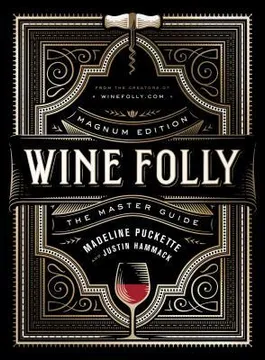
Wine Folly is best understood as a visual field guide, not a linear argument. Its central achievement is to turn an intimidating subject into a sequence of usable questions: What are the wine’s basic sensory traits? What does its label tell me? How did its place and production shape it? What food might make it sing? The book’s structure mirrors that practical journey, moving from tasting and handling to grapes, regions, and label systems. Its compression is unusually effective. Five sensory dimensions give beginners shared vocabulary, while the grape and region entries connect that vocabulary to real bottles. The selection of 100 wines and grapes, said to represent 71 percent of global vineyard area, is a deliberate compromise between a useful overview and wine’s enormous diversity. Regional comparisons make the point vivid: Malbec is not one fixed flavor, and Chardonnay is not a single style. Climate, harvest, winemaking, and vintage all contribute.
The book also has a productive tension. It uses scales, charts, and rules to simplify wine, then repeatedly acknowledges variation: sweetness can be masked by acidity, aromas are personal, and regional styles are not identical from producer to producer. The reader should treat these tools as hypotheses to test, not laws. This matters especially for label classifications and pairing advice, which compress complex local systems into quick guidance.
The strongest practical lesson is that knowledge grows through attentive tasting, comparison, and note-taking. Information about a grape becomes useful when connected to a sensory experience and personal preference. Some of the health discussion reflects the evidence and recommendations presented in 2018, so it should not be read as current medical guidance. Overall, the book’s real promise is not instant expertise. It is confidence: the ability to ask better questions, recognize a style, and choose a bottle for reasons more reliable than prestige or guesswork.
Glossary
Terroir
Place-shaped wine characterA French term describing how a wine-growing region’s climate, soils, terrain, and traditional practices influence the wine. It is a way to connect a bottle to its place of origin. The concept does not mean that one soil type produces a single predictable flavor; grape variety, vintage, and winemaking also shape the result.
Residual Sugar (RS)
Sugar left after fermentationThe grape sugar remaining in wine after fermentation has stopped or completed. Residual sugar is commonly measured in grams per liter and helps describe sweetness, from essentially none in a dry wine to very high levels in some dessert wines. Acidity and tannin can affect how sweet a wine seems, so perceived sweetness does not always reveal its RS.
Tannin
Bitter, drying plant compoundsA group of naturally occurring plant compounds found in grape skins and seeds, as well as in wood used for barrels. In wine, tannin can create bitterness and an astringent, drying sensation. It also contributes structure and can help stabilize wine. The amount and feel of tannin vary with grape variety, winemaking, and aging.
Malolactic Fermentation (MLF)
Softens wine’s acidityA bacterial conversion in which Oenococcus oeni changes sharper malic acid into softer lactic acid. Although commonly called a fermentation, it is not technically a fermentation. It can give wine a smoother, creamier character and produce diacetyl, a compound associated with buttery aromas. Nearly all red wines and some white wines undergo this process.
Carbonic Maceration
Juicy, low-tannin red styleA winemaking method in which whole, uncrushed grape bunches ferment in a sealed environment with carbon dioxide. The lack of oxygen encourages intracellular fermentation in the berries. Wines made this way tend to have lower tannin and color, with juicy fruit and distinctive fermentation aromas. The method is associated with some Beaujolais wines, particularly those made from Gamay.
Chaptalization
Sugar added before fermentationThe addition of sugar to grape juice or must when grapes have not developed enough sugar to produce a desired level of alcohol. It is used in some cool-climate regions and is regulated differently by country. The practice is controversial among some producers and drinkers because it changes the wine’s potential alcohol rather than relying entirely on grape ripeness.
Solera
Layered, ongoing wine blendAn aging and blending system used for Sherry and some other wines. Barrels are arranged in tiers, with younger wine placed in higher tiers and older wine drawn from the bottom. A portion of the older wine is removed for bottling and replenished from the tier above. The repeated blending maintains continuity while incorporating wines of different ages.
Noble Rot
Fungus concentrates grape sugarsA beneficial form of infection caused by Botrytis cinerea under suitable conditions. The fungus helps grapes shrivel and concentrate their sugars and other compounds, allowing producers to make certain sweet wines. It is valued in some white-wine regions, including Sauternes and Tokaj. The same fungus can be damaging when conditions or grape varieties are unsuitable.
Traditional Method
Second fermentation in bottleA sparkling-wine production method in which a second fermentation occurs inside each bottle, trapping carbon dioxide. The wine is typically aged with dead yeast particles, called lees, which can add texture and bready aromas. The method is used for Champagne and many other sparkling wines, including Cava and some Crémant.
Download PDF
Download EPUB
.epub digital book format is ideal for reading ebooks on phones, tablets, and e-readers.








