

Key Takeaways
Win ugly by matching your strengths against an opponent's weakest options
Winning is not a beauty contest. Brad Gilbert became a top-ranked professional without the biggest serve or most elegant strokes. His advantage was arranging points so his reliable shots met an opponent's less reliable ones. That is the book's idea of winning ugly: not playing carelessly, but using observation and tactics to make the opponent solve an uncomfortable problem. If a rival thrives on power, take pace away. If they avoid the net, move forward when the chance appears.
Make the match about the matchup. Gilbert's approach is to notice what is happening, consider the available responses, and choose the one most likely to tilt the next point. He did not need to look better than a stronger hitter. He needed to make that hitter play a less familiar game.
The strategic logic resembles comparative advantage: success often comes less from being best at everything than from choosing the contest in which one's relative strengths matter most. That shift can also reduce ego-driven errors, such as trying to prove that a stronger server can be out-served. The limitation is that tactical intelligence cannot erase every skill gap. Gilbert acknowledges that some opponents simply play too well on a given day. A useful plan improves the odds; it does not guarantee the result.
Arrive with a plan for their best weapon and your best counter
Prepare before the first serve. Gilbert learned that waiting for the opening games to find his rhythm gave elite opponents too much time to take control. Before a match, he reviewed an opponent's strongest shots, weak spots, tendencies under pressure, and behavior between points. Then he decided what to encourage and what to prevent. Against Boris Becker, that meant limiting second serves, offering little pace, and directing play toward Becker's forehand, where misses could unsettle his confidence.
Plans need a compass, not a script. At the 1987 U.S. Open, Gilbert fell two sets behind and trailed 0-3 in the third. His prepared ideas gave him options when the match looked bleak. He extended rallies and stayed with the tactics that could exploit Becker's impatience, eventually winning in five sets. In ordinary club play, Gilbert also recommends receiving first when conditions allow, since a cold, unready serve may be vulnerable.
Pre-match planning is a form of mental rehearsal: it reduces the number of decisions that must be invented under pressure. The benefit is not prediction for its own sake, but having a few useful responses ready when familiar patterns appear. This resembles implementation planning in behavioral science, where deciding in advance what to do in a situation makes action more reliable. Still, preparation can become tunnel vision. Becker's match shows the value of a plan, but also why a player must keep checking whether the opponent is behaving as expected.
Treat each rally as evidence, then change one thing that works against them
Watch the causes, not just the score. Gilbert's coach taught him to ask who was controlling what in a match: which shots created errors, where a player looked uncomfortable, and what changed under pressure. The point is to test assumptions rather than label someone simply good or bad. A player's unreliable stroke may look fine when relaxed and unravel when an important point forces them to use it.
A short slice changed the match. Against Aaron Krickstein, whose powerful forehand dominated from the baseline, Gilbert noticed that a low, soft slice to the forehand drew a weaker reply. Krickstein had to move forward and could not attack the ball with his usual force. Gilbert then directed the next shot toward the backhand. Down 3-2, he won six games in a row and took the match. The discovery came from observing a point, then deliberately testing the pattern.
This is practical hypothesis-testing: notice a pattern, change one variable, and observe the result. That is more useful than making a sweeping judgment after one missed shot. The method also applies to self-scouting. A player can ask a friend to track errors and successful patterns instead of relying on memory, which tends to preserve dramatic moments and miss ordinary causes. One caution: a single success can be noise. A tactic deserves trust when it works repeatedly or forces a clear adjustment, not merely because it produced one memorable winner.
Save your biggest risks for balls that give you a real advantage
Match risk to the ball. Gilbert saw club players often reverse the sensible calculation: they attempt a desperate winner while stretched wide, then push a short ball in the middle of the court safely over the net. A difficult ball may call for a high, neutral return that keeps the rally alive. A short ball inside the player's striking range is the time to take initiative. The aim is not to hit hard every time, but to use placement, angle, or a move to the net when the position supports it.
Change the problem for a Retriever. A Retriever is a baseline player who keeps returning the ball and waits for the opponent to make an error. Against one, trying to hit harder often supplies the pace they use to send the ball back. Gilbert instead recommends patience, selective approaches, and occasional soft shots that make the Retriever generate pace or play at the net.
This is an expected-value view of shot selection: choose the action whose likely payoff justifies its risk from the position actually available. It runs against the highlight-reel instinct to treat every opening as a chance for a winner. The same principle appears in decision-making under uncertainty, where a smaller reliable gain can beat a low-probability spectacular outcome. The balance matters, though. Excessive caution can let an opponent recover or seize initiative. Risk should be earned by position, then taken decisively when the opening is real.
Focus before the obvious game point arrives
Some pressure points are easy to miss. Gilbert calls underrecognized moments with unusual match leverage Hidden Ad Points. A Set-up Point is a point that can create a game point or stop the opponent from getting one, such as 30-all or deuce. A Set-up Game can move a player within one game of the set, especially at 4-all or 5-all. These moments deserve attention before the score announces that the game is nearly over.
The leverage is psychological as well as numerical. Gilbert cites ATP figures from his era showing that top-20 players who won the first set won the match 89.6 percent of the time. In the 1992 Wimbledon final, Andre Agassi held at 4-all in the fifth set, leaving Goran Ivanisevic to serve to stay in the match. Ivanisevic's serve collapsed under that pressure. A steady game had created the decisive test.
The insight is about anticipatory attention. Players often mobilize only once a point is labeled match point or break point, even though the preceding rally may determine who gets that chance. This resembles managing leading indicators rather than waiting for a final outcome to flash red. The cited percentage is specific to professional tennis data from the book's period, not a universal law for every level or format. The transferable lesson is narrower and stronger: notice when one point changes the next point's stakes.
Hold your pace when opponents speed up or slow down
Tempo can move attention. Gilbert uses D.R.M., short for Don't Rush Me, as a reminder to maintain a deliberate personal rhythm between points. He describes Turtle Time as deliberate slowing that can make an opponent impatient and careless. Against Ivan Lendl, Gilbert led 2-0 in the third set before Lendl's interruptions and delays disrupted his concentration. Gilbert began hurrying to compensate, lost his break, and then lost six games in a row.
Respond without joining the drama. A fast player can cause the opposite problem, pushing an opponent into points before they are ready. Gilbert advises taking a permitted moment to reset, towel off, or settle into position, rather than standing at the line feeling rushed. During a long delay, the player should also stay warm and mentally engaged instead of becoming a spectator to the opponent's performance.
Tempo is part of the task environment, not mere etiquette. A changed pace can consume attention that should be available for reading the ball and choosing a shot. A stable routine creates a small pocket of control, much like a pre-performance routine in other sports. The ethical boundary matters: protecting one's own timing is different from escalating delay tactics or trying to distract an opponent. The most durable response is self-regulation within the rules, not a contest over who can manipulate the clock more successfully.
Reset after a mistake before self-criticism becomes a second opponent
Nerves need a next action. Gilbert's Nerve Busters are simple ways to redirect attention: breathe deeply and steadily, keep the feet light and moving, focus on seeing the ball clearly, or use a familiar song to settle the mind. During a match, he returns attention to the next tactical decision instead of replaying the error. Anger can alert a player that something needs fixing, but dwelling on it makes the mistake occupy the next point too.
Serena Williams showed how a loss can stay one match long. At the 2012 French Open, Williams lost in the first round despite leading by a set and holding a 5-1 advantage in the second-set tiebreak. Gilbert highlights her refusal to let the defeat become an ongoing judgment of her ability. She used the setback as a reason to work on her game, then won Wimbledon, Olympic singles and doubles gold, and the U.S. Open that year.
The useful distinction is between learning from an error and turning it into an identity. A short reset protects attention for the task still in front of the player, while later reflection can identify what deserves practice. This is not the same as pretending a loss does not hurt. Serena's response suggests that acceptance and renewed effort can coexist. The sequence of her later victories is inspiring, but it cannot prove that the French Open defeat caused them. The more defensible lesson is that a setback need not dictate the next decision.
Remove preventable breakdowns before the match starts
Preparation includes the bag. Gilbert treats packing as both practical insurance and a cue to focus. His basic club-player list includes water, food, at least two usable rackets, dry socks or shirts, and towels. He recounts changing into an old shoe during a final when a new shoe caused pain, then winning the match. The larger point is simple: a blister, broken string, or lack of water should not become an avoidable match problem.
Warm the body and strokes with a plan. Gilbert and conditioning coach Mark Grabow recommend a few minutes of gentle court movement before stretching, rather than beginning with cold muscles or immediately hitting hard. The on-court warm-up should include volleys, deep groundstrokes on both sides, overheads, the serve, and service returns. It should also give a first look at the opponent's movement and preferences, not turn into an unstructured practice session.
A checklist reduces small sources of cognitive load and gives preparation a clear beginning. In that sense, the equipment bag functions like a pilot's preflight routine: it catches practical omissions while shifting attention toward the job ahead. The warm-up also has a dual purpose, preparing the body and collecting information. The details should be adapted to the player, weather, and medical needs rather than followed mechanically. Preparation is useful when it removes friction, not when packing becomes an elaborate ritual that consumes more attention than the match.
Train weak strokes outside matches instead of demanding miracles under pressure
A match is a poor repair shop. When a stroke breaks down, Gilbert recommends simplifying it rather than asking for more than it can reliably produce. A shaky backhand may need a safe ball in court; a first serve that keeps missing may need less ambition until rhythm returns. For a failing forehand, check whether the racket is prepared early enough. Across strokes, footwork matters because late positioning damages timing, balance, and control.
Build the change in practice. Gilbert suggests getting a coach's diagnosis, isolating the shot with a wall or ball machine, and then deliberately using it in a practice match. A player with a weak backhand should stop running around every backhand during that session. Repeated, focused work gives the stroke a chance to become dependable before a competitive match makes every miss feel consequential.
This separates technical learning from match execution. A player under pressure has limited attention for rebuilding movement, so a simple cue or safer shot can stabilize performance while deliberate practice addresses mechanics later. That distinction fits motor-learning principles: repetition with a specific goal can build a skill, while varied or match-like practice helps transfer it. One nuance is that practicing only against an easy opponent can make a new stroke feel reliable without testing it under pressure. A progression from controlled repetition to demanding situations is more robust.
Borrow champions' decisions, not the physical gifts you lack
Copy the logic, not the highlight. Gilbert studies champions for choices that ordinary players can adapt. Andre Agassi's exceptional ability to take the ball early becomes a modest practice goal: move forward and make contact a little sooner, rather than trying to reproduce his extraordinary timing at once. Ivan Lendl's habit of starting below maximum power offers another transferable lesson: build rhythm before increasing force. Different champions succeed with different styles, so the useful question is what fits a player's own strengths.
A tactical shift can unlock existing talent. When Agassi asked Gilbert for help, the coach urged him to think more carefully about opponents, court position, and how to use his groundstrokes. Agassi rose from number 32 in the world to number one in roughly a year, winning major titles along the way. The story illustrates strategy's potential, not a recipe that guarantees the same rise for every player.
Elite performance is most useful as a source of principles rather than templates. A player can extract gradual escalation from Lendl or early preparation from Agassi without copying their bodies, equipment, or full technique. This resembles transfer learning: retain the structure of a successful solution, then adapt it to a different set of constraints. Agassi's rise also involved his own ability, training, and circumstances. Coaches and tactics can organize talent more effectively, but a single success story should not be mistaken for proof that one coaching method alone produces champions.
Analysis
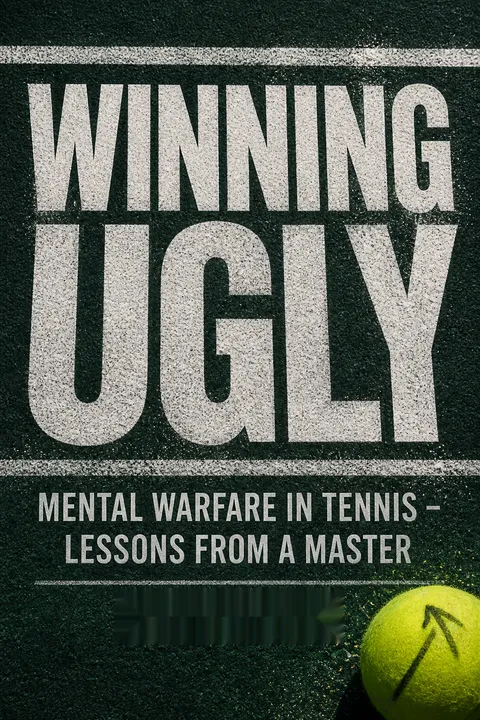
Winning Ugly works as a mix of sports memoir, tactical manual, and performance psychology. Its central move is to treat a tennis match not as a referendum on who has prettier strokes, but as a stream of decisions: what to prepare, what to notice, when to attack, and how to keep an opponent from playing comfortably. Gilbert's stories make that argument unusually concrete. Becker's comeback shows how a prepared plan can survive a dire score; Krickstein's loss shows how one observed pattern can change an entire matchup; the episodes with Connors, McEnroe, and Lendl show that emotional control and tempo belong to the tactics of play.
The book's strongest practical insight is that attention itself is a competitive resource. It should be spent on the opponent's tendencies, the ball's position, and the next useful decision, rather than on proving toughness or replaying a mistake. Its advice also recognizes that the same tactic does not suit every opponent. Good strategy is conditional, and a player must test whether a plan is working.
There are limits. Gilbert's evidence comes largely from personal experience and memorable matches, so it is vivid but not controlled evidence. The dramatic stories can make one adjustment seem more decisive than the many factors that shape a result. His historical statistics belong to the era in which he wrote, and professional patterns may not transfer neatly to recreational players. Some gamesmanship stories also risk normalizing behavior that harms fair play. The sound modern reading is to protect one's own rhythm and attention, not imitate every disruption described.
The book is most valuable when treated as a field guide rather than a rigid system. A player can select a few cues, test them across matches, keep notes, and revise the plan. Its deepest promise is modest and powerful: better thinking cannot replace practice or athletic ability, but it can stop a player from wasting the strengths already in hand.
Review Summary
Winning Ugly receives mostly positive reviews for its practical tennis advice and mental strategies. Readers appreciate Gilbert's insights from professional matches and coaching experience. Many find the book helpful for improving their game, particularly the mental aspects. Some criticize the dated references and Gilbert's writing style. The book is praised for its applicability to various skill levels and its focus on outsmarting opponents rather than relying solely on talent. Overall, readers recommend it for tennis players looking to enhance their competitive edge.
People Also Read

Glossary
Winning Ugly
Tactical advantage over styleGilbert's approach to winning through match awareness and tactical choices rather than relying on superior-looking strokes or overwhelming power. The player identifies a personal strength, finds an opponent's vulnerability, and tries to shape points so those assets meet. The term does not mean playing carelessly or breaking rules.
Set-up Point
Point that creates game leverageA point whose outcome determines whether a player gets a chance to win the game or prevents the opponent from getting that chance. Scores such as 30-all and deuce are examples. Gilbert argues that players should concentrate before the obvious game point because this earlier point often creates it.
Hidden Ad Points
Overlooked match swing momentsGilbert's label for moments that carry significant strategic or psychological consequences but may not look important on the scoreboard. They include points that lead to game points, games that set up a chance to win a set, and vulnerable transitions after a break or at the start of a new set. Recognizing these moments helps a player focus before pressure peaks.
Retriever
Consistent baseline returnerA player who stays mainly at the baseline and returns many balls, often relying on consistency and patience rather than pace or variety. This style can frustrate opponents into taking excessive risks. Gilbert's response is to remain patient, avoid feeding the player comfortable pace, and use short balls or net approaches to test less familiar parts of the game.
D.R.M.
Reminder to resist rushingGilbert's abbreviation for Don't Rush Me, a cue to keep a deliberate personal rhythm during a match. It is used when a player is ahead and risks becoming careless, behind and risks hurrying, or facing an opponent who manipulates the pace. The aim is not to slow every match, but to stay composed enough to choose the next action.
Turtle Time
Deliberately slowed match tempoGilbert's term for an opponent's deliberate delays between points, used to disrupt the other player's rhythm and patience. The tactic can make a player hurry, become irritated, or lose concentration. Gilbert's counter is to preserve composure, use permitted time to reset, and remain physically ready rather than reacting emotionally to the delay.
Nerve Busters
Simple pre-match calming cuesGilbert's set of attention and body cues for handling nervousness: use slow, steady breathing, keep the feet light and moving, focus visually on the approaching ball, and use a familiar song as a distraction. The purpose is to redirect attention from anxious thoughts and restore movement and timing, especially early in a match.
FAQ
What's Winning Ugly about?
- Focus on Mental Game: Winning Ugly by Brad Gilbert emphasizes the importance of mental preparation in tennis, teaching players how to outthink their opponents.
- Strategies for Success: The book provides practical strategies and techniques to improve both mental and physical aspects of the game.
- Real-Life Examples: Gilbert shares anecdotes from his career and those of other tennis legends, illustrating how mental toughness can lead to victory.
Why should I read Winning Ugly?
- Improve Your Game: Ideal for players looking to enhance their mental game and overall performance on the court.
- Timeless Advice: Despite being published in 1992, the principles remain relevant today, making it a valuable resource.
- Learn from a Pro: Written by a former top player and coach, offering authentic, firsthand knowledge.
What are the key takeaways of Winning Ugly?
- Mental Preparation is Crucial: The match begins long before the first serve, highlighting the importance of mental readiness.
- Utilize Your Strengths: Focus on maximizing strengths while minimizing weaknesses in both your game and your opponent's.
- Adapt and Overcome: Be observant and flexible, adapting strategies based on the opponent's style.
What are the best quotes from Winning Ugly and what do they mean?
- “Improve the way you think”: Mental strategies are as important as physical skills in tennis.
- “The serve is the most important shot”: A strong serve can set the tone for the entire match.
- “Recognize, analyze, capitalize”: Encourages players to be proactive and thoughtful in their gameplay.
What mental strategies does Brad Gilbert recommend in Winning Ugly?
- Pre-Match Visualization: Visualize performance and mentally rehearse points to build confidence.
- Breathing Techniques: Control breathing to manage nerves, using deep, rhythmic breaths.
- Positive Self-Talk: Maintain a positive mindset and use affirmations to boost confidence.
How can I overcome pre-match nerves according to Winning Ugly?
- Breathe Deeply: Focus on breathing to calm nerves, using deep, controlled breaths.
- Stay Light on Your Feet: Emphasizes good footwork, advising players to keep moving.
- Focus on the Ball: Concentrate on the ball during warm-ups to maintain focus.
What does Brad Gilbert mean by "destroying your opponent's game plan"?
- Identify Weaknesses: Analyze opponent's strengths and weaknesses to exploit them.
- Change the Rhythm: Vary shots and strategies to disrupt opponent's rhythm.
- Stay Observant: Continuously assess opponent's reactions and adjust tactics.
How does Winning Ugly address the importance of physical preparation?
- Warm-Up Routine: Emphasizes the need for a proper warm-up to prepare mentally and physically.
- Equipment Check: Ensure the right equipment and supplies are ready before a match.
- Conditioning: Highlights the importance of physical conditioning to endure long matches.
How can I improve my serve based on advice from Winning Ugly?
- Focus on Placement: Placement is often more important than power, serving to different areas.
- Practice Your Toss: Ensure consistency with a good toss for a reliable serve.
- Stay Relaxed: Maintain a relaxed grip and swing to improve accuracy.
How does Brad Gilbert suggest handling a powerful serve in Winning Ugly?
- Move Back Three Steps: Adjust position to give more time to react.
- Shorten Your Swing: Reduce swing length for better control and timing.
- Focus on Placement: Aim for placement and consistency to disrupt server's rhythm.
What is the significance of "Hidden Ad Points" in Winning Ugly?
- Critical Moments: Specific points in a match that hold significant psychological weight.
- Types of Hidden Ad Points: Includes Set-up Point and Set-up Game, leading to game-winning opportunities.
- Impact on Match Dynamics: Recognizing these moments can shift match dynamics and provide a psychological advantage.
How can I apply the lessons from Winning Ugly to my own game?
- Practice Mental Strategies: Incorporate mental techniques into training, focusing on recognizing opportunities.
- Develop a Pre-Match Routine: Establish a consistent routine to prepare mentally and physically.
- Stay Adaptable: Be willing to adjust strategies based on match flow and opponent’s behavior.
Download PDF
Download EPUB
.epub digital book format is ideal for reading ebooks on phones, tablets, and e-readers.








