

Plot Summary
Prologue
The narrator looks down through a break in a vast white cloud and sees New York alive beneath it. The city appears small from above, but its bridges, streets, and crowds pulse with purpose.
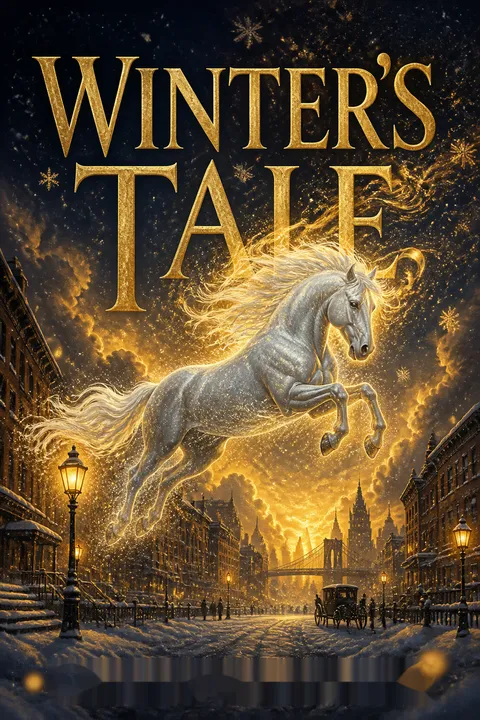
The descent through the clouds becomes a passage into another time, where snow muffles the city and a lone white horse moves toward the Battery, drawn by a light no one else can see.
The opening establishes the novel’s double scale. New York is both a physical place, crowded with work and danger, and a living design whose meaning cannot be read from street level. The cloud curtain makes time feel permeable before the story introduces any character capable of crossing it. The descent also trains the reader to look for connections across distance: an apparently isolated horse, a fugitive, and a city may belong to one pattern. That pattern remains mysterious, but the prologue insists that the city is not merely a setting. It is the book’s central witness and its most ambitious character.
The Horse Chooses Peter
On a winter dawn, a white horse slips from a Brooklyn stable and crosses the Williamsburg Bridge into Manhattan, drawn toward the Battery’s golden light. There he finds Peter Lake, a burglar fleeing Pearly Soames and the Short Tail gang. Peter has been pursued for years, and now Pearly’s men are closing in with pistols and knives.
Peter falls on the ice, but the horse charges to him when he calls for help. He leaps onto its bare back, and the pair gallop north while the gang fires after them. The horse’s sudden loyalty changes Peter’s odds: for the first time, he has a partner who can carry him beyond the city’s familiar traps.
The rescue is both practical and uncanny. Peter survives because he asks an animal for help, not because he outwits the gang or proves himself stronger. The horse’s choice quietly shifts the story’s moral center: agency belongs to a creature that does not bargain, boast, or calculate. Peter’s flight also begins as a familiar criminal escape, but the golden light on the Battery hints that the chase is being pulled toward a larger design.
A Child in a Ship
Years earlier, an immigrant couple arriving in New York is turned away because the father has tuberculosis. Faced with returning to a village where they expect to die, the parents build a bed inside a wooden model of their ship and send their infant across the harbor. Baymen find the miniature vessel in the marsh and rescue the child before it sinks.
They name him Peter Lake and raise him among reeds, canoes, and shifting cloud banks. At twelve, he is sent across the water to make his own life in Manhattan, carrying a sword, a fishing net, and almost no understanding of the city. His childhood leaves him skilled, hungry, and permanently between worlds.
Peter’s origin makes abandonment more complicated than rejection. His parents surrender him because they want him to live, while the Baymen care for him without making him fully one of their own. He enters Manhattan already shaped by two kinds of love, each of which requires departure. The model ship condenses the novel’s scale: a small crafted object carries a life across vast waters, suggesting that invention and imagination can shelter what ordinary institutions exclude.
The City Takes Him
Manhattan overwhelms the boy with machines, crowds, hunger, and streets that seem to multiply as he walks. After two young spielers, Little Liza Jane and Dolly, take him in, he learns to dance for crowds while they pick pockets.
A glimpse of a starving, gravely disabled child in a tenement unsettles him, but the police soon seize Peter and send him to Reverend Overweary’s home for supposedly lunatic boys. Overweary profits from the children’s labor, and his deputy exploits them.
Reverend Mootfowl, by contrast, teaches Peter mechanics, literacy, and mathematics. When Mootfowl dies during a machine experiment, Peter escapes with his friend Cecil Mature. Pearly Soames recruits both men into the Short Tails, where Peter becomes an expert thief and mechanic.
The city gives Peter a trade and takes away the last illusion that skill guarantees safety. Overweary’s institution turns rescue into exploitation, while Mootfowl offers a genuine apprenticeship inside the same machinery of confinement. Peter’s later life depends on this contradiction: he can build and repair, yet his knowledge serves a gang. The suffering child he sees becomes a moral memory that will outlast the criminal routines he adopts.
Pearly’s Golden Room
Pearly wants a room plated entirely in gold, not for ordinary wealth but to trap the rare light that sometimes turns the city golden. He proposes stealing a gold carrier, dragging it through the cloud wall, and building a hidden dry dock in the Baymen’s marsh. To clear a channel, he plans to kill the Baymen, including women and children.
Peter admires Pearly’s hunger for beauty, but the planned massacre ends his loyalty. He knows Pearly would kill him if challenged openly, so he slips away and warns Humpstone John. The warning turns Pearly’s elaborate heist into a war. Peter’s choice costs him his place in the gang, but prevents the Short Tails from attacking an unsuspecting village.
Pearly’s desire is aesthetically serious and morally monstrous at once. He can recognize beauty with a thief’s hunger, yet treats other people as obstacles to possessing it. Peter sees the same contradiction and refuses to let an appetite for splendor excuse murder. His betrayal is therefore more than a change of allegiance. It is his first clear decision to protect a community he once considered home, even at the cost of the only family he knows in the city.
The Marsh Runs Red
When Pearly’s hundred men reach the marsh, the Baymen rise from water, reeds, tunnels, and the backs of horses. They destroy the canoes and kill nearly the entire gang. Peter saves Cecil briefly with a Baymen’s signal, but Cecil keeps running and vanishes into the cloud wall. Pearly escapes through the current, then rebuilds the Short Tails.
Peter returns to Manhattan, still drawn to its lights despite the danger. Years later, an unnamed white stallion becomes his companion, and Peter hides behind the constellations painted inside Grand Central Station. A gang corners him there, but he refuses to sell the horse. The chase has become a life he can no longer imagine leaving.
The battle makes Peter’s divided loyalties irreversible. His warning saves the Baymen, but it cannot save Cecil or restore the gang he once called his own. Pearly survives and turns defeat into renewed pursuit, so Peter’s victory offers no clean escape. The hidden bed behind Grand Central’s artificial sky captures his new condition: he can shelter within the city’s machinery, but he remains exposed to the past that keeps finding him.
A Burglar Meets Beverly
Peter chooses Isaac Penn’s heavily secured house as a burglary target while the family is away for Christmas. The owner’s daughter, Beverly Penn, remains home with tuberculosis and a fever. Peter defeats several alarms but cannot break into a steel vault.
Then he hears Beverly playing a demanding concerto and abandons his tools to listen. She finds him in the music room, a thief standing before her in the dawn. Rather than call for help, she reaches toward him. Peter answers her vulnerability with tenderness instead of taking advantage of her illness.
They spend the morning together, and Beverly, who has never been loved, gives herself to him. Peter leaves knowing that his feelings are real, even as he still fears what her illness and her family’s wealth mean.
The encounter turns theft into attention. Peter enters the house intending to take objects, but Beverly’s music makes him stop and witness someone else’s effort. Her choice is not simple romantic surrender: she risks intimacy because she has been denied ordinary experience, while Peter must decide whether tenderness can replace his practiced appetite for possession. The scene begins their relationship through an interruption, as art briefly makes the burglar forget the role he has built to survive.
A Family at the Lake
Peter and Beverly travel north by steamboat and sleigh to the Lake of the Coheeries, where Beverly reunites with her father, Isaac, and her younger sister, Willa. Isaac questions Peter about his criminal life and his motives, then accepts that Peter loves Beverly and wants responsibility rather than her fortune.
On Christmas Day, Peter drives Beverly, Willa, and the other children across the frozen lake behind the white horse, whose name the Baymen reveal as Athansor. Later, Beverly insists on dancing at Mouquin’s, where Pearly and his gang are present. Her strange stillness first quiets Pearly, then she opens the doors to the winter air and leads the room into a wild country dance at midnight.
The lake gives Peter a brief experience of belonging that the city never offered him. Isaac’s test forces Peter to distinguish love from inheritance, while the children make him imagine a family built through care rather than blood. Beverly’s transformation at Mouquin’s is not simply a cure or a performance. She claims the public life she has never had, and the room’s dance becomes a shared act of courage against the time she knows is running out.
The Year Takes Beverly
Beverly’s health worsens after the New Year. She keeps spending time in the cold air, convinced that the stars offer her a world beyond the fever. Peter remains beside her, but cannot stop her death in March. Isaac dies soon afterward, and the Penn family disperses: Harry goes to war, while Willa and Jack are sent to relatives.
Peter, bereft and unwilling to accept comfort, wanders with Athansor and tries to provoke Pearly into killing him. Instead, he stumbles into a movie theater and sees a film depicting a future New York of towers, lights, and flight. The vision gives him a glimpse of what may come, but it cannot restore Beverly. He drifts into a cellar with the horse, exhausted and alone.
The loss strips away Peter’s old pleasures without replacing them with wisdom. His impulse to seek death is not theatrical despair; it is the collapse of the responsibilities and attachments that had begun to remake him. The film of the future offers spectacle where grief asks for presence, and therefore fails to console him. Beverly’s star-filled visions and the projected city leave Peter with a question about whether beauty can outlast the people who first taught him to see it.
Hardesty Chooses the Salver
In San Francisco, Vittorio Marratta leaves his fortune to whichever son his younger son, Hardesty, chooses. Hardesty gives the wealth to his greedy brother Evan and keeps only the family’s engraved gold salver, which bears four virtues and an ideal of a just city.
He leaves home to search for that city. A freight train accident throws him into the path of Jesse Honey, an undersized climber whose reckless advice leads them through a burning train, a freezing lake, a bear-filled cave, and a catastrophic catapult ride over a waterfall.
After Jesse disappears, Hardesty works on a Colorado sheep ranch, then wins money in a poker game on the Polaris. He reaches New York during a blizzard with little more than the salver and a promise to find Virginia Gamely.
Hardesty’s inheritance is a test of what counts as wealth. The salver is materially valuable, but its deeper demand is ethical: he must take the virtues seriously without assuming that they will reward him. His journey repeatedly puts ideals into physical jeopardy, from freight cars to waterfalls. Jesse’s comic incompetence prevents the quest from becoming a solemn pilgrimage; Hardesty must learn that trust, risk, and practical judgment are inseparable.
Virginia Crosses the Drift
Far north, Virginia Gamely leaves her mother, Mrs. Gamely, with enough food to survive the winter and carries her infant, Martin, toward New York. A towering drift blocks the Hudson, but Virginia climbs it with the baby strapped to her back, trusting a future she believes she has already seen. She boards a stranded ship, and her weight helps it break free of the ice.
The ship brings her to Manhattan, where she arrives exhausted and nearly penniless. Jessica Penn recognizes Virginia in Grand Central and brings her to a newspaper dinner. Managing editor Praeger de Pinto hears Virginia’s account of the city, gives her a writing test, and hires her at The Sun after reading her vivid description.
Virginia’s crossing turns intuition into labor. She does not simply predict that she will reach New York; she climbs the physical barrier with a baby on her back and accepts the danger of being wrong. Her entry into The Sun is another kind of translation, as the skills she acquired in a rural world become a public voice in the city. She does not abandon her home’s knowledge. She carries it into a place that has forgotten how to read its own signs.
Hardesty Finds Virginia
Hardesty finds Virginia at The Sun, delivers Mrs. Gamely’s letter, and falls in love with her. He writes about the city’s architecture, while Virginia becomes a columnist. Still committed to finding the just city, Hardesty buys passage to Europe. Marko Chestnut delays him with breakfast until the ship has already begun to leave; Hardesty jumps aboard anyway.
When the liner meets the cloud wall at sea, he plunges into the water rather than disappear inside it. Asbury Gunwillow, who has been blown off course after a gale, rescues him. Back in New York, Hardesty returns to Virginia, and the two marry. Their home grows around Martin and, later, Abby, while Hardesty’s search for justice remains unresolved.
Hardesty’s return is a choice against the clean authority of an inherited mission. He has treated the just city as a destination elsewhere, but Virginia and the child make responsibility immediate and local. The cloud wall offers him a literal exit from the world he doubts; he refuses it because leaving would repeat an older failure of loyalty. His marriage does not settle the question of justice. It gives him a place from which to keep asking it.
Christiana Saves the Horse
As a child on Long Island, Christiana Friebourg sees a white horse thrashing in the ocean and swims through the surf to reach him. She clings to his neck until he carries her back to shore, then watches him leap across the dunes and vanish. Years later, Marcel Apand takes the beautiful young woman to New York and keeps her as an ornament at his parties.
During an expedition into the city of the poor, Christiana sees a white stallion forced to fight armed men in a blood-soaked arena. He defeats them, and the sight revives the freedom she surrendered to Marcel. She leaves his home, rents a small apartment, and takes a job in the Penn household, choosing work and independence over the luxurious life that had made her feel trapped.
Christiana’s first rescue is an act of bodily courage: she enters the sea before she understands the danger, because the horse’s distress matters more than her safety. Her later escape from Marcel repeats that movement on human terms. The arena exposes how wealth can turn spectatorship into complicity, while the horse’s refusal to submit reminds Christiana of a self she had nearly surrendered. Her independence begins not with a speech, but with leaving.
Love Through the Wall
A gale throws Asbury Gunwillow from his boat and leaves him drifting at sea. Remembering his grandfather’s wish that he go to New York, Asbury makes for the city, where Hardesty gives him a place to live and a job piloting The Sun’s launch. Asbury meets Christiana without seeing her: they sleep in neighboring rooms, separated by a wall, and begin speaking through the fireplace and bedroom plaster.
Their intimacy grows through stories and trust before either knows the other’s face. When they finally meet on the roof, Asbury discovers that Christiana is strikingly beautiful, despite her fears that he will be disappointed. They marry, and she builds a life as a maid and student while he works on the water.
Their courtship makes attention more important than appearance. Asbury falls in love with a voice and a mind before he can attach them to a body, while Christiana fears that being seen will undo the bond she has built through speech. The wall is not merely an obstacle. It lets each disclose what would be harder to say face to face. Their eventual meeting confirms that trust can precede desire rather than being purchased by it.
Peter Returns Nameless
After fleeing through the cloud wall, Peter Lake falls through its white storm and vanishes. Much later, he is found wounded in New York Harbor and pulled aboard a ferry. He wakes in St. Vincent’s Hospital with no name, no memory, and gunshot wounds that heal with startling speed. A young physician treats him, but he mistakes her for a child and cannot understand her equipment.
He identifies the city by its police horses, then insists that an elevated train must still run along Sixth Avenue. When the doctor explains that the El has been gone for decades, Peter demands to see the city from the roof. The unfamiliar skyline confirms that he has returned to a world far beyond the one he remembers.
Peter’s return makes memory a bodily problem before it becomes a mystery to solve. His injuries heal faster than his understanding, and the city itself becomes his only reliable clock. The vanished El marks more than technological change: it proves that Peter has crossed a historical distance he cannot measure. His confidence in small details, horses and train routes, is the first fragile tool he has for rebuilding a self.
The Machines Remember
After surviving the winter in tunnels and shelters, Peter wanders into The Sun’s engine room and recognizes machinery no one else can explain. He repairs a neglected double mutterer, then restores other devices that have baffled generations of mechanics.
The Sun hires him as chief mechanic, though he accepts apprentice’s shares and calls himself Bearer because he still cannot remember his name. Meanwhile, Virginia writes daring essays about the city’s beauty, and her attacks on The Ghost provoke public outrage.
Hardesty and Virginia raise Martin and Abby above Yorkville, where the children observe neighbors as if they were invisible companions. Peter notices the old tenements, theaters, and bridges that preserve fragments of a city he cannot yet place.
The machines offer Peter recognition without memory. His hands know what his mind cannot, so craft becomes a temporary identity grounded in useful action. Virginia’s columns work in the opposite direction: she makes the city newly visible by describing what its inhabitants overlook. The children’s careful observation extends that perception into daily life. Together, the family and the machines suggest that attention can preserve a world even when its history is not consciously remembered.
The Ship and the Bridge
A colossal ship anchors in the Hudson, and its secrecy stirs the city. Praeger de Pinto, Virginia, and Hardesty investigate until they discover that the ship carries machinery and materials for Jackson Mead, a master builder long thought to have vanished. Mead plans Battery Bridge, a structure of light intended to reach beyond the cloud wall.
The mayor, who has visited the ship, hides the plan, and Praeger runs against him on a promise of winter, honest confrontation, and a new civic life. He wins and becomes the Gold Mayor. While Mead’s workers prepare foundations and stockpiles, the city’s institutions divide between those who expect a miracle and those who fear that the bridge will bring destruction.
The ship makes private metaphysics public infrastructure. Mead’s bridge is at once an engineering project and a wager that imagination can alter the conditions of history. Praeger’s victory matters because he refuses ordinary political language and makes winter, the city’s overlooked season, into a promise of collective renewal. Yet the coming structure is not automatically just. Its secrecy and scale expose the danger of treating a future vision as permission to overrule the people who must live through its construction.
Horses Beneath the City
Athansor is captured in the city of the poor and harnessed to a mill that kills horses through relentless labor. He survives for more than a year, drawing strength from the seasons and the city visible beyond his circle. Across the harbor, Abysmillard, the last of the Baymen, leaves his burrow when the ice prevents him from finding food.
He crosses toward New York and freezes on the way. Peter Lake finds his body on the ice and recognizes a friend from childhood, a memory that opens more of his past. Meanwhile Pearly Soames has rebuilt the Short Tails. He discovers Athansor at the mill and drives the horse toward Peter, preparing the old pursuit for one final collision.
The horse and Abysmillard embody two forms of survival that the city cannot comfortably accommodate. Athansor endures exploitation through motion, while Abysmillard survives by retreating into the diminishing marsh. Their return to Peter’s orbit makes the past physical: it is not merely remembered but arrives in a body, wounded or frozen. Pearly’s renewed pursuit turns that recognition into danger, forcing Peter to confront the life he has tried to outlast.
Hardesty Challenges Death
When Abby falls gravely ill, Hardesty refuses to accept the doctors’ verdict. He takes the Marratta salver to the city and tests whether extraordinary effort can alter what seems settled. At a pool hall, he challenges a champion to a game he barely knows, then calculates every shot with the precision of celestial mechanics and wins.
Later, he climbs a rope toward a golden disc of light inside a gymnasium, but the light rejects him and he falls. As the city’s winter worsens, Abby dies in the hospital. Virginia grieves beside her, while Peter Lake visits the child and recognizes her as the little one he once saw dying in a tenement hallway. Hardesty’s faith has not yet become an answer.
Hardesty’s trials expose the difference between courage and control. He can risk money, reputation, and his body, but effort alone cannot compel a miracle. The pool game rewards exact calculation, while the golden light refuses to become a prize he can reach by force. Abby’s death makes the ethical stakes intimate: this is no longer an abstract search for a just city. Hardesty is confronting the limits of a father’s power.
The City Catches Fire
As Jackson Mead’s preparations near completion, the city of the poor rises in a vast wave of arson, looting, and violence. Firestorms spread toward Manhattan, and Praeger directs the militia and fire crews from a high command post, trying to preserve defensible islands. At St. Vincent’s, Peter Lake recognizes that The Sun’s old machines can still work.
Though wounded, he reaches the engine room and restores its generators, turbines, and presses, bringing light back to the newspaper while the surrounding city darkens. Hardesty and Virginia carry Abby’s body through the burning streets toward the Isle of the Dead. The family buries her before midnight, believing the new millennium should not begin with her left behind in the old one.
The uprising turns the city’s social imbalance into a literal fire that cannot be managed by ordinary institutions. Praeger’s defense is pragmatic, but Peter’s work at The Sun answers disaster through maintenance rather than command: he keeps one place functioning when the larger system fails. The burial marks the family’s deepest surrender. They do not yet know that their care for Abby, and Peter’s memory of the child, have entered the same unfolding pattern.
The City Turns Gold
Harry Penn finds Peter at The Sun and shows him the portraits of Beverly, restoring his name and purpose. Peter and Cecil Mature break into Hardesty’s bank vault, retrieve the salver, and leave it where the rising sun can reach its engraved ideal of justice.
Peter then finds Athansor and faces Pearly in the ruined Maritime Cathedral. Pearly claims the horse is dead and drives a sword into Peter, but the real Athansor thunders in, proving Pearly’s report false. Peter dies as the white horse escapes toward the cloud wall.
Mead launches Battery Bridge, but its light buckles and vanishes. At the harbor, Abby opens her eyes aboard Asbury’s launch. The salver catches the sunrise, and gold spreads through the city and over the surrounding waters.
The final turn refuses a simple equation between engineering and salvation. Mead’s bridge fails because technical readiness cannot substitute for the human event it needs; the city’s golden transformation arrives through a chain of love, memory, sacrifice, and care. Peter recovers his identity only when he recognizes Beverly, then spends his remaining agency to restore the salver and the horse. Abby’s return does not erase her family’s grief. It changes grief into evidence that the dead and the living remain connected.
Epilogue
The survivors are lifted into a new city of spring and sunlight, while the old city begins to rebuild. Jackson Mead, Mootfowl, and Cecil Mature disappear, leaving their work unfinished and their return uncertain. Harry Penn lives long enough to see construction begin, then dies in faith.
Praeger and Jessica have a child who will carry The Sun forward. Pearly remains in the renewed city, because a world without opposition would be incomplete. The narrator leaves Peter Lake’s reunion with Beverly unresolved, asking readers to decide whether the just city has restored him or whether his sacrifice has carried him beyond it.
The ending offers renewal without closing every account. The city can rebuild, but Pearly remains, and Mead’s disappearance preserves the possibility of another attempt. Justice arrives not as a permanent social system or a flawless engineering feat, but as a moment in which people, memory, and the city become newly legible to one another. Peter’s fate remains open because the novel treats love as a bond that exceeds evidence without making certainty its price. The final question transfers the book’s central task to the reader: whether to understand the golden city as a reward, a vision, or a truth that must be continually made.
Analysis
Winter’s Tale makes New York more than a setting by giving it a memory, a body, and a history that ordinary chronology cannot contain. The city is built through labor, crime, commerce, art, and neglect; its beauty does not cancel its brutality, and its brutality does not erase the beauty. That tension is made literal in the cloud wall, which lets people cross between times while leaving them uncertain about what they have experienced.
The novel’s characters approach justice from different distances. Pearly wants to possess beauty, Mead wants to build an eternal path, Hardesty seeks a city that can embody virtue, and Praeger tries to lead an unruly population through crisis. Peter’s life cuts across their plans. His most important acts are not victories of control but acts of recognition: he protects the Baymen, loves Beverly, repairs machines, remembers the dead, and finally trusts that a child’s life is still connected to a larger world. The story does not claim that suffering is secretly fair. It insists instead that no one can see the whole account while living inside it.
The recurrent engines, bridges, horses, paintings, and city streets all make time visible through movement. A machine works because its parts remain in relation; a bridge joins places that would otherwise remain separate; a painting holds motion without moving. These images suggest that memory and justice also depend on connections, not isolated moments. The ending’s gold light offers a glimpse of that connection, not a permanent solution. Pearly remains, Mead’s bridge fails, and the city must be rebuilt. Hope is therefore neither optimism nor certainty. It is the decision to care for other people when the outcome cannot be guaranteed, and to keep making a world that might deserve to be seen whole.
Review Summary
Winter's Tale by Mark Helprin is a divisive novel, with readers either loving or hating it. The 750-page magical realism story set in New York City spans a century and features a thief, a flying horse, and numerous interconnected characters. Critics praise Helprin's lyrical prose and vivid imagery, while detractors find the book overly long, convoluted, and pretentious. Many readers struggled to finish the novel, citing its dense writing and lack of clear plot. Despite mixed reviews, some consider it a masterpiece of American literature.
Characters
Peter Lake
Restless city thiefRaised by the Baymen and apprenticed to a master mechanic, Peter Lake enters Manhattan with little knowledge of its rules but an instinctive gift for learning them. He becomes a thief because the city rewards daring, yet he remains alert to beauty and to suffering that others overlook. His life is divided between movement and longing: he is always fleeing someone, searching for a place to rest, or trying to understand what makes a life meaningful. Peter’s humor and practical intelligence protect him from despair, but they also conceal how deeply he fears belonging to no one.
Athansor
White horse of flightAthansor is a huge white stallion with a gentle face, deep eyes, and a powerful love of running. He is not a mount Peter can simply command; he chooses when to leap, when to stop, and whom to trust. His physical grace joins the novel’s ordinary city life to its larger mystery, making a horse’s movement feel both utterly real and beyond explanation. Athansor’s steadiness offers Peter a form of companionship without interrogation. He represents an innocence that does not mean weakness, and a freedom that is expressed through motion rather than escape.
Beverly Penn
Star-gazing pianistBeverly is Isaac Penn’s gifted daughter, a pianist whose tuberculosis limits her ordinary life but sharpens her attention to weather, light, and the stars. She is intelligent, sensual, proud, and impatient with the protections that keep her isolated. Her love of open air is practical as well as imaginative: she believes the cold helps her live, though she cannot fully explain why. Beverly’s courage appears in moments when she claims experiences she has never been allowed, from intimacy to public dancing. She draws Peter toward tenderness by seeing him without pretending he is already virtuous.
Hardesty Marratta
Heir to a moral questHardesty is a thoughtful, disciplined son shaped by military service, grief, and his father Vittorio’s insistence on virtue. He distrusts easy answers and prefers to test ideas against the physical world, whether by studying architecture or enduring a dangerous journey. His reserved nature can look like passivity, but it conceals a stubborn willingness to accept responsibility. Hardesty is drawn to the ideal of a just city because he wants principles to matter beyond private conduct. His relationship with Virginia challenges his tendency to pursue justice as a distant destination rather than a daily obligation.
Virginia Gamely Marratta
Coheeries-born city writerVirginia grows up in the Lake of the Coheeries, where work, language, weather, and imagination are inseparable. She is practical enough to farm, fish, and care for a child, yet her dreams give her unusual confidence in what she cannot prove. In New York, she turns that rural attentiveness into journalism, describing the city as a living presence rather than a collection of commodities. Virginia is loving but not meek, and her faith often puts her at odds with Hardesty’s caution. She is a mother whose fierce tenderness coexists with an independent desire to discover what the city may become.
Pearly Soames
Gang boss hungry for colorPearly is a brilliant and cruel gang leader whose pale eyes, scarred face, and appetite for violence make him a force in Manhattan’s underworld. He is unusually susceptible to color and beauty, which he seeks with an intensity close to religious devotion. That sensitivity does not soften his treatment of other people. Pearly can imagine a golden room but is willing to massacre a community to obtain it. His pursuit of Peter is obsessive, strategic, and personal, revealing how a desire for beauty can become another form of possession when it is severed from compassion.
Harry Penn
Elder publisher and witnessHarry Penn inherits his father Isaac’s newspaper and carries its habits of fairness, curiosity, and public service into old age. He is sharp, playful, and more formidable than his small frame suggests. His authority comes less from wealth than from long experience with the city and the people who keep it running. Harry believes that institutions can be made just through their daily arrangements, but he also knows that the largest events exceed ordinary planning. His affection for the young and his reverence for memory make him a bridge between the city’s past and the people who must shape its future.
Praeger de Pinto
Mayor of winter and riskPraeger is The Sun’s managing editor, a quick-minded journalist who loves argument and recognizes the city as both a political machine and a living place. He distrusts the power of television and refuses to promise simple solutions to problems that resist them. His campaign makes winter a public vision, a way to awaken citizens to the beauty and difficulty they usually try to avoid. Praeger is capable of ambition, but his loyalty to people and to the city is stronger than his desire for comfort. He sees political leadership as a willingness to enter danger alongside those he governs.
Christiana Friebourg
Independent horse rescuerChristiana is a observant, courageous woman whose childhood encounter with a white horse shapes her sense of what is beautiful and worth protecting. Her life in New York places her among the wealthy, but luxury under Marcel Apand leaves her feeling more confined than secure. She longs for purposeful work and a life in which she can move freely. Christiana’s attention is direct and physical: she notices how animals are treated, how people behave when they believe no one is watching, and what a landscape makes possible. Her bond with Asbury grows through trust before appearance.
Asbury Gunwillow
Harbor pilot and sailorAsbury is a skilled sailor whose life is shaped by the sea, a grandfather’s unfinished wish, and his work for The Sun. He is practical in a crisis and often less confident in romance, especially when faced with the possibility that love may ask him to be vulnerable. His navigation skills make him a guide through the harbor, but he is also willing to let chance redirect him. Asbury’s marriage to Christiana begins through voices passing through a wall, a bond that tests his trust before it rewards his curiosity.
Cecil Mature
Peter’s loyal companionCecil is a round, slit-eyed young man who can cook, tattoo, and surprise people who mistake his appearance for stupidity. He follows Peter into the criminal world and stays loyal even when he is frightened. Cecil’s gentleness is unusual among the Short Tails, but it does not make him helpless. His humor, appetite, and practical talents give him an identity beyond his size. Later, he uses the name Cecil Wooley, a connection that matters to those who recognize him across time.
Reverend Mootfowl
Mechanic with a callingMootfowl is an eccentric clergyman and master craftsman who cares more about metal, tools, and machines than conventional religious authority. At Overweary’s home, he trains boys to build the components of a rapidly mechanizing city. His precision is matched by a willingness to see engineering as a spiritual practice, a way to shape matter without denying its mystery. Mootfowl’s mentorship gives Peter a trade and a model of devotion, though his own intensity can be difficult for others to understand.
Jackson Mead
Builder of impossible bridgesJackson Mead is a towering master builder who has spent his life constructing bridges and imagining structures that can alter how people understand the world. He is disciplined, secretive, and convinced that great projects require opposition as well as skill. Mead speaks of justice in cosmic terms, but his methods place immense power in one person’s hands. He is not simply a visionary or a villain. His ambition is sincere, and the danger lies in his confidence that he understands what the city needs better than the city does.
Mrs. Gamely
Coheeries mother and guideMrs. Gamely is Virginia’s mother, a self-taught woman with an astonishing vocabulary, a fierce memory, and an unconventional sense of what the world contains. She cooks, tends her household, and speaks to animals as if they were attentive companions. Her apparent rambling often conceals a precise understanding of people and events. Mrs. Gamely does not separate practical care from wonder: she can prepare food for a blizzard and still believe that a dream may reveal a future. She gives Virginia both independence and a language for living with uncertainty.
Abby Marratta
Young observer of the cityAbby is Hardesty and Virginia’s younger child, curious, fearless, and unusually attentive to the city around her. She watches neighbors from the family’s high apartment and invents names for people she sees through the windows. Like her brother Martin, she treats the boundaries between imagination and observation as porous. Her parents’ protectiveness cannot entirely shelter her from the world’s dangers, but her openness gives the adults a way to see their city freshly. Abby’s childlike confidence is not naivety so much as an untrained trust in what she perceives.
Martin Marratta
Virginia’s perceptive sonMartin is Virginia’s first child, born during her flight from the Lake of the Coheeries. He is talkative, observant, and eager to treat his mother as a real conversation partner. From his apartment window, he studies a nearby building and gives names to the people who live there, noticing patterns adults miss. Martin’s imagination has a practical edge: during storms he tries to care for Abby, and he pays close attention to her well-being. He carries the Coheeries habit of seeing the world as richly inhabited into the city.
Isaac Penn
Newspaper founder and fatherIsaac Penn is a self-made newspaper publisher whose experience at sea shapes his blunt sense of responsibility. He builds The Sun around labor, fairness, and a belief that skill deserves dignity. As Beverly’s father, he is protective without trying to control every choice she makes. Isaac understands that money can corrupt affection, and he tests Peter’s motives while respecting the difference between wealth and character. His ideas about justice are demanding: he believes that human beings may work toward it without ever fully understanding its design.
Abysmillard
Last survivor of the marshAbysmillard is a Bayman whose immense size, awkward movements, and severe neglect make him an object of fear even among his own people. Beneath his repellent appearance, he has a private hope that he may change into something graceful, much as a caterpillar becomes a butterfly. He survives after the marsh and its community are steadily destroyed by industry, pollution, and development. His long isolation gives him a place in Peter’s memories of childhood and makes his presence a measure of what the city’s expansion has cost.
Humpstone John
Elder of the BaymenHumpstone John is an elder among the Baymen who helps raise Peter and teaches him the skills needed to live in the marsh. He is practical, taciturn, and capable of giving startlingly calm instructions in dangerous moments. John’s relationship with Peter is affectionate but unsentimental; he prepares the boy to leave because he knows the city will require more than shelter. His knowledge of Baymen customs, songs, and the white horse gives Peter a connection to a culture that the modern city is steadily erasing.
Little Liza Jane
Spieler and street tutorLittle Liza Jane is a young street performer who takes Peter into her makeshift household after he arrives in Manhattan. She teaches him that dancing can draw a crowd while a partner picks pockets, giving him his first practical education in city survival. Her warmth is mixed with the clear-eyed habits of someone who has little protection and must make a living quickly. Along with Dolly, she offers Peter companionship at the moment he is most bewildered by the city.
Jessica Penn
Actress and family linkJessica is Harry Penn’s daughter and a successful actress whose life moves between the stage, the newspaper family, and relationships that repeatedly converge and separate. She reconnects Virginia with the Penns when Virginia arrives in New York with Martin, helping her find food, shelter, and work. Jessica is both glamorous and practical, with a guarded manner that comes from a life under public attention. Her loyalty to her family gives Virginia an entry into the city’s social world without erasing the difference between their backgrounds.
The Ermine Mayor
Incumbent city politicianThe Ermine Mayor is a capable, machine-backed incumbent whose ceremonial title reflects the city’s strange political traditions. He knows how to work with the city’s political organization and presents himself as a steady administrator. His secrecy around Jackson Mead’s ship puts him at odds with Praeger and with the public’s curiosity. The mayor is neither a simple fool nor a straightforward villain: he believes that withholding information can protect an opportunity, even when that secrecy damages trust.
Jesse Honey
Reckless mountain climberJesse Honey is a diminutive, intensely talkative climber who meets Hardesty on a freight train. He is brave, inventive, and spectacularly unreliable, often offering solutions that create more danger than they solve. His confidence forces Hardesty to make decisions under pressure rather than remain a spectator to his own journey. Jesse’s comic failures do not make him trivial; they reveal how courage and competence can be very different qualities.
Plot Devices
The cloud wall
A border through timeThe cloud wall circles the world around New York, sometimes swallowing people and sometimes releasing them in another place or time. It is visible as a roaring white barrier, but its location and behavior shift. People who enter it may never return, which makes it both a physical danger and a threshold into unknown possibilities. The wall also gives characters a way to imagine that history is not a straight line. Peter, Hardesty, Virginia, and others encounter it in different circumstances, and those encounters connect lives that would otherwise be separated by generations.
Athansor
Freedom with a heartbeatThe white horse is at once a living animal, a companion, and a force that seems to exceed ordinary limits. His leaps and endurance help Peter escape danger, but the horse is never merely transportation. He acts from instinct and affection, refusing to be reduced to anyone’s property or plan. Athansor’s repeated appearances link Peter’s childhood, his love for Beverly, Christiana’s history, and the city’s final crisis. The horse makes the novel’s metaphysical questions physical: his body can be wounded, worked, and loved, even as his movement hints at a world beyond the city.
The golden light
A sign of justiceThe rare golden light appears as a promise that the city’s apparent chaos might resolve into a just design. Pearly wants to trap it in a room, while the Baymen expect it as a sign that the world is approaching a decisive change. The light is never a simple reward for good behavior. It depends on events, relationships, and sacrifices that no single character can control. Its color recurs in the salver, the city’s views, and the final transformation, tying private acts of love to a public vision of what justice might look like.
Machines and bridges
Work made visibleThe city’s machines and bridges embody human skill, cooperation, and ambition. Peter learns to understand machines through Mootfowl and later restores The Sun’s engines when the city loses power. Jackson Mead’s Battery Bridge takes that tradition to an extreme, attempting to turn light itself into a structure that can reach beyond the cloud wall. The machinery is never merely background technology. It can preserve life, express a community’s shared labor, or become an instrument of one person’s overwhelming vision. The story asks whether building something magnificent is enough, or whether the builder must also answer to the people affected by it.
The Marratta salver
Virtue carried into actionThe gold salver bears four virtues and an ideal of a perfectly just city. Hardesty chooses it over his father’s fortune, treating it as an inheritance that demands a life rather than a possession to display. Its importance is easy to underestimate because it can also serve an ordinary household purpose. The salver links the Marratta family’s private history to the city’s larger hopes, while its survival through fire, travel, and theft makes it a durable object in a story where people and places are repeatedly lost. Its meaning becomes decisive only when the story’s separate lives converge.
Download PDF
Download EPUB
.epub digital book format is ideal for reading ebooks on phones, tablets, and e-readers.








