

Key Takeaways
Make rest part of productivity, not its guilty opposite
Hours are not proof. Beverley’s guiding idea is that productive work and recovery belong in the same system. During a punishing stretch at university, she launched her business while facing major exams and deadlines. A technical failure then sent her team into crisis. She worked at an unsustainable pace, felt validated by the effort, and eventually recognized that this was an emergency response, not a model for ordinary life.
Measure what the work produces. The book cites a 2019 comparison in which British employees worked an average of 42 hours a week, while Ireland averaged 39.4 and ranked higher on productivity. The point is not that shorter hours always guarantee better results. It is that time spent working and value created are different measures.
The distinction between effort and output challenges a culture that treats visible exhaustion as evidence of virtue. In organizational terms, hours are an easy metric, while contribution is harder to assess, so workplaces often reward what they can see. That can encourage performance rather than effectiveness. The chapter’s argument is strongest when rest is framed not as a personal perk but as part of sustainable capacity. Still, individual scheduling cannot fix understaffing, unpaid overtime, or managers who expect constant availability. A useful personal practice is not a substitute for fair working conditions.
Replace one lifelong purpose with passions that can change as you do
Purpose need not be singular. Beverley resists the idea that a job must provide meaning, status, and financial security all at once. Instead, she uses self-actualising to describe the ongoing pursuit of activities that develop a person’s talents and bring fulfilment. This can happen at work or outside it, and it need not culminate in one final vocation.
Look for small sources of energy. A micro-passion is an enjoyable activity that can fit inside many different jobs, such as conceptualizing an idea or solving a problem. A macro-passion is a broader field, such as fashion or dance. Beverley’s own enthusiasm for mind-mapping, for instance, could be applied to marketing, design, or reporting. She also cites a LinkedIn survey in which 30 percent of millennial respondents identified as purpose-oriented, compared with 48 percent of baby boomers.
This approach loosens the modern demand that a career must act as a complete identity and a permanent source of meaning. It also makes changes in direction less likely to feel like wasted effort: skills and interests can carry across roles. The micro-passion idea is especially practical because it offers room to improve an imperfect job without pretending that every job can become a calling. Its limit is important, though. Some work offers little autonomy or variety, and a person should not be made responsible for finding fulfilment in conditions that are genuinely harmful.
Judge work by lasting progress, not how impressive it looks online
Busyness can perform. Beverley describes announcement culture as the pressure to make work visible and shareable. She noticed herself seeking the satisfaction of a full checklist and the approval attached to appearing entrepreneurial, even when those activities did not move important work forward. Social media can amplify this habit by placing friends’ achievements beside polished accounts of other people’s careers.
Watch what gets rewarded. The author calls public displays of diligence hustle-signalling. A late-night post, for example, shows that someone worked late once; it cannot establish their usual workload or the value of that work. The practical test is whether a task advances a meaningful goal, not whether it can be announced, ticked off quickly, or used to prove dedication.
This is a sharp account of how measurement changes behavior. When recognition follows visible activity, people naturally invest in activity that can be seen, even if quieter work has greater long-term value. The same incentive problem appears in classrooms and organizations that reward easily counted outputs over learning or quality. The corrective is not to dismiss public achievement: sharing can build community and opportunity. It is to keep visibility from becoming the private definition of worth, and to ask whether an impressive signal corresponds to useful work.
Give important work protected time, and batch the small stuff
Sort before starting. Beverley recommends separating urgent tasks from important ones, then organizing the remaining work by size. Her to-do table has three categories: quick items taking five minutes or less, tasks that take up to about thirty minutes, and larger projects that need to be broken into smaller steps. This prevents a long list from making every item look equally urgent.
Put work on the calendar. Time-blocking means reserving calendar periods for specific tasks, ideally around 1 to 1.5 hours when the work allows it. Similar administrative tasks can be batched together, while deep work, concentrated effort on demanding tasks, gets a protected block without notifications. Beverley advises doing substantial creative work before routine admin when possible, and leaving room for interruptions rather than assuming every plan will hold.
The method translates an abstract wish to be organized into decisions made before the day becomes noisy. Separating tasks by size reduces the cognitive burden of repeatedly deciding what to do next, while protected blocks make attention a planned resource. The structure is most useful when treated as a flexible map rather than a promise that the day will obey. Some workers cannot control meetings, shifts, or incoming demands. In those settings, even a small protected period or a shared team agreement may be more realistic than a fully redesigned calendar.
Match a task’s challenge to your skill, then stop before you crash
Flow needs a fit. Psychologist Mihaly Csikszentmihalyi’s concept of flow describes deep absorption in an activity when its challenge is well matched to the person’s skill. The work feels demanding but manageable, attention narrows, and time can seem to pass unnoticed. Beverley says this can happen in many activities, from solving a difficult problem to developing a campaign or cooking.
Enjoyment has limits. She describes a FlowFlight as the transition into, immersion in, and eventual exit from a flow session. While developing a fashion collection, she became absorbed in the ideas and continued past her planned work period. By mid-afternoon, she was depleted and unable to focus on other responsibilities. A time limit, water and food, movement breaks, and a clear next task can help preserve the benefits without turning absorption into exhaustion.
Flow offers a useful alternative to judging work only by its finished product: the process itself can be absorbing and satisfying. The skill-challenge balance also suggests a practical adjustment when work feels dull or overwhelming. Yet absorption is not automatically a sign that a task deserves more time. It can make physical needs easy to ignore and can crowd out obligations that matter. The valuable skill is not simply entering flow, but managing its boundaries. That distinction keeps an enjoyable state from becoming another excuse to work without stopping.
Define success with your own context, not someone else’s highlight reel
Comparison hides context. Beverley argues that social feeds make other people’s achievements look close and attainable while concealing the conditions behind them. She names her own advantages, including private schooling, Oxford, and a supportive family, rather than presenting her entrepreneurial path as purely self-made. Her point is not to discourage ambition, but to make comparisons more honest: people do not begin with identical resources, risks, or opportunities.
Choose your finish lines. Success can mean a promotion or a business, but it can also mean financial security, time with family, or work that leaves energy for life outside it. The author recommends noticing when a goal comes from personal desire and when it is borrowed from social expectations. Achievements deserve recognition even when they are modest, private, or still in progress.
The insistence on context improves both self-assessment and social judgment. It resists the fiction that outcomes reveal individual effort alone, while preserving room for agency and ambitious goals. That balance matters: structural barriers should not be converted into a reason to lower other people’s aspirations, but privilege should not disappear from accounts of achievement. The chapter also identifies a subtle trap in online comparison: apparent similarity can conceal profound differences in support and security. A personal definition of success is useful precisely because it can be ambitious without pretending that everyone starts from the same place.
Turn changing ambitions into goals you can review and celebrate
Let goals evolve. Beverley describes setting a fashion collaboration as a major ambition in 2017, then realizing the following year that she wanted to build her own sustainable fashion company instead. The change was not a failure of commitment. It was new information about what kind of work suited her. She recommends setting goals at several scales, from annual direction to weekly and daily steps, and reviewing them as priorities shift.
Make progress legible. Useful goals are specific, measurable, achievable, relevant, and time-bound. For the day, she suggests choosing three realistic outcomes connected to larger aims. When a goal is missed, examine what happened and adjust the plan instead of turning the setback into a verdict on personal worth. This is self-accountability without self-attack.
Reviewable goals connect long-range intention with daily action, while leaving room for new evidence to change the destination. The example of Beverley’s pivot makes flexibility concrete: consistency need not mean defending an old ambition after it stops fitting. The framework can also make progress easier to notice, which helps counter the tendency to move straight from one achievement to the next. Its risk is over-planning. If every day becomes a scorecard, goal-setting can reproduce the pressure it is meant to relieve. Review should clarify choice, not create another standard for self-punishment.
Make “having it all” mean what matters to you in this season
Choose the ingredients. Beverley reworks the idea of “having it all” as a personal mix of priorities, not a universal package of career, family, fitness, friendship, and constant happiness. Her changing pie-chart metaphor represents a life whose proportions shift over time. Someone may devote more attention to work in one season, and more to caregiving or recovery in another. Planning can protect room for chosen priorities, but it cannot make unlimited demands fit.
Notice unequal control. The book cites a 2018 survey in which 36 percent of private-sector employers said it was acceptable to ask job candidates about future plans for children, and 46 percent considered it reasonable to ask women about young children. These figures expose a social structure behind individual work-life choices. Beverley cautions that control over time varies with income, care duties, and job conditions.
The season-based model challenges the fantasy that a well-lived life must look balanced every day. It makes room for uneven periods without treating them as personal failure, and it recognizes that a calendar is shaped by institutions as well as preferences. The discussion of hiring questions makes gendered expectations tangible rather than abstract. Still, the pie metaphor can imply that everyone has the same ability to rearrange their time. Its most responsible use is as a tool for identifying priorities where choice exists, alongside a clear-eyed account of where choice is constrained.
Schedule recovery, and give yourself permission to adapt when life intervenes
Rest before collapse. Beverley distinguishes planned nothing, time deliberately reserved for recovery, from what she calls fuck-it nothing, an unscheduled pause taken when energy or circumstances unexpectedly demand it. She describes keeping weekends and some evenings free, and explains that planned recovery can make it easier to work without feeling that every pause is stolen time. Rest can include sleep, movement, time outdoors, social connection, or quiet, depending on what actually restores the person.
Learn from the result. A cancelled plan may be needed care or avoidance; the difference is not always obvious in the moment. Beverley suggests noticing which activities improve or worsen mood and energy, including social media use. If an unexpected pause becomes necessary, respond without turning it into a character judgment. The aim is to understand personal limits and make the next decision more accurately.
This section gives recovery a practical test: does the activity restore capacity, or merely offer brief escape followed by greater depletion? That question is more useful than labeling rest either virtuous or lazy. The distinction between planned and unplanned pauses also respects the unpredictability of ordinary life. A diary can make room for recovery, but it cannot predict illness, care needs, or emotional strain. The deeper skill is therefore adaptation without contempt for oneself. That stance supports accountability while resisting the idea that every lapse requires a harsher rule.
Analysis
The book’s central move is to reject a false choice: relentless work on one side, self-care as retreat on the other. Beverley’s alternative is a practical ethic of self-observation. Identify the work that matters, notice where attention and satisfaction arise, set boundaries around effort, and revise the plan as circumstances change. The stories make this argument credible because they show both the rewards of ambition and the costs of treating exceptional crisis as a normal work rate.
Its strongest conceptual contribution is treating fulfilment as plural and provisional. A single career cannot reliably meet every need, and a person’s interests may change. Micro-passions offer an accessible bridge between idealized purpose and ordinary work, while flow gives a way to recognize when challenge and ability align. The book also understands that success is socially mediated: online visibility, status conventions, gender expectations, and unequal opportunity influence what people want and how they judge themselves.
A productive tension remains. The book critiques the conversion of every hour into an economic resource, yet offers calendars, goals, life pie charts, and routines as tools for managing time. For some readers, those methods will restore agency. For others, especially people with rigid shifts or extensive care duties, they may turn leisure into another performance target. The author acknowledges unequal control, but individual self-management cannot repair low wages, poor staffing, or discriminatory workplaces.
The most useful reading is therefore neither a command to optimize life nor a defense of doing less. It is an invitation to distinguish chosen effort from performative overwork, and restorative rest from avoidance, while remembering that not every constraint is personal. The book’s methods are strongest when used as adjustable instruments, not universal standards. Its lasting question is not how to fit more into every day, but what kind of effort and recovery make a life feel genuinely one’s own.
Review Summary
Working Hard, Hardly Working receives mixed reviews, with an average rating of 3.51/5. Some readers find it helpful for productivity tips and reflections on work-life balance, particularly for Gen Z. However, many criticize it for being repetitive, lacking substance, and not offering new insights. The book's structure and writing style are often described as confusing or resembling a university essay. While some appreciate Grace's perspective on hustle culture, others find her advice too privileged and unrealistic. Overall, opinions are divided on its value and relevance.
People Also Read



Glossary
Self-actualising
Ongoing personal fulfilmentBeverley uses self-actualising to mean the continuing pursuit of activities that develop a person’s talents and potential, rather than reaching a single final state of fulfilment. It can involve meaningful work, small enjoyable tasks, or activities outside employment. The idea is intended to make purpose adaptable as interests, circumstances, and priorities change.
Micro-passion
Small, portable source of fulfilmentA micro-passion is an activity or kind of task that a person enjoys and can often bring into different roles or parts of life. Beverley’s example is conceptualizing ideas through mind-mapping. Unlike a broad field or career interest, a micro-passion can be a particular process, such as problem-solving, writing, or talking with interesting people.
To-do table
Tasks grouped by sizeBeverley’s to-do table organizes work into quick items, tasks, and projects rather than presenting every action as an equal entry on a list. Quick items take around five minutes or less, tasks take up to about thirty minutes, and projects require multiple steps. The table makes workload visible and helps with prioritizing and scheduling.
Deep work
Focused, demanding workUsing Cal Newport’s term, Beverley describes deep work as concentrated professional activity that challenges cognitive ability, creates value, and is difficult to reproduce. Her practical advice is to reserve distraction-free periods for it, separate it from routine administrative work, and use brief warm-up activities when beginning is difficult.
FlowFlight
Stages of a flow sessionFlowFlight is Beverley’s metaphor for moving through a period of flow. It has three stages: taking off, when concentration is not yet settled; being in the zone, when attention is absorbed; and landing, when focus begins to fade and a break or change of task is needed. Recognizing the stages helps prevent overworking.
Creative uniqueness
Personal approach as creative valueCreative uniqueness is Beverley’s term for the distinctive value people bring to a task through their individual perspective and way of working. It does not mean that every task needs artistic treatment. It means considering whether a personal approach can improve the work, make it more useful, or make routine tasks more engaging.
Planned nothing
Scheduled recovery timePlanned nothing is time deliberately kept free from work or other demands so that a person can recover. Beverley describes using weekends and some evenings for this purpose. Unlike an unplanned pause prompted by exhaustion, planned nothing gives rest a legitimate place in the schedule and can reduce the feeling that time off must be earned.
fuck-it nothing
Unplanned pause when neededBeverley’s informal term for an unscheduled break taken when unexpected fatigue, emotional strain, or events make the original plan unrealistic. It recognizes that even careful planning cannot anticipate every human need or disruption. The term is not a claim that all avoidance is restorative; it encourages noticing the need, pausing, and learning from the outcome.
FAQ
What's "Working Hard, Hardly Working" about?
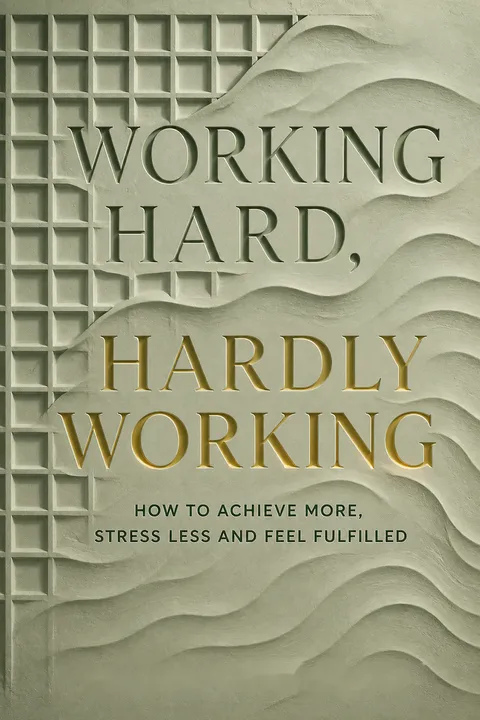
- Overview: "Working Hard, Hardly Working" by Grace Beverley explores the balance between productivity and self-care, aiming to help readers achieve more while feeling less stressed and more fulfilled.
- Structure: The book is divided into two main parts: "Working Hard," which focuses on productivity and finding purpose, and "Hardly Working," which emphasizes redefining productivity and the importance of rest.
- Personal Insights: Beverley shares her personal experiences as a young entrepreneur, offering insights into the challenges and realities of modern work culture.
- Goal: The book aims to provide a blueprint for navigating the complexities of the new working world, encouraging readers to redefine success on their own terms.
Why should I read "Working Hard, Hardly Working"?
- Practical Advice: The book offers practical strategies for improving productivity and managing time effectively, making it valuable for anyone looking to enhance their work-life balance.
- Relatable Experiences: Grace Beverley shares relatable anecdotes from her own life, making the book engaging and easy to connect with for readers facing similar challenges.
- Holistic Approach: It emphasizes the importance of both productivity and self-care, encouraging readers to find a balance that works for them personally.
- Inspiration: As a successful young entrepreneur, Beverley's journey can inspire readers to pursue their own goals with confidence and resilience.
What are the key takeaways of "Working Hard, Hardly Working"?
- Balance is Key: The book stresses the importance of balancing hard work with rest and self-care to achieve sustainable success.
- Redefining Productivity: Beverley encourages readers to redefine productivity beyond just output, focusing on meaningful work and personal fulfillment.
- Self-Actualization: The concept of self-actualization is central, urging readers to pursue passions and find purpose in both work and life.
- Personalized Success: Success is subjective, and readers are encouraged to define it on their own terms rather than adhering to societal expectations.
How does Grace Beverley define productivity in "Working Hard, Hardly Working"?
- Beyond Output: Productivity is not just about the quantity of work done but also the quality and meaningfulness of that work.
- Deep Work: Beverley emphasizes the importance of deep work, which involves focused, distraction-free concentration on tasks that push cognitive limits.
- Time Management: Effective time management is crucial, with techniques like time-blocking and task batching recommended to optimize productivity.
- Self-Care Integration: Productivity should include self-care practices, recognizing that rest and recuperation are essential for long-term success.
What is the "Productivity Method" in "Working Hard, Hardly Working"?
- Prioritization: The method involves prioritizing tasks based on urgency and importance, using tools like the Eisenhower Matrix to manage time effectively.
- Task Batching: Grouping similar tasks together to benefit from autopilot and flow, enhancing efficiency and focus.
- Time-Blocking: Allocating specific blocks of time for different tasks, ensuring dedicated focus and minimizing distractions.
- Self-Reflection: Regularly assessing personal productivity habits and making adjustments to align with goals and well-being.
How does Grace Beverley suggest finding purpose in work and life?
- Self-Actualization: Beverley encourages readers to pursue self-actualization by engaging in activities that fulfill their passions and potential.
- Multiple Passions: Emphasizes the importance of having a variety of passions rather than a single life purpose, allowing for flexibility and growth.
- Goal Setting: Setting clear, achievable goals that align with personal values and aspirations, and regularly reassessing them.
- Mindful Engagement: Being present and engaged in activities that bring joy and satisfaction, both in work and personal life.
What does "Hardly Working" mean in the context of the book?
- Redefining Rest: "Hardly Working" refers to the importance of rest and recuperation as integral parts of productivity and success.
- Self-Care as Productivity: Beverley argues that self-care should be seen as a productive activity, essential for maintaining mental and physical health.
- Balance and Boundaries: Encourages setting boundaries between work and personal life to prevent burnout and promote well-being.
- Intentional Downtime: Advocates for intentional periods of doing nothing, allowing for mental recharge and creative inspiration.
What are some practical tips from "Working Hard, Hardly Working" for managing work-life balance?
- Time Management: Use tools like electronic calendars and paper diaries to organize tasks and appointments, ensuring visibility and order.
- Task Prioritization: Focus on urgent and important tasks first, using methods like the Eisenhower Matrix to determine priorities.
- Scheduled Downtime: Plan regular breaks and downtime to recharge, preventing burnout and maintaining productivity.
- Flexibility: Be adaptable and willing to adjust plans as needed, recognizing that balance is a dynamic process.
How does Grace Beverley address the concept of success in "Working Hard, Hardly Working"?
- Subjective Success: Success is personal and should be defined by individual values and goals rather than societal standards.
- Continuous Journey: Success is an ongoing process, not a final destination, and should be celebrated at every stage.
- Self-Reflection: Regularly assess personal achievements and progress, allowing for adjustments and realignment with goals.
- Avoiding Comparison: Encourages focusing on personal growth and fulfillment rather than comparing oneself to others.
What are some of the best quotes from "Working Hard, Hardly Working" and what do they mean?
- "Productivity and self-care are two sides of the same coin." This quote emphasizes the interconnectedness of work and rest, highlighting the importance of balancing both for sustainable success.
- "Success is not all or nothing." This quote challenges the notion of success as a singular achievement, advocating for recognizing and celebrating small wins along the journey.
- "We are not machines." This quote serves as a reminder of human limitations and the need for rest and self-care to maintain well-being and productivity.
- "Self-actualizing is the goal." This quote underscores the importance of pursuing personal growth and fulfillment through meaningful activities and passions.
How does "Working Hard, Hardly Working" address the impact of social media on work and self-perception?
- Comparison Culture: The book discusses how social media can exacerbate feelings of inadequacy by promoting unrealistic standards of success and productivity.
- Mindful Consumption: Beverley encourages mindful consumption of social media, setting boundaries to protect mental health and self-worth.
- Authenticity: Advocates for authenticity in online presence, sharing both successes and challenges to foster genuine connections.
- Detachment: Suggests detaching self-worth from social media validation, focusing instead on personal growth and fulfillment.
What is the significance of self-care in "Working Hard, Hardly Working"?
- Essential for Success: Self-care is presented as a crucial component of productivity and success, necessary for maintaining mental and physical health.
- Intentional Practice: Encourages intentional self-care practices, such as planned downtime and activities that bring joy and relaxation.
- Balance and Boundaries: Emphasizes the importance of setting boundaries between work and personal life to prevent burnout.
- Holistic Approach: Self-care is integrated into the overall approach to work and life, promoting a balanced and fulfilling lifestyle.
Download PDF
Download EPUB
.epub digital book format is ideal for reading ebooks on phones, tablets, and e-readers.








