

Plot Summary
Prologue
At Delphi Academy, eighteen-year-old Gwen Wexloff1 expects little from her final oracle test and less from anyone’s interest in her. Then Hugh Blacke,2 a young demon serving as a SERC representative, sits with her and listens as she argues for kinder treatment of isolated students.
Their ease together turns into a near-date, until Hugh2 reveals he is actually on the panel judging her. Terrified of failing her struggling family, Gwen1 invents a grand prophecy by recounting Jurassic Park. The panel rejects her, and she leaves believing she has ruined her future and must never see Hugh2 again. Years later, she learns he did act on her plea for students’ safety.
The prologue makes Gwen’s later distrust of Hugh more than a romantic misunderstanding. He offers the rare comfort of taking her seriously, then allows a concealed authority to define their meeting, so attention and deception arrive together. Gwen’s fabricated prophecy is a desperate attempt to turn inadequate power into economic security for her family, but its absurdity also preserves her moral reluctance to deceive. Hugh’s eventual reforms complicate the wound: he fails her in the room, yet honors the substance of what she asked. The scene plants the book’s central measure of character: not status or flawless judgment, but what someone does after hearing another person’s need.
The Zone Goes Dark
Twenty years after her disastrous Delphi test, Gwen1 lives on the poor side of the Containment Zone, where stone walls keep zombies penned beneath Northern Virginia. A sabotage operation has disabled communications, opened inner gates and drawbridges, and released the creatures into the Zone.
Gwen,1 pregnant and newly shaken by an apocalyptic vision, has survived the night’s battle with help from neighbors, former SERC vampire Max Boucher,5 two enormous trolls, and others. The zombies are dead, but the outside world still believes the Zone is merely experiencing technical trouble.
If the truth emerges in the wrong hands, Gwen’s1 vision predicts a war that could exterminate supernatural beings and Enhanced humans. She crosses Wall Four with the trolls to find the one official she hopes might listen: Hugh Blacke.2
The disaster begins not with a monster’s arrival but with the failure of public knowledge. The sealed Zone has always protected its residents by restricting access; sabotage turns that same system into a means of abandonment. Gwen’s urgency therefore has two dimensions: the immediate dead must be counted, and the living must not be manipulated into a larger war. Her pregnancy sharpens the stakes without making her merely vulnerable. She has already joined the fight and now accepts the harder task of persuading an authority who once witnessed her worst failure. Survival becomes a civic responsibility.
Guy Fieri at Four
Disguised in a borrowed flame-covered shirt and oversized wig, Gwen1 reaches Hugh’s2 expensive Georgetown building before dawn. The doorman, Haziq,14 initially refuses to disturb the councilor, but Gwen1 proves she knows his aunt15 Farhanah15 by recalling a prophecy that saved the older woman’s family cookbook from a roof leak.
Haziq14 lets her write a note that references the false Jurassic Park prophecy and insists she is not lying this time. Hugh2 recognizes the memory and admits her into his penthouse. His grand portrait and formal manner make clear how far he has risen since Delphi, but he still gives Gwen1 his full attention. She asks what he has been told about the Zone, then exposes the official account as dangerously incomplete.
Haziq’s decision turns neighborhood trust into a practical route through institutional barriers. Gwen cannot establish credibility with a title, money, or a record of impressive visions, so she relies on the modest, verifiable work she has done for Farhanah. That exchange quietly rebukes the hierarchy that branded her a failed oracle: the prophecy mattered because it protected something precious to an ordinary family. Hugh’s polished home contrasts with Gwen’s precarious life, yet the old connection lets her reach him. The first bridge between them is not attraction but a specific act of care remembered by someone else.
The Vision at Wall One
Hugh2 starts to alert SERC as Gwen1 describes the breach, so she takes his phone and makes him hear the evidence first. Max5 and human neighbor Edie6 found a cut in the containment wall, a makeshift bridge, dead guards marked by burns and restraints, and traces suggesting both demon and fae involvement.
Gwen1 explains why they kept the news inside the Zone: an official response could turn suspicion into anti-supernatural violence. At the breach site, the evidence triggers another overwhelming prophecy.
Gwen1 sees human and fae commanders laughing over a battlefield of slaughter, and Hugh2 finally accepts that her warning is real. He agrees to delay official reporting until they can remove evidence planted to frame demons, even though that means breaking procedure.
Hugh’s shift is not a sudden surrender of his principles. He changes course because Gwen gives him a reason to distinguish procedure from justice: reporting first could create the very massacre he is meant to prevent. His willingness to observe the site before deciding shows the ethical value of doubt when institutions have already supplied a convenient explanation. Gwen, meanwhile, must trust a power that has humiliated her before. Her body’s collapse makes prophetic authority costly rather than glamorous, and Hugh’s belief gives her a brief reprieve from carrying that cost alone.
Prince Fights a Troll
At Wall One, Hugh2 and the trolls document the breach while Gwen1 rests. Sabrina,7 a witch and Gwen’s1 friend, heals marks on the guards, but the sulfur smell of demon violence remains.
When military helicopters arrive, Hugh2 and Kip3 stage a jealous lovers’ fight so Hugh2 can deliberately release brimstone scent in front of the officials, giving the smell an innocent explanation. Gwen1 plays the disputed girlfriend, and the performance becomes convincing enough to include a real kiss.
SERC chair Tanielle Beech17 and demon councilor Josiah Goodling11 question Hugh,2 while Max5 presents a version of events that blames human saboteurs. Beech17 counters with video supposedly showing demons freeing the zombies. Hugh2 and Max5 reject the footage as a frame, and the group leaves before suspicion settles.
The staged fight is a tactical use of stereotype: the officials expect a demon to be dangerous, so Hugh supplies a visible, controlled burst of danger that explains the physical evidence without proving guilt. Yet the performance also exposes him to a different risk, since public intimacy can be mistaken for private feeling by both observers and the people involved. Gwen’s kiss matters because it feels real to her even while serving a cover story. In this book, deception is not automatically corruption. Its moral character depends on whether it protects people from a lie designed to make them targets.
A Borrowed Home
Max5 gathers the survivors in his underground home and argues that Hugh’s2 and his own independent objections weaken the accusation against demons. The group chooses Hugh2 to lead a quiet investigation, and he asks Gwen1 to stay in his apartment, ostensibly so he can monitor her new visions and keep her safe.
At Gwen’s1 cramped home, she packs while Hugh2 discovers her shelves of ordinary cheddar and admits he remembers the cheese novels she described at Delphi.
Farhanah15 arrives with news that a fae company is buying Zone property, giving Hugh2 a possible motive to investigate. Back at his penthouse, he comforts Gwen1 through nightmares, brings her cheese, and tells her powerful oracles have been disappearing. Her new gift has made her a potential target too.
The move from a crisis site to Hugh’s home makes material inequality intimate. Gwen’s refrigerator and his penthouse reveal different histories, but he does not treat her poverty as a flaw or her cheese fixation as trivial. Their shared viewing and nighttime care begin repairing the old association between Hugh and judgment. The missing oracles add a disturbing institutional mirror: people valued for prediction are being removed, yet their lives remain hidden behind the same secrecy meant to protect them. Hugh’s protection is caring, but it also risks making Gwen dependent on the powerful man whose motives she cannot yet read.
Smoke Behind the Wards
A vision places Gwen1 close to the silver-haired fae from her battlefield prophecy, who seems to notice her. Hours later, she wakes to smoke in Hugh’s2 apartment and crawls toward the door, too weak to stand. Haziq,14 who has returned to check on her, breaks in and helps her down the emergency stairs. Outside, Gwen1 learns she is pregnant and receives medical attention while Hugh2 races from SERC headquarters to reach her.
At the hospital, a werewolf doctor confirms that she and the baby are safe. He also identifies the cause of her sudden prophetic strength: long-standing vitamin deficiencies, corrected by the supplements she began taking during pregnancy. Her ordinary health care has unlocked power she never knew she possessed.
The fire converts private vulnerability into political evidence. Someone has bypassed Hugh’s wards, disabled alarms, and nearly killed Gwen, while the rescue depends on Haziq’s personal courage rather than the building’s expensive safeguards. The medical revelation is deliberately undignified: Gwen’s supposedly negligible talent was not proof of innate inadequacy but partly the result of unmet nutritional needs. That reframes her past without erasing its consequences. Her new power may matter to the conspiracy, but it also arrives through bodily care, a reminder that capacity cannot be separated from the conditions that allow a person to live.
The Empath's Secret
Investigators suspect Hugh2 set the fire, and the news that Gwen1 is pregnant gives them a cruel motive. Hugh2 refuses to believe the accusation or blame Gwen1 for keeping her pregnancy private.
At Max’s5 refuge, he explains that his human ancestry gave him a weak empathic ability, which he suppressed after sensing his parents’ cold ambition as a child. His identical twin, Eloise,10 shared the gift and resisted the family’s demand that she hide her identity.
Hugh2 tells Gwen1 how corporate injustice, betrayal, and his sister’s10 death shaped his departure from the family law firm. He also admits he sensed Gwen1 at Delphi despite having shut out nearly everyone else. Their long attraction was not one-sided, but he insists that desire never substitutes for her consent.
Hugh’s empathic talent is not a convenient superpower so much as a wound that taught him to distrust feeling. He learned to survive his parents by narrowing his access to other people’s emotions, then built a public identity around rules and control. Gwen’s presence unsettles that strategy because she reaches him without demanding access. Their intimacy develops through a distinction the novel takes seriously: perceiving another person’s desire does not confer permission. Hugh’s restraint is not emotional coldness but an effort to keep care from becoming entitlement, a corrective to the family’s habit of treating people as instruments.
The Missing General
Sabrina7 learns that a disguised demon hired a witch to install the soundproofing spell that muffled Hugh’s2 alarms, confirming the fire was deliberate. Gwen1 identifies the human general from her vision as Micah Cartwright,18 but he has vanished. Hugh’s2 half-fae informant, Thora Creekwood,9 reports signs that a SERC insider may be helping the fae extremists; Tanielle Beech,17 the Council’s only fae member, becomes an uneasy possibility, not a proven culprit.
Hugh2 leaves Gwen1 in Max’s5 guarded home to pursue the lead. Before he can return, a demon teleports into the library, incapacitates Gwen,1 removes her protective amulet, and takes her away. The intruder is Hugh’s2 mother, Marlee,12 bound by a bargain she made with Goodling.11
The investigation now turns inward. The conspirators can exploit the very institutions meant to coordinate a response, and Hugh cannot simply trust the Council because one of its leaders may be compromised. Thora’s uncertain intelligence and Cartwright’s disappearance leave the group with leads rather than proof, preserving the danger of acting too soon. Gwen’s abduction repeats the novel’s central violation in physical form: someone else decides where she belongs and what risks she should accept. Marlee’s involvement also shows how coercive bargains recruit people through fear for their families, then make self-preservation indistinguishable from complicity.
Goodling's Hidden Face
In the Realm Below, Gwen1 finds the kidnapped oracles held in office cubicles guarded by armed men. Josiah Goodling11 arrives and reveals that his demon appearance is a glamour; he is the ancient fae leader behind the conspiracy.
He admits that he arranged the fire and used Marlee’s12 bargain to gain access to Hugh’s2 home and abduct Gwen.1 The captives’ visions have helped him plan, while their isolation has kept their disappearance quiet. Gwen1 recognizes that he wants to start a war between humans and supernatural communities, then rule over whoever survives.
She also discovers that the prisoners have been left to fend for themselves. Drawing on the neighborly cooperation that sustained her in the Zone, she begins building trust among the exhausted seers.
Goodling’s reveal turns a familiar figure of institutional reassurance into the architect of the danger. His disguise works because he understands how much others rely on reputation: mentor, elder, and respected councilor are roles that discourage scrutiny. The prisoners’ isolation is not incidental to his plan; it is the resource he exploits. Gwen counters him not with force or a superior prophecy but with social knowledge learned among people who have little money and no protected status. Her organizing begins to undo the conditions that made the oracles easy to control.
A Union of Oracles
During six days in the cubicles, Gwen1 helps the prisoners share food, water, warnings, and comfort. Matilda Tinley,13 her former Delphi classmate, reports visions of Gwen1 dying in several possible escape attempts. The captives also piece together Goodling’s11 next plan: a mass-casualty attack at a parade, blamed on witches and werewolves.
When Goodling11 threatens to kill weakened oracles, Marlee12 visits under the guise of her own identity, then reveals she is actually Eloise,10 Hugh’s2 dead twin, serving as a guardian demon. Eloise10 promises to alert Hugh2 through her elderly charge, Dottie.16 Goodling11 moves the prisoners before the rescue can arrive, so Gwen1 and the others agree to attack their new guards before dawn rather than wait to be killed.
Community here is a survival technology. The oracles’ professional culture has taught them to guard information from one another, but imprisonment makes that competition fatal, and Gwen offers a different practice: share what each person can use. Matilda’s predictions do not guarantee rescue; they clarify the costs of each choice. Eloise’s return adds hope while complicating it, since she risks her afterlife assignment to help a brother she cannot directly contact. The captives’ decision to act before dawn marks a shift from being objects of prophecy to agents who knowingly choose a dangerous future.
Hugh Finds the Prison
Hugh2 reaches the relocated prison by using his strengthened empathic connection to Gwen as a guide. He incapacitates the guards, and the oracles leave together rather than abandon one another. The group runs through the Realm Below’s corridors, steals food and water from employees, and encounters a three-headed dog that Matilda13 had foreseen killing Gwen.1
Gwen1 throws the roast beef sandwich at it, buying the group time to escape into a guardian-demon dormitory. There Hugh2 finds Eloise’s10 comatose body and learns that her consciousness is aboveground, protecting Dottie.16 He promises to get every oracle out, although his contracted teleporter can carry only two people at a time. The group chooses the courtroom as their meeting point.
The rescue depends on both extraordinary and ordinary means. Hugh’s empathic bond crosses a distance no official system can map, while a sandwich distracts a supernatural guard dog long enough for exhausted prisoners to keep moving. The scene refuses a hierarchy between magic and practical improvisation. Hugh’s promise to rescue everyone matters because Gwen has built solidarity among captives; saving her alone would restore the old logic of selecting the most valuable oracle. Finding Eloise’s body gives him proof that his grief has been answering a real, if distant, connection.
The Courtroom Trap
At the courtroom, Goodling11 ambushes the group and reveals that their contracted teleporter works for him. Guardian demons arrive through Eloise’s10 intervention and carry the other oracles to safety, but Goodling11 keeps Gwen1 as leverage over Hugh.2
He demands that Hugh2 become his compliant SERC plant, threatening Gwen1 and her unborn child if Hugh2 refuses. Hugh2 will not endorse a lie that could ignite a war. Eloise10 attacks Goodling11 with an iron kitchen knife, but his hidden armor protects his heart.
As Goodling11 tightens his hold on Gwen,1 Hugh2 turns him inside out with a lethal burst of demonic power, collapsing himself in the process. Eloise10 stabs Goodling’s11 exposed heart, while Death23 and the Fates reverse time before Hugh’s2 sacrifice can become final.
The climax brings the book’s ethical conflicts into one room: coercion, loyalty, law, and the value of a single life against millions. Goodling treats love as leverage, assuming Hugh’s devotion can be converted into political obedience. Hugh refuses the bargain, but his first response is still self-sacrificial violence, the same pattern that has made duty both his strength and his danger. Eloise’s knife cannot overcome the armor, yet it creates the opening Hugh needs. Death’s intervention does not erase their choices; it gives the people harmed by them a chance to continue.
The Fates Take Their Due
With time restored, Death23 and the Fates hold Goodling11 for trial and compel him to confess. He confirms the alliance between fae extremists and human officials, the zombie breach, the planned parade attack, and the kidnapping of oracles. Gwen1 and Hugh2 secure the names of his fae and supernatural collaborators, though Goodling11 cannot identify the human conspirators he never met.
The judges kill him with iron scissors through his heart and assign him an undisclosed afterlife sentence. Gwen,1 Hugh,2 and Eloise10 are forgiven for entering the Realm, while Eloise10 is allowed to return to her guardian work. Hugh2 tells her he has never been ashamed of her, and the twins part knowing their bond survives their separation.
The courtroom converts a hidden conspiracy into an accountable record. Goodling’s forced confession supplies evidence that Gwen’s visions and Hugh’s judgment could not establish alone, while the Fates’ iron scissors enforce the vulnerability fae armor could not conceal. Justice is not entirely clean: the human plotters remain unidentified, and the sentence is kept from the living. Yet the trial restores distinctions Goodling tried to erase between power and legitimacy, secrecy and privacy, obligation and love. Hugh’s reunion with Eloise also repairs a wound that political victory alone could never touch.
A Future Without Permission
After the trial, Hugh2 asks Gwen1 to marry him, but she first admits her fear that she will not be enough for him. He answers with concrete choices: he wants to raise her child as his own, can imagine leaving his penthouse to live in her Zone C community, and values the small prophecies she has spent years giving neighbors.
Hugh2 plans to cut off Marlee,12 whose bargain enabled Gwen’s1 kidnapping, and remains uncertain about his father. Together they prepare to help identify and arrest the remaining conspirators, while the freed oracles consider organizing for better protections.
Gwen1 accepts Hugh’s2 proposal, no longer measuring herself against the powerful seers who once defined her as a failure. She chooses him as partner and family, with her own worth intact.
The romantic resolution answers the book’s opening injury without pretending it never happened. Hugh cannot retroactively give Gwen a fair Delphi test, but he can offer a future in which her judgment, community, and work count. His willingness to move into Zone C makes commitment materially meaningful rather than a promise spoken from privilege. Gwen’s hesitation is not proof she lacks love; it is the residue of a life in which institutions taught her that usefulness determines worth. Accepting Hugh means accepting care without surrendering the self she built among her neighbors.
Epilogue
After Goodling’s11 fae allies are arrested, Hugh2 assigns Thora9 to infiltrate the remaining human conspiracy. Their leaders are trying to recruit new fae partners at a luxury resort in Norway, so Thora9 will pose as one of their allies.
Hugh2 supplies an unexpected partner: Kip,3 a troll who agrees to play her husband in exchange for lifetime access to several upscale brunch buffets. Thora9 doubts the plan’s discretion, but Hugh2 trusts her judgment and insists she will not go without backup. Kip3 arrives loudly enough to break the coffee shop’s speaker, giving their next operation a chaotic beginning.
The epilogue refuses to mistake the courtroom verdict for a completed peace. The fae leadership has been disrupted, but the human conspirators remain organized and still hold institutional power. Thora’s assignment extends the book’s argument that intelligence work must be collaborative rather than built around a lone, expendable operative. Hugh’s insistence on giving her backup reflects his own altered priorities after Gwen’s captivity. Kip’s presence undercuts the sleek spy-thriller setup with comic disorder, but it also signals a coalition whose members are valued for more than fitting conventional expectations of competence.
Analysis
The novel makes a sharp distinction between being powerful and being useful. Gwen1 spends years believing that her weak visions disqualify her, while her neighbors depend on the practical warnings she gives them. Her worth becomes visible not through a sudden rise in rank, but through the relationships and small acts of care that already sustain Zone C. The vitamin revelation complicates this argument rather than overturning it: Gwen1 gains tremendous ability, but the body that carries it suffers, and the visions expose her to danger. The story asks whether power can be considered a gift when its costs are borne by the person who has it and its benefits flow to institutions.
Hugh’s2 arc examines a different form of miseducation. Raised to privilege rationality and family reputation, he treats rules as safeguards against arbitrariness. Gwen1 forces him to see that procedure can become a weapon when the powerful design it and the vulnerable are left without recourse. His decision to delay official reporting is not a rejection of ethics; it is an attempt to preserve the conditions under which justice might still be possible. His empathic gift adds psychological depth to that change, especially because he must learn that sensitivity creates responsibility, not entitlement.
The supernatural conspiracy is built from familiar political tools: false evidence, secrecy, scapegoating, and the exploitation of people whose testimony is discounted. The Containment Zone’s walls physically stage the problem. They offer safety while making residents easier to isolate and abandon. The kidnapped oracles embody the same contradiction: valued for their predictions, they are deprived of agency and community. Gwen’s1 response is not a better weapon or a grander prophecy. She organizes people to share information, food, and risk. The climax vindicates that collective ethic, while its unresolved human conspirators prevent victory from becoming complacency. Love, in this story, is not escape from political responsibility. It is the bond that makes responsibility bearable and keeps care from being reduced to control.
Review Summary
World's Okayest Oracle (Reluctantly) Seeks Demon receives mixed reviews, averaging 3.88 stars. Many readers praise its humor, lovable characters, and the sweet romance between oracle Gwen and demon Hugh. Fans enjoy the absurd, comedic tone, cheese running jokes, and Hugh's devoted caretaking nature. However, critics cite pacing issues, excessive world-building exposition, an underdeveloped pregnancy subplot, and insta-love as weaknesses. Most reviewers strongly recommend reading the first series installment, Zomromcom, beforehand, and many remain excited for the next book despite reservations.
Characters
Gwen Wexloff
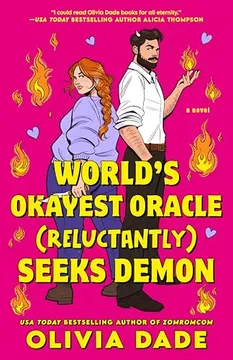
Neighborhood oracleGwen is a human oracle whose ordinary visions help people with limited money and little access to power. Years of being judged against stronger seers have left her quick to call herself useless, even as neighbors rely on her practical generosity. She is funny, food-loving, anxious, and more courageous than she believes: she keeps showing up when a friend, client, or community needs her. Her bond with Hugh2 tests whether she can receive care without treating it as a debt. Gwen’s central struggle is not simply to become powerful, but to recognize the value she already creates through trust, attention, and collective action.
Hugh Blacke
Rule-bound demon councilorHugh is a half-demon SERC councilor, trained in law and known for discipline, honesty, and careful procedure. His restraint comes partly from a childhood spent hiding his human ancestry and partly from witnessing the ambition and emotional coldness of his parents’ world. He is protective without wanting to control, and he takes consent seriously even when his own feelings run deep. Gwen1 draws him toward a more flexible idea of justice, while his loyalty to his twin sister10 shapes both his grief and his moral imagination. Beneath his formal manners is a capacity for warmth he has rarely been encouraged to show.
Kip
Gourmet troll allyKip is one of Gwen’s1 troll companions, a giant with an enormous appetite, theatrical humor, and far more tactical intelligence than outsiders expect. His apparent clumsiness and lack of subtlety help trolls avoid political scrutiny, but he can act decisively when the group needs strength. He is loyal to his cousin Lorrie4 and affectionate toward Gwen1, often using absurd jokes to keep fear from taking over.
Lorraine
Protective troll cousinLorraine, usually called Lorrie, is Kip’s3 troll cousin and Gwen’s1 fiercely practical friend. She is physically imposing, cheerful, perceptive, and as devoted to food as Kip3, but she knows when a joke should give way to protection. Her care for Gwen1 extends to the wider neighborhood, where she checks on vulnerable residents and offers help without making a performance of kindness.
Max Boucher
Misanthropic vampire allyMax is an ancient, politically experienced vampire who has withdrawn from SERC life but retains a formidable network and a sharp sense of strategy. His theatrical vanity and cutting wit conceal fierce loyalty to the people he loves. He trusts evidence, understands how public narratives can be weaponized, and is willing to make difficult choices to protect his community. His relationship with Edie6 reveals a tenderness that his formidable reputation rarely advertises.
Edie Brandstrup
Human maker and witnessEdie is Max’s5 human neighbor and partner, a resourceful soap maker whose ordinary status does not diminish her courage or judgment. She investigates the breach alongside Max5 and insists that human witnesses count even when supernatural authorities might prefer to ignore them. Her humor and independence keep Max5 from turning concern into suffocating control, while her practical knowledge makes her a valuable participant in the group.
Sabrina
Witch and steadfast friendSabrina is Gwen’s1 witch friend, a capable healer and investigator who is fiercely devoted to her wife, Starla8. She uses her magic pragmatically and does not confuse bravery with limitless capacity. Sabrina’s directness helps the group cut through panic, while her loyalty to Gwen1 remains grounded in long friendship rather than political calculation.
Starla
Telepathic witch's wifeStarla is Sabrina’s7 ill wife and an Enhanced human telepath. She remains connected to events despite being too unwell to join the dangerous work in person. Her communication helps the group respond to changing threats, and her relationship with Sabrina7 gives the witch a deeply personal reason to balance public danger against private care.
Thora Creekwood
Half-fae SERC informantThora is a half-fae operative who works undercover among politically disaffected fae. Cool, precise, and highly observant, she understands that useful intelligence depends on patience and trust. Her professionalism can make her seem distant, but she takes responsibility seriously and is willing to keep working when an investigation grows more dangerous. Hugh2 values her expertise and treats her as a collaborator rather than a disposable source.
Eloise Blacke
Hugh's daring twinEloise is Hugh’s2 identical twin, a demon with a shared empathic gift and a much greater appetite for risk. She resists the pressure to conceal who she is and is drawn to people and causes her family’s circles dismiss. Her warmth and humor can make her seem impulsive, but her decisions grow from a fierce commitment to individuality and justice. Her bond with Hugh2 is central to his emotional life.
Josiah Goodling
Hugh's senior SERC mentorJosiah is an experienced SERC councilor and longtime mentor to Hugh2, with the polished manners and political knowledge expected of an elder statesman. He has helped shape Hugh’s2 public career and moves comfortably among powerful supernatural figures. His authoritative presence makes him an important source of counsel within the Council, though his confidence in hierarchy can obscure the needs of people with less status.
Marlee Blacke
Hugh's status-conscious motherMarlee is Hugh2 and Eloise’s10 demon mother, a successful lawyer deeply invested in family standing and the preservation of appearances. Her marriage to a human man challenges her social world, but she responds to that challenge by trying to secure the family’s place within it. She loves her family, yet her idea of protection is shaped by reputation and obligation, creating painful distance between her priorities and her children’s needs.
Matilda Tinley
Powerful Delphi oracleMatilda was Gwen’s1 exceptionally gifted classmate at Delphi Academy. Her prophetic ability makes her formidable, but years of competition and isolation have left her unused to relying on other seers. Under pressure, she begins to recognize the strength of shared information and mutual care. Her history with Gwen1 carries the emotional weight of an old school hierarchy that can be challenged.
Haziq
Brave building doormanHaziq is Farhanah’s15 nephew and the doorman at Hugh’s2 apartment building. Courteous and cautious, he takes his responsibilities seriously, but his concern for family outweighs blind obedience to routine. His knowledge of Gwen’s1 character gives her a chance to reach Hugh2, and his calm practical courage makes him an important ally in a crisis.
Farhanah
Gwen's generous clientFarhanah is Gwen’s1 older neighbor and occasional client, a warm woman whose family connections often become a source of practical support. She trusts Gwen1 because the oracle has helped protect what matters to her, and she responds to trouble with food, gifts, and determined matchmaking. Her kindness reflects the informal network of care Gwen1 has built around herself.
Dottie
Werewolf guardian's chargeDottie is an elderly werewolf whose connection to a guardian demon gives her access to unusual information. She is resourceful, stubborn, and fond of snakes despite repeated warnings. Her everyday presence in the afterlife system eventually makes her an unexpected link between hidden worlds.
Tanielle Beech
Fae SERC chairTanielle is the fae chair of SERC, an influential leader accustomed to scrutinizing claims about her species. She is politically formidable and protective of the Council’s stability, qualities that make her both a consequential authority and a difficult person to assess. Her guardedness reflects a governing body that often prizes calm and reputation over transparent debate.
Micah Cartwright
Missing human generalMicah Cartwright is a high-ranking human general whose appearance connects Gwen’s1 visions to the military world. His authority makes him a potentially consequential figure in any conflict between human institutions and supernatural communities. His professional position gives the group reason to investigate how official power might be used or misused.
Timon
Captive oracle allyTimon is one of the oracles held with Gwen1. Tired and frightened, he still offers help when the prisoners begin to cooperate. His earnestness and occasional confusion bring humor to a bleak situation without reducing the danger the captives face.
Corey
Young captive seerCorey is a young oracle whose ability has been weakened by captivity and stress. Night terrors and physical exhaustion make them especially vulnerable, but their visions can still offer useful fragments. Gwen’s1 care helps Corey become part of a community rather than endure fear alone.
Jing-Jing
Captive oracle in needJing-Jing is one of the imprisoned seers, physically weakened by confinement and the demands of prophecy. The group’s attention to her health shows how easily powerful institutions overlook the bodies behind an oracle’s work. She becomes part of Gwen’s1 cooperative circle.
Harry
Elderly captive seerHarry is an older oracle whose age and remaining prophetic ability make him a vulnerable member of the captive group. He contributes information even while exhausted, and the other prisoners recognize that he needs practical assistance as much as they need his insight.
Death
Realm Below's judgeDeath rules the Realm Below alongside the Fates and oversees the afterlife’s legal proceedings. His manner is dry, impatient, and unexpectedly preoccupied with administrative delays and personal appointments. He possesses immense authority, but his initial confidence in the Realm’s security reveals that power does not guarantee attentiveness.
Plot Devices
Oracle visions
Warnings with a costOracles access visions through prophetic power, often using blood offerings, and the stronger visions can leave them unconscious, bleeding, nauseated, or injured. Gwen’s1 traditionally small predictions help ordinary clients, while her sudden visions show a battlefield and identify people connected to the conspiracy. Her visions provide clues but not complete explanations, and captive seers’ abilities deteriorate under stress. Because they can be misused by employers or conspirators, prophecy is both a source of knowledge and a reason oracles need protection.
The Containment Zone
Protection turned trapThe Zone is enclosed by concentric walls, guarded gates, and moats around the compound where zombies were contained. Its security is meant to protect residents from another outbreak and prevent dangerous outsiders from reaching the oracles and other inhabitants. During the breach, saboteurs disable communications and open inner barriers while leaving the outer wall shut. The system’s isolation prevents residents from warning the outside world and lets officials accept a false account. Gwen’s1 passage through the wall becomes the first step toward exposing that failure.
Fae glamour and bargains
Identity hidden by powerFae glamour can conceal a person’s species and appearance, making even familiar supernatural authorities difficult to identify. The most powerful version hides its creator from detection at a steep cost, while bargains can bind people to serve another’s plans. These mechanisms let conspirators plant misleading evidence, pass as trusted figures, and recruit helpers through threats to their families. They make evidence and reputation unreliable, forcing Gwen1 and Hugh2 to distinguish what someone appears to be from what their choices reveal.
Hugh's empathic bond
A feeling becomes a compassHugh’s2 human ancestry gives him a limited ability to sense other people’s emotions, a talent he suppressed after childhood exposure to his parents’ ambition and contempt. His unusual connection to Gwen1 persists even when he is not deliberately reaching for anyone. As he cautiously uses the ability, it helps him understand her unspoken needs and eventually guides him toward her in the Realm Below. The bond supports intimacy and rescue, but the story keeps it distinct from consent: knowing what Gwen1 feels does not give Hugh2 permission to act without her choice.
The Realm Below
Afterlife as workplaceThe Realm Below is Death23 and the Fates’ domain, a vast place with restricted access, courtroom proceedings, administrative offices, and guardian demons assigned to the dead. Its bureaucracy is both fantastical and mundane, complete with digitization projects, shift schedules, and cramped dormitories. The Realm’s authority gives it power over trespassers, but Goodling11 exploits an unguarded area to hide abducted oracles. The courtroom ultimately provides a venue where his crimes can be forced into the open and judged.
Download PDF
Download EPUB
.epub digital book format is ideal for reading ebooks on phones, tablets, and e-readers.








