

Key Takeaways
Make heroism a costly choice for something beyond the self
A code under pressure. The collection treats a hero not as someone who racks up victories, but as someone who struggles for an ideal and accepts real costs for it. The Morrises call their fighting company’s shared standard the Sacred Band ethos: steadfast effort, loyalty to comrades, and devotion to a common ideal. Its hero is not invulnerable or always successful. The test is whether the ideal still matters when survival would be easier.
Conn refuses the easy escape. In Cecelia Holland’s battle story, young Conn sees his commander flee and chooses to keep fighting. Later, as the ships sink, he insists the wounded must come with the survivors. His courage is not just defiance of death. It is responsibility for other people, even when that responsibility makes escape harder.
What's compelling is the distinction between bravery as spectacle and heroism as obligation. Conn matters because his courage protects people, not merely because he faces danger. That makes the ideal legible through decisions rather than speeches. The collection also implies a useful limit: an ideal can be noble without making every action taken in its name just. Readers can ask who benefits from a hero's code, who pays its price, and whether loyalty has become obedience. Those questions make heroic conduct more human, not less admirable.
Let myth enlarge a hero without erasing the human being
History supplies resonance. Janet and Chris Morris argue that fantasy gains depth when its invented heroes echo older myths and historical experience. Their stories of Tempus and the Sacred Band connect imagined fighters to Gilgamesh, the legendary Sacred Band of Thebes, and remembered military leaders. Such connections give a fantasy world a sense of inherited values, rather than making it feel like a pile of unrelated inventions.
Keep the grief visible. Achilles is not compelling simply because he is mighty. He quarrels over honor, withdraws from battle, grieves when Patroclus dies, and then chooses a path that brings his own death. Homeric heroes weep and regret their losses. The Morrises use this kind of emotional exposure to keep their larger-than-life figures recognizably human, even when gods and fate shape their lives.
Myth works here as a cultural memory bank: a new character can feel connected to old questions about honor, mortality, and power. The emotional detail is what prevents that inheritance from becoming mere pageantry. A useful caution follows from the book's historical examples. Ancient heroic ideals often included customs modern readers would reject, so borrowing a myth does not require treating its world as morally superior. The strongest adaptation preserves the myth's conflict and emotional force while making its values visible enough to examine.
Make reluctant heroes choose public duty without private payoff
Reluctance is a moral test. Orson Scott Card distinguishes a reluctant hero from someone simply dragged into danger. The hero may be appointed by fate, birth, or circumstance, but still must choose to act for a community larger than himself. If the central motive is saving a loved one, the act may be courageous, but it no longer carries the same public self-sacrifice.
The choice must remain real. Card contrasts the immediate, unplanned rescue of strangers with a hero who has time to hesitate, refuse, and reconsider. Frodo's acceptance of a dangerous task is powerful because he has little personal reward and no easy escape. Card warns that a formulaic refusal followed by an inevitable yes can feel hollow. The reader needs to see the hero recognize the stakes and freely accept them.
This distinction clarifies why reluctant heroes can feel more than a plot device: hesitation makes the eventual commitment observable. It also raises a productive question about motive. Public duty and personal love rarely arrive in cleanly separated packages, and Card's own examples acknowledge that mixed motives can still produce meaningful courage. Rather than demand a perfectly selfless character, a writer can show what the hero is willing to lose and whether the community's needs genuinely influence the decision.
Give veteran heroes a job to do, not an ego to defend
Experience changes the performance. Alex Bledsoe contrasts an untested young fighter, eager to prove himself, with an older hero who already knows what he can do. The veteran tends to avoid needless boasts, assess an opponent, and conserve effort. A warning or attempt to talk may reveal more confidence than a theatrical challenge. When fighting begins, it should serve a story purpose, not merely confirm that both combatants are skilled.
Maturity changes relationships too. Bledsoe's Eddie LaCrosse accepts capable partners as equals rather than treating them as prizes or props. He has also learned that drink, sex, and the thrill of violence can compromise judgment. The point is not that older heroes never indulge themselves. They have learned to notice when a pleasure threatens the work, the relationship, or another person's safety.
The veteran's appeal comes from judgment as much as competence. This gives a writer ways to show experience without pausing for a biography: the hero notices a trap, avoids a needless duel, or treats a partner as a person with independent agency. Bledsoe's examples are often framed through heterosexual male heroes, so their assumptions about gender and romance should not be treated as universal rules. The deeper principle travels further: maturity is visible in how a character handles power, risk, and other people's choices.
Turn worldbuilding into scenes readers can inhabit
Information needs a dramatic home. Ian Esslemont warns fantasy writers against inserting the entire history, geography, and politics they have invented. Exposition delivers facts directly; dramatization lets readers encounter information through a scene. In his opening example, a short summary of a shipwreck becomes a longer encounter in which villagers find wreckage, loot it, and face the Norman owner of a horse. The scene conveys setting and character while giving the reader something to discover.
Choose details that reveal. Esslemont revises vague description into concrete sensations: grain heads bow in the wind, and a laborer's heavy baskets scrape her shoulders. A detail earns its place when it makes the world tangible or reveals a character's position in it. Dialogue should not become a disguised lecture, and withholding an answer can create tension when the person being questioned has a reason not to explain.
The practical insight is that readers do not need every fact at once; they need enough evidence to build a working picture and a reason to keep looking. This resembles good teaching, where a concrete problem gives abstract information a purpose. Yet withholding is not automatically engaging. If a scene hides facts the viewpoint character would naturally notice, the reader may feel confused rather than curious. The test is whether a detail invites inference while keeping the action and emotional stakes clear.
Write fights through a hero's senses, choices, and immediate goal
Orient the reader first. Brandon Sanderson argues that prose fights fail when they become lists of blows. Before action begins, establish where the combatants are, how many there are, and what the surroundings allow. During the fight, maintain clear movement and use concrete sensory details. A reader needs enough spatial information to understand danger, but not a full report of every motion.
Make the fight personal. In Sanderson's example, Jim attacks men connected to a woman's death. The scene becomes more compelling when his anger, fatigue, and objective shape what he notices and does. A chair, doorway, or thrown apple can become part of the action. If a fight runs long, re-establish the setting and the hero's goal. Vary sentence rhythm carefully, since clipped sentences do not automatically make a scene feel faster.
Sanderson's advice identifies prose's special advantage over film: access to motive. A screen can show a fast punch; a novel can make the reader understand why this punch is difficult to throw, or why the hero risks taking one. That access can also become clutter if every movement is paired with an explanation of emotion. The most effective balance gives the reader a stable physical map, then selects only the thoughts and sensations that change the meaning of the struggle.
Reveal your protagonist through allies, witnesses, and ordinary people
A hero exists in a network. Cat Rambo shows how a side character can reveal a larger conflict through rumors, household concerns, and partial knowledge. In her story about the mage Alkyone, an innkeeper's daughter witnesses events she cannot fully understand. The child's observations make a war and a city's destruction intimate, while Alkyone's kindness gives the heroine a human dimension beyond her magical deeds.
Give supporting characters lives. Jennifer Brozek's NPCs, or non-player characters, can move a plot, set a scene's tone, and expose a hero's values. A mother asking Hart to protect his sister makes his responsibility concrete. A wounded horse forces another hero to choose between tactical advantage and ending its suffering. Howard Andrew Jones adds that teams become vivid through different temperaments, friction, and trust, as with the contrasting partners Spock and McCoy.
Supporting characters do more than populate a setting. They provide social evidence: a hero's conduct looks different when seen by someone who depends on, resents, or misunderstands that hero. The witness perspective also limits information in a way that can make epic events feel intimate. A practical restraint matters, however. Minor characters need enough individuality to feel alive, but not every passerby needs a full biography on the page. The writer's private knowledge can guide a brief, convincing appearance.
Make monsters strange enough to test the hero's beliefs
Fear begins with difference. C. L. Werner argues that a monster can disappear into a fantasy setting if it is treated like an ordinary opponent. Its appearance, habits, and the characters' reactions should establish why it is unsettling. In one example, blind snake-like creatures attack warmth, striking at a torch and then at the heat left in corpses. Their behavior feels alien because it follows a creature's own sensory world, not ordinary human motives.
Make the encounter matter. A monster can threaten a hero physically, expose a belief, or serve as a dark reflection of the hero. The battle should challenge the hero rather than end in an effortless victory after elaborate buildup. Alternatively, a writer can conceal the creature and let traces of its violence build dread. Either strategy depends on believable fear and a meaningful consequence, not simply a larger body count.
The monster is most effective when it changes the reader's assumptions about what counts as ordinary. Distinct behavior creates that shift more economically than a catalogue of claws and scales. The mirror function adds another layer: the beast can make the hero's principles costly to maintain. Concealment and vivid description are opposing techniques, but both depend on controlled information. If the creature remains vague without producing consequences, mystery can start to feel like withheld content rather than genuine uncertainty.
Use familiar fantasy tropes as shorthand, then complicate them
Familiarity is a tool. Ari Marmell defines tropes as recurring genre ideas, such as the chosen savior, the black-armored warlord, or the party of familiar fantasy peoples. Readers recognize these patterns quickly, so a trope can establish a character or setting without lengthy explanation. It can also create a deliberate false expectation. Marmell introduces a fearsome warlord, then contrasts that image with the same man as an older family figure.
Do not stop at recognition. A trope becomes a cliché when it substitutes for character development. The black knight still needs personal motives, flaws, and choices; the farm-born savior needs a story beyond inherited destiny. Writers can alter, disguise, or satirize a familiar pattern, but the variation must serve the tale. Originality is not a requirement to reject every convention. It is the result of making a familiar element do specific work.
Tropes are a shared vocabulary between writer and reader. That vocabulary can create speed, comfort, and surprise, depending on how the story uses it. Marmell's strongest point is that convention itself is not the enemy; unexamined convention is. A trope can also mislead unfairly if the story relies on a promise it has no intention of honoring. The reader's pleasure comes not from being tricked for its own sake, but from discovering that the familiar image contains a more particular person or problem.
Make armies obey food, distance, disease, and terrain
War has a supply chain. Paul Kearney asks writers to consider how an army forms, survives, and fights. Armies require time to gather, different troop types reflect equipment and training, and thousands of people need food, water, and sanitation. Kearney notes that disease killed more soldiers than combat in many pre-modern wars. An army that loots for food must send out vulnerable foraging parties; a camp left in one place can become unhealthy.
Scale changes movement. Kearney calculates that 10,000 soldiers marching four abreast would stretch for nearly three miles, so an army cannot respond instantly as one body. Scouts, advance guards, flanks, and supply wagons shape what a commander can do. On the battlefield, troop types and terrain matter: disciplined spearmen can stop cavalry, while missiles threaten the spearmen. A map beside the draft helps keep movement and visibility plausible.
Logistics turns battle from a decorative spectacle into a system with constraints. Food, distance, and disease can generate plot pressure before an enemy appears, while terrain can make a victory feel earned rather than granted by the author. The figures are useful as scale checks, not universal laws: armies vary by era, equipment, and organization. The larger lesson is to trace consequences. If a force is enormous, the story should show what that size costs in time, coordination, and supply.
Finish the story and let disruption reveal what matters
Completion teaches craft. Steven Erikson advises writers to finish what they start because understanding often arrives near the end of a scene or book. The completed work lets a writer see how earlier decisions fit together and what needs revision. Glen Cook offers a complementary approach: unexpected events can redirect a story and reveal character under pressure. He describes discovering a major figure in the middle of drafting, then finding that the character became central to the series.
Make chance consequential. Cook's concept of the Sea of Stories is a metaphor for the store of events and possibilities from which stories emerge. In life, an abrupt disappearance, accident, or death can reshape everything without offering a tidy explanation. In fiction, surprise matters when its consequences are carried forward. An unexpected event should change relationships, plans, or the story's understanding of a character, rather than function as a random shock.
These essays support two different creative temperaments: Erikson emphasizes persistence through a planned undertaking, while Cook welcomes discovery during composition. They need not conflict. A writer can finish a draft without treating its first plan as sacred, then revise so surprising events feel inevitable in retrospect. The key distinction is between unpredictability and arbitrariness. A shock gains weight when the characters must live with it, and when the writer has done enough work to make its effects coherent.
Analysis
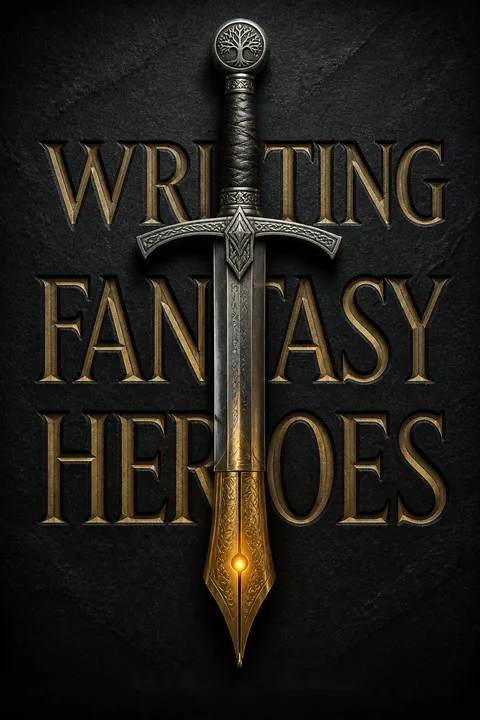
Writing Fantasy Heroes is an anthology, not a single prescriptive manual. Its contributors disagree about temperament, method, and even what counts as heroic fantasy. Some favor the veteran who enters danger with clear eyes; others focus on the reluctant figure who accepts a burden he never wanted. One writer embraces disruptive invention, while another stresses the discipline of finishing a draft. The shared subject is not a universal hero formula, but the craft of making extraordinary action feel human and consequential.
Across the essays, three practical questions recur. What does the hero want, and what ideal competes with that desire? What can the reader actually perceive in the scene, from a sword fight's blocking to a laborer's bruised shoulders? Who else is affected by the hero's choices? These questions link character design to description, worldbuilding, monsters, military logistics, and supporting roles. They also explain why the book gives so much attention to costs. A heroic deed matters when a reader can understand what it demands and from whom.
The anthology's most durable strength is its resistance to empty spectacle. A battle is more than motion, a monster more than a target, and an archetype more than a shortcut. Yet its range means some advice is intentionally partial. Bledsoe's model of the mature male adventurer, for instance, is one useful character type rather than a definition of all heroic fantasy. Likewise, Card's distinction between public sacrifice and personal love sharpens a moral problem, but real motives often overlap. Readers should treat the chapters as a set of lenses, not commandments.
The best synthesis is simple: build a character with a recognizable code, then pressure that code through vivid situations, other people, and consequences the character cannot control. Let conventions help readers enter the story, but give them a reason to revise their first impression. And finish enough of the work to discover what the story has actually become.
Review Summary
Writing Fantasy Heroes receives mostly positive reviews, with readers praising its insightful essays on crafting memorable characters and engaging narratives. Many find the advice from established authors valuable, particularly Brandon Sanderson's chapter on fight scenes and Paul Kearney's on warfare logistics. Some readers note the book's uneven quality, with certain essays feeling self-promotional or less useful. Overall, reviewers appreciate the diverse perspectives offered and recommend it as a helpful resource for aspiring fantasy writers and genre enthusiasts alike.
People Also Read
Glossary
Sacred Band ethos
Shared ideal and loyaltyThe moral standard associated with the Sacred Band of Stepsons in Janet and Chris Morris's fiction. It centers on determination, loyalty to comrades, and devotion to a common ideal. Characters may fail to meet it, since the stories treat their heroes as flawed people, but the ethos provides a measure against which their choices can be judged.
Hero of Circumstance
Hero acting in an emergencyOrson Scott Card's term for someone who becomes heroic because an urgent situation presents an immediate choice. The person did not set out to pursue a heroic role, but must act now or lose the opportunity to help. The defining feature is the decision made under pressure, often without time to consider every consequence.
Hero by Career
Hero who accepts a roleCard's term for a person who takes on an established role of service or responsibility and accepts its obligations. Such a hero is not necessarily eager for every danger, but the role itself involves preparation and a chosen commitment to others. Card contrasts this with heroes whose circumstances thrust an unexpected task upon them.
Reluctant Hero
Hero who accepts an unwanted dutyA hero who does not seek a heroic life or its rewards, yet freely accepts a serious responsibility when others need help. In Card's account, reluctance alone is not enough: the character must make a meaningful choice, and the action should serve a wider community rather than only personal advantage. Fate may present the task, but the hero embraces it.
Sea of Stories
Metaphor for story possibilitiesGlen Cook's metaphor for the vast field of events, images, and possibilities from which a writer may draw. Stories narrow as words and decisions accumulate, while unexpected ideas can alter the direction of a draft. Cook uses the metaphor to value discovery and unplanned events, especially when their consequences reshape characters and plot.
NPCs
Supporting non-player charactersNPC means non-player character, a term from games that Jennifer Brozek applies to supporting figures in fiction. These characters may provide information, establish a scene's tone, create obstacles, or reveal a protagonist's qualities. Brozek advises writers to imagine that even a minor figure has an occupation, interests, relationships, quirks, and personal values.
Download PDF
Download EPUB
.epub digital book format is ideal for reading ebooks on phones, tablets, and e-readers.








