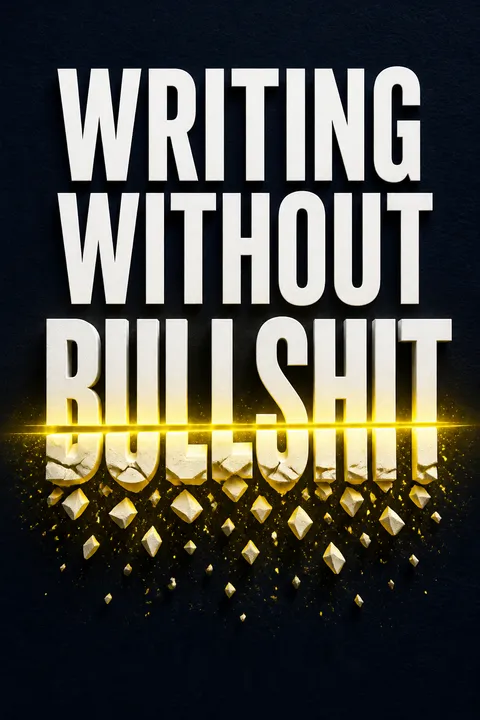


Key Takeaways
Make readers spend less time decoding what you already know.
Use the reader's clock. The book's central rule, the Iron Imperative, is to value the reader's time above the writer's convenience. “Bullshit” means writing that obscures or fails to convey useful meaning, whether through jargon, rambling, or evasions. In the 2016 WOBS survey, 81% of 547 respondents said poor writing wasted their time, and 61% said what they read was often unclear. The sample was self-selected, not representative of all professionals, but the complaints are familiar.
Count useful meaning. Bernoff's meaning ratio estimates the share of words that actually communicate. An Inovalon company description scored 59%, with 38 of 92 words judged unhelpful or unclear. A plain-language rewrite cut it to 54 words while explaining whom the company serves and how.
The rule turns style into a practical ethical test: who bears the cost of ambiguity? In workplaces, writers often save minutes by sending an unedited draft, while dozens of readers each spend time interpreting it. That cost is distributed and therefore easy to ignore. The ratio offers a useful prompt for revision, though it is a judgment call, not an objective measure. A technical term may look empty to outsiders but carry real precision for specialists. The key is to measure usefulness for the actual audience, not to chase a perfect score.
Put the news first, then earn the reader's attention.
Lead with the payoff. Screens, interruptions, and crowded inboxes leave little time for a slow introduction. The survey found that 65% of respondents often encountered writing that was too long, and another 65% complained about poor organization. Bernoff's fix is to state the conclusion first, then support it. Make the subject line, title, or opening sentence useful even if it is all the reader sees.
Do the hard cut. When Nokia became part of Microsoft, division head Stephen Elop sent employees a 1,100-word email about organizational changes. The announcement of 12,500 job cuts appeared deep in the message. A rewrite of about 240 words put the central news and key changes in view. Important writing deserves more editing, not more padding.
Front-loading is a form of progressive disclosure: readers receive the essential information first, then choose how deeply to engage. That structure serves both a hurried executive and a careful analyst without forcing either to follow the same path. It also makes the writer confront the real hierarchy of a message. The caution is that a conclusion without enough evidence can sound like a decree. A strong lead does not replace reasoning. It gives readers a clear reason to keep reading the reasoning.
Name the actor, define the terms, and replace fog with facts.
Make responsibility visible. Passive voice hides who acted; jargon assumes readers share an insider's vocabulary; a “weasel word” is a vague quantity or intensity word, such as “many” or “very,” that sounds informative without being precise. The book calls writing that excludes readers through specialist language “insider bias.” Replace these habits with direct sentences, plain explanations, and concrete claims. Use “I,” “we,” and “you” when they clarify who is speaking and who should act.
Say the difficult thing. In Bernoff's example, a service manager's cautious report buried the fact that a technician failed to repair a customer's machine, leading to costly damage. A direct rewrite named the failure, listed the response, and included a 98% quality rating for context. The point is not to remove every passive sentence or specialist term, but to choose each deliberately.
These revisions do more than improve readability. They expose the structure of accountability: who knows, who decides, who acts, and who bears consequences. That is especially valuable in recommendations, incident reports, and customer communication. Plain language also gives readers a better chance to challenge an unsupported claim. Directness is not the same as bluntness, however. A writer still needs tact, and some actors are genuinely unknown. In that case, acknowledging uncertainty is clearer than assigning responsibility without evidence.
A statistic without a source or comparison is decoration.
Make numbers answerable. A statistic needs provenance, context, appropriate precision, and a sound method. Bernoff traces a claim about 100,000 child-pornography websites through organizations back to an estimate given to a reporter in 2000, with no clear basis. Repetition had made the figure seem established. Numbers can also create false stories: the book pairs rising science spending with rising hangings to show how two trends can move together without one causing the other.
Give readers a scale. A 470-point Dow decline sounds dramatic until readers learn it was a 2.84% loss, and not among the largest daily percentage drops. Report sources and dates, explain the base behind growth rates, consider alternative explanations, and avoid displaying more precision than the evidence supports. A spreadsheet's extra decimal places do not make its inputs more reliable.
The chapter treats statistics as claims that need an audit trail, not as ornaments that lend authority. This is especially important because precise figures can feel more trustworthy than vague language even when their origins are weak. Context also changes what a number means: absolute change, percentage change, and comparison with a relevant baseline answer different questions. The discipline has a limit. Not every short workplace note needs a full methods section. But when a number could influence a decision, readers should be able to see what it measures and where it came from.
Define the reader's change before drafting a single paragraph.
Give writing a job. ROAM is a planning framework that asks four questions: who are the Readers, what is the Objective, what Action should follow, and what iMpression should remain? The objective is a change in understanding or attitude; the action is what the reader does; the impression is what the writing suggests about its author or organization. These are related but distinct. A helpful blog post, for example, might teach workers to run remote meetings better while leaving them with a favorable view of the company publishing it.
Write a target sentence. Summarize the intended change in one line: after reading, this audience should understand something, take a particular action, and see the writer in a particular way. Use that line to decide what belongs in the piece and what does not. Recheck it when the project shifts or enters revision.
ROAM makes writing success more testable. Instead of asking whether a document sounds polished, the writer can ask whether the intended reader understood the message and acted on it. Separating objective from action is particularly useful: knowing what to do is not the same as doing it. The impression question adds a reputational dimension without making the piece merely self-promotional. One useful safeguard is to keep the desired impression subordinate to reader value. If the content is not genuinely useful, a planned image of helpfulness will feel manufactured.
Research and outline early; the first draft is not the project.
Replace deadline panic. Bernoff calls the common cycle the three Ps: writers procrastinate, panic, then pray reviewers will approve a rushed draft. His alternative gives preparation, drafting, and revision separate jobs. Early preparation means identifying the audience and purpose, gathering evidence, finding missing information, and testing the structure before writing polished prose.
Build a fat outline. Unlike a bare list of headings, a fat outline mixes planned sections with sample wording, evidence to find, and notes about what each section must accomplish. It lets collaborators challenge the argument before the writer invests in finished paragraphs. Bernoff also recommends drafting a provisional title and opening early, then revising them as research develops. For a four-week project, he suggests spending only a few days on the first draft, with substantial effort reserved for preparation and revision.
The process shifts effort toward decisions that are expensive to change once polished prose exists. A weak argument can be hidden by smooth sentences, but it cannot be repaired by copyediting. A provisional title and outline also make uncertainty visible: missing evidence becomes a research task rather than a last-minute surprise. The method is not a rigid timetable for every assignment. A short, urgent message may need little planning. Its greatest value is for substantial work where research, review, and coordination create dependencies.
Protect uninterrupted time so your thinking can connect.
Prepare for concentration. Bernoff uses “flow” for deep involvement in a task that is challenging but manageable, where attention stays with the work and progress feels continuous. Research, an outline, and gathered examples reduce the questions that would otherwise interrupt drafting. He recommends setting aside at least 90 minutes, finding a space where colleagues will not interrupt, and silencing email and social media.
Let problems incubate. The book recounts mathematician William Rowan Hamilton's long struggle to extend number systems. During a walk, he found the solution that became quaternions. The lesson for writers is not to wait passively for inspiration: work hard, accept that early attempts may fail, step away, and give ideas time to connect. When stuck, note what needs fixing and continue elsewhere rather than letting one knot stop the whole draft.
The chapter frames concentration as a condition to design, not a mysterious gift. Preparation lowers the number of open questions competing for attention, while protected time makes sustained thought more likely. The account of insight during a walk also gives rest a practical role: stepping away can change the mental context in which a problem is represented. Still, uninterrupted time is a privilege not every worker controls. Teams can help by protecting shared focus periods and reducing needless interruption, rather than treating distraction as an individual failure.
Treat edits as evidence about the page, not verdicts about you.
Keep ownership, accept help. Bernoff argues that reviewers reveal problems the writer may not see; they should not automatically dictate the solution. A useful response to a comment is to ask what weakness it points toward, then decide how to fix that weakness. For a substantial piece, feedback can progress from idea and structure to sentences, copyediting, fact-checking, and proofreading. Asking for line edits on an incomplete draft wastes effort because the structure may change.
Avoid committee prose. In the parable of Ray's Helicopter, executives keep adding their priorities to a purpose statement until it becomes a lifeless inventory. The CEO regains clarity by stating what the company actually stands for, then resolving a real question about whom it serves. Agree on purpose and roles early, request specific kinds of feedback, and thank contributors without surrendering the document's central direction.
The distinction between critique and command preserves both humility and authorship. Writers who accept every suggestion can produce a document with no coherent voice; writers who reject every suggestion lose access to other people's perspective. The productive middle is interpretive: identify what a comment reveals, then choose a response that serves the reader. Ray's story also shows why collaboration needs decision rights. A group can supply valuable expertise, but shared input does not automatically create a shared vision.
Choose each format for its reader, not its familiar rituals.
Fit the container. Emails compete with inbox traffic, social posts need to earn attention quickly, reports must support decisions, and marketing communication must offer readers a real reason to engage. A useful work email has a precise subject, a clear opening, one main topic, and a specific request with a deadline. The Boston Globe union leader's 132-word call for staff to help deliver missing papers gave readers the problem, task, place, and instructions, and people acted.
Replace ritual with value. Bernoff challenges press releases padded with boilerplate, superlatives, and generic executive quotations. A direct account of what happened, why it matters, and the supporting facts can work better as a post written in the company's own voice. Reports, meanwhile, should tell a true story: establish the problem, show what the evidence reveals, and conclude with recommendations. The format matters, but the reader's need matters more.
The concept of a container is a reminder that communication formats shape expectations. A report invites evidence and a decision; an instant message implies urgency and brevity. Trouble begins when writers follow the genre's conventions without asking whether those conventions help. A press release can still serve internal review or legal accuracy, and a long report may be necessary for complex decisions. The point is not to abolish formats. It is to make their inherited rituals justify their cost to the reader.
Change workplace writing through small, measured experiments.
Choose a winnable target. To improve a company's writing culture, Bernoff advises recruiting influential supporters, narrowing the project, and defining how success will be measured. A team might focus on reports that are too long, jargon in a specific group's mass emails, or clearer graphics in presentations. Gather evidence of the problem, propose a practical change, and track whether it helps. A bounded effort is easier to support than a campaign to fix every sentence in the organization.
Respect the politics. Do not attack every buzzword or single out powerful leaders without support. Some terminology is strategic or legally necessary; some habits cannot be changed immediately. Work with colleagues rather than treating them as obstacles, build on demonstrated successes, and expand only when the first effort works. Clear writing can raise a person's profile, but lasting change depends on making the improvement useful to the group.
This is organizational change at a workable scale: define a local problem, make a limited intervention, observe the result, and build credibility. It resembles an experiment more than a crusade, which makes it easier to learn from resistance and unintended effects. The emphasis on allies is realistic because writing norms are reinforced by hierarchy, incentives, and templates, not just individual habits. A useful measure should reflect reader outcomes, such as fewer clarification requests or faster decisions, rather than rewarding shortness for its own sake.
Analysis
The book's strongest claim is not that short sentences are inherently virtuous. It is that business writing allocates attention, and careless writing transfers the cost of the writer's uncertainty to readers. That makes clarity both a craft and a question of power. A manager can obscure a decision behind passive constructions; a company can use jargon to define who belongs; a report can bury unwelcome facts beneath reassuring context. Bernoff's advice is persuasive because it pairs diagnosis with concrete revision habits, then connects the sentence level to planning, collaboration, and organizational norms. The framework also anticipates a modern tension: communication is abundant, while sustained attention is scarce. Front-loading, headings, and concise subject lines are not merely stylistic tricks. They help readers decide what deserves attention and make information easier to retrieve. The number-checking guidance is especially important because clarity without epistemic discipline can make false claims more persuasive. Direct prose should reveal uncertainty, not erase it.
There are limits. Brevity can remove necessary context, and directness can carry unequal risks across roles, cultures, and gender. The book recognizes workplace gender bias, but a reader should not infer that better writing alone can neutralize biased reactions. Nor should its 2016 survey be mistaken for a representative measure of all professionals: respondents were recruited through channels likely to attract people already concerned about writing. Those limits do not weaken the central practice. They sharpen it: write plainly, but calibrate tone, evidence, and detail to the stakes and audience. The goal is not minimal words. It is maximum usable meaning with honest accountability.
Review Summary
Writing Without Bullshit receives mixed reviews, with an overall positive reception. Many readers praise its practical advice on concise, clear business writing, highlighting the "Iron Imperative" principle of valuing the reader's time. Some find it particularly useful for emails and reports. Critics argue that the book doesn't fully follow its own advice, becoming repetitive and lengthy. While some reviewers consider it essential for professional development, others feel it's more suited for beginners or marketing professionals rather than academics.
People Also Read






Glossary
Iron Imperative
Reader-first writing ruleThe book's governing principle: value the reader's time more than the writer's convenience. It directs writers to remove unnecessary material, make meaning easy to find, and avoid forcing readers to decode vague or poorly organized prose. It applies across emails, reports, marketing content, and other business formats.
meaning ratio
Share of meaningful wordsA rough measure of how much of a passage communicates useful meaning. The writer identifies words that are unclear, decorative, or too vague to inform most intended readers, then compares the remaining meaningful words with the total. It is an editorial diagnostic rather than an objective linguistic measurement.
ROAM
Four-part writing planA planning framework based on Readers, Objective, Action, and iMpression. It asks who the audience is, what change in understanding or attitude the piece should create, what readers should do, and what impression the writing should leave. The answers can be condensed into a target sentence that guides drafting and revision.
fat outline
Content-rich writing planAn outline containing more than headings and topic labels. It can include draft language, descriptions of planned sections, evidence to collect, examples to find, and promises about what the finished piece will explain. It helps writers clarify structure and lets collaborators respond to the argument before substantial prose is complete.
weasel word
Imprecise qualifying wordAn adjective, adverb, or noun that signals quantity or intensity without enough precision to support a clear claim. Examples include “many,” “very,” and “generally.” Such words can hide uncertainty or substitute for research. Writers can often replace them with verified specifics, numbers, or a clearly stated limitation.
insider bias
Writing for a narrow clubThe tendency to write as if readers share the writer's specialized knowledge, vocabulary, or assumptions. It commonly appears as unexplained jargon and can make customers, colleagues, or other outsiders feel excluded. Visualizing the actual audience and explaining necessary technical terms helps writers avoid it.
three Ps
Procrastinate, panic, prayA dysfunctional pattern for large writing projects. The writer delays preparation, rushes when the deadline becomes urgent, then sends an unfinished draft to reviewers while hoping nothing major goes wrong. The book contrasts this cycle with planned preparation, focused drafting, and deliberate revision.
five Rs
Passive-voice revision stepsA process for reducing unconscious overuse of passive voice: recognize why it obscures meaning, raise awareness of where it appears, reconsider why it was used, rewrite when a clearer active sentence is possible, and retrain through continued editing. The aim is not to eliminate every passive construction, but to use it deliberately.
email apnea
Breath-holding during emailA term researcher Linda Stone uses for the disrupted or suspended breathing some people experience while reading and responding to email. Bernoff uses it to illustrate how automatic and physically absorbing email habits can become, strengthening the case for pausing and writing important messages thoughtfully.
FAQ
1. What is "Writing Without Bullshit" by Joshua Bernoff about?
- Focus on clear business writing: The book is a practical guide to writing clearly, concisely, and directly in a business context, eliminating unnecessary jargon, passive voice, and filler.
- Addresses the problem of "bullshit": Bernoff defines "bullshit" as writing that wastes the reader’s time by being unclear, verbose, or evasive, and he explains why it’s so prevalent in modern business communication.
- Presents actionable strategies: The book offers step-by-step advice and techniques to help professionals write more effectively, from emails to reports to social media posts.
- Emphasizes reader-centric writing: Central to the book is the "Iron Imperative": treat the reader’s time as more valuable than your own.
2. Why should I read "Writing Without Bullshit" by Joshua Bernoff?
- Career advancement: Bernoff argues that clear, bold writing can boost your career by making you stand out as a communicator with integrity and impact.
- Universal relevance: The book is for anyone who writes at work—emails, reports, web copy, or social media—regardless of their role or industry.
- Practical, proven advice: The methods are based on Bernoff’s experience with thousands of professionals and are illustrated with real-world examples and case studies.
- Immediate application: The book’s tips can be applied right away to improve your writing and reduce the time you and your readers spend on ineffective communication.
3. What are the key takeaways from "Writing Without Bullshit" by Joshua Bernoff?
- Adopt the Iron Imperative: Always treat the reader’s time as more valuable than your own.
- Write short and front-load: Get to the point quickly, use fewer words, and put your main message at the top.
- Eliminate passive voice, jargon, and weasel words: These habits obscure meaning and waste time; replace them with direct, active, and clear language.
- Plan and revise purposefully: Use tools like ROAM (Readers, Objective, Action, iMpression) and fat outlines to clarify your intent and structure before writing.
4. What is the "Iron Imperative" in "Writing Without Bullshit" by Joshua Bernoff?
- Definition: The Iron Imperative is Bernoff’s core principle: "Treat the reader’s time as more valuable than your own."
- Guiding all writing decisions: Every recommendation in the book is designed to help you respect your reader’s time and attention.
- Counteracts common business habits: It challenges the tendency to write for your own convenience, deadlines, or self-protection, which leads to unclear and bloated writing.
- Moral and practical impact: Following the Iron Imperative not only improves your writing but also enhances your integrity and reputation.
5. How does Joshua Bernoff define "bullshit" in business writing, and why is it a problem?
- Definition of bullshit: Bullshit is any writing that fails to communicate clearly and accurately, including jargon, passive voice, unnecessary qualifiers, and poorly organized thoughts.
- Wastes time and erodes trust: It burdens readers, obscures meaning, and can damage your credibility and relationships at work.
- Root causes: Bernoff traces the problem to poor training in school, lack of editing in the workplace, and a culture of risk aversion and self-protection.
- Measurable impact: He introduces the "meaning ratio"—the proportion of meaningful words in a passage—to quantify how much of business writing is actually useful.
6. What is the ROAM method in "Writing Without Bullshit" by Joshua Bernoff, and how do I use it?
- ROAM explained: ROAM stands for Readers, Objective, Action, and iMpression—the four questions to answer before starting any writing project.
- Clarifies purpose: Identify who your readers are, what change you want to create in them, what action you want them to take, and what impression you want to leave.
- Guides content and tone: ROAM helps you focus your writing, cut irrelevant material, and choose the right style for your audience.
- Target sentence: Summarize your ROAM analysis in a single sentence to keep your writing on track throughout the process.
7. What practical techniques does "Writing Without Bullshit" by Joshua Bernoff recommend for clearer writing?
- Write short: Edit ruthlessly, aim for specific word counts, and remove unnecessary introductions and repetition.
- Front-load your message: Put your main point in the subject line, title, or first sentence, so readers get the gist immediately.
- Purge passive voice: Use active constructions to clarify who is responsible for actions.
- Replace jargon and weasel words: Use plain language and specific facts or numbers instead of vague or inflated terms.
- Reveal structure: Use headings, bullets, tables, and graphics to make your writing skimmable and easy to navigate.
8. How does "Writing Without Bullshit" by Joshua Bernoff address fear and psychology in business writing?
- Fear as a root cause: Bernoff explains that fear of being wrong, criticized, or held responsible leads to evasive, unclear writing.
- Integrity over fear: He encourages writers to choose integrity and directness, even when it feels risky.
- Practical examples: The book shows how fear manifests in real emails and documents, and how to rewrite them boldly.
- Special note for women: Bernoff discusses how societal expectations can make directness especially challenging for women, but argues that clear writing can help overcome these barriers.
9. What are the most common bad habits in business writing, according to "Writing Without Bullshit" by Joshua Bernoff, and how can I fix them?
- Passive voice: Hides responsibility and makes writing vague; fix by identifying the actor and using active verbs.
- Jargon: Alienates readers outside your "insider" group; replace with plain, accessible language.
- Weasel words: Qualifiers like "very," "many," or "potentially" weaken your statements; replace with specific facts or delete them.
- Overly long writing: Results from insecurity and lack of editing; cut unnecessary sections, combine points, and use bullets or graphics for clarity.
10. How does "Writing Without Bullshit" by Joshua Bernoff recommend handling numbers and data in business writing?
- Provide context: Always compare numbers to something familiar or relevant so readers understand their significance.
- Be precise but not misleading: Use the right number of significant digits and avoid false precision.
- Cite sources and methodology: Ensure your data is credible by referencing where it comes from and how it was collected.
- Avoid bias and spurious correlations: Present numbers honestly, consider alternative explanations, and be aware of confirmation bias.
11. How does "Writing Without Bullshit" by Joshua Bernoff suggest adapting writing for different business formats (emails, reports, social media, etc.)?
- Universal principles apply: The Iron Imperative, clarity, brevity, and directness are essential in all formats.
- Email: Use clear subject lines, concise bodies, and direct calls to action; avoid unnecessary recipients and long threads.
- Reports: Structure with descriptive titles, executive summaries, skimmable sections, and actionable recommendations.
- Social media and blogs: Front-load content, use engaging titles and graphics, and write for sharing and conversation.
- Press releases and web pages: Focus on facts, direct voice, and reader benefit; minimize jargon and boilerplate.
12. What are the best quotes from "Writing Without Bullshit" by Joshua Bernoff, and what do they mean?
- "Treat the reader’s time as more valuable than your own." This is the Iron Imperative, the book’s central principle, urging writers to prioritize clarity and brevity.
- "If you plant daisies around a pile of poo, it still stinks." Bernoff’s colorful way of saying that dressing up bad news or unclear writing doesn’t make it better—honesty and directness are required.
- "Bullshit is communication that wastes the reader’s time by failing to communicate clearly and accurately." This definition underlines the book’s focus on meaningful, effective writing.
- "If you can’t explain it simply, you don’t understand it well enough." Quoting Einstein, Bernoff emphasizes that clarity is a sign of true understanding, not a lack of sophistication.
- "The tighter you write, the more persuasive you will be." Conciseness is not just about saving time—it also makes your arguments stronger and more convincing.
Download PDF
Download EPUB
.epub digital book format is ideal for reading ebooks on phones, tablets, and e-readers.








