

Key Takeaways
Modern posture yoga emerged through twentieth-century exchange, not an unbroken ancient lineage.
A new center of gravity. Today, yoga often means a sequence of standing, balancing, and stretching postures. Older Indian yoga traditions did include postures, but usually treated them as a small, preparatory part of a broader path. Medieval hatha yoga, for example, emphasized breath control, bodily seals, and subtle-body practices as much as, or more than, posture. The modern global emphasis on exercise and fitness has no close equivalent in those sources.
A history of exchange. Singleton traces modern posture yoga to a meeting of Indian yoga traditions with European and American gymnastics, bodybuilding, health movements, and spiritual exercise. Indian teachers adapted these influences, framed them as yoga, and sent new forms across borders. The result is not simply ancient yoga preserved, or gymnastics renamed, but a modern synthesis with a complicated ancestry.
What's valuable here is the distinction between historical descent and present-day significance. A practice can be new in its current form and still carry older ideas, disciplines, and meanings. This avoids the false choice between calling modern yoga timeless and dismissing it as counterfeit. The comparison also asks a useful question of any tradition: which features are treated as essential, and who has the authority to decide? Singleton's focus is transnational, English-language yoga, so the account should not be mistaken for a complete history of every yoga practice in India.
Before yoga became respectable, the public often saw yogins as disreputable performers.
A troubling public image. European travelers described yogins as naked, ash-covered wanderers who begged, performed painful austerities, and sometimes carried weapons. These accounts often confused Hindu yogins with Muslim fakirs and other ascetics. The hostility was not purely invented: some ascetic groups had been powerful, mobile, and involved in military or commercial networks. British restrictions helped push many out of those roles and toward public performance and begging.
Contortion as spectacle. In 1897, a performer called Yogi Bava Lachman Dass displayed postures in a London sideshow. The magazine coverage treated him less as a yoga teacher than as an exotic entertainer. European audiences already knew contortionists and posture masters, so extreme poses readily read as circus spectacle. Many educated Indians also wanted to distance respectable Hinduism from these figures.
The book makes a strong case that yoga's reputation was shaped not only by doctrine, but by who could be seen practicing it and under what conditions. That is a useful corrective to histories centered on famous texts and teachers. It also prevents an overly simple colonial story: local social hierarchies and the yogins' varied livelihoods mattered alongside European prejudice. The same posture can look like spiritual discipline in one setting and a stunt in another. Public image is not a superficial layer; it can determine which practices are welcomed into a tradition.
Vivekananda made yoga exportable partly by excluding the postures later made central.
Respectability through selection. In his influential 1896 book, Raja Yoga, Swami Vivekananda emphasized mental and spiritual discipline while dismissing most hatha yoga practices as overly physical and spiritually limited. He allowed that some techniques might be useful, but he did not present posture practice as yoga's foundation. The posture-performing ascetic, already associated with fakirism, magic, and social disorder, threatened the refined public image he was building for yoga.
A long absence. Early English-language yoga manuals often followed this lead. Some ignored postures; others described them with disgust. Teachers who wished to present yoga as a respectable expression of Indian religion therefore had reason to leave hatha yoga at the margins. This created a historical puzzle: the postures that became yoga's most visible feature were initially excluded from its modern public revival.
Vivekananda's influence shows how reform often works by drawing boundaries: some practices are elevated as universal wisdom, while others become embarrassing remnants. That kind of selective presentation can help a movement travel, but it also narrows what audiences recognize as authentic. The tension is especially revealing because Vivekananda supported physical strength for Indian youth, yet rejected hatha yoga's posture practices. His objection was not a blanket hostility to the body. It reflected the particular stigma attached to the hatha yogin and the spiritual goals associated with him.
Recast foreign gymnastics as Indian strength training, and yoga gained a new body.
Fitness became political. In colonial India, British educators portrayed Indians as physically weak, while Indian reformers used strength training to challenge that claim and build national pride. The European physical culture movement offered methods and ideals that Indian teachers could adapt. Swedish gymnastics, bodybuilding popularized by Eugene Sandow, and YMCA physical education all helped shape this environment. The YMCA combined exercise with moral education and a broad ideal of balanced development.
A hybrid called indigenous. Indian physical culturists combined imported methods with wrestling, martial practice, sun salutations, and postures. Figures such as K. V. Iyer presented yoga as a source of health and strength, while also incorporating bodybuilding. This was not simply copying the West: it was a creative effort to claim physical culture as Indian, sometimes even by arguing that foreign exercises had ancient Indian origins. Nationalist ambition and borrowing could coexist.
This history clarifies why national identity and exercise became entangled. Physical training was not only about muscles; it offered visible evidence against claims of racial weakness and a way to imagine a stronger collective future. The exchange also complicates the language of cultural ownership. Imported techniques could be repurposed to resist colonial authority, while their European ideals of discipline and fitness remained influential. Such hybridization is not an anomaly. It is a common route by which practices become locally meaningful, though claims of ancient origin can obscure the very creativity that made them compelling.
Medical science made postures respectable by presenting them as measurable health practices.
A scientific translation. Before the better-known experiments of Swami Kuvalayananda and Shri Yogendra in the 1920s, writers were already trying to explain hatha yoga through modern medicine. Major B. D. Basu, for instance, interpreted the subtle channels and centers described in yoga texts as parts of the nervous system. That mapping was not supported by evidence of ancient anatomical dissection, but it made yoga easier to discuss in the language of science.
A change in purpose. Kuvalayananda and Yogendra investigated posture, breathing, and other techniques for their physiological effects, then developed health-oriented instruction. This helped move practices once linked to suspect ascetics into clinics, schools, and public exercise programs. In the process, some older frameworks became secondary. The subtle body was often treated as anatomy in disguise, rather than as a ritual and contemplative model of the body.
Medical language can open doors: it lets practices meet the standards of institutions that might otherwise dismiss them. But translation also changes what counts as knowledge. A symbolic body map does not have to be a failed anatomical chart to be meaningful, and treating it as one can flatten its original function. The same tension appears whenever traditional practices are tested through biomedical categories. Evidence about health effects can be useful, while claims that ancient concepts anticipated modern anatomy require separate scrutiny.
Today's gentle hatha class owes much to women's gymnastics and esoteric movement.
Spiritualized exercise. Singleton uses the term harmonial gymnastics for exercise systems that joined breathing, stretching, relaxation, and spiritual development. American teacher Genevieve Stebbins combined gymnastics with Delsarte movement and esoteric ideas. In Britain, Mollie Bagot Stack built a popular women's exercise program around stretching and rhythmic movement. After learning some postures in India, she incorporated them without calling the system yoga.
A familiar class format. These programs promised grace, health, beauty, and a sense of harmony between body and world. Their forms and intended audiences resemble many modern gentle yoga classes, which often attract more women than men. This does not mean those classes descend from one single source. Rather, it shows that Western exercise traditions had already normalized stretching and relaxation as meaningful bodily practices before they were widely labeled yoga.
This connection helps explain why modern yoga can feel culturally familiar even when it is presented as an Eastern import. Breathing, flexibility, and self-cultivation were already linked in Western women's exercise and spiritual movements. The gender history matters too: styles framed as gentle or graceful can inherit assumptions about which bodies and temperaments belong in a class. Still, resemblance does not prove direct borrowing in every case. Singleton's comparison is most persuasive as a shared historical context, not a single chain of transmission.
Photographs did more than record poses; they helped define the modern yoga body.
The body made visible. Early yoga manuals increasingly used photographs to show people performing postures. This made techniques easier to copy and turned the body into a public example of health, discipline, and national strength. Earlier images of yogins often reinforced the idea of the ascetic as an exotic spectacle. Newer instructional images presented posture as controlled, repeatable, and suitable for ordinary readers.
A modern kind of evidence. A 1905 manual by Yogi Ghamande used a then-new photographic printing method to illustrate postures. In the 1920s and 1930s, photographic manuals made the practice still more accessible. Such images seemed to show yoga objectively, but they also selected which bodies and poses mattered. The photographed body helped shift attention away from the subtle physiology of older hatha yoga and toward visible form, alignment, and physical performance.
Images teach by making a practice look possible, but they also establish a template. A reader does not merely learn a posture from a photograph; the reader sees which body is presented as exemplary and what kind of result seems desirable. This is why visual media belong inside yoga's history, not outside it as neutral packaging. The image can democratize instruction while standardizing appearance. Its apparent objectivity is especially powerful because the choices behind framing, selection, and presentation tend to disappear.
Krishnamacharya's Mysore sequences grew from royal schooling, group drills, and experiment.
A local teaching problem. In 1933, T. Krishnamacharya opened a yoga school in Mysore under the patronage of the Maharaja. Palace records describe the classes as physical culture, intended to support the physical well-being of royal boys. Mysore already had a lively exercise scene, including the nearby gymnasium of bodybuilder K. V. Iyer. Krishnamacharya also encountered yoga-based physical education associated with Kuvalayananda.
A flexible synthesis. His dynamic teaching had parallels with Niels Bukh's vigorous gymnastics and with group drill formats used in school exercise. The evidence does not prove he copied a particular system. Accounts from students also suggest he adapted poses and teaching to individuals, while public demonstrations rewarded impressive, flowing sequences. Claims that a lost ancient text, the Yoga Kurunta, prescribed the system cannot be verified. The Mysore method is best understood as a creative response to its setting, not a timeless syllabus recovered intact.
The Mysore story turns a celebrated lineage into a concrete educational experiment. Royal patronage, children, demonstrations, and competing exercise systems all help explain why a dynamic method made sense there. That does not make the practice a sham; it makes its design intelligible. The lost-text claim remains hard to assess because the text is unavailable, while surviving records and varied student memories point to a more flexible teaching environment. Historical uncertainty should be stated plainly rather than converted into either proof of antiquity or proof of fabrication.
Judge yoga's history honestly without confusing historical novelty with spiritual worth.
Separate origin from value. Singleton rejects two easy verdicts: that modern posture yoga is an unchanged ancient inheritance, and that its modern influences make it merely gymnastics. The word yoga has referred to different practices and goals across Indian history. Modern posture systems can share features with older traditions without being direct descendants of them. Their practitioners may also find value that cannot be settled by tracing where each movement came from.
Check the claim, then understand it. A claim that a modern sequence is laid out in an ancient Vedic text can be historically implausible, while the sequence itself may still be meaningful and effective for its practitioners. The better question is how a practice formed, what authority its history is meant to provide, and what it does in the present. Historical criticism need not be a campaign to expose yoga as false.
This approach offers a useful standard for studying living traditions: distinguish evidence about origins from judgments about meaning. Genealogies are often part of practice, helping communities express continuity and authority, but they should not automatically be treated as literal history. Conversely, demonstrating innovation does not settle whether a discipline is valuable. The book's account is strongest when it keeps those questions in view at once. Its own scope also matters: its emphasis on English-language exchange makes it a focused history, not a total account of yoga's many regional and vernacular lives.
Analysis
Yoga Body is a history of how a practice became recognizable, not a verdict on whether modern yoga is authentic. Singleton follows a striking reversal. In the late nineteenth century, posture was associated with ascetics whom reformers and scholars often considered embarrassing, dangerous, or spiritually inferior. Vivekananda's influential public account of yoga largely left those practices out. Yet within decades, posture had become yoga's most visible feature. The explanation is not one founder or one ancient text, but a chain of social pressures and practical experiments: colonial stereotypes of Indian weakness, nationalist physical training, imported gymnastics, body-building, medical research, women's exercise, spiritual movement systems, and new forms of visual instruction.
The account's deepest contribution is to make the body historical. Posture is not merely a technique passed along unchanged. Its meaning changes with its audience, setting, and presentation. A pose can signify ritual discipline, circus contortion, national strength, medical therapy, or personal well-being. Photography and public demonstrations did not just spread a settled practice; they helped establish what yoga looked like and which bodies could represent it.
This history also changes how lineage claims should be read. A tradition can preserve older concepts while adapting its methods, and a modern innovation can gain authority by being described as ancient. The book asks readers to distinguish those claims without treating innovation as disqualification. That distinction is both historically careful and generous to practitioners.
The scope is deliberately limited to transnational, English-language yoga and especially the rise of posture practice. It cannot stand for every local Indian tradition, and the surviving sources are uneven: printed manuals, institutional records, photographs, and memories each have their own biases. But that limitation sharpens the thesis. Within this particular exchange, modern posture yoga is not a simple return to the past. It is a productive, contested invention whose history helps explain its present form.
Review Summary
Yoga Body receives mixed reviews, with praise for its thorough research on modern yoga's origins and criticism for its academic writing style. Readers appreciate the book's insights into yoga's evolution, blending Indian traditions with Western physical culture. Some find it eye-opening, while others struggle with its dense content. The book challenges common assumptions about yoga's ancient roots, exploring its development in the early 20th century. Critics note the book's dry tone and complex vocabulary, suggesting it may be better suited for academic audiences than general readers.
Glossary
transnational anglophone yoga
Yoga shaped across English-speaking worldsSingleton's term for forms of yoga created and transmitted through exchange between India and the West, primarily in English. It emphasizes cross-border movement of ideas and practices rather than a single national origin. The book focuses on this field, not every yoga tradition or every language of yoga teaching.
harmonial gymnastics
Spiritualized breathing and movementA label Singleton uses for exercise systems that combine bodily movement with breathing, relaxation, mental imagery, and spiritual development. Examples include Genevieve Stebbins's Delsarte-influenced exercises and related women's programs. These systems provide a Western context for practices that resemble some modern gentle yoga classes.
New Thought
Positive thought as self-cultivationA late nineteenth-century American spiritual movement that emphasized the divine potential of the self and the ability of thought to influence health and material life. In early yoga writing, its methods, including affirmations and auto-suggestion, often blended with breathing, physical exercise, and claims about personal spiritual power.
Yoga Kurunta
Unverified source for a yoga systemA text said in some Ashtanga Vinyasa accounts to have described the sequences taught by T. Krishnamacharya. No copy is known to survive, and the text cannot be independently checked. Singleton treats the claim cautiously, noting that surviving records do not establish it as the historical source of the Mysore sequences.
sryanamaskr
Sun-salutation movement sequenceA sequence of movements and postures associated with salutations to the sun. In the modern period, physical culturists and yoga teachers incorporated it into exercise programs, including dynamic yoga practice. The book notes that it was not always regarded as part of yoga and challenges claims that modern sequences are fully described in ancient Vedic texts.
vinysa
Ordered steps into a postureIn Krishnamacharya's broader teaching, vinysa can mean an appropriately arranged sequence of steps leading into and out of a posture. In Pattabhi Jois's Ashtanga system, the term is strongly associated with repeated linking movements between postures. Singleton stresses that these meanings are related but not identical.
homonym
Same word, different meaningsSingleton proposes treating modern postural yoga and earlier traditions called yoga as possible homonyms: the words are the same, but their histories, practices, and aims may differ. This allows historical comparison without assuming that every use of yoga refers to one continuous system or that modern forms are invalid.
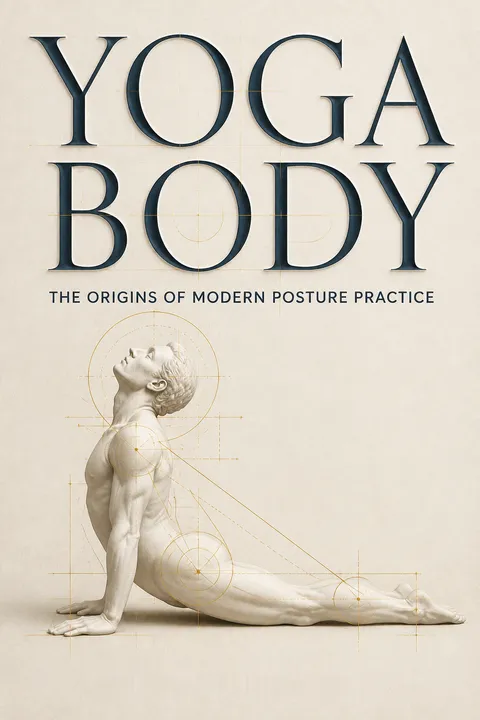
Yoga Body
The modern visible yoga bodyThe book's organizing idea for the body presented in modern posture practice. Through physical culture, medical interpretation, public demonstrations, and photography, the yoga body came to be seen as strong, flexible, healthy, and reproducible. It differs from older subtle-body frameworks, even while modern practice may retain elements from them.
FAQ
What's Yoga Body: The Origins of Modern Posture Practice about?
- Historical Context of Yoga: The book explores the evolution of modern postural yoga, tracing its roots back to early twentieth-century India and its interactions with Western physical culture.
- Cultural Influences: It argues that contemporary yoga does not directly stem from ancient texts like the Yoga Sutras but is a product of various influences, including British calisthenics and Indian nationalism.
- Reinterpretation of Practices: Singleton examines how practices traditionally associated with yoga were redefined and repurposed in the context of modernity, leading to the yoga we recognize today.
Why should I read Yoga Body: The Origins of Modern Posture Practice?
- Scholarly Insight: Mark Singleton provides a well-researched and nuanced account of the historical and cultural factors that shaped modern yoga, making it essential for serious students of the practice.
- Debunking Myths: The book challenges common misconceptions about yoga's origins, offering a fresh perspective that can deepen your understanding of its practice.
- Engaging Narrative: The writing is accessible and engaging, making complex historical and cultural concepts easy to understand.
What are the key takeaways of Yoga Body: The Origins of Modern Posture Practice?
- Yoga as a Modern Construct: The book argues that modern yoga is a product of various historical influences rather than a direct continuation of ancient practices.
- Physical Culture Influence: Singleton emphasizes the significant impact of Western physical culture on the development of modern yoga postures.
- Diverse Practices: The text illustrates that yoga encompasses a wide range of practices and philosophies, challenging the idea of a monolithic tradition.
What are the best quotes from Yoga Body: The Origins of Modern Posture Practice and what do they mean?
- “Yoga as we know it today does not flow directly from the Yoga Sutras or India’s medieval hatha yoga traditions.”: This quote underscores the book's central thesis that modern yoga is a reinterpretation influenced by various cultural and historical factors.
- "Yoga comes to be considered as an Eastern variant of New Thought physical culture.": This encapsulates Singleton's argument that modern yoga has been shaped by Western ideologies and practices.
- “Postural yoga is booming.”: This statement reflects the current popularity of yoga, setting the stage for Singleton's exploration of its origins and transformations.
How does Yoga Body: The Origins of Modern Posture Practice address the relationship between yoga and physical culture?
- Interconnected Development: The book details how modern yoga developed alongside the international physical culture movement, particularly in the late 19th and early 20th centuries.
- Influence of Western Gymnastics: Singleton highlights the impact of Western gymnastics, particularly Scandinavian systems, on the shaping of modern postural yoga practices.
- Cultural Adaptation: The text argues that Indian physical culture adapted and integrated these Western influences, leading to a unique synthesis that characterizes contemporary yoga.
What role did figures like T. Krishnamacharya play in the evolution of modern yoga according to Yoga Body: The Origins of Modern Posture Practice?
- Pioneering Influence: T. Krishnamacharya is portrayed as a key figure in the revival of hatha yoga, blending traditional practices with modern physical culture.
- Mysore Style: The book discusses how Krishnamacharya's teachings laid the groundwork for various popular yoga styles today, including Ashtanga and Iyengar yoga.
- Cultural Context: Singleton emphasizes that Krishnamacharya's work cannot be viewed in isolation but must be understood within the broader context of India's colonial experience and the global physical culture movement.
What misconceptions about yoga does Yoga Body: The Origins of Modern Posture Practice seek to clarify?
- Misunderstanding of Origins: Singleton aims to clarify that modern yoga is not a direct continuation of ancient practices but rather a reimagining influenced by various cultural exchanges.
- Overemphasis on Asanas: The book critiques the modern focus on asanas as the primary aspect of yoga, arguing that this is a recent development that overlooks the philosophical and meditative dimensions of traditional yoga.
- Cultural Appropriation: Singleton addresses the issue of cultural appropriation in the global yoga community, urging readers to consider the historical context of yoga's evolution.
How does Yoga Body: The Origins of Modern Posture Practice explore the commercialization of yoga?
- Yoga as a Business: The book discusses how yoga has transformed into a multimillion-dollar industry, particularly in the West, with various styles and postures being marketed and commodified.
- Impact on Practice: The commercialization of yoga is critiqued for potentially diluting its spiritual and philosophical roots, leading to a focus on physical appearance and fitness over deeper practices.
- Legal Battles: Singleton highlights the legal disputes over the ownership of yoga styles and postures, illustrating the complexities of yoga's commercialization.
What methodologies does Mark Singleton use in Yoga Body: The Origins of Modern Posture Practice?
- Historical Analysis: Singleton employs a historical approach, examining primary sources such as early yoga manuals and travel writings to trace the evolution of yoga.
- Cultural Studies Framework: The book utilizes a cultural studies lens to analyze the interactions between Indian and Western physical cultures, emphasizing the dialogical nature of yoga's development.
- Visual Representation: Singleton incorporates visual elements, such as photographs and illustrations, to enhance the narrative and provide context for the practices discussed.
How does Yoga Body: The Origins of Modern Posture Practice contribute to the academic study of modern yoga?
- Filling a Gap: The book addresses a significant gap in the literature by providing a comprehensive historical account of modern postural yoga's origins and development.
- Interdisciplinary Approach: Singleton's work is interdisciplinary, drawing from history, cultural studies, and religious studies to offer a well-rounded perspective on yoga.
- Encouraging Further Research: By challenging existing narratives and misconceptions, Yoga Body encourages further scholarly inquiry into the complexities of yoga's evolution and its contemporary practice.
What specific methods or practices are discussed in Yoga Body: The Origins of Modern Posture Practice?
- Hatha Yoga Techniques: Singleton discusses various hatha yoga postures and their interpretations in modern contexts, emphasizing how these have evolved from traditional practices.
- Breath Control (Pranayama): The book explores the significance of breath control in yoga, linking it to both physical and spiritual practices.
- Auto-suggestion Techniques: Singleton examines the use of auto-suggestion in early yoga practices, particularly in the context of New Thought movements.
How does Yoga Body: The Origins of Modern Posture Practice define the relationship between yoga and physical culture?
- Interconnectedness of Practices: Singleton argues that yoga and physical culture are deeply intertwined, with modern yoga incorporating elements from various physical fitness regimes.
- Cultural Adaptation: The book illustrates how yoga has been adapted to fit into the framework of Western physical culture, often prioritizing physical fitness over spiritual development.
- Historical Context: Singleton provides a historical overview of how physical culture movements influenced the evolution of yoga, particularly in the early 20th century.
Download PDF
Download EPUB
.epub digital book format is ideal for reading ebooks on phones, tablets, and e-readers.








