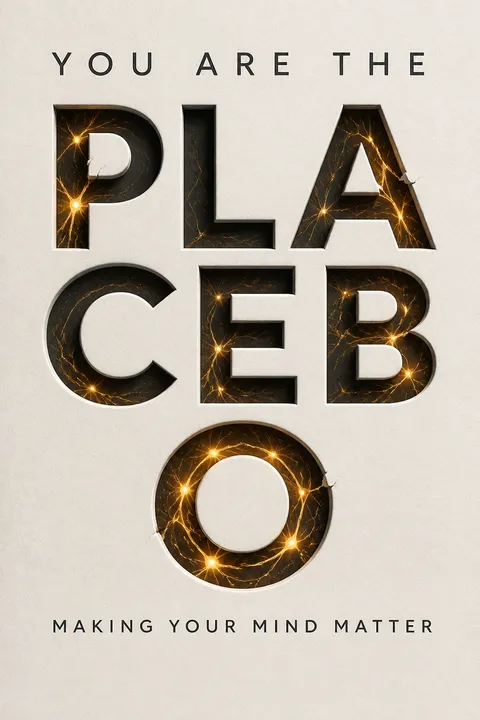


Key Takeaways
A sugar pill can trigger real biology, not merely imagined relief
The book’s central wager. Dispenza uses “you are the placebo” to mean that expectation and belief can help set off real bodily responses, even without an active drug. One study he describes found that 38 percent of participants taking placebo pills in an antidepressant trial improved, compared with 52 percent taking the drug. Brain recordings showed changes among some placebo responders, suggesting their improvement was not simply pretend. The book also opens with Dispenza’s account of recovering from severe spinal fractures after declining surgery and repeatedly imagining his spine healing. He reports walking again within about ten weeks, after visualization, rehabilitation, dietary changes, and other support. That story is vivid, but it cannot establish which factors caused his recovery.
What the claim supports. Placebo responses can affect symptoms and measurable processes such as pain, mood, and movement. They show that treatment context and expectation matter, not that belief can reliably cure serious disease. Dispenza encourages readers to keep using treatments that help and to check results with medical tests.
What's striking is the distinction between an effect being psychologically mediated and being imaginary. Expectation can influence attention, distress, and the brain systems involved in symptoms, which is one reason a patient’s sense of agency belongs in good care. The book’s strongest case is that mind and body interact, not that thought alone explains every recovery. The spinal injury story is best read as a personal account of determination and rehabilitation, rather than a reproducible treatment result. That distinction protects both the promise of patient participation and the credibility of medical evidence.
Expecting harm can make a harmless treatment feel dangerous
The negative mirror. The nocebo effect is a harmful response shaped by the expectation of harm. In one case, a young man swallowed almost 30 pills from a blinded antidepressant trial, believing he had overdosed on medication. He arrived at the hospital with very low blood pressure, a rapid pulse, and other alarming symptoms. When a researcher identified the pills as a placebo, his vital signs quickly returned toward normal. The episode illustrates how fear and expectation can affect the body, though a single case cannot rule out every other influence.
Anticipation matters. The book also describes chemotherapy patients who felt nauseated before treatment began. In one study, 40 percent of those who expected nausea developed it in advance, compared with none of those who did not expect it. Such findings make the way risks are explained important: honest information is essential, but needlessly alarming language may worsen distress.
The nocebo effect makes clinical communication more than a matter of bedside manners. The same information can inform a patient and also prime attention toward side effects, especially when symptoms are already feared. This does not justify hiding risks or pretending that expectations control every outcome. It points instead toward careful, balanced explanations: describe genuine risks clearly while also explaining what can be done about them. The book’s examples make a persuasive case for taking anticipated symptoms seriously, while cautioning against treating a striking anecdote as proof that belief alone caused a medical crisis.
Build new expectations through learning, repetition, and meaningful cues
Three ingredients. Dispenza explains placebo responses through conditioning, expectation, and meaning. Conditioning occurs when a cue becomes associated with a bodily result. After repeated experiences of taking a pain reliever and feeling better, for instance, the pill-taking ritual may itself help prompt relief. Expectation is anticipating a result, such as feeling better after a clinician explains a treatment. Meaning is the significance attached to the treatment or action.
The body learns context. The book traces this idea from Pavlov’s dogs, which learned to respond to a bell associated with food, to studies in which placebos produced responses resembling those of drugs previously given to participants. It also describes hotel workers who changed health measures after learning that their daily tasks counted as exercise. Their work did not change, but what they understood it to mean did. The lesson is to notice which cues and explanations shape a response.
This account connects naturally to learning theory: bodies respond not only to substances, but to cues that predict what comes next. Ritual, trust, prior experience, and a clinician’s confidence can all contribute to treatment context. Meaning can also shift behavior, as the hotel workers’ new understanding may have affected how they experienced their activity. The concept is useful without assuming every placebo effect follows one simple recipe. Different symptoms and treatments involve different mechanisms, and a cue that reduces pain may not change the underlying disease. That makes context a complement to care, not a replacement for it.
Interrupt familiar thought-feeling loops to make room for new responses
A rehearsed identity. The book describes a loop in which repeated thoughts shape choices and behavior, experiences reinforce familiar emotions, and those emotions make the same thoughts more likely. Over time, a reaction that began with one experience can feel like an unchangeable feature of the self. Dispenza argues that new learning can alter neural connections, a capacity known as neuroplasticity. He draws on research showing that practice strengthens some connections, while unused connections can weaken.
Change takes practice. The point is not that a single positive thought rewires a whole personality. Instead, noticing a habitual response and repeatedly choosing a different one can help build new patterns. Someone who associates speaking to a group with panic, for example, can observe the familiar reaction, rehearse a more capable response, and take small real-world steps. The book calls the discomfort of leaving familiar patterns part of change, not evidence that change is impossible.
The loop is a memorable way to connect cognition, emotion, and behavior. It also resembles approaches that make automatic thoughts visible before testing them against experience. Repetition matters because new responses need practice in the settings where old ones were learned. Yet the book’s language can make identity sound more biologically fixed than it is: people change unevenly, and old patterns may return under stress. That is not failure. A more useful measure is whether a person can recognize a familiar reaction sooner and choose a response that better serves their aims.
Rehearse the response you want, then practice it in real life
Mental practice has limits and uses. Mental rehearsal means imagining an action or future situation in detail, repeatedly, to prepare attention and behavior. The book describes a study in which people mentally practiced a piano exercise and developed changes in the brain areas involved in finger movement. In another experiment, participants who only imagined exercising a small finger increased its strength by 35 percent; those who physically trained it improved by 53 percent. These findings support a role for mental practice, while the larger gain from physical training shows that imagination is not identical to action.
Picture choices, not miracles. Dispenza recommends pairing a clear intention with the feeling one hopes to bring to a future situation. A useful rehearsal might involve picturing a calm conversation, noticing the choices that help create it, and imagining how calm feels. The next step is to act on that preparation. Visualization can help someone practice skills and responses, but it cannot guarantee a particular outcome or replace physical rehabilitation.
Mental rehearsal is most convincing when treated as a training tool. Imagining an action can engage some of the same planning and motor systems involved in performing it, giving people a way to prepare before practice or performance. The book’s own comparisons preserve an important boundary: imagined exercise helped, but actual exercise helped more. The same principle applies beyond sport. Visualization can clarify what to do under pressure, but real-world feedback remains necessary. Treating an imagined success as proof that the world must comply would confuse preparation with control.
Reduce chronic stress to give repair and recovery more room
Stress consumes attention and energy. Dispenza argues that the body’s short-term stress response can become costly when it stays active. He describes the response as useful in immediate danger but poorly suited to constant pressure, because prolonged stress can affect sleep, immune function, and other bodily systems. The book cites research linking stress with slower wound healing and describes studies in which meditation practices were associated with changes in gene activity related to stress and immune response.
Genes are responsive, not destiny. Epigenetics is the study of how biological signals can affect gene activity without changing the DNA sequence itself. This helps explain why behavior and environment can influence health, but it does not mean people can choose genes on and off at will. A small retreat study of older men, in which some were asked to act as if they were younger, reported changes in several physical measures. It suggests that expectations and surroundings can matter, but does not establish that aging was reversed.
The practical insight is stronger than the book’s most expansive biological claims: prolonged stress can burden health, while practices that support relaxation may help people cope and recover. Epigenetic research does show that gene activity responds to many signals, including behavior and environment. It does not show that a thought can selectively switch on a desired gene or cure a disease. The distinction matters because stress reduction can be worthwhile even when it does not change a diagnosis. It also avoids blaming sick people for failing to maintain a sufficiently positive state.
Treat a diagnosis as information, not as your entire identity
Beliefs filter experience. Dispenza describes attitudes as repeated combinations of thoughts and feelings, beliefs as more enduring patterns, and perceptions as the wider picture formed by related beliefs. These patterns shape what people notice and expect. The book uses stereotype-threat experiments, in which students performed differently after being primed with beliefs about group ability, to show how expectations can affect performance. It also describes how familiar surroundings can trigger learned responses, even when the original stimulus is absent.
Keep agency without denying facts. The book encourages readers to question assumptions about what a diagnosis means for their future, not to reject medical findings. A diagnosis can guide treatment without defining every part of a person’s life. It can help to identify which surroundings, relationships, and routines repeatedly reinforce fear or helplessness, then change what can be changed. The aim is to widen choices while taking symptoms and medical advice seriously.
This is a valuable distinction between accepting information and surrendering one’s whole identity to it. Expectations can shape performance, and settings can cue learned responses, so changing routines and social contexts may support change. But a diagnosis is not merely a belief, and replacing it with a preferred story cannot remove a biological condition. The strongest version of the advice is therefore both psychologically active and medically grounded: ask what the diagnosis means, seek clarification, follow appropriate care, and preserve roles and goals beyond being a patient.
Use meditation to practice change, and medical tests to judge health
A repeatable practice. Dispenza’s meditation has three broad stages. First, use open focus, a form of attention that notices space around and within the body rather than concentrating on objects. Second, settle attention in the present instead of following worries about the past or future. Third, identify a belief to change, decide what to believe instead, and mentally rehearse how that new outlook would feel and shape behavior. He recommends regular practice, often in the morning or before sleep, in a quiet place where interruptions are unlikely.
Stories are not trials. The book recounts participants with serious conditions who reported striking improvements, including Laurie, whose clinicians later found no fractures on her x-rays. It also reports 402 EEG recordings from two workshops, with 91 percent showing improved brain-function measures. These observations may document changes in brain activity or symptoms, but workshop reports and selected cases cannot show that meditation cured the illnesses. The book advises readers to continue treatments that help and use medical tests as feedback.
The meditation instructions provide a concrete way to practice attention, emotional regulation, and future-oriented planning. Those aims can support well-being even without accepting the book’s quantum explanation, which presents consciousness as selecting physical possibilities but is not established evidence that thoughts collapse reality into cures. The workshop EEG results are measures of brain activity, not proof of disease remission. For health decisions, controlled studies and clinical evaluation carry more weight than testimonials. Meditation can be an adjunct, while medical care remains essential for serious or worsening symptoms.
Analysis
The book’s most durable contribution is its insistence that treatment is not only a molecule or procedure. Expectation, prior learning, ritual, clinician communication, and a patient’s interpretation can shape how symptoms are experienced and, in some cases, measurable physiological responses. The examples of placebo analgesia, anticipatory nausea, and sham surgery make a compelling case for taking these contextual effects seriously. Its practical emphasis on meditation, mental rehearsal, and noticing habitual reactions can also be useful beyond medicine, as tools for attention, emotional regulation, and preparation.
The book is less reliable when it moves from these modest claims to broad promises of spontaneous disease reversal. A change in mood, pain, movement, EEG activity, or a laboratory marker is not automatically a cure for the condition causing symptoms. The workshop stories are selected case reports, and the reported EEG changes do not establish that meditation caused remission. A causal claim would require independent assessment, suitable comparison groups, transparent outcomes, and long-term follow-up. The quantum argument is especially weak: the role of measurement in quantum physics does not demonstrate that human intention can select a desired health outcome. It functions better as a metaphor for possibility than as a biological explanation.
That distinction is ethically important. Encouraging people to participate actively in their care can restore agency, but suggesting that illness reflects insufficient belief risks turning disease into a personal failure. Genetics, infection, injury, toxins, social conditions, and chance all matter. A responsible reading keeps the book’s useful message while rejecting its implication that disciplined thought can reliably override them: context and mindset may influence symptoms and support recovery, but they do not replace diagnosis or evidence-based treatment. The most defensible practice is to use meditation as an adjunct, track objective outcomes, and discuss changes with qualified clinicians.
Review Summary
You Are the Placebo receives mixed reviews. Many praise its exploration of the mind-body connection and placebo effect, finding it inspirational and life-changing. Critics argue it contains pseudoscience, especially regarding quantum physics, and relies heavily on anecdotes. Some appreciate the meditation techniques but warn against the author's claims. Readers debate the scientific validity of the book's assertions, with some finding it empowering and others dismissing it as misleading. Overall, opinions are divided on its merits and potential benefits.
People Also Read



Glossary
Placebo effect
Response shaped by treatment contextA change in symptoms or bodily response associated with receiving a treatment, including an inert one. In the book, expectation, learning, and the meaning attached to a pill, procedure, or clinician help explain why a placebo can produce measurable effects. A placebo response does not by itself show that an underlying disease has been cured.
Nocebo
Expectation-linked harmful responseA harmful symptom or response associated with expecting harm, including when the suspected cause is inactive or harmless. Dispenza uses the term for effects such as nausea before chemotherapy or symptoms after taking placebo pills believed to be active medication. The concept emphasizes expectation and context, while not implying that every symptom is caused by belief.
Associative memory
Learned link between cue and responseA learned connection between a cue or situation and the bodily or emotional response that has repeatedly followed it. For example, a person may associate a treatment ritual with pain relief. The book uses associative memory to explain how a familiar cue can prompt a response even when the original active drug or event is absent.
Mental rehearsal
Repeated imagined practiceThe deliberate imagination of an action, response, or desired future experience, often repeated to prepare attention and behavior. The book describes studies in which imagined piano practice or muscle exercise produced measurable changes, though physical practice generally produced greater effects. Dispenza also recommends pairing rehearsal with the emotions associated with the intended outcome.
Neuroplasticity
The brain's capacity to changeThe brain's ability to alter its connections and patterns of activity through learning, experience, and practice. The book uses neuroplasticity to explain how repeated thoughts and actions may strengthen some neural pathways while others weaken. It supports the possibility of learning new responses, but does not establish that every imagined change will occur.
Epigenetics
Regulation of gene activityThe study of biological processes that affect whether genes are more or less active without changing the underlying DNA sequence. Dispenza presents epigenetics as a route by which environment and behavior can influence the body. The field supports the idea that gene activity is responsive, but not the claim that people can consciously select particular genes or guarantee a cure.
Suggestibility
Openness to accepted suggestionsA person’s readiness to accept an idea or suggestion and respond to it, which the book links to attention, emotion, expectation, and reduced analytical resistance. Dispenza argues that meditation can make people more receptive to new beliefs. Suggestibility varies, and being receptive does not mean that a belief can override all biological limits.
Open focus
Attention to space, not objectsA meditation approach described in the book that shifts attention from specific objects and problems toward the space around and within the body. The aim is to reduce fixation on external cues and habitual thoughts, supporting a calmer, more inwardly focused state. Dispenza presents it as the opening stage of his guided meditation.
Information to Transformation
Teaching followed by practiced changeDispenza’s name for a workshop approach that combines scientific explanations, instruction, meditation, and measurements of participants’ experiences. The intended sequence is to learn an idea, apply it in practice, and use the experience as further information. The book presents workshop brain recordings and participant reports, though these do not independently establish that the practices cured disease.
FAQ
What's You Are the Placebo about?
- Mind-Body Connection: The book explores how thoughts and beliefs can influence physical health, suggesting that mental states can lead to healing or illness.
- Placebo Effect: Dr. Joe Dispenza illustrates how belief in a treatment can lead to real physiological changes, emphasizing that individuals can harness this effect without external interventions.
- Scientific and Practical Approach: It combines scientific research with personal anecdotes and provides practical meditation techniques to help readers change their beliefs and perceptions.
Why should I read You Are the Placebo?
- Empowerment Through Knowledge: The book empowers readers to take control of their health by changing their thoughts and emotions, challenging the notion that health is solely determined by external factors.
- Scientific Evidence and Stories: Dr. Dispenza combines scientific research with personal stories of transformation, making the concepts relatable and credible.
- Practical Techniques: It offers meditation techniques that readers can implement in their daily lives to rewire their brains and change their states of being.
What are the key takeaways of You Are the Placebo?
- Beliefs Shape Reality: Our beliefs and perceptions significantly shape our reality and health outcomes, and changing these beliefs can lead to profound changes.
- Mind Over Matter: Thoughts can create physiological changes in our bodies, and meditation and visualization are tools for transformation.
- Quantum Possibilities: The book suggests that all possibilities exist in the present moment, and by focusing on the unknown, individuals can create new futures.
What is the placebo effect, according to You Are the Placebo?
- Definition: The placebo effect is when a person experiences real changes in their health after receiving a treatment with no therapeutic effect, due to belief in the treatment.
- Mechanisms: It works through conditioning, expectation, and meaning, with the brain releasing neurotransmitters and hormones in response to thoughts and beliefs.
- Mind Over Matter: The mind can significantly impact the body, suggesting that thoughts and emotions can lead to healing or illness.
How does meditation play a role in You Are the Placebo?
- Meditation Techniques: The book provides specific meditation practices designed to help individuals access their subconscious and change limiting beliefs.
- Accessing the Subconscious: Meditation allows individuals to bypass the analytical mind and connect with the subconscious, vital for reprogramming beliefs.
- Creating New Experiences: Through meditation, individuals can create new emotional experiences that signal the body to change, crucial for transformation and healing.
How can I apply the concepts from You Are the Placebo in my life?
- Practice Meditation: Engage in guided meditations to create new neural pathways and visualize desired outcomes.
- Change Your Thoughts: Become aware of habitual thoughts and beliefs, and think greater than how you feel to break free from limiting patterns.
- Embrace Elevated Emotions: Cultivate positive emotions like gratitude and joy to enhance the effectiveness of your intentions.
What role do emotions play in the placebo effect, according to You Are the Placebo?
- Emotions as Chemical Messengers: Emotions trigger the release of neuropeptides that communicate with the body, influencing health.
- Positive vs. Negative Emotions: Positive emotions can enhance the placebo effect, while negative emotions can hinder it.
- Creating New States of Being: By embracing elevated emotions, individuals can signal new genes and create a healthier state of being.
What is mental rehearsal, and how does it relate to the placebo effect in You Are the Placebo?
- Definition of Mental Rehearsal: It involves visualizing a desired outcome repeatedly to create a new reality.
- Neuroplasticity and Change: This practice helps to rewire the brain, creating new neural pathways that support the desired outcome.
- Emotional Connection: Combining mental rehearsal with elevated emotions can amplify the effects, signaling the gene ahead of the environment.
How does the brain change in response to thoughts and beliefs in You Are the Placebo?
- Neuroplasticity Explained: The brain can change its structure and function based on experiences and thoughts.
- Creation of New Neural Pathways: New thoughts lead to new connections, changing behavior and health.
- Gene Expression: Thoughts can influence gene expression, affecting health through the production of proteins.
What is the significance of epigenetics in You Are the Placebo?
- Definition of Epigenetics: It refers to changes in gene expression without altering the DNA sequence.
- Influence of Environment: Environmental factors, including thoughts and emotions, can turn genes on or off.
- Potential for Change: Understanding epigenetics empowers individuals to take control of their health by changing thoughts and behaviors.
What are the best quotes from You Are the Placebo and what do they mean?
- “You are the placebo.” This quote suggests that individuals have the power to heal themselves through their beliefs and thoughts, independent of external treatments.
- “Wherever you place your attention is where you place your energy.” It emphasizes the importance of focus in creating change, suggesting that directing attention toward positive possibilities can lead to transformative outcomes.
- “The moment you change your energy, you change your life.” This highlights the connection between emotional energy and personal transformation, reinforcing that shifting one’s emotional state can lead to significant changes in health and well-being.
How can I change my beliefs and perceptions using the methods in You Are the Placebo?
- Identify Limiting Beliefs: Recognize the beliefs and perceptions you want to change, and reflect on how they affect your life.
- Set Clear Intentions: Make a firm decision to change these beliefs, accompanied by a strong emotional commitment to the new belief.
- Practice Meditation: Engage in guided meditations to reinforce new beliefs, helping to rewire your brain and condition your body to accept them.
About the Author
Other books by Joe Dispenza
Download PDF
Download EPUB
.epub digital book format is ideal for reading ebooks on phones, tablets, and e-readers.








