

Key Takeaways
Explore America as many lived worlds, not one national personality.
The map misleads. After years exploring other countries, Peter Santenello realizes he knows surprisingly little about the country he calls home. America contains deserts, tundra, dense cities, remote islands, and hundreds of distinct communities. The greater New York metropolitan area alone has more people than thirty-five European countries; the book also notes 575 federally recognized Native tribes. A national headline cannot convey how people actually live in places as different as Amish Ohio, East Los Angeles, and Saint Lawrence Island.
Go listen in person. Santenello drives back roads, shares meals, and lets residents explain their own worlds. His point is not that travel makes anyone an expert. It reveals how much remains unknown, and how easily distant neighbors become abstractions when people rely only on headlines.
What's striking is the shift from national identity as a slogan to national identity as lived variety. This resembles a basic principle of ethnography: local practices make sense in context, not when extracted as curiosities. Contact with people outside familiar circles can weaken stereotypes, especially when the encounter involves sustained conversation rather than a quick spectacle. Still, a traveler's welcome is not a representative survey. The book's strongest claim is not that one visitor can speak for a community, but that listening exposes the limits of speaking about a country from a distance.
Choose community's protections only after seeing the rules they require.
Belonging has terms. Holmes County, Ohio, is home to nearly forty thousand Amish people. Amish communities are not uniform: each church district follows its own Ordnung, the local rules governing conduct, technology, clothing, and daily life. Some groups accept conveniences such as electricity or motorized equipment; stricter Swartzentruber communities avoid many of them. Rumspringa, a period when some young people experience the outside world before deciding whether to join the church, does not erase the commitment involved. The book estimates that about 80 percent stay.
Support is tangible. Amish neighbors helped an injured farmer harvest his fields, and shared arrangements can help cover medical costs or rebuild a home. The tradeoff is clear: strong mutual aid grows from shared values, but those values narrow the room for individual experimentation.
The Amish example complicates the modern idea that freedom means maximum individual choice. Social science often distinguishes freedom from interference from the practical capacity to rely on others. A tightly bound community can provide security that an isolated individual must otherwise purchase or do without. Yet solidarity is not costless: it depends on conformity, and the book acknowledges that this life would not suit its restless narrator. The useful question is not whether communal life is better, but which constraints people accept in exchange for which forms of care.
Let people name their identity before outsiders flatten it.
Identity is lived, not filed. In East LA, Ronin calls himself Chicano, an identity shaped by Mexican heritage and American life. It is not a standard census category, and not every Mexican American uses it. Some families have roots on both sides of a border that shifted after the Mexican-American War; others came to the United States later. The label can express a culture made in the meeting of those histories, rather than a simple choice between them.
Craft carries memory. Lowriders, customized cars built to cruise slowly and display skilled design, turn neighborhood history into public art. Their hydraulics grew partly from adapting aircraft components after laws targeted low cars. Ronin, once caught up in drug dealing, moved into film work and acting without abandoning his cultural pride. His path shows that leaving harmful patterns need not mean rejecting home.
What's valuable here is the distinction between identity as inheritance and identity as self-description. Labels can be imposed by institutions, reclaimed by communities, or rejected by individuals; none of those meanings can safely be assumed from appearance. The lowrider also illustrates how cultural expression can work as an archive, preserving family, political, and neighborhood memory in objects people use together. That pride deserves recognition without turning a community into an aesthetic or treating one person's story as a template for everyone who shares a label.
Explain regional hardship through history, not stereotypes about character.
Follow the money and work. In Central Appalachia, coal built towns such as Bluefield and Welch, but mining jobs declined as energy markets changed and technology reduced the need for workers. Earlier, company scrip tied miners to stores and housing owned by employers, while profits often left the region. In the Mississippi Delta, farm machinery replaced much of the labor once performed by tenant farmers and sharecroppers. Towns that depended on those jobs lost residents, businesses, and services.
People bear the consequences. Santenello meets miners proud of dangerous work, families shaped by mine deaths, and Wes, a fifth-generation miner whose injury led to opioid dependence and prison. These accounts connect present-day struggles to labor systems and industrial change, rather than to a caricature of people as lazy or backward.
The chapter's force comes from placing personal testimony beside economic history. That is a useful corrective to explanations that moralize poverty while ignoring who controlled work, land, and investment. It also avoids a simple villain story: coal remained an important livelihood even as its environmental and health costs mounted. The limitation is that individual conversations cannot establish the prevalence of any single cause, whether addiction, joblessness, or outmigration. They can, however, show why policy discussions become shallow when they treat a region's residents as the problem instead of examining the systems that shaped their choices.
Back local capability instead of arriving with rescue fantasies.
Ability already exists. Booker T Beckum grew up picking cotton and left Mississippi without a GED. He became a welder, pursued further education, and spent more than four decades working in industrial plants from Wyoming to Abu Dhabi. After returning home, he considered opening a welding shop to pass his skills to younger people. In Appalachia, Santenello meets teenagers learning diesel mechanics, welding, and practical repair, alongside a young historian pursuing university study.
Help must last. Residents describe shortages of jobs, housing, and reliable opportunity, but the book argues that money alone cannot reverse decline. It points instead to effective education, credible local leadership, self-confidence built through action, and accountability for helpers as well as residents. The goal is not to romanticize self-reliance, but to support people already working to improve their communities.
This emphasis on local capability aligns with community-development approaches that treat residents as partners rather than passive recipients. Skills, trust, and knowledge of local conditions are assets that outside programs can easily overlook. Beckum's career also shows how education and practical craft can reinforce each other rather than compete. The necessary caution is that praising resilience can become a way to excuse neglect: no amount of grit can substitute for adequate housing, healthcare, or viable employment. Respect for local agency should strengthen public investment, not serve as an argument against it.
Keep traditions alive by allowing them to change.
Culture is not frozen. The Siberian Yupik people of Saint Lawrence Island maintain a spring bowhead whale hunt that feeds and involves the community. Their island ties extend across the Bering Sea to relatives in Russia, even as national borders and politics complicate contact. Reindeer, now part of local hunting life, were introduced about a century ago as a food source after famine. Their relatively recent arrival does not make the practice meaningless.
Language also shifts. In Cajun Louisiana, generations of children once spoke French at home, while schools punished its use. French immersion programs now support a revival, yet many grandchildren understand more than they speak. Traditions endure through use, adaptation, and renewed teaching, not merely by repeating an unchanged past.
The examples challenge the notion that cultural authenticity depends on uninterrupted continuity. Anthropologists often describe tradition as something communities continually interpret and remake. A new practice can become meaningful through shared labor and memory, while an old language can weaken despite its symbolic importance. That perspective avoids treating cultural change as either contamination or automatic progress. It also raises a practical question: who gets to decide which changes serve a community? The answer belongs primarily to the people who live with the tradition, not to outsiders seeking a more picturesque version of it.
Build social safety nets from relationships, not just programs.
Care is infrastructure. In Amish country, neighbors harvested a farmer's fields after an accident, while shared funds and work parties help families manage medical bills or rebuild after a fire. On Saint Lawrence Island, residents described checking on elders when severe weather threatens power, water, or phone service. In Cajun communities, relatives gather for meals and take in neighbors during storms. These are not simply warm gestures; they are practical systems for sharing risk and labor.
Trust takes repetition. The support depends on people knowing one another, seeing needs, and expecting to help. It can be especially vital where outside services are distant or unreliable. But closeness is not a substitute for public services, and tight networks can leave newcomers or people who do not fit local expectations with less support.
The book makes an important distinction between community feeling and community capacity. Social capital, the trust and reciprocal ties that help people coordinate, can mobilize labor faster than formal systems in a crisis. It cannot replace clinics, reliable utilities, or fair public funding. Nor is every close-knit group equally welcoming. The strongest model is not a choice between neighbors and institutions, but a combination: local relationships identify needs and sustain daily care, while public infrastructure protects people when informal networks are stretched too thin.
Rebuild patiently from what survives an economic collapse.
A lost industry is not a whole identity. Humboldt County has endured the decline of old-growth logging, shrinking fishing fleets, and a cannabis boom followed by a steep downturn. Communities have tried to build new livelihoods through forest restoration, environmental work, local agriculture, tourism, and craft businesses. The shift remains difficult; the county is not presented as a finished recovery story.
Reinvention can be slow. Brett, a farmer and musician, was imprisoned for a cannabis offense before legalization transformed the same crop into a legal industry. Neighbors protected his equipment and supported his wife while he was away. After prison, he rebuilt a life and farm. Ancient redwoods, some surviving fires while hollowed inside, offer a fitting image: endurance can create room for new growth, but it does not erase damage.
The redwood metaphor is persuasive because it links ecological persistence with human rebuilding without pretending either happens quickly. Economic diversification also matters: a community less dependent on one employer or crop may be less vulnerable to the next downturn. Still, resilience language can make recovery sound more inevitable than it is. New industries may not replace lost wages or benefit the same residents. The book is most grounded when it describes adaptation as ongoing work, supported by relationships and local knowledge, rather than as a triumph already achieved.
Meet irreversible change with practical care, not denial.
Smith Island is changing physically. Jerry Smith's family has lived there for generations, and he works as a waterman, a local term for someone whose livelihood comes from the bay. The island is losing land to erosion and rising water. During storms, water can enter Jerry's house; he pulls on boots and waits for the tide to retreat. His matter-of-fact response is not proof that the threat is small. It is a way of living with conditions he cannot control.
Attention stays local. Residents preserve family stories, work the water, and adapt their homes to flooding. Jerry's perspective suggests that accepting uncertainty can make room for gratitude and practical action, rather than endless resentment. The community's future remains precarious, and personal resilience cannot hold back the sea.
Jerry's composure offers a useful distinction between acceptance and passivity. In environmental psychology, perceived control can be limited even when meaningful action remains possible: people can prepare, care for neighbors, and protect what matters without imagining they command the larger force. The book gives this stance dignity, not as a universal answer but as a local way of living. It also leaves an ethical tension visible. Adaptation should not romanticize exposure to flooding or excuse institutions from helping communities facing risks they did little to create.
Protect local livelihoods without treating wealth as the only future.
The Hamptons contains competing economies. Alongside second homes and luxury shops are commercial fishermen, surf instructors, small businesses, and families rooted there for generations. Jimmy, a fisherman and surfboard repairer, accepts the arrival of wealthy visitors more easily than some younger locals, who worry that housing prices will push them out. They also object to development that damages ponds, beaches, and wildlife.
Protection has tradeoffs. Environmental rules help preserve the landscape that draws residents and visitors, but fishing restrictions have also cut into local livelihoods. Jimmy recalls regulations ending haul seining, a method of dragging nets from shore, and reducing income for working families. The challenge is not simply to oppose change or welcome it, but to ask who gets to stay, work, and shape the place.
This chapter resists the easy claim that wealth automatically ruins a place or that regulation automatically saves it. A beautiful landscape can be both ecological habitat and economic asset, while rules designed to protect it distribute costs unevenly. The younger residents' concerns make clear that cultural continuity requires more than preserving scenery; people need a viable way to live there. A fair planning process must weigh ecological limits alongside housing and working access, instead of assuming that affluent ownership is the natural endpoint of local change.
Use small adventures to expand the life you can imagine.
The first journey changed the map. At eighteen, Santenello and his friend Steve left Vermont in a stripped-down van with roughly $3,500 each and no detailed itinerary. They slept in parking lots, cooked cheap meals, and crossed the country for months. Breakdowns and a shrinking budget repeatedly threatened the trip, but conversations with strangers and unexpected landscapes kept opening new possibilities. In Seattle, Steve's knowledge of car mechanics bridged the gap between two scruffy travelers and a luxury-car crowd.
Adventure need not be grand. The book's closing invitation is to explore a town, neighborhood, or road that routine has made invisible. Curiosity, attention, and a willingness to talk can make ordinary places feel newly legible. The point is not to copy reckless teenage choices, but to let experience challenge assumptions about where life can lead.
The road trip functions as an education in attention: a place becomes memorable when its details matter to the traveler. Experiential learning can build confidence precisely because it asks people to navigate uncertainty rather than merely consume information about it. The story also benefits from a caveat: youth, health, and a forgiving safety net made this journey possible, and its risks should not be mistaken for a universal prescription. The transferable practice is smaller and safer: step outside routine, stay curious, and allow unfamiliar encounters to revise expectations.
Analysis
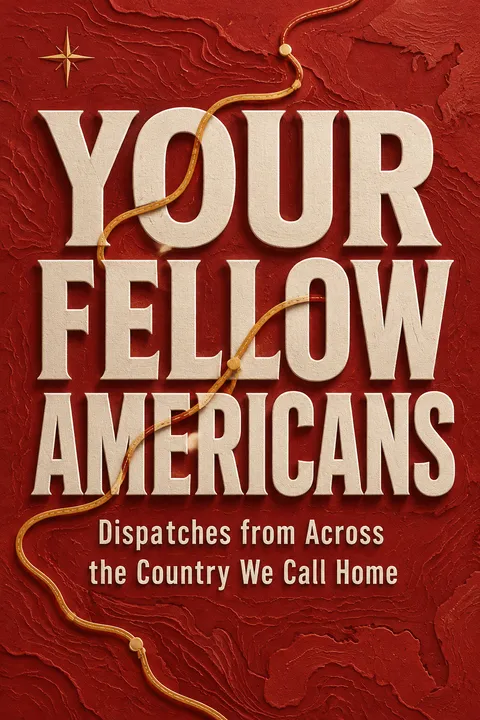
Your Fellow Americans is travel memoir, reportage, and civic argument arranged as a journey. Its four sections move from communities living beside modernity, through economically battered regions, toward places shaped by long adaptation and individual exploration. The recurring method is intimate access: a meal, a ride, a workday, or an unplanned conversation becomes a way into larger histories. The book's central argument is that America cannot be understood as one culture or reduced to the most visible national conflicts. Its most compelling evidence is not a statistic but a scene: an Amish farmer explaining mutual aid from a hayfield, a Chicano artist describing inherited identity, or a Smith Island waterman accepting floodwater in his home.
The narrative's strength is its willingness to let contradiction remain. Amish communal security requires conformity; the Hamptons' environmental protections can constrain local fishing; rural self-reliance exists alongside dependence on public services and supply chains. The people are not presented as flawless symbols. Santenello sometimes acknowledges the limits of his view, including his preference for finding the good and his lack of access to hidden problems. That honesty matters because the book's generosity could otherwise slide into romanticizing poverty, traditional life, or resilience.
The same limitation applies to its method. A visitor's conversations reveal texture and possibility, not a representative account of a whole region. Anecdotes about work, addiction, or community values should not be mistaken for prevalence data, and residents' interpretations do not settle contested histories. Still, the method has civic value: it makes distant lives harder to dismiss and encourages readers to notice the blind spots created by routine, geography, and media framing.
The book's most useful lesson is therefore methodological as much as patriotic. Curiosity does not solve regional decline or erase political disagreement. It can improve the questions asked, expose dependencies between places, and make respect possible before policy consensus. America appears here not as a settled national character, but as a continuing negotiation among local histories, livelihoods, freedoms, and limits.
Review Summary
Your Fellow Americans receives overwhelmingly positive reviews, averaging 4.24 out of 5. Fans of Peter Santenello's YouTube channel praise the book as an authentic, hopeful companion to his videos, highlighting his unbiased, curiosity-driven approach to underrepresented American communities. Readers appreciate vivid storytelling, behind-the-scenes insights, and the final chapter about his origins. Common criticisms include the book feeling too short, occasionally surface-level on difficult topics, and some audiobook editing issues. Overall, most readers find it uplifting, thought-provoking, and a meaningful reminder of America's diverse humanity.
Glossary
Pennsylvania Dutch
Amish community languageA German-derived language spoken by many Amish families in the United States. Despite the name, it is not Dutch from the Netherlands; Dutch reflects an older English rendering of Deutsch, meaning German. The book describes it as German spoken with an American accent, and notes that English is also used, including in Amish schools.
Ordnung
Local Amish rulesThe unwritten rules that guide conduct within an Amish church community. They can cover technology, clothing, work, and everyday behavior. There is no single Ordnung for every Amish person: bishops and church districts interpret rules differently, so one community may permit tools or conveniences that another rejects.
Rumspringa
Period before church commitmentA period during which some Amish young people experience aspects of the outside world before deciding whether to commit to the Amish church for life. Practices vary across communities, and the term does not mean that every young person follows the same path. The book notes that most Amish youth ultimately remain in the church.
Chicano
Self-chosen Mexican American identityA cultural and political identity associated especially with Mexican American communities in the American Southwest and East LA. The book describes it as a self-chosen term shaped by Mexican heritage and life in the United States, not a category on the census. Some Mexican Americans identify as Chicano; many do not.
Lowrider
Customized cruising carA customized automobile associated with Chicano culture, designed for slow cruising and often featuring detailed paint, polished chrome, and hydraulic suspension. Lowriders grew from local craft and postwar car culture. Their visual designs can express family history, faith, neighborhood pride, and cultural identity.
Siberian Yupik
Indigenous Arctic peopleAn Indigenous people whose communities live in western Alaska and far eastern Siberia. The book focuses on Siberian Yupik residents of Saint Lawrence Island, whose lives are closely connected to the Arctic coast, community hunting, and cultural ties across the Bering Sea. Their experiences should not be treated as interchangeable with those of other Native peoples.
waterman
Bay-based working fisherA local term used on Smith Island for people who earn their living from the Chesapeake Bay, including crabbers and other working fishers. The word signals a way of life organized around the water, its seasons, and its catch, rather than simply naming a job.
haul seining
Shore-based net fishingA fishing method described in the Hamptons chapter in which a large net is set in the water and hauled back toward shore, historically with horses and wagons and later with vehicles. Restrictions on this method reduced income for some local fishers, illustrating the tension between environmental rules and established livelihoods.
Download PDF
Download EPUB
.epub digital book format is ideal for reading ebooks on phones, tablets, and e-readers.








