

Key Takeaways
Treat recovery as healing for every wound, not only addiction.
Recovery reaches beyond substances. Celebrate Recovery addresses hurts, hang-ups, and habits: painful experiences, recurring personal difficulties, and destructive patterns. John and Cheryl Baker’s marriage was nearing collapse as John’s drinking worsened. He entered recovery, but the couple could not find a church group where they felt safe discussing their struggles. Their private need became the starting point for a Christ-centered recovery ministry.
A small beginning grew. The first meeting, held in 1991 in a psychiatric hospital, drew 43 people. The program later added groups for concerns including anger, gambling, eating problems, abuse, and relationship struggles. Baker reports that only about one-third of participants dealt with substance abuse. The central idea is that recovery belongs to anyone whose pain or behavior is damaging life and relationships.
The origin story gives the program a useful design principle: build support around shared patterns of struggle, not only around a single diagnosis. That wider lens can help people recognize problems before they fit a narrow label. The story also illustrates how a service can emerge from an unmet need inside a community. Its growth and testimonials are compelling evidence of reach, but they do not independently establish outcomes for every participant or every kind of problem.
Stop negotiating with denial; name what you cannot control.
Denial blocks the starting line. In this program, denial means refusing to acknowledge the reality or impact of a problem. John’s drinking escalated while he insisted it was ordinary, manageable, and unrelated to his family’s distress. Cheryl had heard similar explanations in childhood, yet could not initially face what they meant in her marriage. Their story shows how a problem can be visible to others while remaining hidden from the person living it.
Powerlessness is specific. The first recovery principle asks people to admit that they cannot reliably control their destructive behavior through willpower alone. It does not mean surrendering responsibility for every choice. It means stopping the exhausting attempt to manage what has already become unmanageable, and facing the consequences honestly. The program treats this admission not as defeat, but as the first opening for change.
Naming a loss of control can interrupt the cycle of minimizing, hiding, and trying the same failed solution again. It also separates accepting limits from abandoning agency: a person may be unable to control an entrenched pattern alone while still choosing to seek help and alter daily conditions. The distinction matters because blanket powerlessness can sound fatalistic. The program’s useful claim is narrower: honest recognition can redirect effort toward support and actions that remain possible.
Let hope become dependence on Christ, not another self-rescue plan.
Hope follows honest limits. The next principles ask participants to believe that God exists, that they matter to God, and that divine help can support recovery. Baker connects this hope specifically to Jesus Christ, whom the program identifies as its Higher Power. The sequence then moves from belief to a decision to place one’s life and will in Christ’s care. The book describes surrender as an initial commitment accompanied by repeated daily choices.
Belief can begin small. The program does not demand that newcomers arrive with settled faith. It says people may attend without being Christian, while asking them to remain open to its explicitly Christian approach. Baker presents faith as a beginning point rather than a reward for having solved every doubt. In this framework, hope means that change need not depend on personal willpower alone.
The sequence pairs spiritual meaning with an alternative source of agency: instead of treating recovery as a solitary contest of will, it places change within a relationship and a community of belief. That can offer coherence to people who share the tradition. The welcome to non-Christian attendees also lowers the threshold for seeking support. At the same time, the program’s account of lasting recovery depends on a distinctly Christian conviction, so it should not be mistaken for a religiously neutral model.
Tell the truth about your past with a trusted witness.
Inventory means honest examination. The program’s moral inventory is a structured review of significant experiences, relationships, motives, harms, and strengths. It is not meant to catalogue only failures. Participants consider areas such as family, priorities, integrity, health, and relationships, including ways they were hurt and ways they hurt others.
Disclosure breaks isolation. Baker describes confession to God, oneself, and a trusted person as the next part of this work. Marnie, whose childhood abuse was entangled with later destructive behavior, first disclosed a secret at a Celebrate Recovery meeting. Being heard without judgment helped her connect earlier pain with present choices. The program recommends a same-gender sponsor or accountability partner to help participants stay grounded and supported while they work through difficult material.
The combination of private reflection and carefully chosen disclosure makes a hidden pattern observable to another person, which can weaken shame’s grip. Including positive experiences also guards against turning an inventory into a verdict that a whole life is bad. Yet disclosure is not automatically healing. Trust, consent, pacing, and confidentiality matter, especially when memories involve trauma. A group’s supportive culture is valuable, but it does not replace specialized care when a person needs it.
Prepare for change without demanding instant perfection.
Readiness comes before control. After examining and admitting harmful patterns, participants are asked to become willing to change them and to seek God’s help. The program recognizes that some habits and character patterns have become deeply established over years. The task is not to dictate exactly how or when change must happen, but to become ready to participate in it.
Progress is not perfection. A testimony from John, a counselor who struggled with codependency, describes using constant work and helping others to feel valuable and indispensable. He eventually saw that his busy service could also be a way to avoid his own issues. Working through his own inventory and accepting help changed the focus from being everyone else’s rescuer to examining his own life. The program encourages steady growth rather than an instant transformation.
Readiness is a practical bridge between insight and behavior: recognizing a pattern does not mean it can be switched off on command. The counselor’s story is especially useful because socially praised behavior, such as tireless helping, can conceal avoidance or a need for control. A caution is warranted around the language of character defects, which may intensify shame if applied carelessly to trauma responses. Change is more sustainable when accountability is paired with compassion and appropriate support.
Repair your harm, forgive carefully, and keep necessary boundaries.
Repair focuses on the future. The program asks participants to list people they have harmed, become willing to make amends, and act directly when doing so is appropriate. It also asks them to work toward forgiving people who hurt them, and to accept the possibility of forgiving themselves. Baker distinguishes these forms of forgiveness rather than treating them as one event.
Amends have a safety limit. The program explicitly cautions against making contact when it could harm the other person or someone else. Cheryl’s story makes a related distinction: she describes forgiving her abusive parents while maintaining that they were not safe people to have in her life or her children’s lives. In this view, forgiveness does not require restoring access, pretending the harm did not happen, or taking responsibility for another person’s behavior.
This distinction is essential: moral repair concerns responsibility for one’s own actions, while forgiveness concerns how a person relates to injury received. Neither requires denying consequences. The safety exception prevents amends from becoming a demand that victims reopen contact for someone else’s relief. It also makes clear that reconciliation depends on more than one person’s willingness. A recovery practice is strongest when it supports both accountability and boundaries, rather than treating peace as compulsory closeness.
Turn recovery into a daily practice, not a graduation certificate.
Maintenance means continued attention. The later principles ask participants to keep examining their choices, admit mistakes promptly, and build a regular practice of prayer, Bible reading, and reflection. Baker suggests three kinds of inventory: noticing problems as they arise, reviewing the day, and taking a broader review about every 90 days. A journal can help identify recurring reactions as well as choices that went well.
Growth needs repetition. The program treats these practices as ongoing rather than as a final test that proves someone is cured. John’s account of gambling describes stopping for a time through meeting accountability, then returning to gambling after he felt cured and stopped attending. His story illustrates why recovery is framed as one day at a time, with relationships and spiritual practices reinforcing what a person is learning.
The daily review turns a broad aspiration into a feedback loop: notice behavior, identify a recurring trigger or response, and choose a more constructive next action. Recording successes as well as mistakes can prevent self-examination from becoming a prosecution. The emphasis on continued practice also resists the misleading idea that a period of improvement guarantees permanent immunity. Still, journaling and prayer are supports, not universal treatments; needs differ, and some people require additional clinical or practical help.
Choose accountable community, with clear rules that make honesty safer.
The meeting has several layers. A typical night begins with a large gathering for worship, teaching, or a recovery testimony. Participants then join a gender-specific open share group, where they may speak or pass. Newcomers attend an orientation to learn how the program works and ask questions. A step study, held separately, uses participant guides for deeper work and usually takes about nine to twelve months. Baker recommends attending the regular meetings for several months before beginning one.
Safety is designed, not assumed. Group guidelines limit cross-talk, advice-giving, graphic descriptions, and breaches of confidentiality. Leaders are people with recovery experience, not necessarily trained counselors. Sponsors offer guidance, while accountability partners provide peer support. The program is not therapy, and its structure depends on participants respecting boundaries as well as showing up.
The separate settings solve different problems: orientation reduces uncertainty, open sharing builds connection, and step studies provide a slower structure for reflection. Clear rules protect participants from being interrupted, judged, or recruited into rescuing others. These safeguards are particularly important because disclosure can create vulnerability. The distinction between peer support and professional treatment should remain clear. A community can be a powerful part of recovery without being equipped to manage every mental-health crisis or complex clinical need.
Let received healing become useful service, not a new savior role.
Service is the final movement. The program’s last principle asks people to share what has helped them and to practice recovery values in ordinary life. Baker describes this as giving back without needing anything in return, while warning against unhealthy, codependent helping. Participants may support newcomers, sponsor others, or serve elsewhere in their church.
Pain can become connection. Mac’s story traces a path from drug addiction and family damage toward recovery and service. A young daughter’s question about why he no longer attended church helped him recognize the harm his behavior caused. After entering treatment and support meetings, he and Mary eventually helped lead recovery work. Their story gives the program’s service ethic a human shape: experience can help someone recognize another person’s struggle, but the helper must still protect personal recovery and limits.
Service can transform a private history into social usefulness, giving recovery a purpose beyond self-monitoring. Peer support also carries a distinctive credibility: someone who has lived through a struggle may notice forms of shame or avoidance that outsiders miss. The caution against rescuing is crucial, since helping can become another route to control, overwork, or self-neglect. Healthy service offers companionship and direction while leaving another person responsible for their own choices.
Analysis
Celebrate Recovery’s central contribution is not simply a Christian version of a familiar recovery sequence. It is an attempt to place several kinds of change inside one church community: admitting loss of control, building hope, examining behavior, speaking honestly, repairing harm, maintaining daily practices, and turning experience toward service. Its order matters. It asks a person to acknowledge limits before expecting change, and to take responsibility without claiming control over other people or outcomes.
The book’s stories supply the emotional logic of this model. John’s drinking strains a marriage; Cheryl’s silence shows how shame spreads beyond the person with the visible addiction; Marnie’s account links early abuse with later destructive behavior; and Mac’s recovery becomes a source of help to others. Together, these accounts insist that suffering is not confined to a single individual. Families and communities are affected, and they can also become sources of support. The program’s wide definition of recovery makes room for struggles that may be ignored when help is reserved for substance use alone.
The same strengths create obligations. A safe group is not safe merely because its rules say so. Confidentiality, skilled facilitation, careful handling of trauma, and clear referral pathways matter. The book acknowledges that leaders are not necessarily clinicians and that Celebrate Recovery is not therapy. That boundary should be taken seriously rather than treated as a minor disclaimer. Spiritual practice and peer connection may be deeply meaningful, but they do not make every form of care unnecessary.
The book’s evidence is primarily testimonial and institutional: personal accounts, participation figures, and the program’s spread through churches. These demonstrate reach and perceived value, not a guarantee that every participant will heal or that every method suits every person. Read most usefully, the book is an invitation into a structured, explicitly Christian community, alongside a practical sequence for honesty, accountability, repair, and continued growth.
Review Summary
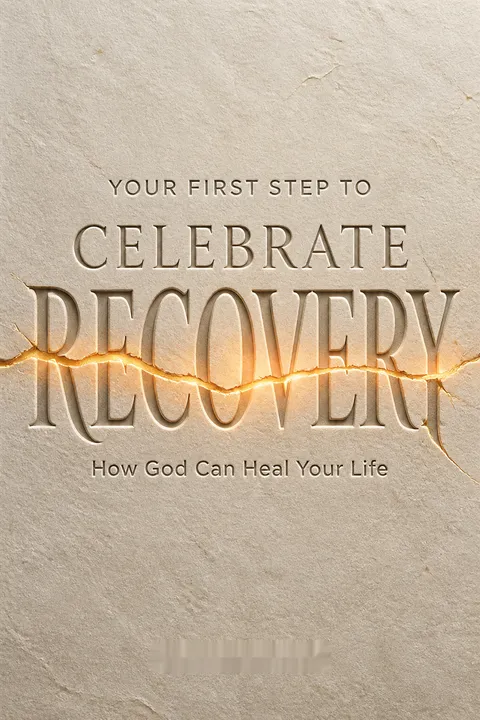
Your First Step to Celebrate Recovery receives mostly positive reviews, with an average rating of 4.35/5. Readers find it informative, inspirational, and helpful for those new to recovery. Many appreciate the testimonies and clear explanation of the program. Some praise it as a valuable leadership tool. However, a few critics argue it lacks biblical depth or specifics on program implementation. Overall, reviewers recommend it for those interested in or starting Celebrate Recovery, highlighting its potential for life change and spiritual growth.
Glossary
Celebrate Recovery
Christ-centered recovery ministryA church-based recovery program developed by John Baker at Saddleback Church. It uses biblical teaching, small groups, guided step studies, and peer support to address a broad range of hurts, hang-ups, and habits, rather than focusing only on drugs or alcohol. Its approach is explicitly centered on Jesus Christ, although the book says non-Christian participants are welcome.
Eight Recovery Principles
Biblical recovery sequenceA set of eight principles that Baker connects to the Beatitudes in Matthew 5 and to the 12 Steps. The sequence moves from recognizing the limits of personal control and seeking help from God, through self-examination, confession, change, forgiveness, and continued spiritual practice, toward serving others. It is the program’s broad framework for recovery and growth.
Christ-centered 12 Steps
Jesus-centered adapted stepsCelebrate Recovery’s adaptation of the 12 Steps associated with Alcoholics Anonymous. The steps retain a sequence of admitting powerlessness, seeking help, examining and confessing wrongs, making amends, maintaining change, and helping others. The program identifies the Higher Power as Jesus Christ and pairs each step with a biblical passage.
moral inventory
Structured personal examinationA written review of significant experiences, relationships, resentments, fears, actions, and harms. In Celebrate Recovery, the inventory considers both positive and negative parts of a person’s life, including the person’s own contribution to problems and the ways others caused harm. It is shared with God, oneself, and a trusted person as part of honest self-examination.
Step Study
Guided recovery workbook groupA small group that works through Celebrate Recovery’s participant guides and discusses questions connected to the recovery principles and steps. It offers a more sustained and accountable form of reflection than the weekly open share group. The book says groups usually meet weekly for roughly nine to twelve months and close to new participants after work on the third principle.
Open Share Small Group
Structured peer-sharing groupA meeting that follows the large group gathering and gives participants a place to share struggles and progress. Groups are gender-specific and may be organized around particular recovery concerns. Members may pass rather than speak. Guidelines limit cross-talk, fixing others, graphic descriptions, and sharing identifying information outside the group.
codependency
Prioritizing another’s welfareIn the book’s explanation, codependency involves repeatedly placing another person’s happiness or situation above one’s own, often by making excuses for that person or shielding them from consequences. Celebrate Recovery presents boundaries as a way to care for others without taking control of their choices or neglecting one’s own recovery.
Download PDF
Download EPUB
.epub digital book format is ideal for reading ebooks on phones, tablets, and e-readers.








