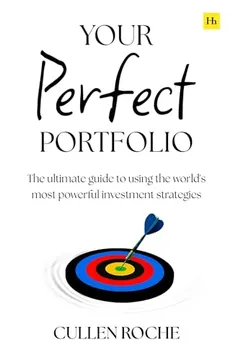


Key Takeaways
Build the portfolio you can hold, not the one that wins a spreadsheet
The right fit is personal. Roche opens with a spectacular beginner’s mistake: in a classroom simulation, he turned $100,000 into $100 by day trading leveraged futures he barely understood. Later, a stock he thought was a bargain kept falling. The losses taught him that a strategy can look brilliant on paper and still be wrong for its owner. His search for a perfect portfolio ends with a more useful idea: there is no single ideal allocation for everyone. Like diets, strategies work only if people can follow them through uncomfortable periods.
Fit can change over time. Income, spending, family responsibilities, and retirement all alter what a portfolio needs to do. The task is not to imitate a famous investor, but to understand a range of approaches and choose one that fits both financial goals and temperament.
The book’s opening failures make its central claim credible: investment choice is partly a problem of self-knowledge. In behavioral economics, a plan is useful only if actual behavior remains close enough to the plan for its assumptions to matter. That makes emotional tolerability a design constraint, not a soft preference. Still, comfort alone cannot establish that a portfolio is financially adequate. A reassuring allocation may fail to keep pace with inflation or fund future spending. Fit therefore means a workable balance between psychological endurance and a realistic plan, not simply choosing whatever feels safe today.
Treat your portfolio as saved wages, not a shortcut to wealth
Savings are not the whole economy. Roche distinguishes economic investment, spending that builds future productive capacity, from buying stocks or bonds on secondary markets, which generally transfers ownership between savers. Most people invest directly in their skills, work to earn income, spend some of it, and allocate what remains to financial assets. He calls this wider picture the Total Portfolio.
Protect the engine of wealth. A person’s skills, job, business, property, and financial holdings all shape their economic life, but they play different roles. This book focuses on the savings portfolio: liquid assets intended to help meet future expenses. It is not a get-rich-quick machine. Saving regularly and building earning capacity may matter more than trying to extract spectacular returns from a portfolio.
This distinction shifts attention from market performance to the household balance sheet. Personal finance often treats a stock account as though it were the entire economic life of its owner, when future wages, debt, housing, and dependents also shape financial capacity. The framework is especially useful for seeing why two people with identical holdings can face very different risks. Its limitation is that human capital is not as bond-like as a dependable coupon: jobs can disappear, earnings can fluctuate, and skills can lose value. The broader view improves planning, but each component still needs its own uncertainty assessed.
Design against panic before markets give fear a microphone
Behavior is part of the portfolio. When account values fall, the urge to escape can feel like an immediate threat response. Selling may reduce anxiety today, but abandoning an allocation during a downturn can lock in losses and undermine long-term plans. Roche compares investing with amateur tennis: success often comes less from brilliant shots than from avoiding unforced errors.
Make the plan survivable. A portfolio with a stable cash or bond component may be valuable even if it does not maximize returns. That component can help an investor resist selling volatile assets at the worst time. Roche also warns that frightening financial stories and political narratives can exploit fear. His practical advice is to identify likely weak points in advance and choose a structure robust enough to withstand periods of stress.
This is a strong application of behavioral design: rather than demanding heroic self-control during a crisis, build conditions that make a destructive response less likely. The same logic appears in safety engineering, where systems are designed to tolerate foreseeable human error. Yet stability can become its own trap if a protective allocation grows so large that it cannot support long-run spending. A useful test is whether a defensive asset has a defined job, such as near-term liquidity or psychological ballast, and whether its cost is acceptable for that job.
Stop paying for market-beating promises the arithmetic rarely delivers
Costs compound against investors. According to the SPIVA data cited in the book, 94% of US domestic active funds underperformed their benchmarks over periods longer than 20 years. The arithmetic is simple: before costs, the average actively managed dollar earns the market return; after costs, the average active dollar earns less than the average passive dollar.
Small fees become large claims. Roche compares a $100,000 stock investment held for 30 years. At a 1% annual fee, it grows to about $1.63 million; at 0.5%, about $1.90 million. The half-point difference amounts to roughly $265,000 in the example. This does not mean paid advice is never worthwhile. It means investors should ask what a fee buys and whether its benefits plausibly exceed its drag.
The fee example makes compounding visible in a way that annual percentages often do not. It also clarifies why a manager’s skill must overcome a persistent hurdle, not merely look persuasive in a good year. The comparison has limits: advisory fees may pay for planning, tax work, or behavioral support, not just security selection, and the value of those services varies. The relevant question is therefore not whether a fee is high in isolation, but whether the complete service improves the investor’s likely outcome enough to justify its cost.
Diversify across independent risks, then stop before complexity becomes diworsification
Different return paths can smooth a ride. Diversification works when assets with positive long-term prospects do not move in lockstep. In Roche’s simplified illustration, two assets each return 6% over a year but rise and fall at different times. Holding both can produce a smoother path without giving up the illustrated return. The principle matters because individual stocks are difficult to select: the research cited in the book found that 66% of Russell 3000 stocks underperformed the index, and 40% suffered declines greater than 70%.
More holdings are not always better. Diversification can span companies, asset classes, countries, and time horizons. But piling on funds can disguise a simple portfolio, make it hard to understand, and add fees or tax costs. The goal is useful variety, not maximum product count.
Diversification is valuable because it reduces dependence on any single outcome, a logic also central to reliability engineering and risk pooling. The uncomfortable corollary is that a diversified investor will almost always own something that looks foolish in the moment. That is not necessarily evidence of failure; it may be the price of not betting everything on one forecast. Correlations also change, however, so a portfolio that once diversified effectively may not do so in every shock. A sound design combines broad exposure with periodic scrutiny of what each holding actually contributes.
Measure success in purchasing power and spending certainty, not headline returns
Nominal growth can mislead. The useful return is what remains after inflation, taxes, and fees. If an asset earns only enough to match inflation, it preserves nominal dollars but does not increase purchasing power. Cash and Treasury bills can offer strong short-term principal stability, while stocks are much less predictable in the short run but have historically protected purchasing power better over long periods.
Risk is a life outcome. Roche frames financial risk as uncertainty about having enough money when expenses arrive. In his historical US stock data, the probability of a positive return rises with the holding period, reaching 99.94% over 20 years. That is not a promise. A retiree withdrawing during an early downturn can suffer sequence-of-returns risk: losses plus withdrawals can permanently weaken the portfolio even if later returns recover.
The shift from volatility to future consumption makes risk concrete. A falling account matters not as an abstract statistic, but because it may collide with a tuition bill, housing cost, or retirement withdrawal. This resembles liability-aware planning in pensions, where assets are judged partly by their ability to meet dated obligations. Historical holding-period probabilities can help frame expectations, but they do not guarantee any individual outcome. The most important distinction is between money that must be available soon and money that can tolerate a long, uncertain path.
Choose a plain core before buying anyone’s clever portfolio
Simple allocations can do serious work. The book contrasts several useful starting points. A 60/40 portfolio blends stocks and bonds, returning 5.00% annually in real terms with 9.95% volatility in the cited 1962-2025 US data. A three-fund approach uses domestic stocks, international stocks, and bonds. The Global Financial Asset Portfolio instead weights global stocks and bonds by their total outstanding market values, which the book estimates at 45% stocks and 55% bonds in 2025.
Famous investors are hard to copy. A simple 90/10 stock and Treasury bill allocation resembles one public version of Buffett’s advice, but not Berkshire’s full system of insurance cash flows, tax efficiency, and disciplined capital allocation. These examples are starting points, not universal answers. Choose by time horizon, spending needs, and tolerance for losses.
The menu of cores helps separate portfolio design from investment folklore. A familiar name does not make an allocation appropriate, and a simple index portfolio can be sophisticated in the sense that it deliberately avoids unnecessary bets. The Global Financial Asset Portfolio is conceptually useful as a market-wide reference, but its construction depends on what counts as investable and which assets are included. Benchmarking should therefore clarify a decision, not become another contest. The sound question is why an investor departs from a broad core, and what risk or need that departure addresses.
Use alternatives only when you can name the risk they insure
Different strategies solve different problems. The Permanent Portfolio divides equal shares among stocks, cash, gold, and long-term US government bonds, aiming to respond to expansion, recession, inflation, and deflation. Risk Parity tries to balance risk contributions rather than dollar amounts, often using leverage. Trend Following uses systematic price trends across markets and may help during severe market moves, but can endure long flat stretches and carry higher costs.
A tilt is still a bet. Factor strategies emphasize traits such as value, size, momentum, quality, or low volatility, but past premiums may not persist. Roche’s Forward Cap Portfolio is an explicit forecast about future economic winners, not a proven market-neutral solution. Dividend stocks are not bond substitutes, and private-market endowment strategies can bring illiquidity and high fees. Add complexity only for a clear purpose.
Calling some diversifiers insurance captures an important trade: investors may accept a lower expected return in exchange for protection in a particular adverse environment. That can be rational when a loss would damage a life plan more than a modest return drag would. But insurance metaphors can make a hedge sound more dependable than it is. Gold, trend strategies, and long bonds each have their own failure modes, and apparent diversification may vanish in a crisis. The discipline is to specify the hazard, the expected cost, and the conditions under which the hedge might disappoint.
Match each dollar to when you expect to spend it
Time is a dimension of diversification. Defined Duration Investing, Roche’s planning framework, assigns approximate time horizons to assets and connects them to future liabilities. Its five pillars are short-term liquidity needs, intermediate-term expenses, moderate long-term needs, long-term growth, and insurance for uncertain events. For example, a planned home purchase within five years calls for assets less exposed to a sudden market drop than money intended for retirement decades away.
Retirement needs special protection. A bond tent raises bond exposure around retirement, when income from work may stop and early withdrawals can magnify a downturn. A target date fund automates a changing stock-bond mix, while a Flying Ladder combines a maturity-staggered bond ladder for scheduled income with a separate growth allocation. Each is designed to align assets with timing, not to beat the market.
This framework makes a portfolio legible by linking holdings to actual future uses. That can reduce the temptation to judge every asset by the same short-term scorecard: a long-term growth holding and next year’s spending reserve have different jobs. The approach also resembles mental accounting, which can help investors stay disciplined when each bucket has a clear purpose. The danger is false precision. A household’s expenses, health, and work life can change, and estimated asset horizons are not contractual maturities. The buckets need review as plans evolve.
Keep portfolio maintenance boring so market drama cannot rewrite your plan
A plan needs a routine. Roche generally favors infrequent rebalancing, often annually or less, to limit unnecessary trading, taxes, and fees. Cash deserves more active attention because it serves near-term needs: Treasury bill ladders can stagger maturities so money becomes available at planned intervals. Contributions matter too. Regular saving feeds the portfolio and reduces reliance on trying to time market entry.
The rest is household management. Understand withdrawal needs before retirement, use tax-advantaged accounts sensibly, and do not let tax efficiency override liquidity. Discuss the plan with a spouse and keep estate documents and beneficiaries current. Treat financial news as information rather than an instruction to trade. The portfolio should adapt when life changes, but routine market noise is not itself a reason to abandon it.
The operational advice recognizes that portfolio returns are shaped by behavior between market events, not just by asset selection. Scheduled contributions, clear cash reserves, and a shared household plan can act as commitment devices: they reduce the number of urgent decisions that must be made under stress. Annual rebalancing is a useful default rather than a universal rule, since cash flows, taxes, or a strategy’s design may require different treatment. The deeper principle is to make portfolio activity intentional, with a reason and a schedule, instead of reactive.
Analysis
The book’s most important contribution is not a winning allocation but a change in the unit of analysis. It asks readers to stop evaluating portfolios as isolated return engines and instead judge them as parts of a household plan, shaped by time, liquidity, taxes, and human behavior. That move makes apparently competing strategies easier to compare: a 90/10 stock and bill allocation seeks growth with a modest reserve, while a bond ladder or cash holding purchases near-term certainty. Their worth depends on the obligation being funded, not on which has the highest backtested return.
The author’s personal failures and later professional experience provide a narrative spine for a broad tour of strategies. The memorable lesson is that investors rarely need a portfolio that wins every comparison. They need one whose risks they understand and whose downturns they can endure. The emphasis on fees, diversification, and disciplined saving is especially persuasive because each attacks a common source of preventable damage.
The book also asks readers to be cautious with its own evidence. Return histories vary in length, some strategies are assessed with live funds and others with reconstructed data, and historical results are not equivalent to forecasts. This matters most for newer or explicitly predictive ideas, such as the Forward Cap Portfolio, and for strategies whose records span only a few market regimes. A strong backtest can illustrate behavior without establishing a durable premium.
Defined Duration Investing is the book’s most distinctive synthesis. It connects asset choice to spending dates and behavior, extending familiar asset allocation into a planning framework. Its precision should be treated as a map rather than a measurement of certainty: stock-market horizons and future expenses cannot be known exactly. Used that way, the framework offers a practical question for every holding: what future need is this meant to serve, and what would make it fail? That question is more useful than asking whether a portfolio is perfect.
Review Summary
Reviews for Your Perfect Portfolio are largely positive, averaging 4.04 out of 5. Readers praise Roche's accessible, practical approach to portfolio construction, particularly his defined duration strategy and time-based diversification framework. Many appreciate the book's behavioral insights and broad overview of portfolio strategies with clear pros and cons. Some note it can feel repetitive or overlapping, and a few wish for a glossary of technical terms. Most agree it suits investors seeking stability and long-term thinking over get-rich-quick strategies.
Glossary
Total Portfolio
Whole household balance sheetRoche’s broad view of a person’s economic resources and obligations. It includes financial savings, investments in skills or a business, and non-financial assets such as property. The framework distinguishes the liquid savings portfolio used to fund future spending from assets and activities that generate income or productive capacity.
Global Financial Asset Portfolio
Market-weighted global assetsA proposed reference portfolio that allocates across global stocks and bonds according to their total outstanding market value. Roche presents it as a close approximation of the aggregate financial market portfolio. Its precise weights depend on choices such as whether to count assets that are not readily available for public investment.
Forward Cap Portfolio
Forecast-weighted equity portfolioRoche’s equity strategy weights selected regions and sectors according to estimates of future economic importance rather than current market capitalization. Its design emphasizes technology, consumer spending, emerging markets, healthcare, and smaller firms. It is an active forecast, not an established passive benchmark, and its historical analysis does not demonstrate that its assumptions will prove correct.
Defined Duration Investing
Match assets to spending datesA planning framework that assigns approximate time horizons to assets, including stocks and alternative investments, then matches those assets to expected future expenses. It organizes needs into short, intermediate, and long-term periods, plus an insurance category for uncertain events. The aim is greater clarity about liquidity and risk, not market-beating returns.
Flying Ladder Strategy
Bond ladder plus growthA barbell-style portfolio that pairs a staggered bond or Treasury ladder with a separate, more aggressive equity allocation. The ladder is intended to provide predictable principal and income over chosen periods; the equities are intended to support longer-term growth. Its proportions can be customized to spending needs and risk tolerance.
Countercyclical Rebalancing Portfolio
Shift risk against market cyclesA stock-and-bond strategy that changes its allocation in response to market and economic indicators, reducing equity exposure when conditions appear riskier and increasing it after declines. Roche describes combining valuations, credit spreads, the yield curve, and unemployment, with allocation limits intended to avoid extreme all-in or all-out positions.
Shareholder yield
Total capital returned to ownersA measure of how companies distribute or return value to shareholders through dividends, net share repurchases, and debt reduction. It broadens a dividend-only view of cash returns. The approach may capture companies with different capital allocation choices, but the measure itself does not guarantee superior investment performance.
Download PDF
Download EPUB
.epub digital book format is ideal for reading ebooks on phones, tablets, and e-readers.








