

Key Takeaways
Before trusting a compelling business story, ask what evidence could disprove it.
Stories make facts feel conclusive. Confirmation bias is the tendency to notice evidence that supports an existing belief while discounting evidence against it. At French oil company Elf Aquitaine, executives and government leaders accepted a fraudulent claim that aircraft could detect underground oil. Decades later, investors backed a strikingly similar venture. In both cases, the promise matched what powerful decision makers wanted to believe, and scrutiny became a search for confirmation.
Check the explanation, not just the facts. In a sales example, a manager hears that a competitor is cutting prices and later hears corroborating complaints. Those reports may be accurate, yet the conclusion of an impending price war may still be wrong. A better test asks what evidence would distinguish that story from alternatives, such as isolated lost deals or ordinary staff turnover.
What's striking is that fact-checking alone cannot repair a faulty explanation. A collection of accurate observations can still be cherry-picked into a misleading pattern. Scientific practices such as preregistering an analysis help by specifying what evidence would count before results are known. Business decisions rarely permit that level of control, but leaders can borrow the discipline: write down the claim, its assumptions, and what would change the decision. This does not eliminate judgment. It makes judgment more answerable to evidence.
Study the conditions behind winners, not just the personalities onstage.
Success has more than one parent. Attribution error is the habit of giving individuals too much credit or blame while overlooking circumstances and chance. The Apple Store story became a showcase for executive Ron Johnson, although the stores’ growth coincided with the iPod, iPhone, and iPad launches. At J. C. Penney, Johnson transplanted Apple-inspired design and pricing across the chain without testing the changes. Sales fell 25 percent in a year, and losses approached $1 billion.
Winners are a selected sample. Survivorship bias means drawing lessons from successful cases while ignoring the many similar attempts that failed. A famous leader’s methods may be inseparable from unusual talent, timing, products, or luck. Even a celebrated practice such as GE’s forced employee ranking spread widely, then was abandoned by most adopters amid damage to morale and teamwork.
The deeper lesson is about causal inference: observing that a practice accompanies success does not show that it produced success. A company is a system, and a practice can work only alongside complementary capabilities, incentives, and market conditions. This is why imitation can be dangerous even when the model is genuinely excellent. Still, caution should not become an excuse to ignore useful methods. The practical test is whether the mechanism behind a practice fits the adopting organization, not whether the practice carries a famous name.
Trust intuition only where practice receives fast, clear feedback.
Experience is not automatically expertise. The recognition-primed decision model describes how skilled people rapidly recognize a familiar situation and act without consciously comparing every option. A veteran firefighter sensed that a burning house was about to collapse after noticing cues inconsistent with an ordinary kitchen fire. Years of practice in an environment with observable signals and quick feedback had trained that judgment.
Strategy offers the opposite conditions. Major acquisitions and transformations are rare, their outcomes take years to emerge, and results are tangled with market shifts and competitors’ moves. Quaker CEO William Smithburg trusted his success buying Gatorade when paying $1.7 billion for Snapple. Quaker sold Snapple three years later for less than one-fifth of the purchase price. The analogy felt familiar, but the differences mattered more.
This distinction prevents two common errors: worshipping intuition as mysterious genius and dismissing it as irrational. Expertise is strongest when the environment is stable enough to teach reliable cues and feedback arrives soon enough to correct mistakes. Strategic leadership often lacks both conditions. A useful extension is to ask not whether a person is experienced, but whether their experience repeatedly resembles this decision and whether they learned from its consequences. Confidence alone is not evidence that those conditions exist.
Separate stretch goals from forecasts about forces no leader controls.
Confidence distorts both plans and predictions. Overconfidence includes overestimating personal ability, underestimating project time and cost, and expressing forecasts with unjustified precision. In one study, 88 percent of American drivers believed they drove more safely than half of other drivers. Across 258 transportation projects, 86 percent exceeded their original budgets. A separate confidence-interval test found that people who claimed 90 percent certainty were often correct only three to six times out of ten.
Competitors are not scenery. Procter & Gamble expected its marketing strength to win customers from bleach leader Clorox. Clorox responded by delivering free bleach to every household in the test city, and P&G abandoned the launch. Optimism is useful for goals a team can influence. It becomes self-deception when treated as a forecast of markets, costs, exchange rates, or rivals’ reactions.
A forecast is a claim about what is likely; a target is a choice about what the organization wants to achieve. Confusing them lets ambition masquerade as evidence and makes plans harder to evaluate honestly. Forecasting research favors calibration: comparing predictions with actual outcomes, using ranges, and checking them against comparable past cases. These practices may make a plan look less bold, but they improve the distinction between motivation and knowledge. A leader can demand ambitious effort without pretending the external world has promised success.
Reallocate resources deliberately, or last year's budget becomes this year's strategy.
Old numbers exert quiet force. Anchoring is the tendency to rely too heavily on an available starting figure. In a study of 1,600 diversified companies, the previous year’s capital allocation strongly predicted the next year’s, with a correlation of 92 percent. Companies that reallocated more actively earned 30 percent higher shareholder returns over fifteen years than low-reallocation companies.
Inaction can turn into escalation. Status quo bias favors leaving current arrangements untouched, while the sunk-cost fallacy treats unrecoverable past spending as a reason to keep investing. Polaroid recognized digital photography but struggled to shift from its profitable film business; it went bankrupt in 2001. General Motors kept funding Saturn despite years of losses. The sound question is not how much has already been spent, but whether the next dollar is justified by future prospects.
Resource inertia is not merely a failure of will. Budgets are negotiated, managers defend their units, and changing allocations can imply that earlier decisions were wrong. A fresh perspective or a budget model that ignores historical allocations can create a competing reference point and make reconsideration possible. Yet aggressive reallocation is not always wise: businesses need continuity, and volatile funding can destroy long-term capability. The useful discipline is periodic challenge, not constant reshuffling. Every unit should be able to explain why its current resources still fit the strategy.
Build portfolios of small, explicit risks instead of disguising giant bets as certainties.
People fear losses and unknown odds. Loss aversion means that a loss hurts more than an equal-sized gain pleases. Uncertainty aversion adds a preference for known risks over situations whose probabilities cannot be estimated. In a survey of executives considering a project that could return four times its cost, the average tolerated chance of loss was only about 18 percent, even when the investment amount was reduced tenfold.
Organizations can be timid and reckless at once. Managers may reject modest experimental projects, yet approve a major acquisition presented with an overconfident forecast. The proposal appears safe because its uncertainty has been hidden, not because the underlying bet is small. Present bias, the tendency to favor immediate outcomes over future ones, also makes leaders reluctant to accept short-term costs for long-term gains. The result is too little patient investment and occasional oversized gambles.
The answer is not to celebrate risk-taking for its own sake. A rational organization distinguishes the size of a possible loss from the quality of the opportunity, then spreads uncertainty across a portfolio where possible. Staged funding can limit exposure while preserving upside. A further complication is accountability: employees may be punished for a sensible gamble that fails, so their personal incentives can be more conservative than the company’s interests. Risk policy therefore depends not only on financial models, but also on how leaders treat failure after outcomes arrive.
Treat conformity and conflicts as system-design problems, not character defects.
Groups can silence useful knowledge. Groupthink occurs when people with doubts align with a prevailing view rather than voice their concerns. Before the Bay of Pigs invasion, President Kennedy’s respected advisers failed to challenge a flawed plan. In experiments, roughly three-quarters of participants conformed at least once to an obviously incorrect group judgment. Agreement can also arise through information cascades: people infer that earlier speakers know something and withhold their own private evidence.
Self-interest can distort honest judgment. Bounded ethicality describes how ordinary people can make biased, self-serving judgments without recognizing the distortion. At Wells Fargo, sales pressure contributed to millions of fraudulent customer accounts. Incentives matter, but awareness and disclosure alone may not neutralize conflicts. When a person’s role or reward makes impartiality difficult, the safer remedy is to change the decision arrangement, not simply ask that person to try harder.
The important nuance is that silence is not always cowardice. People may reasonably defer to colleagues they believe are better informed, while also fearing social or career costs for dissent. A robust process must separate independent judgments before discussion, make disagreement legitimate, and protect those who raise inconvenient evidence. Likewise, conflict-of-interest rules should reduce exposure rather than depend on self-awareness. Transparency can inform observers, but it cannot guarantee that the decision maker sees their own bias. Systems shape which information gets heard and whose interests count.
Organizations can offset biases that individuals cannot reliably notice alone.
Knowing about bias does not make it disappear. People readily identify overconfidence in others but rarely revise their own self-assessment, a pattern called the bias blind spot. Training can help within a specific task, but its lessons often do not transfer to unrelated decisions. The book’s alternative is organizational: use collaboration to let people detect one another’s blind spots, and process to ensure those observations affect the choice.
The same team can decide differently. Kennedy’s advisers mishandled the Bay of Pigs, then worked through the Cuban missile crisis using a more deliberate process. They considered multiple options, debated consequences, and invited challenge. In high-stakes settings, NASA crews and pilots rely on checklists and structured communication rather than personal confidence alone. The point is not that procedures replace expertise, but that they make expertise more dependable under pressure.
This is a shift from moral psychology to institutional design. A checklist, review rule, or structured discussion changes the environment in which judgment occurs, so success does not require every participant to defeat their own mental habits in real time. Safety-critical fields illustrate the value of this approach particularly well. Still, a procedure can become ceremonial if nobody can question it or act on what it reveals. Effective process combines standardization with permission to report anomalies and authority to respond.
Judge decisions by their reasoning process, not the outcome luck delivers.
Results mix skill with chance. Paul the Octopus correctly predicted eight World Cup matches, but a lucky streak is not proof of forecasting ability. The fund manager Bill Miller beat the market for fifteen calendar years, yet the probability that at least one manager would produce such a streak across many managers and time periods was estimated at about 75 percent. Outcomes can also reflect execution, market conditions, and the level of risk taken.
Process offers a fairer test. A study of 1,048 investment decisions found that collaboration and decision process explained 53 percent of the variation in returns, while analytical tools explained 8 percent. That does not make analysis irrelevant. It suggests that evidence matters only if a process forces people to examine assumptions, hear opposing views, and discuss uncertainty before committing.
This distinction resembles the separation between decision quality and outcome quality in medicine, sports, and forecasting. A sound choice can fail, while a reckless choice can win. Repeated results still matter, but they should be interpreted alongside the information available at the time, the risks accepted, and the quality of execution. The investment study is a strong reason to examine process, not conclusive proof that any particular meeting ritual causes better returns. Process evaluation is most useful when linked to later evidence and revised as experience accumulates.
Design decision meetings for dissent, evidence, and adaptive commitments.
A decision architect designs how choices get made. The book organizes this work around dialogue, divergence, and decision dynamics. Dialogue means genuine exchange rather than a presentation followed by rubber-stamp approval. Tools include writing a memo instead of relying on slides, asking for competing proposals, and running a premortem: imagining that a project has failed and asking why. Divergence brings in alternative explanations and outside challenge, then tests assumptions against comparable cases rather than relying only on the project’s own optimistic story.
Make learning part of execution. Organizations can run experiments that are allowed to fail, release funding in stages, and review successes as well as failures to identify luck. Leaders should protect candid disagreement, make decision criteria explicit, and take responsibility for the final choice. The aim is not bureaucracy or consensus. It is a repeatable way to expose weak assumptions before committing heavily.
The three-part architecture is valuable because it joins intellectual quality to organizational behavior: good evidence must be heard, challenged, and allowed to change action. Its main risk is ritualization. A premortem can become box-ticking, a red team can be ignored, and staged investment can collapse into endless review. The leader’s role is therefore double: create real opportunities for challenge, then set a deadline and decide. The strongest decision culture treats changing one’s mind in response to evidence as competence, not weakness.
Analysis
The book’s central move is to replace the familiar story of the foolish executive with a more useful account: capable people make recurring errors because human judgment is systematic, social, and shaped by organizational incentives. That reframing matters. Blaming a failed leader may satisfy a need for moral explanation, but it offers little protection against the next acquisition built on an appealing analogy or the next transformation that cannot move resources away from a legacy business.
Sibony’s most valuable contribution is the shift from individual correction to decision architecture. Bias awareness is weak protection when people cannot see their own blind spots, when meetings reward agreement, or when a failed but reasonable risk damages a manager’s career. Procedures that make disagreement concrete, compare forecasts with reference classes, and permit staged experimentation alter the conditions of judgment rather than demanding heroic self-control. The emphasis also links decision quality to fairness: people are more likely to commit to a decision when dissent was genuinely heard, even if their recommendation loses.
The evidence deserves careful interpretation. The reported relationship between process and investment returns is striking, but observational associations do not by themselves prove that process caused the difference. Strong organizations may both deliberate better and possess advantages that improve returns. The practical case for process is therefore broader than a claim of guaranteed financial gain. It provides traceable reasoning, exposes hidden assumptions, and supports learning across decisions.
There is also a productive tension between standards and flexibility. Templates can prevent selective storytelling, but rigid procedures can suppress exceptional insight or slow a response to urgent events. The book’s strongest version avoids that trap: formalize the questions that should be asked, not the answer that must be reached. A mature decision system is neither intuition worship nor spreadsheet worship. It is a disciplined way to combine evidence, dissent, judgment, and accountability while accepting that uncertainty never disappears.
Review Summary
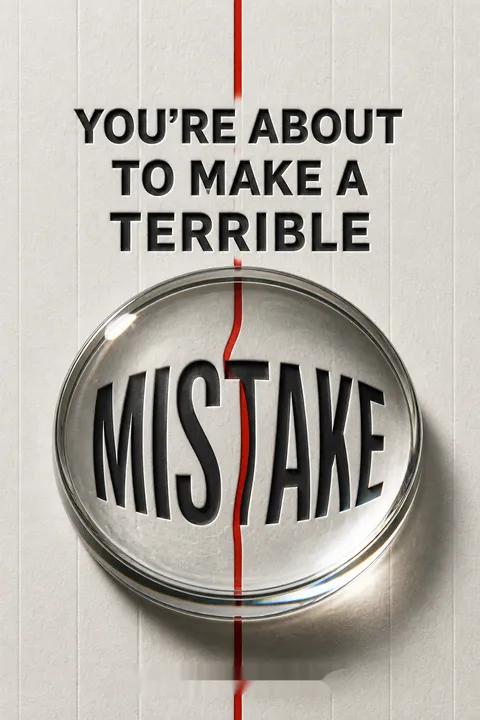
You're About to Make a Terrible Mistake explores cognitive biases in decision-making, particularly in business contexts. Readers appreciate its practical approach, clear structure, and real-world examples. The book offers strategies to improve organizational decision-making processes, emphasizing the importance of diverse perspectives and structured frameworks. While some found it repetitive if familiar with behavioral economics, many praised its insights and applicability. The book is highly recommended for leaders, managers, and anyone interested in understanding and mitigating cognitive biases in decision-making.
Glossary
Behavioral strategy
Psychology applied to strategyAn approach to strategic management that takes human cognition, emotion, and social behavior seriously. Rather than assuming that executives weigh options with perfect rationality, it studies how predictable biases affect organizational choices and how decision processes can reduce their influence.
Recognition-primed decision model
Experience-based rapid judgmentA model of expert intuition in which a decision maker recognizes features of a familiar situation and quickly identifies a workable response. It is most reliable when the environment has valid, recurring cues and the person has extensive practice with prompt, clear feedback.
Confirmation bias
Favoring belief-confirming evidenceThe tendency to seek, notice, and accept evidence that supports an existing belief while neglecting or discounting evidence that challenges it. It can shape interpretation even when the facts themselves are accurate, particularly when they are organized into a persuasive story.
Planning fallacy
Underestimating project demandsThe tendency to underestimate the time, cost, or difficulty of a planned task. Decision makers focus on the details of their own plan and overlook the many obstacles that affect similar projects. Comparing a proposal with the actual record of comparable projects can counter this bias.
Status quo bias
Preferring the existing arrangementA preference for leaving things as they are, especially when maintaining the current state requires no explicit decision. In organizations, it can preserve budgets, business units, or strategies even when circumstances change and alternatives deserve review.
Loss aversion
Losses weigh more than gainsA pattern of judgment in which a loss generally feels more significant than a gain of the same size. It can make people resist change, avoid sensible risks, and continue an existing course to avoid acknowledging a loss, even when future prospects do not justify doing so.
Present bias
Overweighting immediate outcomesThe tendency to value an immediate reward or cost more heavily than a comparable future one. Because people discount the near present inconsistently, they may reject a worthwhile effort today while accepting the same effort when it is scheduled for a later date. In companies, this can favor short-term performance over future investment.
Bounded ethicality
Unintentional ethical distortionThe idea that people who intend to act ethically can still make self-serving judgments without recognizing the distortion. Financial incentives, loyalties, and personal attachments may shape a sincere assessment. The concept differs from deliberate fraud, although it does not excuse harmful behavior.
Reference class forecasting
Forecasting from comparable casesA forecasting method that estimates a project’s likely cost, duration, or outcome by comparing it with a group of similar completed projects. This outside view counters the tendency to focus only on the specific plan and its advocates’ assumptions.
Premortem
Imagined failure analysisA structured exercise conducted before a decision is final. Participants imagine that a proposed project has failed and independently list plausible reasons, then share them with the group. The exercise makes potential weaknesses easier to voice and identify before commitment.
Decision architecture
Design of decision processesThe deliberate design of the routines, participants, information, and meeting practices through which an organization makes important choices. The approach emphasizes candid dialogue, divergent evidence, and adaptive decision dynamics so that collective processes can compensate for individual limitations.
FAQ
What's You’re About to Make a Terrible Mistake about?
- Focus on Decision-Making: The book delves into how cognitive biases distort decision-making in both personal and professional settings, challenging the notion of rational judgment.
- Nine Decision Traps: Olivier Sibony identifies nine specific traps, such as overconfidence and groupthink, that often lead to poor outcomes.
- Practical Solutions: It offers practical techniques and frameworks to help individuals and organizations improve their decision-making processes.
Why should I read You’re About to Make a Terrible Mistake?
- Understanding Biases: The book helps readers become aware of cognitive biases that affect their decisions, enhancing self-awareness.
- Improving Decision Quality: It provides actionable insights and techniques to improve decision quality, leading to better outcomes in various aspects of life.
- Real-World Examples: Sibony uses compelling examples to illustrate the impact of biases, making the concepts relatable and easier to understand.
What are the key takeaways of You’re About to Make a Terrible Mistake?
- Cognitive Bias Awareness: Recognizing cognitive biases is crucial for improving decision-making.
- Nine Traps Identified: The book outlines nine traps, such as the "Storytelling Trap" and the "Imitation Trap," that can lead to poor decisions.
- Decision Architecture: Emphasizes designing decision-making processes that mitigate biases, encouraging leaders to act as "decision architects."
What are the best quotes from You’re About to Make a Terrible Mistake and what do they mean?
- “We have met the enemy and he is us.” This highlights that our own cognitive biases are often the biggest obstacles to sound decision-making.
- “Don’t play for safety—it’s the most dangerous thing in the world.” Suggests that avoiding necessary risks can lead to worse outcomes than taking calculated risks.
- “If we want things to stay as they are, things will have to change.” Emphasizes the need for adaptation in decision-making processes to avoid stagnation.
How does You’re About to Make a Terrible Mistake define cognitive biases?
- Systematic Errors: Cognitive biases are systematic errors in thinking that affect decisions and judgments, leading to irrational behavior.
- Five Families of Biases: The book categorizes biases into five families: pattern-recognition, action-oriented, inertia, social, and interest biases.
- Impact on Decision-Making: Understanding these biases is crucial as they can distort reality and lead to flawed conclusions.
What are the nine traps discussed in You’re About to Make a Terrible Mistake?
- “Too Good Not to Be True” (Storytelling Trap): Decision-makers are swayed by compelling narratives rather than objective data.
- “Steve Jobs Was Such a Genius” (Imitation Trap): Involves blindly imitating successful leaders without considering unique contexts.
- “I’ve Seen This Before” (Intuition Trap): Highlights the danger of relying on past experiences, leading to overconfidence and misjudgments.
How does You’re About to Make a Terrible Mistake define confirmation bias?
- Bias Definition: Confirmation bias is the tendency to search for and interpret information that confirms preexisting beliefs.
- Impact on Decision-Making: This bias can lead to overlooking contradictory evidence, resulting in flawed conclusions.
- Real-World Examples: The book illustrates confirmation bias through examples, showing its distortion in perceptions.
What techniques does You’re About to Make a Terrible Mistake suggest for improving decision-making?
- Fostering Dialogue: Encourages open dialogue by ensuring cognitive diversity and setting clear agendas.
- Encouraging Divergence: Emphasizes seeking diverse viewpoints and challenging assumptions through techniques like appointing a devil’s advocate.
- Agile Decision Dynamics: Advocates for flexible decision-making processes, allowing for adaptation and experimentation.
How can I apply the concepts from You’re About to Make a Terrible Mistake in my decision-making?
- Recognize Biases: Start by identifying and acknowledging your own cognitive biases.
- Implement Decision Processes: Use techniques from the book to design decision-making processes involving collaboration and critical evaluation.
- Encourage Open Dialogue: Foster an environment where team members feel comfortable expressing dissenting opinions.
What is the role of leadership in decision-making according to You’re About to Make a Terrible Mistake?
- Facilitating Collaboration: Leaders should create an environment that encourages collaboration and open dialogue.
- Modeling Humility: Effective leaders model humility by being open to changing their minds based on new information.
- Trusting the Process: Leaders must trust the decision-making processes they establish and rely on collective judgment.
How does You’re About to Make a Terrible Mistake address the issue of risk in decision-making?
- Calculated Risks: Encourages taking calculated risks rather than avoiding them, viewing uncertainty as an opportunity.
- Gradual Commitments: Suggests making gradual commitments to new initiatives, allowing for testing without full resource commitment.
- Learning from Failure: Highlights the value of learning from both successes and failures through postmortems.
What is the "Inertia Trap" in You’re About to Make a Terrible Mistake?
- Definition of Inertia Trap: Refers to the tendency to maintain the status quo and resist change, even when faced with new challenges.
- Anchoring Effect: Often exacerbated by anchoring, where past decisions unduly influence current choices.
- Consequences: Organizations may miss opportunities for innovation and fail to adapt, leading to decline.
Download PDF
Download EPUB
.epub digital book format is ideal for reading ebooks on phones, tablets, and e-readers.








