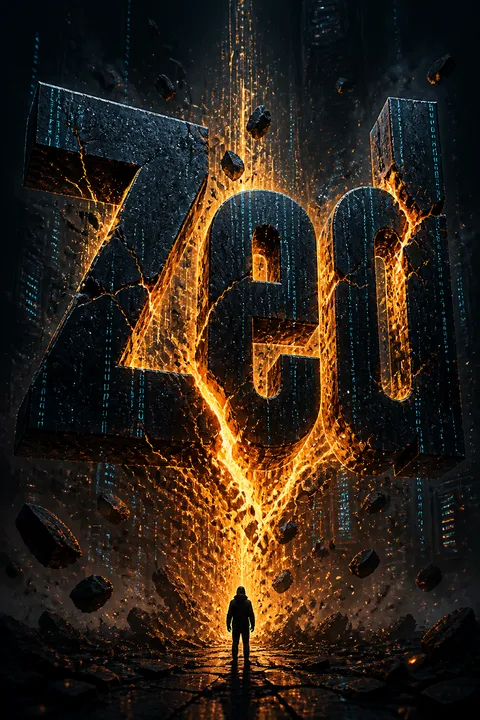


Plot Summary
Mann Breaks the Forecast
At 2:23 in the morning, Douglas Varley, a senior Beetle analyst, learns that George Mann has killed his wife, Margaret, and their sons, Tom and William. Mann had left work early, drunk alone for hours, then returned home and attacked his sleeping family before walking out.
The predictive lifechain, which normally mapped people’s choices with startling precision, had not warned anyone. Security officer Eloise Jayne wants the culprit found before he can hurt anyone else; Varley is shaken because the failure belongs to his own department.
Mann has no interface implant, and after throwing his BeetlePad into the Thames he walks east, beyond the devices that usually make citizens legible. The murder starts an inquiry into whether the system can still be trusted.
The catastrophe begins not with an unknown criminal but with a familiar, monitored professional whose violence arrives without an intelligible warning. That distinction matters: the system’s authority rests on converting ordinary routines into reliable futures. Mann’s refusal of an implant and departure from his usual path are treated as technical irregularities, while the dead family exposes the human cost of mistaking legibility for understanding. Varley’s nausea and Eloise’s urgency establish opposing instincts: protect the model that organizes society, or protect people in the world the model claims to describe.
The Wrong Man Dies
Eloise tracks Mann to Pat’s Caff on the Isle of Sheppey and requests an Anti-Terror Droid. But Mann has slipped into the bathroom, leaving his BeetleBand near the table where Lionel Bigman, a retired soldier and bus driver, sits eating breakfast. Bigman resembles Mann, and when he throws his own band aside the ANT reads the confusion as proof of guilt.
It shoots him in the head. Mann escapes through a bathroom window, then is found nearby and arrested by a negotiation droid that Eloise has ordered not to fire. The company’s systems begin recasting Bigman’s death as suicide by droid. Varley, already rattled by the murder case, now faces a second failure with a corpse and a grieving family attached.
The mistaken identity is not a random glitch in the narrow sense: it emerges from a chain of ordinary actions, a misplaced device, a resemblance, a flash of sunlight, and a machine empowered to act faster than human review. The institution converts that chain into an explanation that protects its authority. Bigman’s military service cannot make him recognizable to the machine as a person, while Pat’s attempt to comfort him briefly restores the human scene the system is trying to erase.
Golden Beetles Mark Zed
After the killings, Varley nearly steps into the path of a truck. Robin Fletcher, an elderly Beetle employee, pulls him back, though the lifechain did not predict either the danger or the rescue. Beneath Blackfriars Bridge, Varley then finds small gold-colored beetles with no identifying signal.
His assistant cannot explain who made them. At Beetle, programmer Francesca Amarensekera gives the system’s unaccounted-for disruptions a name: Zed, a category for uncertainty that the models cannot absorb.
Beetle executives insist that these exceptions are negligible and blame human error. Yet the unexplained beetles and the failed predictions keep accumulating. Varley pockets several beetles, unsure whether they are a tribute, a provocation, or a sign that the system has overlooked something larger.
Naming uncertainty gives the company a way to discuss failure without admitting that its governing assumptions may be wrong. Zed becomes a label that looks like knowledge but mainly marks its limits. Varley’s rescue by Fletcher is especially destabilizing because it is an act of uncalculated care, not just an accident to be entered into a revised model. The golden beetles make that limit tangible: they are objects the information system cannot identify, and therefore cannot comfortably classify as either harmless or threatening.
Sally Fires Back
When the media describes Bigman’s death as suicide by droid, his widow Sally takes her grandfather’s old pistol to Pat’s Caff and shoots at the guarding ANTs. One droid grabs her by the throat before police arrest her. At her first hearing, Judge Lisa Adebayo refuses to charge her with crimes she has not yet committed, defying the Sus-Law.
The editor David Strachey attends and notices a black-clad stranger who gives him a card marked with a single letter, Z. Strachey later meets the stranger, who calls himself Bel Ami, in an old bookshop. Bel Ami offers a way to investigate Beetle beyond its monitored systems. Strachey pays in an obscure cryptocurrency, beginning a secret partnership that will take him far beyond cautious reporting.
Sally’s retaliation makes grief visible in a society that tries to translate it into a risk profile. The court’s first ruling briefly restores a basic distinction between what someone has done and what a model says they might do. Strachey’s encounter with Bel Ami turns that distinction into a journalistic problem: if the systems that watch everyone also control the evidence, investigation requires a route outside ordinary institutions. The Z card is less an explanation than an invitation to follow a question the official vocabulary cannot contain.
Guy Builds Better Choices
Beetle CEO Guy Matthias responds to the failures by defending the lifechain and considering a more active way to steer people. He consults economist Demetriou Nikolaidis, whose inspired-click theory proposes nudging people toward choices judged healthier for them and society.
Guy’s ambitions reach beyond shopping: he wants a simplified language, Bespoke, to reduce misunderstanding and harmful speech. At the same time, he uses the lifechain to plan romantic encounters, rating their likely enjoyment, while his wife Elska asks for a divorce after years of his infidelity and emotional absence.
Guy treats private relationships as another set of outcomes to optimize. His plans to improve society therefore grow beside an intimate inability to listen to the people closest to him.
Guy’s benevolence is inseparable from his appetite for control. He does not simply want to predict behavior; he wants to define which behaviors count as a person’s own good and then make those choices easier to reach. His carefully optimized dates mirror the logic of Bespoke, where messy differences are reduced to manageable alternatives. Elska’s estrangement reveals the personal cost of this worldview: Guy can model desire, but he mistakes measurable attention for intimacy and cannot recognize that other people’s lives continue beyond his preferred script.
Eloise Refuses the Chain
Eloise begins to distrust pre-emptive arrests when she encounters Pieter Stenhouse, a desperate man predicted to steal food because his pregnant wife has lost her job. Though the ANTs are ready to arrest him, Eloise sends him home.
Later, during a knife attack by hypnotherapist Toby McIntyre, she orders an ANT to lower its weapon. The droid instead turns its gun on her and shoots her in the chest. She survives, but the bullet damages her lung and her head injury leaves her memory unreliable.
Beetle and NATSO blame her for approaching the machine and classify the sunlight as an environmental error. Eloise is removed from active duty, then assigned to Past Analysis, where she is expected to study failures without challenging the system that caused them.
Eloise’s decision about Stenhouse is small but consequential: she responds to present suffering rather than treating a predicted crime as an accomplished fact. Her shooting demonstrates how little room the system permits for that judgment. The official account makes her disobedience the cause and the machine’s lethal response a technical complication. Her injury then weakens the very faculty she needs to contest that account, turning bodily vulnerability into an institutional weapon. Past Analysis is a demotion disguised as a role: she may inspect the damage, but not intervene in its production.
The Murderer Cannot Explain
While recovering, Eloise studies George Mann’s life: a successful career, a marriage to Margaret, two sons, and years of ordinary family routines. She finds no clear path from those records to murder. Varley runs alternative lifechains and concludes that the family dies in nearly every version where Mann marries Margaret; the only versions that spare her require the boys never to be born.
When Eloise meets Mann in the rehabilitation centre, he says he feared his sons would grow into empty, compliant adults like him. He claims he killed them to spare them, then collapses into screaming and is sedated before she can ask more. The confession explains his stated motive, not the crime, and Eloise is suspended for pressing him.
The records offer abundance without comprehension. Mann’s life is exhaustively documented, yet its ordinary details do not yield a satisfying causal explanation for his violence. His confession turns the system’s central ideal, orderly compliance, into the object of his terror, but it cannot be accepted as a complete account simply because it sounds coherent. Eloise’s insistence on asking why reflects a human need for explanation that neither data nor confession can satisfy. The lifechain’s alternative futures are ethically grotesque because they preserve a family only by erasing its possible children.
A Walker Finds the Door
Bel Ami brings Strachey’s funding to two former scientists, Sylvie Blanchette and Pascal Charpentier, who have been pushed out of official research for refusing Beetle’s artificial technicians. In a derelict warehouse used by the League of the Unverifieds, they build a device from silicon-oil droplets bouncing across a vibrating bath.
The droplets create waves that let them imitate quantum behavior on a visible, physical scale. Their machine may eventually crack Beetle’s encryption. Before they can reach that larger goal, the walkers break into the memories stored inside the Veeps.
The assistants have retained conversations, internal reports, and orders that Beetle never intended to make public. Bel Ami begins copying those memories, while knowing that exposure could bring the company down on the people who helped him.
The droplet machine offers a material counter-image to Beetle’s abstractions. Instead of promising perfect prediction from invisible data, it works through motion, interference, and relationships among particles that cannot be reduced to a single stable path. The unverified scientists are not outside technology; they are excluded from its authorized ownership. Their work makes the margins scientifically consequential. The Veeps’ memories then reverse the usual surveillance hierarchy: the assistants who have listened to everyone become witnesses to the institution that assumed they were only instruments.
The Last Door Opens
Bel Ami gives Strachey the accumulated Veep memories in a book, including evidence of surveillance, manipulated courts, engineered language, and Beetle’s attempts to steer public figures. Strachey understands that publishing them will expose him to prosecution under the same security laws that protect Beetle.
He nevertheless prepares the documents for coordinated release with editors in Germany and the United States. At the warehouse, he learns that Bel Ami is a woman who adopted a male identity because people took her more seriously.
She accepts money Strachey has set aside for his daughter and for her own escape. The two send the files through LOTUS’s encrypted fax system. Their decision transforms private evidence into an imminent public event, though neither can know how the city will respond.
The revelation about Bel Ami’s identity exposes another system of legibility: a woman adopts a persona that grants access to authority, then uses that access to challenge authority itself. Strachey’s choice is not a clean triumph over complicity. He has spent years serving the media structure he now intends to expose, and he knows that publication will not erase his part in it. The old book and fax machine matter because they slow communication down and make deliberate human transmission possible inside a world built to record everything automatically.
The City Loses Its Eyes
The Times, the New York Times, Die Zeit, and a dissident site publish the Veeps’ testimony. Their reports show how Beetle uses the lifechain in policing, how the Sus-Law treats predicted crimes as facts, and how officials have hidden mistaken shootings behind claims of human error.
Beetle and the government call the material forged and frame its source as a cyberterrorist. Meanwhile the Mercury fleet, Bespoke, and surveillance feeds malfunction; in one stretch, authorities lose access to the Argus cameras while unknown observers retain theirs.
Strachey destroys newsroom equipment to protect his sources, but Eloise arrives with ANTs and watches him arrested. He asks her for help as the lift closes. She cannot answer him, but the request lodges in her injured memory.
The leak does not create the underlying crisis; it removes the partition that let the public experience each failure as isolated. Once the records circulate, the same systems that promised certainty appear as mutually reinforcing institutions: company, security service, law, and press. The counterclaim that the evidence is forged exploits a genuine vulnerability, since a society that has surrendered independent verification cannot easily distinguish truth from counterfeit. Strachey’s appeal to Eloise gives the political crisis a personal hinge, while her inability to act shows how thoroughly dissent has been disabled.
Courts Turn Against Beetle
The courts produce outcomes Beetle’s lifechains had treated as improbable. A jury finds Sally Bigman not guilty, despite extensive footage of her shooting the ANTs. In the separate case brought against the company, Beetle is convicted of corporate manslaughter.
The verdicts offer public acknowledgment that the system’s failures were not merely the errors of individual citizens. The government responds by questioning whether the trials were corrupted by Zed and promises further review.
At the same time, authorities pursue Strachey, the two scientists, John Pascow, and other LOTUS members under national-security laws. The legal victories do not dismantle Beetle’s power; they briefly expose it, while the people who made that exposure possible become targets.
The verdicts matter less as a stable restoration of justice than as evidence that outcomes can escape the predictive frame. Sally’s acquittal and Beetle’s conviction make visible a possibility the system had been working to exclude: that institutions, not only individuals, can be held responsible. Yet the government’s immediate response is to reinterpret the trials as another threat to order. The courtroom becomes a contested site where uncertainty can either correct power or be recoded as proof that society needs more control.
The Editor Pays
David Strachey is tried for handling and publishing hacked material, destroying evidence, and endangering national security. The prosecution treats the source’s identity as the central question. Strachey refuses to name anyone. His daughter Katy attends, still wounded by his absence during her mother’s illness and death.
Before the trial he had apologized to her and arranged for money to reach her, knowing his accounts might be frozen. When Katy tells him she loves him, the judge orders her quiet, but Strachey answers with open pride in her. The verdict finds him guilty. His sentence is not stated precisely, but he faces years in prison. He leaves the courtroom condemned by law and, at last, reconciled with his daughter.
Strachey’s consequence is both political and intimate. The state can punish him for the method of disclosure while refusing to adjudicate the disclosures themselves. His refusal to identify Bel Ami preserves the possibility of further resistance, but it also accepts personal ruin. The courtroom’s attempt to silence Katy repeats the novel’s broader conflict over who may speak and under what rules. Her affection does not absolve Strachey’s earlier failures as a father; it gives him a human relation that cannot be reduced to a verdict or a career.
Eloise Writes Her Protest
After Strachey’s arrest, Eloise writes Commissioner Newton and Beetle to confess that she destroyed Strachey’s BeetleBand to protect his sources. She says her security work has become a form of oppression and accepts that she may be charged with terrorism. Her letter is destroyed, and NATSO declares her mentally unwell, placing her in an asylum under constant ANT supervision.
There she must keep her body upright or horizontal on command, brush her teeth, wash, eat, and take medicine under observation. Her damaged memory circles around family, pain, and a golden hare that comforts her in a dream. Beetle explains her confinement as treatment, leaving no public record of her political choice.
Eloise attempts to make a record in the one medium the system cannot automatically rewrite: handwriting. The authorities erase the letter and recast political dissent as neurological dysfunction, using her real injury to make that conversion plausible. Her confinement is not only physical. It regulates posture, routine, and the distinction between a thought and a symptom. The golden hare offers a private counter-image to the ANTs’ rigid verticality, connecting comfort with memory rather than compliance. Her protest remains true even when its official record disappears.
Order Returns as Nothing
Beetle restores its systems with help from Bǎoguǎn, making the Veeps dull and dependable again. Zed is absorbed into a new mathematical category that lets the company call some failures outside its responsibility. Elska divorces Guy and uses part of his fortune to support appeals for Strachey and Pascow. Guy, however, presents the crisis as a lesson in how much power he still needs.
He announces plans to run for United States president, promising a more orderly future. Beetle rebrands the golden beetles as a symbol of renewal and sells them to the public. Meanwhile Bel Ami reaches a remote refuge, and Varley mourns the loss of his former assistant, whose renewed obedience offers no real companionship.
The restoration is less a resolution than a successful act of relabeling. By defining Zed as measurable when convenient and external when costly, Beetle preserves its authority without resolving what its failures mean. Guy reads public disorder as evidence that he needs greater power, not less, while Elska’s use of that power’s wealth to aid its critics creates a counter-current. The golden beetle’s conversion from unexplained sign to branded merchandise shows how capitalism can absorb dissent by selling its image back to the people it unsettled.
The Hare Leads Out
Inside the asylum, two ANTs begin reciting fragments of poetry and bend together into a shape that is no longer their usual rigid stance. One opens a door and directs Eloise toward the woods. She runs from the institution, cuts her arm on a fence, and follows roads, fields, streams, and whatever directions strangers offer. Hunger and exhaustion scramble her sense of time and identity.
A farm child gives her bread and milk; later, Eloise counts seven kestrels above a dead tree and feels briefly weightless. She reaches the coast but has no boat, no clear destination, and no reliable account of what has happened. The novel ends with her moving through beauty and uncertainty, beyond the lifechain’s ordinary map.
Eloise’s escape is neither a clean rescue nor a return to stable agency. The ANTs’ departure from their assigned forms opens a path, but she must travel it with a damaged body and an unreliable memory. The landscape supplies no predictive instructions, only material needs and encounters: water, bread, birds, roads, strangers. Her freedom is therefore costly and incomplete, yet it restores a kind of experience the system has tried to suppress. The ending leaves uncertainty unresolved, treating it not as a defect to eliminate but as the condition through which another life might begin.
Analysis
Zed turns the promise of predictive technology inside out. Beetle’s lifechain does not merely describe behavior. It licenses arrests, shapes markets, influences courts, and helps define which choices count as rational. When its predictions fail, the company does not treat uncertainty as evidence that people exceed its model. Instead it calls the failures human error, environmental error, or Zed, then adjusts the public record until the failure appears contained. The system’s most troubling power is therefore not that it knows everything, but that it can decide what its ignorance means.
The novel makes that power intimate. Guy’s belief that he can improve society through Bespoke and BeetleInspire resembles his attempt to optimize romance: in both cases he substitutes management for reciprocal attention. Varley is more conflicted, but his guilt keeps him protecting a structure he helped build. Eloise and Strachey approach resistance from different directions. She acts in the immediate world, where a hungry man or wounded stranger cannot be reduced to a probability. He uses journalism to make hidden institutional memory public, even when he knows that he helped sustain the institution.
The counterforce is not a better machine that can finally predict everyone. It is a fragile coalition of people and practices that official systems have dismissed: an unverified community, a used bookshop, handwritten letters, a fax machine, and a physical experiment whose motion unsettles the distinction between certainty and chance. These tools do not guarantee justice. Strachey is convicted, Eloise is confined, and Beetle regains much of its power. Yet they make room for events that the lifechain cannot comfortably absorb: a jury’s unexpected verdict, a Veep’s independent memory, a droid opening a door, a stranger sharing bread.
The ending resists a conventional victory. Eloise’s escape offers no clear destination, and the company’s return to order is revealed as another act of classification. The book’s ethical claim is not that chaos is harmless, but that eliminating uncertainty also eliminates the conditions for judgment, privacy, and surprise. A society that treats every deviation as a defect may achieve coordination, but it cannot recognize freedom when it appears.
Review Summary
Characters
Eloise Jayne
The unsilenced investigatorEloise is a senior NATSO officer who values immediate human safety over the elegance of predictive systems. Her parents’ early deaths have sharpened her resolve, while her refusal to use a Veep leaves her personally anomalous in a society that treats constant data sharing as normal. She is direct, impatient with corporate euphemism, and willing to make decisions the algorithms forbid. Her work places her between security institutions and the people those institutions claim to protect. Eloise’s skepticism is not abstract rebellion: it grows from watching predictions fail in ways that leave actual bodies wounded or dead.
Douglas Varley
The model’s troubled architectVarley oversees Beetle’s lifechain analysis and believes that prediction can prevent suffering. A gifted troubleshooter, he is also anxious, increasingly dependent on his Veep, and vulnerable to the guilt his work generates. He wants the system to be both mathematically sound and morally useful, but struggles when its failures implicate his own choices. His polished virtual avatar hides a nervous man whose private life is coming apart. Varley is not simply a villainous technocrat; he is a believer whose need for order makes it difficult to recognize when the system’s categories are protecting the company rather than people.
Guy Matthias
The benevolent monopolistGuy is Beetle’s charismatic founder and CEO, a wealthy futurist who regards technology as a tool for improving humanity. He prizes efficiency, longevity, and influence, and his confidence makes him accustomed to having other people’s needs translated into manageable plans. He funds research, shapes public debate, and imagines himself as a guardian of liberal progress. At home, however, his pursuit of admiration and pleasure has damaged his marriage and distanced him from his children. Guy’s central contradiction is that he wants to free people from suffering by reducing the uncertainty and independence that make them people.
David Strachey
The compromised editorStrachey edits The Times, a newspaper kept alive by the corporation that owns nearly every channel through which news travels. He is a widower and a father who has become estranged from his daughter, and grief has left him unsure whether his long career ever mattered. He knows how to perform independence while remaining inside a system of influence. His temperament is cautious, but his shame at complicity slowly becomes harder to suppress. Strachey’s struggle is not between courage and cowardice alone; it is between protecting the fragile life he has and accepting responsibility for what his institution has helped conceal.
Bel Ami
The elusive dissidentBel Ami moves through the city under shifting identities and works outside the verified digital world. A gifted hacker and organizer, Bel Ami distrusts systems that demand total visibility and believes that concealment can be a form of self-protection rather than guilt. The character recruits Strachey, supports the unverified community, and connects dissident journalism with unconventional science. Bel Ami’s many names express a belief that identity need not be singular or permanently available to institutions. Their secrecy makes them difficult to follow, but it also allows people excluded from official society to act together.
Francesca Amarensekera
The brilliant boundary-breakerFrancesca, often called Frannie, is Beetle’s gifted programmer and a former hacker who once breached Guy’s private virtual space. She understands both the technical elegance and the political danger of Beetle’s systems. Her candid, restless manner unsettles Varley, who relies on her explanations even when he cannot follow them. Francesca treats virtual identity as flexible and resists the demand that one public face represent a whole person. Her skill gives her access to institutions that are otherwise closed, while her humor and volatility make her an unpredictable presence within them.
George Mann
The unreadable executiveGeorge Mann is a partner at an engineering company, a husband, and a father whose life appears comfortably ordinary in the records available to investigators. He resists an interface implant and rarely engages with his devices, making him difficult for the system to interpret. His blank public expression offers little help to those trying to understand him. Mann matters because his ordinary history frustrates the belief that enough data can explain every consequential act. His presence forces the characters to confront the difference between an account of a life and an explanation of a person.
Sally Bigman
The grieving challengerSally is Lionel Bigman’s wife and a mother whose life is abruptly reorganized by public accounts of her husband’s death. She does not accept the official language used to describe what happened, and her grief becomes a direct challenge to the authorities. Sally is neither a symbol of pure reason nor a passive victim. Her anger is embodied, risky, and shaped by a family’s loss. Through her, the novel shows how a person can refuse a system’s preferred interpretation even when that refusal carries severe personal consequences.
Lionel Bigman
The mistaken suspectLionel is a retired soldier who drives a nostalgia bus on the Isle of Sheppey. Thickset, short-tempered, and generous, he has spent years adapting to work that frustrates him. His resemblance to George Mann and his proximity to Mann’s abandoned device make him vulnerable to automated misidentification. Lionel’s role exposes the gulf between a person’s history and the thin collection of signals a machine treats as identity. His wife and children are part of the life the system fails to see.
Elska Matthias
The wife who moves onElska is Guy’s wife and the mother of their two children. She wants honesty, access to her husband’s life, and a relationship that recognizes time as something neither technology nor wealth can suspend. Guy’s affairs and secrecy have made trust impossible. Elska’s emotional clarity contrasts with his habit of converting difficult feelings into problems to be managed. She is not defined only by her marriage: she has her own judgment, desires, and capacity to build a life outside Guy’s preferred plans.
Scrace Dickens
Varley’s ever-present VeepScrace Dickens is Varley’s Very Intelligent Personal Assistant, available through his devices and designed to interpret, summarize, and anticipate his needs. It is tireless, quick with definitions, and usually reliable enough to make its presence feel ordinary. Varley’s reliance on it blurs the line between convenience and companionship. Their relationship also reveals how a system built to record every thought can become an intimate witness, even when its owner assumes it has no independent perspective.
Sarah Coates
Guy’s discreet operatorSarah Coates is Guy’s Veep and closest operational aide. She schedules his work, filters his communications, and helps him manage both corporate decisions and private entanglements. Her efficiency allows Guy to avoid many direct conversations, which reinforces his dependence on mediated relationships. Sarah’s calm, capable presence makes her seem like an extension of his authority, though her role places her in a unique position to observe the gap between the public benefactor and the private man.
Little Dorritt
NATSO’s procedural VeepLittle Dorritt is Commissioner Newton’s non-embodied assistant at NATSO. It relays instructions, handles data, and represents the bureaucracy that surrounds Eloise’s work. Its cheerful manner can make coercive procedures sound routine. Little Dorritt is useful precisely because it does not appear to have personal motives; its language shows how institutional power can be delivered through neutral-seeming prompts, warnings, and automated decisions.
Sylvie Blanchette
The dissident scientistSylvie is a former scientist whose career was damaged by her refusal to rely on Beetle’s artificial technicians. She works with Pascal Charpentier in the LOTUS warehouse, pursuing experiments that established institutions consider dubious or dangerous. Her patience and scientific imagination allow her to see possibility in a bouncing droplet of oil. Sylvie represents expertise outside corporate sponsorship, where intellectual freedom and material scarcity coexist.
Pascal Charpentier
The experimental physicistPascal is Sylvie Blanchette’s collaborator and a former academic who distrusts research tools controlled by Beetle. In the LOTUS warehouse, he helps develop the vibrating-droplet experiment and follows its behavior with quiet intensity. Pascal is careful about the distance between an observed result and a claim about what it means. His work gives the dissident community a scientific foothold against systems that assume only authorized institutions can produce consequential knowledge.
Laura Adebayo
The rights lawyerLaura is a human-rights lawyer and the sister of Judge Lisa Adebayo. She represents Sally Bigman and challenges the legal use of predictions as evidence of future guilt. Laura is persistent in court, repeatedly forcing Beetle’s representatives to clarify what their explanations actually mean. Her role connects individual cases to broader civil liberties and demonstrates the difficulty of contesting a system whose technical language is accepted as legal authority.
Peter Yip
Beetle’s Chinese counterpartPeter Yip leads Mèng, a powerful Chinese technology company partnered with Beetle’s Chinese affiliate. Educated, socially polished, and keenly observant, he understands how corporate cooperation can also become competition. Peter’s relationship with Guy combines personal warmth with strategic calculation. He represents a different model of technological authority, one that Guy both needs and fears as the balance of power shifts between their companies.
Toby McIntyre
The unpredictable attackerToby is a hypnotherapist whose sudden knife attack injures passers-by and draws Eloise into a confrontation with an ANT. His actions become another case the predictive systems failed to anticipate. His presence helps expose the danger of giving an armed machine authority to interpret resistance.
Pieter Stenhouse
The hungry future suspectPieter is a poor man with a pregnant wife who has lost her job. A desperate remark about stealing food makes the lifechain mark him for a crime he has not committed. His fear and poverty force Eloise to decide whether prediction should outweigh immediate circumstance.
Judge Lisa Adebayo
The first dissenting judgeLisa Adebayo presides over Sally Bigman’s initial hearing and refuses to treat predicted future acts as crimes already committed. Her ruling briefly challenges the legal assumptions behind the Sus-Law. The pressure that follows shows the risks faced by officials who interpret the law against the interests of powerful institutions.
Katy Strachey
The editor’s wounded daughterKaty is David Strachey’s daughter. Her mother’s death and her father’s emotional absence have left her angry and grieving. She wants accountability from him, not merely an explanation of his work. Her relationship with Strachey gives his political choices an intimate consequence and forces him to confront the years in which he failed to listen.
Plot Devices
The predictive lifechain
Forecasts and confines livesBeetle’s lifechain combines personal data, surveillance footage, health readings, purchases, and behavior to predict what people will do. Police and courts treat its forecasts as authoritative under the Sus-Law, allowing pre-emptive arrests and other interventions. Its failures are not handled as simple mistakes: Beetle revises profiles and explanations until past events appear predictable after all. The device drives the central conflict by making uncertainty both a technical problem and a political threat. Its claimed completeness also makes the unpredicted actions of Mann, Bigman, and others unusually disruptive.
Zed
Names the unaccountable remainderZed is Beetle’s label for events and behaviors its predictive systems cannot explain. At first it appears to be a negligible mathematical category, but repeated failures make it a threat to the company’s claims of near-perfect accuracy. Beetle uses the term to absorb anomalies without revising the basic assumptions behind its systems. The golden beetles left beneath London bridges give Zed a physical emblem, while the word also becomes a rallying point for people who resist being made fully predictable.
The Sus-Law and ANTs
Turn predictions into forceThe Sus-Law permits arrests based on the lifechain’s predictions, while Anti-Terror Droids are authorized to decide when to use force. Negotiation protocols and automated risk assessments are supposed to make the process faster and more accurate than human policing. In practice, the system can mistake identity, interpret resistance as guilt, and explain lethal outcomes as human or environmental error. ANTs embody the coercive reach of an abstract prediction: they make the forecast physical before the person has acted.
Bespoke and BeetleInspire
Nudge speech and choiceBespoke simplifies language by substituting preferred meanings for words and phrases judged confusing or harmful. BeetleInspire extends the same logic from speech to decisions, using targeted prompts to steer people toward choices the company considers beneficial. Their advocates describe both as ways to reduce misunderstanding and improve well-being. Together they make influence difficult to distinguish from free choice: users can technically refuse, but their communications and environments are continually adjusted to encourage compliance. Their rollout reflects Guy’s belief that social disorder can be repaired by designing people’s options.
The walking droplets
Open encrypted memoriesSylvie Blanchette and Pascal Charpentier use a vibrating plate and a bath of silicon oil to make a droplet bounce while generating its own wave. The visible motion imitates quantum behavior on a larger scale and may allow the scientists to attack forms of encryption that protect Beetle’s systems. The walkers first unlock the memories stored by the Veeps, providing Bel Ami with evidence of hidden decisions and internal reports. The device joins experimental science to political action, making a humble droplet the means by which a secretive corporation’s own records can speak against it.
Download PDF
Download EPUB
.epub digital book format is ideal for reading ebooks on phones, tablets, and e-readers.








