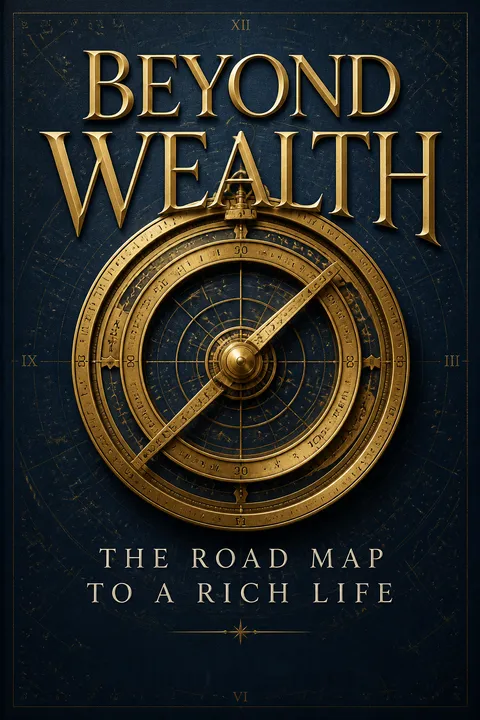


Key Takeaways
Treat money as freedom's tool, not the final measure of a rich life.
Money buys choices. The book begins with Jay, an art dealer whose retirement savings were battered by the 2008 financial crisis. At 65, he feared he could no longer retire. Green did not recommend a new investment. He helped Jay calculate how much he could withdraw monthly over 30 years, even under conservative assumptions. The numbers changed Jay's outlook because they changed what he believed his money could do. The lesson is not that a portfolio is guaranteed to last, but that financial decisions become clearer when fear gives way to a realistic picture of income, spending, and time.
Wealth has other parts. Money can reduce dependence and widen choices, but it cannot replace health, close relationships, meaningful work, or interests that make life engaging. The book treats financial security as important precisely because it can help protect those other goods.
Jay's story shows how a financial plan can act as more than arithmetic: it can restore a sense of agency. That distinction matters because anxiety often turns uncertain risk into imagined certainty of disaster. A budget, withdrawal estimate, or debt plan cannot eliminate uncertainty, but it can make trade-offs visible. The broader argument is strongest when money is treated neither as corrupting nor as salvation. Financial independence is valuable because it expands options, while a good life still depends on what those options are used to protect and pursue.
Build financial freedom by spending beneath your means, not performing success.
A balance sheet tells more. The book contrasts wealth with income: a high salary can coexist with debt and little security, while a modest lifestyle can allow savings and investments to grow. Drawing on Thomas Stanley's research, Green describes many millionaires as living in ordinary homes, driving practical cars, and avoiding prestige purchases. He calls people who imitate luxury without accumulating assets aspirational consumers. Their spending can make them look successful while leaving them financially exposed.
Keep the surplus. Ordinary millionaires in Stanley's surveys often favored family, friends, museums, civic life, and charitable giving over conspicuous consumption. The point is not that every luxury is foolish. It is that status spending competes with savings, and savings create future choices. A less impressive car can be a more powerful asset if it helps someone leave unwanted work or weather a setback.
The contrast between income and net worth corrects a common visual bias: consumption is easy to see, while security is not. Status markets exploit that asymmetry by making purchases function as public signals. Yet frugality should not become a moral badge or a universal prescription. Housing costs, family obligations, health needs, and local wages shape what saving is possible. The useful question is not whether a purchase looks extravagant, but whether it advances a person's priorities or merely purchases approval that quickly expires.
Choose work that uses your strengths in service of something real.
Work can express a person. Green challenges the idea that a job is worthwhile only when it pays well, offers security, or carries prestige. Work can also use a person's abilities to create something useful, reduce suffering, or help others develop. The book borrows Aristotle's idea that vocation lies where personal talents meet the world's needs. That may describe paid employment, parenting, community work, or service after retirement.
Meaning changes the frame. In one example, lawyers declined an offer to provide low-cost services to retirees in need, but many agreed when asked to volunteer. The task was similar; the meaning attached to it was different. Green argues that large fixed expenses can trap people in work they dislike, so reducing financial overhead may create room to pursue more meaningful work. Still, meaningful work need not be a person's only source of identity or purpose.
The example reveals that compensation is not the only reward people value. Autonomy, mastery, and contribution can make effort feel worthwhile, a useful lens for thinking about career design. But a call to find meaningful work can become unfair when it overlooks economic constraint. People do not all have the same freedom to take a pay cut, retrain, or leave an insecure job. The practical extension is to seek greater purpose where possible, while also recognizing that fair wages and decent conditions are not optional extras.
Invest in relationships: the Harvard study found them central to life satisfaction.
Long lives were observed. The Harvard Grant Study followed 268 men who entered college in the late 1930s, tracking health, careers, marriages, and family life for decades. The cohort was unusually privileged and all male, so it cannot represent everyone. Still, its director, George Vaillant, concluded that relationships with other people were the strongest correlate of a positive assessment of life in old age. Green uses this finding to challenge the idea that success is mainly a tally of income, achievement, or good health.
Trust makes connection workable. In relationships and organizations, trust lets people rely on one another without constant suspicion and negotiation. It grows through demonstrated integrity, competence, and concern for the other person's interests. The book argues that repairing lost trust is difficult, which makes small acts of reliability consequential: keeping commitments, listening carefully, and taking responsibility when something goes wrong.
The study's power comes from its long time horizon: it asks what remains important across changing fortunes, rather than what feels rewarding this week. Its limits matter too. A small sample of male Harvard students cannot establish that every relationship has the same value for every person. Even so, the result fits a broader insight from social science: well-being is shaped by connection, not just individual achievement. Trust is the mechanism that turns connection into dependable support, though healthy relationships also require boundaries and mutuality.
Interrupt endless wanting by imagining loss and noticing what remains.
Wanting resets the target. The hedonic treadmill is the tendency to adapt to improvements, so yesterday's exciting purchase becomes today's ordinary possession and new desires take its place. Green argues that the pursuit of happiness can therefore generate dissatisfaction, especially when it is tied to status and consumption. The Stoic practice of negative visualization offers a counterweight: deliberately imagine losing something valued, such as health, work, or a loved one, so its presence becomes vivid again.
Use the pause wisely. This practice is not a prediction or an invitation to dwell in fear. It is a way to interrupt taken-for-grantedness and prepare emotionally for change. Green also recommends questioning what a desired purchase will really deliver, stepping out of competition with others, and paying attention to what is already present. The aim is not to eliminate ambition, but to stop confusing every fresh want with a missing ingredient of life.
This practice resembles a mental contrast: a valued good becomes easier to notice when its absence is briefly imagined. That can counter adaptation without requiring a crisis to force appreciation. It also contains a caution. Rehearsing loss could intensify anxiety for some people, especially if it becomes rumination rather than a bounded exercise. The useful version is brief and grounded: consider impermanence, then return attention to the actual person, opportunity, or ordinary pleasure in front of you.
Defend attention from screens, hurry, and the habit of missing your life.
Convenience has a cost. Green recalls lunch with a friend who repeatedly checked a BlackBerry, illustrating how alerts can train attention toward the next interruption. The book argues that online reading often encourages skimming, while sustained reading gives ideas time to connect and settle. It also warns that television and constant media can crowd out conversation, exercise, and activities people claim to value.
Make room for presence. Walking, eating slowly, and allowing unplanned leisure are presented as simple ways to return to the immediate world. Thich Nhat Hanh's mindful-eating guidance, for example, asks diners to reduce distractions, notice the food, and take smaller, slower bites. Leisure is not merely empty time: it can support rest, contemplation, and creativity. The practical move is to choose a few periods when devices are away and attention belongs to the people or activity at hand.
Attention is not just a private resource; it shapes what becomes emotionally real. A person who repeatedly fragments attention may remain informed yet feel absent from meals, conversations, and surroundings. The book's case for disconnection is persuasive when framed as deliberate choice rather than a rejection of technology. Digital tools can support access and connection, but they also compete for attention by design. The test is functional: does a device help the user do something valued, or does checking it become the activity?
Grow a wealth of interests through art, books, travel, and curiosity.
Interests multiply experience. Green's idea of wealth extends to the number of things a person can notice and enjoy. Curiosity makes familiar places and subjects newly interesting; art, music, poetry, and books offer ways to encounter lives and perspectives beyond one's own. Travel can unsettle assumptions by making the traveler the outsider. Even a mishap, like Green's unwanted camel ride and attempted shakedown near the pyramids, became a memorable story rather than a ruined trip.
Taste can be learned. Green describes coming to appreciate jazz after attending a live performance, and argues that unfamiliar art often needs patient attention before it becomes rewarding. The book champions enduring works alongside contemporary culture, while encouraging readers to explore rather than perform sophistication. Its point is not to collect prestigious tastes. It is to let sustained exposure widen what can move, surprise, or interest you.
Curiosity converts consumption into participation: a museum visit or concert becomes richer as attention and knowledge deepen. This is a compelling alternative to measuring leisure by expense or novelty. There is a risk, however, that praise for canonical art can slide into cultural gatekeeping. A classic need not be everyone's pleasure, and popular forms can carry real artistic force. The most generous interpretation is that readers should expand their range without surrendering their own judgment or treating taste as a status contest.
Align your conduct with your values, including the good you keep postponing.
Values need witnesses. Green presents conscious living as seeing one's circumstances clearly, being willing to discover mistakes, and matching stated priorities with daily behavior. A parent who calls family central but gives children little undistracted time may feel a gap between belief and action. The same test applies to honesty, work, and relationships. One practical exercise is to complete a sentence stem quickly, such as, "If I gave more attention to my priorities..." The uncensored answers can expose changes a person already knows are needed.
Inaction counts too. Green revisits sloth as more than laziness: it can mean indifference to suffering or duties one avoids. A life can be free of obvious wrongdoing and still omit reasonable acts of care. The book's standard of honor is therefore behavioral. Character appears in kept promises, apologies, generosity, and the effort to use one's abilities responsibly.
The alignment test makes morality concrete. Instead of asking whether someone holds admirable beliefs, it asks what those beliefs organize in a real day. That resembles an audit of revealed priorities: time and behavior often disclose commitments more clearly than self-description. Yet moral responsibility has limits. No individual can answer every need, and guilt alone rarely produces durable service. A workable ethic identifies a manageable obligation, acts on it consistently, and remains alert to whether the action helps rather than merely reassures the giver.
Borrow wisdom widely, but test beliefs against evidence and honest doubt.
No authority is infallible. Green draws on Stoic, Buddhist, Taoist, Jewish, Christian, and other traditions for guidance about compassion, restraint, humility, and conduct. He treats this inherited conversation as a resource, not a demand to accept every doctrine. The Buddha's advice to examine claims rather than accept them solely because of tradition or authority captures the approach. For factual questions, the book favors evidence, testing, and willingness to revise beliefs.
Different questions need different tools. Science investigates testable claims about the natural world; it cannot by itself decide what people ought to value. Religious and philosophical traditions address meaning and moral practice, but should not be used to override reliable evidence about physical events. Green's model is neither automatic faith nor automatic skepticism. It is intellectual humility: distinguish what is known, what is believed, and what remains uncertain.
This pluralism is strongest when it treats traditions as sources of insight that can be examined, rather than as interchangeable systems with identical claims. A shared ethical principle does not erase real disagreements about history, authority, or the divine. Likewise, scientific methods are powerful for empirical questions but do not settle every moral dispute. The disciplined stance is to match the method to the claim, state uncertainty plainly, and resist the comfort of certainty when evidence is incomplete.
Let mortality and cosmic history clarify what deserves your finite days.
Scale changes the story. Big History connects cosmic, geological, biological, and human history into one account of how people came to exist. Green uses Carl Sagan's Cosmic Calendar to compress the universe's roughly 13.7 billion years into one year. On that scale, modern humans appear just before midnight on December 31, and recorded history occupies only the final seconds. The image enlarges human belonging while shrinking claims to importance.
Finitude sharpens choice. The book also asks readers to face death rather than postpone all reflection until a crisis. Mortality makes time precious and can clarify whether work, family, friendship, service, or a deferred ambition deserves attention now. The point is not to solve the afterlife or predict the future. It is to use the limited life available: say what matters, prepare responsibly, and pursue a life that feels worth having lived.
Cosmic scale offers both humility and dignity: human beings are brief, yet capable of reconstructing a history vastly older than themselves. That perspective can loosen tribal self-importance without making personal obligations meaningless. The danger is that deep time can feel so immense that individual action seems negligible. The answer is not to inflate human significance, but to work at the scale where responsibility is real: relationships, communities, care for the living world, and choices made before time runs out.
Analysis
Beyond Wealth is best understood as a philosophical essay collection organized around a practical question: what does money serve, and what makes a life feel rich when money cannot supply every good? Its short chapters move between personal anecdotes, research, history, literature, religion, art, and science. That structure is both its strength and its summarizing challenge. The reader receives no single technical system to memorize. Instead, recurring themes accumulate: attention, moderation, relationships, curiosity, humility, service, and mortality.
The book's most durable move is to connect financial independence with freedom from fear and status competition, while refusing to treat wealth as the whole destination. Jay's retirement calculation makes that claim vivid: a changed interpretation of the same assets altered his experience more than a new investment did. The essays then broaden the measure of wealth to include trust, meaningful work, intellectual appetite, and ethical action. Their strongest advice is often modest and testable: spend less than you earn, keep promises, put away the phone, read deeply, walk, and notice what is already valued.
The collection also has limits. Its wide-ranging examples can make some claims feel more certain than their evidence warrants. The Grant Study was small and demographically narrow; several cited statistics reflect the period around publication in 2011; and the author's confidence in particular cultural hierarchies will not persuade every reader. These limits do not erase the book's central value, but they encourage readers to separate its enduring questions from dated figures or debatable judgments.
Ultimately, Green offers not a formula for happiness but a curriculum for attention. The reader is asked to look closely at money, time, belief, and conduct, then compare those choices with the life actually desired. Its deepest measure of wealth is not how much one possesses, but how freely and thoughtfully one can spend a finite life.
Review Summary
Beyond Wealth receives mixed reviews, with an average rating of 3.78 out of 5. Many readers appreciate its philosophical approach to life beyond material wealth, finding it thought-provoking and insightful. The book is praised for its wide-ranging topics and well-written essays on living a fulfilling life. Some readers find it inspiring and a great reminder of life's important aspects. However, critics describe it as filled with platitudes, lacking depth, and occasionally pretentious. The book's format and presentation are criticized by some, while others find it an enjoyable and easy read.
People Also Read








Glossary
Grant Study
long-term life studyA longitudinal Harvard research project that began by following 268 men who entered college in the late 1930s. Researchers tracked their health, work, marriages, and family lives over many decades. Director George Vaillant interpreted the findings as showing the importance of relationships to life satisfaction, while the narrow, privileged sample limits how broadly the results can be generalized.
Hedonic treadmill
adaptation to improvementsThe tendency to grow accustomed to improved circumstances or newly acquired possessions, so their initial pleasure fades and dissatisfaction returns. Green uses the idea to explain why acquiring more can restart rather than end desire. It does not mean that all goals are futile, but it cautions against expecting purchases or status gains to provide lasting contentment.
Negative visualization
imagining valued things lostA Stoic exercise in which a person briefly imagines losing something deeply valued, such as health, work, or a loved one. The aim is to recognize impermanence, appreciate what is present, and become more prepared for setbacks. It is meant as a deliberate reflection, not as a prediction or a reason to dwell continually on catastrophe.
The Great Conversation
cross-cultural debate on livingGreen's name for the continuing exchange of ideas about how to live, drawing on philosophy, religion, literature, and history across cultures and eras. Participants seek durable insights about conduct and meaning without assuming that every tradition agrees. The conversation asks readers to study inherited wisdom, test it, and put useful principles into practice.
Methodological naturalism
natural causes in scienceA working rule of scientific investigation: scientific hypotheses are explained and tested through natural causes and observable events. The rule does not prove that realities beyond nature do not exist. It defines the scope of scientific methods, which depend on testable explanations rather than appeals to supernatural causes.
Big History
history across cosmic scalesAn interdisciplinary account that connects the history of the universe, Earth, life, and humanity. Instead of focusing mainly on political events or famous individuals, it traces large-scale changes across deep time and draws on fields such as cosmology, geology, biology, archaeology, and history. Green presents it as a way to understand human beings' connections to the natural world and cosmos.
Systematic withdrawal calculation
planned retirement withdrawalsA financial estimate of how much a person can withdraw from an investment portfolio at regular intervals over a chosen period, given assumptions about returns and lifespan. Green uses the calculation to help a worried retiree assess whether his assets could support him. It is a planning tool, not a guarantee, because actual returns, inflation, spending, and lifespan can differ from assumptions.
Sins of omission
harm left unaddressedGreen's ethical term for failures to act when action could reasonably help, such as ignoring preventable suffering or neglected responsibilities. It contrasts with sins of commission, which involve directly doing something wrong. The concept asks readers to consider not only whether they have harmed others, but also whether indifference or avoidance has kept them from offering meaningful help.
FAQ
What's Beyond Wealth: The Road Map to a Rich Life about?
- Exploring Wealth Beyond Money: The book emphasizes that true wealth is more than financial success, focusing on personal freedom, relationships, and meaningful experiences.
- Essays on Life's Richness: Alexander Green presents essays reflecting on happiness, personal growth, and generosity, encouraging readers to consider their values and priorities.
- Philosophical Foundations: It draws on ideas from thinkers like Aristotle and Socrates, providing a context for understanding a fulfilling life.
Why should I read Beyond Wealth: The Road Map to a Rich Life?
- Shift Your Perspective: The book challenges conventional success notions, inviting readers to explore deeper meanings in life.
- Practical Insights: Green offers advice and reflections applicable to everyday life, inspiring action toward a richer existence.
- Engaging Writing Style: Written accessibly, it makes complex ideas easy to understand, prompting readers to reflect on their lives.
What are the key takeaways of Beyond Wealth: The Road Map to a Rich Life?
- Wealth is Multifaceted: True wealth includes health, relationships, and personal interests, not just financial assets.
- Importance of Relationships: Meaningful relationships are crucial for a fulfilling life, as emphasized by Dr. George Vaillant.
- Value of Generosity: Green discusses radical generosity, encouraging readers to use resources to uplift others.
What are the best quotes from Beyond Wealth: The Road Map to a Rich Life and what do they mean?
- “You can’t wear your stock portfolio...”: Highlights that financial wealth isn't the ultimate measure of a rich life, emphasizing experiences and relationships.
- “The unexamined life is not worth living.”: Encourages self-reflection for personal growth and fulfillment.
- “It is how we spend ourselves...”: True richness comes from investing time and energy in life, not just financial gain.
How does Beyond Wealth: The Road Map to a Rich Life address happiness?
- Happiness as a By-Product: Green posits happiness results from living meaningfully, not as a direct pursuit.
- The Trouble with Happiness: Pursuing happiness relentlessly can lead to dissatisfaction; focus on growth and relationships instead.
- Embracing Life's Dualities: Contentment comes from accepting life's joys and sorrows, finding beauty in both.
What does Beyond Wealth: The Road Map to a Rich Life say about personal freedom?
- Financial Independence: Achieving financial independence is crucial for personal freedom, allowing choices aligned with values.
- Self-Restraint: True freedom often requires discipline and delaying gratification.
- Empowerment through Knowledge: Understanding finances and making informed decisions fosters control and freedom.
How does Beyond Wealth: The Road Map to a Rich Life encourage generosity?
- Radical Generosity: Green illustrates how wealth can uplift others, sharing examples of significant societal contributions.
- Wealth as a Tool for Good: Financial resources should be used to make a positive impact, supporting causes readers care about.
- The Joy of Giving: Acts of generosity benefit others and enrich the giver’s life.
How does perspective play a role in Beyond Wealth: The Road Map to a Rich Life?
- Changing Your Perspective: Shifting perspectives can lead to profound life changes, as illustrated by personal anecdotes.
- Mindfulness and Awareness: Practicing mindfulness enhances connection to life and overall well-being.
- Seeing Beyond Materialism: Green challenges readers to look beyond possessions, focusing on experiences and growth.
How does Beyond Wealth: The Road Map to a Rich Life relate to personal growth?
- Continuous Learning: Lifelong learning and personal development are essential for a rich life.
- Embracing Change: Personal growth often comes from adapting to new circumstances and stepping outside comfort zones.
- Reflecting on Values: Self-reflection helps understand values and priorities, crucial for meaningful choices.
What is the significance of the essays in Beyond Wealth: The Road Map to a Rich Life?
- Diverse Perspectives: Essays cover various topics, offering unique insights into living a rich life.
- Encouragement for Reflection: Designed to provoke thought, they encourage readers to reflect on their lives.
- Practical Wisdom: Essays provide relatable, actionable advice grounded in real-life experiences.
How does Beyond Wealth: The Road Map to a Rich Life address the concept of spirituality?
- Spiritual Wealth Defined: Spiritual wealth includes relationships, personal growth, and purpose, contributing to happiness.
- Integration of Philosophy and Spirituality: Draws on traditions to guide individuals toward a richer life.
- Practical Spiritual Practices: Offers advice on cultivating spiritual wealth through mindfulness, gratitude, and reflection.
What is the relationship between happiness and wealth in Beyond Wealth: The Road Map to a Rich Life?
- Happiness Beyond Material Wealth: True happiness comes from emotional, spiritual, and relational wealth, not just financial success.
- Impact of Mindset: A positive outlook and gratitude enhance well-being.
- Long-term Fulfillment: Meaningful experiences and relationships lead to lasting happiness, contrasting with fleeting material satisfaction.
Download PDF
Download EPUB
.epub digital book format is ideal for reading ebooks on phones, tablets, and e-readers.








