

Key Takeaways
Manage software teams as living systems, not predictable machines
Plans meet complexity. Jurgen Appelo learned this the hard way: investors valued his startup at millions, but new hires, extra content, and business deals failed to produce more customers or revenue. The company folded when the dot-com bubble burst. The lesson is not that planning is useless, but that cause and effect in social systems rarely behave as neatly as a spreadsheet predicts.
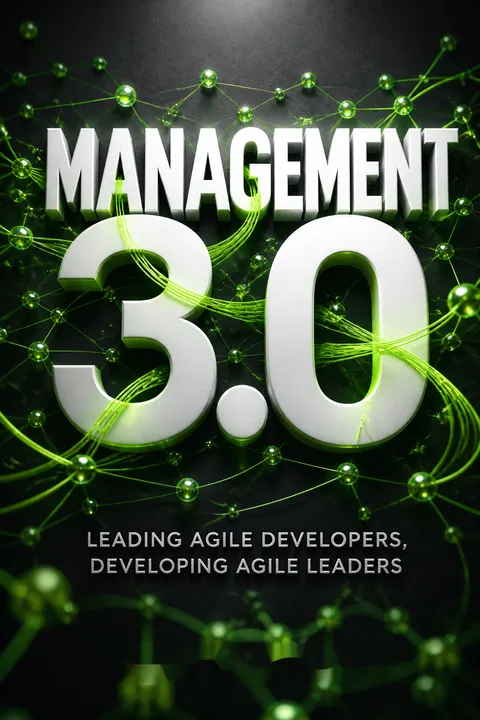
A different management lens. Management 3.0 is Appelo’s model for managing Agile organizations as complex adaptive systems: groups of people who interact, learn, and change in response to experience. Its six views are energizing people, empowering teams, aligning constraints, developing competence, growing structure, and improving everything. Together, they shift management from controlling every action to shaping the conditions in which useful work can emerge.
What's striking is how the failed startup story makes the book's central argument concrete: managerial confidence is not the same as predictive power. The model treats management as a set of responsibilities rather than a heroic individual role, which is a useful corrective to both command-and-control and leader-as-savior myths. Its limitation is that the living-systems analogy can tempt managers to overstate what biology proves about workplaces. The analogy is most valuable as a warning against false certainty, not as a literal operating manual.
Build innovation by connecting knowledge, creativity, motivation, diversity, and character
Five conditions feed innovation. Appelo describes software teams as systems that turn information into new products and useful changes. That transformation depends on five connected elements: knowledge to understand problems, creativity to generate original and useful ideas, motivation to act, diversity to widen the available perspectives, and personality traits that shape how people work together.
Ideas need implementation. Creativity is not a mysterious flash reserved for artists. It can move through preparation, incubation, insight, and testing. For example, a team investigating a slow website might discover that the bottleneck is its data model, not the queries or hardware it first blamed. But an idea creates business value only when someone tests it, improves it, and puts it to use. A lively brainstorming session is not yet innovation.
The five-part model is stronger than advice to simply hire creative people because it shows that innovation is produced by a system, not a personality type. Diversity matters most when different perspectives can connect and influence one another; difference without communication can become fragmentation. The practical test is whether information travels across roles and whether someone has the authority and time to act on what is learned. Without those links, creativity becomes performance theater: energetic talk with no change in the product.
Design work around intrinsic motivation, not bonus schemes
Rewards can distort work. Extrinsic motivation uses outside incentives, such as bonuses or prizes, to prompt behavior. Appelo warns that these incentives can shift attention toward what is rewarded, weaken interest in the work itself, and set colleagues against one another. A bonus for finishing quickly, for instance, may encourage speed at the expense of quality. The danger is not that every reward fails, but that consequences in a complex team are hard to predict.
Find the real drivers. Intrinsic motivation comes from the activity and its meaning. People often want to feel capable, exercise choice, belong to a group, satisfy curiosity, and contribute to a purpose. Herzberg’s distinction is useful: adequate pay and safe conditions prevent dissatisfaction, but they do not necessarily make work engaging. Managers can ask what would help each person do better work, then adjust responsibilities and the environment accordingly.
The argument usefully separates fair working conditions from the deeper reasons people invest effort. That distinction prevents a common management mistake: treating a salary increase as a substitute for autonomy, mastery, or respect. Yet intrinsic motivation is not a cure-all. Some work is repetitive, and compensation remains a matter of fairness, not merely psychology. The strongest application is therefore not to abolish external rewards by decree, but to avoid using them as the primary lever for creative, interdependent work.
Empower teams because distributed decisions handle complexity better
Self-organization is ordinary. It means people arrange their own work and relationships without every decision being imposed from above. It is not the same as anarchy: teams still operate within boundaries, goals, and laws. Appelo argues that no manager can hold a complete picture of a complex project. Team members each possess partial information, so the group often makes better local decisions than a distant manager could.
Give away control deliberately. Empowerment is more than handing over a task. It means granting authority, trust, and room to learn. Appelo recommends matching the level of authority to people’s capability, from telling and consulting to advising or fully delegating. The manager’s job resembles a gardener’s: shape the conditions and protect the system, rather than pulling every plant into the desired shape by hand.
Distributed decision-making is compelling when information is scattered among people doing the work. It can reduce delays and let teams respond to details management cannot see. But delegation without clear authority, skill, or accountability is abandonment dressed up as empowerment. The useful question is not whether managers should control or let go, but which decisions belong closest to the relevant information and what safeguards protect everyone affected. Empowerment works best as a designed transfer of decision rights.
Set a shared purpose, clear authority, and safeguards for self-organizing teams
Direction is not micromanagement. A team’s intrinsic purpose is to produce software; a manager can also assign an extrinsic goal that gives the work direction. That shared goal should help people make decisions, not serve as a threat or a bonus formula. Teams may develop their own goals, too, so managers should surface conflicts and negotiate a workable compromise rather than assuming one stakeholder’s wishes represent the whole group.
Protect the conditions for work. Appelo identifies three management responsibilities: develop the self-organizing system, protect people and shared resources, and direct the system toward valuable outcomes. A boundary list can specify who decides what and at which authority level. Managers also need to set expectations for quality and intervene when people are mistreated or common resources are being overused. Freedom without protection can simply empower the strongest voices.
This view avoids the false choice between rigid rules and laissez-faire management. A shared purpose can coordinate action while leaving teams room to choose how to proceed. The difficult part is deciding whose purpose counts and how to resolve competing goals without disguising executive preference as consensus. Clear decision rights and protections make that negotiation more honest. A goal is useful when it helps people choose; it is less useful when it becomes a slogan displayed on a wall but disconnected from actual trade-offs.
Develop both skill and discipline instead of prescribing more process
Competence has two parts. Skill is the ability to do the work well. Discipline is the ability to apply sound practices reliably. A developer might understand testing but skip it under pressure; another might follow a checklist faithfully without knowing how to recognize a design problem. Strong teams need both, and managers should not confuse a certificate, a process document, or years of experience with demonstrated competence.
Use several routes to learning. Appelo describes a progression from self-development and coaching through certification, useful tools, peer influence, supervision, and management. The manager’s role is to make the system support competence, not to impose rules for every possible situation. Measure more than one dimension, such as quality, delivery, and customer value, and give feedback close to the work. A single annual rating cannot capture the changing contribution of a complex team.
Separating skill from discipline is a practical diagnostic: it helps distinguish not knowing how from not reliably doing. The broader point is that competence develops through multiple channels, so training alone cannot fix every performance problem. Still, measurement can create its own distortions if teams optimize for visible indicators rather than outcomes. Metrics are best treated as signals to investigate, not verdicts on a person. The manager’s craft lies in combining evidence with context and helping people improve without reducing their work to a score.
Treat communication as verified understanding, not information sent
Messages lose meaning in transit. A sender translates thoughts into words or gestures; the message travels through a medium; a receiver interprets it through different experiences and assumptions. Any step can distort the meaning. Appelo therefore treats communication as incomplete until people check that they understand one another. An SOS signal is only meaningful to someone who knows what it signifies and can respond.
Structure shapes who talks. Organizations are social networks as well as hierarchies. Information often travels through relationships, not formal reporting lines. Teams need enough connection to share knowledge, but too many demands on attention can overwhelm them. Face-to-face discussion, visible work, and stable teams can help people build shared understanding. A good structure does not eliminate miscommunication; it makes feedback and correction easier.
The distinction between sending and understanding is a powerful antidote to the assumption that a memo, meeting, or dashboard has done its job. Feedback is not administrative overhead; it is evidence that meaning crossed the gap. The network perspective also explains why formal authority alone cannot manage information flow. Yet more connection is not always better: constant communication can consume the attention needed for focused work. The design challenge is to create reliable channels for consequential information while allowing people room to concentrate.
Grow adaptable teams instead of freezing one ideal organization chart
Structure depends on context. Appelo argues that organization design changes with the environment, products, company size, and people. For project work, cross-functional teams often reduce handoffs because the people needed to deliver value work together. Specialist groups can still make sense when expertise or shared services benefit from concentration. A hybrid organization can combine teams with functional communities, provided those groups serve projects rather than turning into control gates.
Keep teams identifiable and flexible. Appelo favors generalizing specialists: people with depth in one skill and enough breadth to help beyond it. Broad job titles and informal leadership make it easier to shift responsibilities as needs change. Research he discusses suggests small teams, often around five people and generally within a range of three to seven, are workable starting points, not universal laws. Long-lived teams have more time to develop trust and efficient communication.
The emphasis on adaptability is more useful than searching for a universally optimal chart. Cross-functional teams can shorten the path from idea to delivery, while specialist groups preserve depth and shared standards. The trade-off is real: spreading specialists across teams can weaken knowledge exchange, while centralizing them can create queues. The suggested team size is best read as a practical heuristic, not a scientific constant. Structure should be judged by how well it supports value delivery and learning in its particular setting.
Improve through experiments, feedback, and occasional radical changes
Change is not linear. Appelo describes teams as moving through a fitness landscape: a metaphor for the changing performance of different ways of working. Small adjustments can improve a team, but sometimes a larger shift is needed to escape a local optimum. A team may initially perform worse after adopting a new approach, then improve as it learns. Managers can also change the environment, such as contracts, team boundaries, or departmental policies, instead of repeatedly pushing the same team to behave differently.
Use three learning modes. Teams adapt to what experience reveals, explore by trying unfamiliar approaches, and anticipate what may be needed. Short delivery cycles and retrospectives make feedback available while there is still time to respond. Errors can expose assumptions and teach the team about its environment. Improvement is not a guarantee of rising performance at every step; it is a way to keep learning as conditions shift.
The landscape metaphor captures why improvement can involve temporary setbacks and why a team can become stuck despite sincere effort. It also encourages managers to examine environmental constraints rather than blaming individuals. The caution is that metaphors of peaks and fitness can suggest a measurable optimum where none exists. Teams serve different stakeholders, and performance involves trade-offs among speed, quality, cost, and human sustainability. Experiments should therefore specify what they hope to learn, not merely declare that a new practice is better.
Choose Agile practices by context, not loyalty to a method
No method fits every landscape. Scrum, Extreme Programming, Kanban, and other approaches offer useful but incomplete ways to organize work. Appelo’s central warning is against treating any framework or practice as universally correct. A method that helped one team may fail another because their skills, products, customers, and constraints differ. The environment also changes when a new practice or product enters it, so yesterday’s successful approach may need revision.
Use models as tools. Management 3.0 offers six views for examining people, teams, constraints, competence, structure, and improvement. It is not a formula that removes judgment. The book’s closing principle is that models simplify reality and therefore leave things out. Compare approaches, try them in real work, gather feedback, and adapt. The goal is not to prove that one camp is right, but to find what is useful in the present context.
The book’s pluralism is its most durable contribution: disagreement among methods can generate options rather than demand a winner. That stance is especially valuable in technical work, where local constraints often determine whether a practice helps. The challenge is avoiding relativism. If every method is merely context-dependent, teams still need criteria for deciding: customer value, quality, learning, and sustainability provide a defensible starting set. Contextual judgment is not permission to do anything; it is the responsibility to explain why a choice fits.
Analysis
Management 3.0 is strongest when read as a theory of managerial attention. It asks managers to stop treating their own decisions as the main engine of productivity and instead attend to the conditions that let a team make sound decisions: motivation, authority, competence, communication, purpose, and feedback. This is a practical shift, not a call to abolish management. The manager remains accountable for boundaries, shared resources, and organizational direction, while yielding many local choices to people with better information.
The book’s complexity language serves as a useful corrective to linear planning, but it also creates a risk. Scientific concepts such as emergence, attractors, and fitness landscapes can illuminate organizational behavior without proving that a particular workplace practice will succeed. The author recognizes that models are incomplete, though some of the metaphors can sound more decisive than the evidence allows. Managers should use them to ask better questions, not to dress intuition as science.
The framework is also notably human-centered without being sentimental. Motivation is connected to agency and belonging, while competence is tied to skill and discipline. Teams are not presumed to be virtuous simply because they self-organize. They need safeguards, clear purpose, and the capacity to learn. This balance distinguishes the argument from both authoritarian control and romantic visions of leaderless work.
Its practical challenge is integration. The six views overlap, and changing one can affect the others. A new team structure alters communication; new authority changes motivation; new metrics influence behavior. No checklist can fully anticipate those interactions. The most defensible use of Management 3.0 is as a diagnostic map: identify the constraint that matters now, intervene modestly, observe consequences, and revise. The aim is not perfect prediction, but a more capable organization that can respond without waiting for one manager to know everything.
Review Summary
Management 3.0 receives high praise for its innovative approach to leadership and agile development. Readers appreciate its practical advice, comprehensive overview, and theoretical foundations in complexity theory. Many find the humor and writing style engaging, though some struggle with its density. The book's strengths include its scientific approach, actionable insights, and extensive references. Critics note that some ideas may be outdated, and the content can be overwhelming. Overall, it's considered a valuable resource for managers seeking to improve their agile leadership skills, despite occasional challenges in readability.
People Also Read








Glossary
Management 3.0
Complexity-based management modelJurgen Appelo’s model for managing Agile organizations as complex adaptive systems. It offers six connected views: energize people, empower teams, align constraints, develop competence, grow structure, and improve everything. The model is a way to examine management responsibilities, not a fixed sequence of steps or a universal recipe.
Information-Innovation System
Information converted into innovationAppelo’s description of how an organization uses information to produce useful novelty. Knowledge, creativity, motivation, diversity, and personality interact to help people develop and implement ideas. The system emphasizes that innovation depends on people and on the conditions that let ideas become products, services, or improvements.
Self-Organization
Order formed without central directionThe process by which a system develops patterns or structure without an authority directly planning each detail. In a team, members coordinate work and create local practices through interaction. Self-organization does not guarantee valuable outcomes, so organizations still need goals, boundaries, and protection of people and shared resources.
Darkness Principle
No agent knows the whole systemA principle stating that each participant in a complex system has only partial knowledge of the system’s behavior. If one agent contained the complete complexity of the whole, that complexity would reside in that agent. In teams, the principle supports collective planning and local decision-making rather than reliance on one person’s mental model.
Conant-Ashby Theorem
Control requires a system modelThe theorem states that an effective regulator must have a model of the system it controls. A manager’s ability to make good decisions depends on the quality of available information and the accuracy of that mental model. Complex projects are difficult to model centrally, which supports distributing decisions closer to the work.
Discipline-Skill Grid
Separates reliable practice from abilityA two-dimensional way to consider competence. Skill concerns a person’s ability to perform work well; discipline concerns applying sound practices consistently. Someone may be skilled but unreliable, or disciplined but not yet capable. The distinction helps managers choose whether a problem calls for training, support, or more reliable routines.
Subsidiarity Principle
Decisions stay at the lowest capable levelAn organizing principle that assigns decisions to the smallest or least centralized authority capable of handling them effectively. Applied to teams, it favors local rulemaking when individuals or teams can do the work well. A higher level should intervene when it can demonstrate that coordination or effectiveness requires it.
Fitness landscape
Map of changing system performanceA metaphor for the different possible configurations of a system and how well each fits its environment. Changes in people, tools, features, or practices move a team to a different position. The landscape can change as the environment changes, so a once-effective approach may lose value and require another adjustment.
Red Queen’s Race
Improve to avoid falling behindAn evolutionary metaphor for systems that must keep changing just to maintain their relative position. Competing products, users’ rising expectations, and changing environments can make yesterday’s success insufficient. In software, continuous improvement may preserve relevance rather than produce an ever-increasing advantage.
Panarchy
Overlapping networks of authorityA model of governance in which people and groups participate in multiple overlapping networks of collaboration and authority. In an organization, different groups may set standards or provide expertise, while a management hierarchy still carries formal authorization. The concept presents organizational structure as a network rather than a single chain of command.
FAQ
What's Management 3.0 about?
- Agile Management Focus: Management 3.0 by Jurgen Appelo emphasizes adapting management practices to support Agile software development, integrating complexity theory with practical strategies.
- Complex Adaptive Systems: The book views organizations as complex adaptive systems, helping managers understand team dynamics and the unpredictability of outcomes.
- Six Views Model: It introduces six key views: Energize People, Empower Teams, Align Constraints, Develop Competence, Grow Structure, and Improve Everything, providing a comprehensive framework for Agile management.
Why should I read Management 3.0?
- Practical Guidance: The book offers actionable insights for managers adapting to Agile methodologies, making it a valuable resource for leadership roles.
- Addressing Management Gaps: It fills a gap in literature by focusing on the role of managers in Agile settings, often overlooked in other resources.
- Engaging Style: Jurgen Appelo's writing is accessible and engaging, using humor and real-world examples to make complex theories understandable.
What are the key takeaways of Management 3.0?
- People-Centric Approach: Emphasizes that people are the most critical element in any organization, focusing on energizing and motivating teams.
- Self-Organization as Default: Teams naturally organize themselves, and managers should facilitate this process rather than impose rigid structures.
- Empowerment is Essential: Delegating authority and trusting teams to navigate challenges is crucial for effective management in complex systems.
What is the Management 3.0 model?
- Six Views Framework: Consists of Energize People, Empower Teams, Align Constraints, Develop Competence, Grow Structure, and Improve Everything, each addressing different aspects of managing Agile teams.
- Complexity Theory Integration: Recognizes organizations as complex adaptive systems, helping managers understand team interactions and emergent behaviors.
- Practical Application: Each view is supported by practical techniques and strategies that managers can apply in their organizations.
How does Management 3.0 define self-organization?
- Natural Team Behavior: Described as the natural behavior of teams, organizing activities without central authority, fundamental to Agile operations.
- Emergent Properties: Self-organization leads to emergent properties, where the whole is greater than the sum of its parts, achieving outcomes beyond individual capabilities.
- Context Matters: Influenced by the context in which teams operate, managers must create environments that support and encourage self-organization.
What are the best quotes from Management 3.0 and what do they mean?
- Complex Problems Quote: "For every complex problem there is an answer that is clear, simple, and wrong." Highlights the need for nuanced understanding of complexity in management.
- Self-Organization Definition: "Self-organization is the process where a structure or pattern appears in a system without a central authority." Reflects the core principle of Agile management.
- Employee Well-being Quote: "People who feel good about themselves produce good results." Emphasizes the link between employee well-being and productivity.
How does Management 3.0 address motivation?
- Intrinsic vs. Extrinsic Motivation: Focuses on intrinsic motivation driven by personal satisfaction over extrinsic rewards, fostering creativity and innovation.
- Ten Desires of Team Members: Outlines ten intrinsic desires like competence, autonomy, and relatedness, crucial for motivating teams.
- Eliminating Demotivation: Emphasizes identifying and eliminating factors that demotivate employees to enhance motivation and performance.
What is the relationship between diversity and innovation in Management 3.0?
- Diversity as a Strength: Argues that diversity enhances creativity and problem-solving, leading to more innovative solutions.
- Connectivity Over Gender: Emphasizes diversity focusing on connectivity and collaboration rather than just demographic factors.
- Inclusive Diversity: Introduces inclusive diversity, balancing common ground with valuing diverse perspectives for effective teamwork.
How can managers implement the principles of Management 3.0?
- Adopt the Six Views: Integrate the six views of the Management 3.0 model into leadership practices, focusing on energizing people and empowering teams.
- Encourage Self-Organization: Allow teams to self-organize, enhancing collaboration and innovation by creating a supportive context.
- Focus on Continuous Improvement: Promote a culture of continuous improvement through retrospectives and open discussions about team processes.
What is the SLIP model in Management 3.0?
- Simple Linear Improvement Process: Consists of eight steps for continuous improvement, providing a structured approach to managing efforts.
- Iterative Nature: Emphasizes that improvement is not always linear, reflecting the reality of navigating complex systems.
- Feedback and Learning: Incorporates feedback loops to ensure teams learn from experiences, allowing for adjustments based on outcomes.
How does Management 3.0 address the concept of failure?
- Learning from Mistakes: Posits that errors and failures are valuable learning opportunities, leading to greater insights and improvements.
- Postponing Failure: Defines success as the ability to postpone failure, encouraging resilience and adaptability over perfection.
- Iterative Process: Views failure as integral to the iterative process, encouraging experimentation and adaptation based on experiences.
What role does communication play in Management 3.0?
- Foundation of Trust: Essential for building trust within teams, fostering a collaborative environment through transparency and openness.
- Facilitating Change: Helps facilitate change by ensuring everyone understands goals and processes, reducing resistance and encouraging buy-in.
- Enhancing Collaboration: Emphasizes communication's role in enhancing collaboration, leading to better coordination and effective teamwork.
Download PDF
Download EPUB
.epub digital book format is ideal for reading ebooks on phones, tablets, and e-readers.








