

Key Takeaways
Treat Pure O as OCD with hidden rituals, not thought-only OCD
The ritual may be invisible. The label Pure O is sometimes used when obsessions dominate and compulsions are hard for others to see. But the compulsions are usually present: they can be mental checking, avoidance, repeated reassurance seeking, or confessing thoughts to someone else. Anthony avoids a jacket linked to a sneeze; Sophie repeatedly tests whether she loves her parents; Lou avoids time with his son to escape thoughts about losing their closeness.
Relief keeps the loop alive. These actions may calm distress briefly, but the relief reinforces the response, making it more likely to recur when the thought returns. The cost can be lost time, narrowed choices, and strained relationships. The book’s examples are composites based on patients, not diagnostic tests for readers.
The distinction between visible symptoms and hidden rituals matters clinically because behavior can look like ordinary caution, reflection, or affection from the outside. A person may appear to be merely thinking, while privately repeating a checking routine or steering away from triggers. This also cautions against treating every repeated worry as OCD: the pattern, distress, impairment, and function of the behavior matter. A qualified clinician can help distinguish OCD from other conditions and identify rituals that the person may not recognize as rituals.
Treat intrusive thoughts as mental events, not evidence about reality
Thoughts can feel literal. Cognitive fusion is the experience of a thought and what it refers to becoming entangled, so the mind and body react as if the thought were reality. Anthony knows his jacket is not physically covered in mucus, yet the image of the sneezer makes it feel contaminated. Sophie’s fear that she might not love her parents feels like evidence of lovelessness, while Lou experiences an imagined future distance from his son as an existing loss.
Target the stickiness. The book’s central move is not to prove each thought false or force it away. It is to change the relationship to the thought. Cognitive defusion means experiencing a thought as a thought, distinct from the event, object, or future it describes. The thought may remain; it need not dictate behavior.
This distinction resembles a basic principle of scientific reasoning: a representation of an event is not the event itself. A forecast can prompt useful preparation without becoming proof that the predicted storm has arrived. In OCD, however, emotional intensity can be mistaken for evidential strength. Defusion offers a way to notice that mismatch without arguing endlessly with the thought. The approach is not a claim that thoughts never contain useful information. It asks whether a thought is actionable and proportionate, rather than letting vividness alone decide.
Notice the alarm without mistaking it for proof of danger
Anxiety is a warning system. The book traces anxiety to the body’s threat response: faster heart rate, tense muscles, and narrowed attention prepare a person to act. That response can protect against real danger, but it can also activate in response to a word, image, memory, or imagined possibility. The mind becomes more alert to threat and more likely to interpret ambiguity negatively.
A warning is not a verdict. LeJeune compares anxiety to a sensitive smoke alarm that sometimes sounds when there is no fire. The signal deserves notice, but it does not by itself establish that danger is present. If the alarm is treated as the fire, attempts to escape or suppress it may intensify the response. Pausing to identify bodily sensations and the thought attached to them can create room to choose a response.
The alarm metaphor is useful because it separates a signal from its interpretation. Threat systems are designed to favor detection over precision, a sensible tradeoff when missing danger is costly. In everyday life, the same bias can make uncertain situations feel more threatening than they are. Still, the metaphor should not become a reason to dismiss physical symptoms or genuine hazards. Its value is in encouraging a second question: what evidence exists beyond the feeling of alarm? That distinction supports both sensible caution and less automatic avoidance.
Test the magical bargain between mental rituals and imagined outcomes
Rituals promise control. In OCD, a person may perform an action on one level to influence an outcome on another, despite no clear causal link. Judy studies for an exam while watching clock numbers, clearing her throat, and entering her room in a particular way. The rituals briefly reduce her anxiety and feel connected to success, even though studying is what prepares her for the test.
Name the bargain. The book calls this kind of link sympathetic magic and uses the image of a rain dance: controlling one thing here in hopes of controlling something there. Similar patterns can be subtle, such as mentally neutralizing a disturbing thought or checking for reassurance. Labeling a ritual as an attempt to control uncertainty can expose the difference between practical preparation and an anxiety-relieving act that has no reliable effect on the outcome.
Rituals are not inherently irrational. Shared ceremonies can mark transitions, express belonging, and offer structure, even when they do not physically cause an outcome. The clinically important distinction is the ritual’s function and rigidity: does it express a chosen meaning, or must it be repeated to neutralize feared uncertainty? Research on ritual across cultures suggests that uncertainty often invites structured action. That context helps explain the impulse without treating every symbolic act as pathology. In OCD, the burden emerges when relief depends on repetition and ordinary life shrinks around it.
Treat imagined futures as possibilities, not verdicts on today's choices
The mind makes time feel fixed. Time fusion is when thoughts about the future or past are experienced as if they were present, settled realities. Miguel imagines that one job choice will make him happy and the other will ruin his life, so he delays choosing. His imagined future self, full of regret, seems more real than the uncertain outcomes he cannot yet know. Regret can work similarly, making a past decision feel changeable and demanding action now.
A choice is a starting point. The book argues that outcomes depend not only on the initial decision, but on what follows: effort, communication, and adaptation. Keeping options open also has a cost. Drawing on research about maximizing and satisficing, LeJeune suggests using a good-enough standard for many decisions rather than trying to prove that no better option exists.
Decision science distinguishes uncertainty that can be reduced with information from uncertainty that remains even after careful research. Miguel treats an unknowable future as though more analysis will reveal a guaranteed correct door. That strategy can become an avoidance behavior rather than better decision-making. A practical test is whether further deliberation is generating new evidence or recycling the same imagined outcomes. The author’s emphasis on commitment is useful, though not every choice should be rushed: consequential decisions deserve proportionate inquiry, followed by acceptance that certainty is unavailable.
Separate the observing self from the alarming story it hears
A thought is part of experience. The contextual self, also called self-as-context, is the perspective from which a person notices thoughts, feelings, memories, and sensations. It differs from the conceptual self, the changing story a person tells about who they are. Carl fears that violent images mean he is secretly dangerous; the book distinguishes the imagined person in a thought from the person observing it and acting according to his values.
Make room without self-erasure. LeJeune uses the image of a sky that contains changing clouds: thoughts and feelings can pass through awareness without defining the whole person. A simple practice is to notice an experience as something being observed, rather than equating it with identity. This is not a claim that a permanent inner essence has been scientifically established; it is an ACT perspective-taking exercise intended to loosen identification with distressing mental content.
The observing-self idea can be understood as a useful shift in perspective rather than a metaphysical discovery. In cognitive science, people routinely monitor their own thoughts and revise their responses, even while the feeling of a unified self remains compelling. The exercise can reduce shame by separating an unwanted image from a person’s chosen conduct. It should not be used to excuse actions or bypass accountability. Thoughts alone do not establish intent, but behavior, context, and clinical assessment still matter when evaluating risk.
Use LLAMP to move from noticing distress toward values-led action
Five skills form the route. LLAMP is LeJeune’s flexible set of practices: Label what is happening, Let go of the struggle, Accept thoughts as thoughts, use Mindfulness to notice the present, and Proceed with Purpose by acting in line with values. The steps can be used together or selectively. Labeling might mean naming a thought as an anxious prediction; letting go means easing the effort to suppress it; acceptance means allowing it to be present without treating it as fact.
Then choose the next move. Mindfulness brings other parts of the moment into awareness, while purpose points toward what matters beyond immediate relief. The skills are not meant to guarantee calm or make thoughts disappear. They aim to create enough flexibility to respond differently. For someone with OCD, that may mean approaching a trigger or declining a familiar reassurance ritual.
LLAMP turns a broad therapeutic philosophy into a memorable sequence, while its flexibility avoids making the sequence another rule to perform perfectly. That matters because an anxious person can turn even a coping method into a required ritual. The strongest interpretation is functional: use whichever skill helps restore choice, not whichever one feels most complete. The acronym also resembles skill-based approaches in emotion regulation, where noticing, tolerating, and redirecting attention precede action. Its usefulness depends on practice and fit, not on reciting the letters correctly.
Widen attention until obsession becomes one part of the present
Bring in the surroundings. Obsessive thinking can narrow awareness until a private story crowds out what is happening nearby. Mindfulness means noticing present experience with openness, including bodily sensations, sounds, sights, and thoughts, without needing to judge or change each one. LeJeune suggests sensory exercises, mindful walking, body scans, and watching thoughts pass like trains at a station.
Practice outside meditation. Cooking, walking, listening to music, or spending time with a pet can all develop attention to the present. The aim is not to use these activities to block unwanted thoughts. Instead, the thought remains one part of a larger moment. A person can notice the fear and also notice the chair beneath them, a conversation, or the task they chose to do.
Attention is selective: what occupies the foreground can make everything else seem absent. Broadening awareness is therefore not a distraction in the dismissive sense; it changes the proportion of experience taken up by an obsession. This resembles attentional training used in several psychological approaches. A useful caution is that mindfulness can itself become avoidance if it is used only to escape a thought or force calm. The distinction is intention: openness includes the unwanted thought, while escape requires it to disappear before life can continue.
Let values set direction while anxiety reports the weather
Feelings describe conditions, not destination. LeJeune compares values to a compass and feelings to a barometer. Anxiety can signal that a choice may be difficult, but it does not determine whether the choice is worthwhile. Anthony values connection with his girlfriend Lisa, yet fear of change keeps him protecting a solitary routine. Clarifying what matters helps him see that avoiding discomfort is not the same as choosing the life he wants.
Values are not moods or targets. They are ongoing qualities of action, unlike feelings that fluctuate or goals that can be completed. A person may value intimacy while feeling uncertain, or value meaningful work while having a difficult day. The book’s Values Mall exercise asks readers to allocate a limited budget across areas of life, making tradeoffs visible and prompting reflection on what deserves time and energy.
Values-based action offers a decision standard when emotional certainty is unavailable. It does not require anxiety to be ignored; weather reports matter, but they are not a destination. The distinction also protects against confusing a specific goal with the quality that made it meaningful. A goal can change while the value remains, allowing adaptation instead of rigid pursuit. One limitation is that values may conflict, and people can feel pressure to describe socially approved priorities. Reflection should uncover personally meaningful directions, not produce a morally correct shopping list.
Practice planned exposures, even when progress arrives unevenly
Approach what avoidance protects. Exposure and response prevention, or ERP, involves deliberately encountering triggers while reducing the rituals or avoidance that bring temporary relief. Anthony photographs and rates sidewalk feces, uses public bathrooms, and wears the jacket he had avoided. The point is not to prove that every feared thought is false, but to make room for discomfort while returning to valued activities. ACT adds labeling, acceptance, mindfulness, and purpose to this behavioral work.
Make the plan concrete. LeJeune recommends listing obsessions, triggers avoided, and compulsions performed, then setting modest weekly commitments to approach triggers or reduce rituals. Progress can include setbacks. Lou initially spends more time with his son but slips into seeking reassurance; a different therapist and more direct exposure help him reconnect through shared exploration. The account treats improvement, not perfect symptom disappearance, as the practical aim.
The integration of exposure with values helps explain why treatment is more than enduring distress for its own sake: the exposure serves a life the person wants to reclaim. Behavioral learning research also supports approaching feared cues without relying on the usual safety behavior, although anxiety does not always decline within a session and should not be the only measure of success. The cases usefully show that treatment fit matters. Self-help plans can support change, but severe impairment, uncertainty about diagnosis, or difficulty reducing rituals warrants guidance from an OCD-informed professional.
Analysis
The book’s central contribution is a change in target. Rather than treating intrusive thought content as the enemy, it focuses on the relationship between thought, alarm, and response. This reframing is especially valuable for less visible OCD, where mental review, avoidance, reassurance, and confession can be mistaken for ordinary reflection. The cases make those functions legible: the jacket, the parent calls, and the missed time with a child are not unrelated quirks, but different attempts to obtain relief from uncertainty.
The framework also joins two strands of OCD care that can be presented as competitors: exposure and response prevention, which changes behavior, and acceptance and commitment therapy, which emphasizes psychological flexibility and values. LLAMP makes the latter practical, while the examples show it operating alongside exposure. Its best promise is not instant calm, but the ability to act while uncertainty and distress remain.
Several distinctions deserve careful handling. Cognitive fusion is a clinical model for describing experience, not a literal claim that thoughts and reality become identical. The contextual self is similarly best understood as a perspective-taking tool, not proof of an unchanging inner entity. The evolutionary account of threat bias is explanatory but broad, and the book’s vignettes illustrate mechanisms rather than establish treatment efficacy. Likewise, intrusive harm thoughts alone do not determine whether someone poses a risk; assessment must consider behavior and context.
The treatment message is strongest when held with appropriate humility. Anxiety can signal a genuine problem, and reasonable safety measures remain important. The task is to distinguish proportionate action from repetitive attempts to secure certainty that cannot be obtained. For readers with significant impairment, the book’s exercises are best treated as a guide to discussion with an OCD-informed clinician, particularly because exposure planning should be individualized. Taken together, the work offers a humane and memorable account of how a person can stop organizing life around the demand that the mind become quiet first.
Review Summary
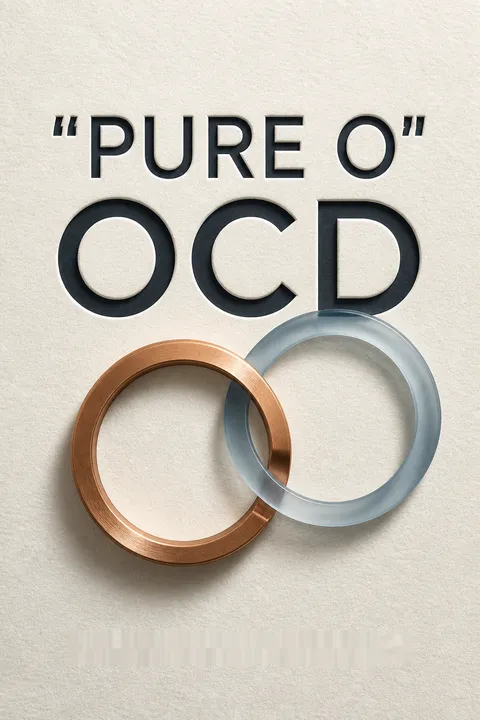
"Pure O" OCD receives high praise from readers for its insightful approach to OCD, particularly the "Pure O" variant. Reviewers appreciate the book's clear explanations of mindfulness, ACT, and cognitive fusion. Many found the examples and practical tools provided extremely helpful in managing anxiety and intrusive thoughts. Readers highlight the author's deep understanding of OCD and his ability to address less common themes. The book is lauded for its validating and empowering content, offering new perspectives on self-concept and anxiety management. Overall, it's considered a valuable resource for those with OCD and anxiety disorders.
People Also Read


Glossary
Pure O
OCD with hidden compulsionsAn unofficial label for OCD in which obsessions appear to dominate and compulsions are not readily visible. The compulsions may include mental rituals, avoidance, reassurance seeking, or repeatedly discussing thoughts. The term does not mean that compulsions are absent; it highlights how easily they can be missed by other people or by the person experiencing them.
Cognitive fusion
Thought and reality feel joinedAn ACT term for experiencing a thought as though it were the reality it describes. A person may intellectually know that an imagined event is only a thought while still reacting emotionally and physically as if it were happening. In OCD, this felt merging can make intrusive thoughts seem dangerous, meaningful, or demanding of immediate control.
Cognitive defusion
Seeing thoughts as thoughtsA set of ACT processes that help a person experience thoughts as mental events rather than as literal facts or commands. Defusion does not require eliminating, disproving, or agreeing with a thought. Methods can include labeling it, repeating its words, viewing it as an image, or noticing it while attending to other parts of the present moment.
Time fusion
Past or future feels presentLeJeune’s term for becoming entangled with thoughts about the past or future as if they were immediate, fixed realities. A feared future can seem inevitable, while regret can make an unchangeable past feel as though it must be corrected now. The term applies cognitive fusion to how people experience time in worry, indecision, and rumination.
Contextual self
Perspective that notices experienceAn ACT concept for the observing perspective from which a person notices thoughts, emotions, memories, and sensations. It is distinguished from the conceptual self, the changing story a person holds about their identity. The contextual self is used as an experiential perspective, helping people notice difficult mental content without treating it as the whole of who they are.
LLAMP
Five flexible ACT skillsLeJeune’s acronym for five skills used to respond differently to obsessive thoughts: Label, Let go, Accept, Mindfulness, and Proceed with Purpose. The skills help a person notice what is happening, ease the struggle to control thoughts, allow them as thoughts, broaden awareness of the present, and choose behavior guided by personal values. They can be combined or used selectively.
Exposure and response prevention
Approach triggers, reduce ritualsA behavioral treatment for OCD that involves intentionally encountering feared thoughts, objects, or situations while refraining from the compulsions or avoidance normally used for relief. Repeated practice can help weaken the cycle that links a trigger to ritualized relief. In this book, ERP is presented as compatible with ACT skills that support acceptance and values-guided action.
Sympathetic magic
Ritual meant to control outcomesA term for rituals based on an assumed correspondence between two things that lack a clear causal connection. In OCD, a person may use a thought, count, or action to feel that a separate outcome has been controlled. LeJeune uses the concept to explain how rituals can reduce anxiety temporarily while reinforcing a perceived link between ritual and safety or success.
FAQ
What's “Pure O” OCD about?
- Focus on Obsessive Thoughts: “Pure O” OCD by Chad LeJeune explores a form of obsessive-compulsive disorder characterized by intrusive thoughts without visible compulsions.
- Acceptance and Commitment Therapy (ACT): The book introduces ACT as a therapeutic approach to manage these thoughts, emphasizing acceptance over control.
- Cognitive Fusion: A key concept is cognitive fusion, where thoughts are perceived as reality, increasing anxiety.
- Practical Skills: LeJeune provides practical skills, encapsulated in the acronym LLAMP, to help manage thoughts and live a fulfilling life.
Why should I read “Pure O” OCD?
- Expert Guidance: Chad LeJeune is a recognized expert, offering evidence-based strategies for managing OCD.
- Empowerment Through Understanding: The book empowers readers by helping them understand their thoughts and reclaim control over their lives.
- Comprehensive Approach: It addresses both symptoms and underlying cognitive processes, making it a holistic resource.
- Relatable Stories: Real-life examples help readers connect with the material on a personal level.
What are the key takeaways of “Pure O” OCD?
- Understanding Cognitive Fusion: Recognizing cognitive fusion is crucial for managing OCD, as it explains how thoughts become sticky and lead to suffering.
- Five Skills for Defusion: The LLAMP skills help create distance from thoughts, allowing for a values-driven life.
- Acceptance and Commitment Therapy: ACT focuses on accepting thoughts rather than trying to control them, leading to improved mental well-being.
- Values-Based Living: The book encourages aligning actions with personal values rather than being driven by fear.
What is cognitive fusion, as defined in “Pure O” OCD?
- Thoughts and Reality Merging: Cognitive fusion occurs when individuals fail to distinguish between thoughts and reality, experiencing thoughts as threats.
- Impact on Behavior: This fusion can lead to compulsive behaviors and a cycle of avoidance and distress.
- Path to Defusion: Strategies are provided to recognize and interrupt cognitive fusion, helping individuals manage OCD effectively.
What are the five skills introduced in “Pure O” OCD?
- Label: Observing and identifying thoughts and feelings to create a sense of defusion.
- Let Go: Relaxing the struggle with thoughts, allowing them to exist without judgment.
- Accept: Recognizing thoughts as just thoughts, reducing their power over actions.
- Mindfulness: Grounding in the present moment, fostering non-judgmental observation of thoughts.
- Proceed with Purpose: Acting in alignment with values, leading to a more fulfilling life.
How does “Pure O” OCD address the treatment of OCD?
- Acceptance and Commitment Therapy (ACT): Focuses on changing the relationship with thoughts rather than eliminating them.
- Exposure and Response Prevention (ERP): Acknowledges ERP's role in treating OCD, encouraging engagement with obsessions while resisting compulsions.
- Holistic Understanding: Addresses both cognitive and behavioral aspects, helping readers develop effective coping strategies.
What specific methods does “Pure O” OCD recommend?
- Labeling Thoughts: Labeling obsessive thoughts as just thoughts to reduce their emotional impact.
- Defusion Techniques: Techniques like visualizing thoughts as clouds or singing them to a tune help separate individuals from their thoughts.
- Mindfulness Practices: Staying present and aware of experiences through mindfulness, focusing on breath and bodily sensations.
How does “Pure O” OCD define acceptance?
- Openness to Experience: Acceptance involves experiencing thoughts and feelings without trying to change them.
- Separation from Self: Recognizing thoughts as separate from oneself, understanding they don't define the individual.
- Ongoing Process: Acceptance is a continuous practice requiring patience and effort to cultivate.
What role does mindfulness play in “Pure O” OCD?
- Present Moment Awareness: Mindfulness helps reduce the power of obsessive thoughts by focusing on the present.
- Non-Judgmental Observation: Observing thoughts and feelings without judgment fosters acceptance.
- Integration with Other Skills: Enhances the effectiveness of LLAMP skills, supporting overall mental well-being.
How can I apply the skills from “Pure O” OCD in my life?
- Create a Problem List: Identify specific obsessive thoughts, triggers, and compulsions to work on.
- Develop a Commitment List: Make weekly commitments to face thoughts and reduce avoidance behaviors.
- Practice Regularly: Consistent practice of labeling, letting go, and mindfulness strengthens management of obsessive thoughts.
What are some common misconceptions about “Pure O” OCD?
- Invisible Compulsions: Misconception that OCD only involves visible compulsions; “Pure O” includes mental rituals and avoidance.
- Thoughts as Reality: Belief that intrusive thoughts indicate character or intentions; the book clarifies they are experiences to manage.
- Misdiagnosis: Subtle nature of “Pure O” can lead to misdiagnosis; recognizing the full spectrum of symptoms is crucial.
What are the best quotes from “Pure O” OCD and what do they mean?
- “Don’t target the thoughts; target the stickiness.”: Focus on reducing the emotional grip of thoughts rather than eliminating them.
- “You are the observer, and the experience is whatever you observe.”: Emphasizes the distinction between self and thoughts, promoting agency.
- “The alarm is not the fire.”: Anxiety is often a false alarm, not a reflection of reality, encouraging healthier responses to thoughts.
About the Author
Other books by Chad Lejeune
Download PDF
Download EPUB
.epub digital book format is ideal for reading ebooks on phones, tablets, and e-readers.








