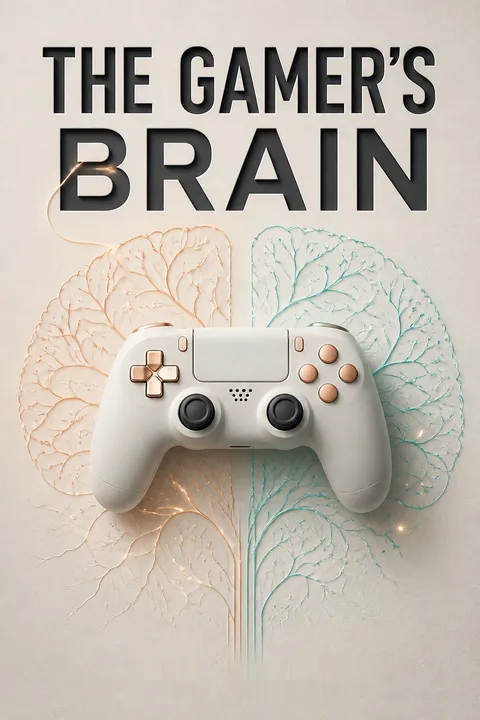


Key Takeaways
Design for the player's mind, not the developer's mental model
The experience happens in the player. A game is not the design team’s intention or the code running underneath. It is what players perceive, understand, and do when they meet the game. The distance between those versions can be large: a designer sees an obvious prompt because they already know what it means; a new player may see a loading screen and wait. Hodent calls for using cognitive science and user experience practice to narrow that gap, not to make every game easier or alike.
Skip the brain magic. The book warns against neuroscience claims that turn complicated mental processes into simple tricks. There is no guaranteed formula for a hit. The practical value comes from understanding human limits, then testing whether the intended experience is actually reaching its audience.
What's compelling is the shift from judging a game by its blueprint to judging it by the encounter it creates. That principle resembles a useful distinction in engineering: a system can satisfy its specification and still fail its users. The emphasis on cognitive science is strongest when treated as a source of hypotheses, not a bag of universal laws. Players differ in experience, culture, ability, and goals, so scientific principles can orient design, but observation must decide whether a particular design works.
Test what players perceive, because obvious usually means familiar to you
Perception is constructed. People do not receive the game world like a camera recording a scene. Prior knowledge, expectations, context, and sensory differences shape what they notice and what it means to them. A symbol that instantly reads as a floppy disk to one generation may be meaningless to someone who has never seen one. In a Street Fighter image made from colored blocks, experienced players may recognize characters while others see only abstract shapes.
Design for discovery. Hodent describes PC players getting stuck at No Man’s Sky’s opening prompt because they interpreted it as a loading message, not an instruction. Developers cannot reliably predict such misunderstandings from inside the project. Test icons and interface cues with the intended audience, and watch people play before deciding that a sign is clear.
This section makes a useful point about expertise: experience improves pattern recognition, but it can also hide the work required of newcomers. That tension appears in many forms of technical communication, where specialists mistake learned conventions for universal ones. Testing should include more than a single imagined novice, however. A design may be legible to genre veterans and confusing to new players, or the reverse. The important question is not whether one interpretation is correct in theory, but whether the intended audience reaches the right interpretation in practice.
Spend attention on core play, not on avoidable memory work
Attention is scarce. Working memory, the temporary mental workspace used to hold and manipulate information, can manage only a few items at once. Trying to juggle several demanding tasks makes each harder. Players can also miss a dramatic event when attention is fixed elsewhere, a phenomenon called inattentional blindness. A flashing cue is no guarantee that its message registered.
Design for forgetting. In Ebbinghaus’s classic self-experiment, memory for meaningless syllables dropped sharply: roughly 40 percent was gone after 20 minutes and around 70 percent after a day. Meaningful practice and repetition can improve retention, but players still forget controls, objectives, and features. Space lessons over time, repeat important mechanics in new situations, and provide reminders. If recalling a button combination is not part of the challenge, show the control when it is needed.
The design implication is broader than reducing clutter. Every interface choice competes for the same limited mental workspace as the game’s actual challenge. A reminder can therefore increase immersion rather than weaken it, if it removes an irrelevant memory test. At the same time, not all effort is waste. Remembering a pattern or managing competing demands can be the intended pleasure of a game. The useful distinction is whether cognitive effort serves the experience’s central promise or is merely an accidental toll.
Teach mechanics through meaningful action, not tutorial walls
Learning needs a reason. People tend to retain information better when they process it actively and deeply. A player who reads a tutorial and presses a button to dismiss it may have learned little. A player who uses a mechanic to solve a problem has to attend to its consequences and practice it.
Put teaching inside play. In Fortnite, players begin in a cave and can see a chest above them. Building stairs becomes useful because it offers a way out and a route to the reward. The lesson is contextual, actionable, and tied to a goal. The book argues that tutorials should be designed as part of level design: introduce skills gradually, give clear feedback, and avoid punishing players harshly while they are still learning. A failed attempt should help them understand what to try next.
This approach connects instruction to motivation: a skill becomes easier to attend to when it solves a problem the learner already cares about. It also gives designers a practical test for tutorials: can the player explain why this action matters right now? There is a trade-off, since building bespoke teaching situations takes production time and can make a game feel overly guided. Not every mechanic needs a custom lesson. The strongest candidates are the unfamiliar, central mechanics that players must master to enjoy the game.
Make progress feel competent, chosen, and socially meaningful
Three needs shape engagement. Self-determination theory describes competence, autonomy, and relatedness as psychological needs that support intrinsic motivation. Competence means feeling capable and seeing progress. Autonomy means experiencing meaningful choice, not merely being left without guidance. Relatedness means having worthwhile connections with others.
Make goals matter. Pokémon gives players short-term aims, such as winning a match, alongside longer pursuits such as strengthening a team and completing a collection. Minecraft offers room for players to set their own projects. Guilds and cooperative goals can make effort matter to a group as well as an individual. The book’s recurring test is meaning: does a player understand why a goal or reward is valuable to them? Clear progress signals and visible consequences help choices feel consequential rather than decorative.
The framework helps explain why adding options alone does not create agency. A choice feels meaningful when players can anticipate its consequences and see those consequences unfold. Likewise, a social feature is not automatically relatedness; a chat box can facilitate friendship or harassment. This makes the framework useful for asking design questions, but less suited to predicting an individual player’s behavior. Different players may seek mastery, exploration, cooperation, or competition, so varied routes to satisfaction can broaden a game’s appeal.
Use rewards carefully, and make losses feel explainable and fair
Rewards teach behavior. Positive feedback can reinforce an action, and unpredictable rewards can keep behavior going longer than rewards delivered on every attempt. That pattern helps explain both variable loot systems and the pull of slot machines. Yet rewards are not a universal engagement switch. An expected external prize can sometimes weaken a person’s original interest in an activity, especially if the prize later disappears.
Emotion changes judgment. Players may blame a game for failure when they cannot see why they lost. In competitive play, humiliation, unclear rules, or perceived imbalance can make defeat feel unfair. The book recommends making outcomes legible, recognizing varied contributions, and avoiding unnecessary penalties. Emotional design matters too: sound, animation, and responsive controls can heighten pleasure, while poor usability can turn frustration into dislike of the whole game.
The valuable distinction here is between motivating participation and cultivating durable interest. A reward may raise short-term activity while weakening the sense that the activity is worthwhile on its own. That is especially important when games use random rewards, daily incentives, or persistent progression. Fairness also depends on explanation: a difficult outcome can be accepted when its cause is understandable. Designers should therefore assess not only whether players lose, but whether they can make sense of the loss and choose a useful response.
Treat usability as seven safeguards, not a demand to simplify
Remove accidental friction. Hodent groups game usability into seven practical concerns: signs and feedback, clarity, form that communicates function, consistency, minimum workload, error prevention and recovery, and flexibility. Together they ask whether players can perceive what is happening, understand what controls and objects do, and recover from mistakes that are not part of the intended challenge.
Keep the real challenge. Clear feedback does not mean removing difficult enemies or forgiving every failure. It means avoiding confusion that adds nothing. For example, a door that looks interactive but cannot be opened creates a false expectation. A control remapping option can help different players, while a confirmation prompt can prevent an irreversible mistake. The design goal is not a frictionless game; it is to reserve friction for the experience the game means to provide.
The distinction between designed difficulty and accidental difficulty is the framework’s most useful protection against simplistic usability arguments. Accessibility belongs in the same conversation: captions, remappable controls, and readable interface elements can remove barriers without removing meaningful challenge. Still, safeguards can conflict. A confirmation prompt prevents an error but can interrupt flow; a persistent instruction aids memory but can clutter the screen. The pillars are best used as questions to weigh against the game’s purpose, not as a checklist that every feature must satisfy identically.
Keep challenge within reach, then vary pressure to restore mastery
Flow depends on fit. The book uses flow to describe deep engagement when a meaningful challenge matches a player’s current ability. A task that is too easy can bore; one that feels impossible can provoke anxiety or quitting. Clear goals, immediate feedback, and a sense of control help players stay absorbed.
Shape the rhythm. Challenge should not simply climb in a straight line. The book describes a saw-tooth pattern: let players acquire power and feel capable, then introduce a challenge that asks them to use that power in a new way. Pacing matters too. A long stretch of high pressure can exhaust attention, so quieter moments can help players reset. Controls, camera, and character animation also shape game feel, the physical and emotional quality of interacting with the game.
The flow model is memorable because it treats difficulty as a relationship, not a fixed property of a level. A boss that is fair for an expert may be opaque to a novice, and the same player’s capacity can change with fatigue or unfamiliar controls. Difficulty options and adaptive systems can help, but they can also obscure the designer’s intended rhythm. Playtesting across different skill levels is therefore essential. The goal is not constant comfort, but a challenge players can understand and believe they can meet.
Prototype early, test honestly, and let evidence challenge your instincts
Iteration finds the real problem. A user-centered design cycle moves from observation to ideas, prototypes, tests, and revisions. Cheap paper or interactive prototypes let teams discover flaws before investing in polished implementation. Testing should use people who resemble the target audience and should focus on what the team needs to learn.
Pair data with context. Playtests can reveal why people miss a cue or fail a task. Telemetry can show how widespread a behavior is once many players are involved. Neither is sufficient alone: a correlation in analytics does not establish what caused it, while a small lab sample cannot show how common an issue is. Define hypotheses and metrics in advance, record behavior neutrally, and treat findings as evidence for decisions, not commands.
The book’s strongest organizational insight is that research works when it is integrated into production rather than delivered as a late verdict. Early testing reduces the emotional and financial cost of changing direction, while collaboration gives designers ownership of fixes. The cautions around analytics are equally important: large datasets can create false confidence when sampling, measurement, or interpretation is weak. Evidence does not eliminate judgment. It makes assumptions more visible and gives teams a better basis for choosing among imperfect options.
Games teach only when play is engaging and learning transfers
A game is not educational by decoration. Adding points, badges, or cute animation to a quiz may make it look game-like without making the learning meaningful. Educational games still need good usability, motivating goals, and a challenge suited to the learner. The player should actively use ideas, not just receive instructions.
Make knowledge travel. Learning is valuable when it can be applied beyond the exact situation in which it was acquired. Seymour Papert’s Logo projects let children instruct a computer-controlled turtle to draw shapes, learning geometry while pursuing a concrete goal. The book contrasts that purposeful construction with simply dressing exercises in game imagery. It also cautions that skills learned in one game context do not automatically transfer to real-world tasks. Educational claims need evidence of learning, not just evidence that students played.
This is a useful correction to the assumption that engagement alone produces education. A learner can be absorbed in a game while practicing something irrelevant to the intended curriculum. Conversely, an effective lesson can fail if the interface or reward structure makes students disengage. The hard design question is how to align the game’s source of pleasure with the knowledge to be learned, then test whether understanding survives outside the game. That standard is more demanding than adding game mechanics, but it gives educational design a clearer purpose.
Analysis
The book’s central contribution is its attempt to connect two kinds of knowledge that game development often separates: how people perceive, remember, attend, and learn, and how teams actually design, test, and ship games. Its most practical claim is that user experience is not a final polish pass. It is a way to make the intended experience more likely by designing around human capacities, observing players, and revising assumptions.
The structure moves from cognitive foundations to a working design framework. This is useful because it explains why interface choices matter, rather than presenting usability as taste or etiquette. A prompt can fail because of context; a tutorial can fail because attention is elsewhere; a reward can fail because its value is unclear. The same connection also guards against neuro-hype: cognitive science informs design, but it does not provide a secret formula for success.
The framework’s clearest strength is its insistence on separating avoidable confusion from intended challenge. Its limits are equally important. Models such as flow and self-determination theory can guide questions, but they cannot specify the right experience for every player or genre. Claims drawn from small playtests need careful interpretation, and telemetry can measure behavior without explaining its cause. Even research-backed principles may conflict in practice: reminders reduce memory demands but can clutter a screen; consistency improves learning but can constrain deliberate surprise.
The most durable lesson is methodological rather than prescriptive. Define the audience and intended experience, make a testable guess about what players will understand, observe them without assuming their motives, and revise the design accordingly. The player-centered approach does not replace creative judgment. It disciplines that judgment by exposing the gap between what a team meant and what people actually experience.
Review Summary
The Gamer's Brain receives mostly positive reviews, with an average rating of 4.30/5. Readers appreciate its comprehensive coverage of psychology and UX in game design. Many find it informative and valuable for both professionals and students. However, some criticize the writing style as dense and repetitive, with awkward formatting. The book is praised for its insights into human behavior and game development, but a few reviewers suggest it could be more concise and user-friendly. Overall, it's considered a solid resource for understanding the intersection of neuroscience and game design.
People Also Read







Glossary
Game UX
The player's overall experienceGame user experience covers how players perceive and understand a game, interact with its interface and systems, and feel during that interaction. Hodent organizes it around usability, or ease of use, and engage-ability, or the game's capacity to sustain engagement. The approach considers both intended design goals and the actual experience players have.
Engage-ability
Capacity to sustain engagementEngage-ability is Hodent’s term for the extent to which a game engages players through motivation, emotion, and game flow. It includes whether players care about goals, feel emotionally involved, and remain interested in playing. Unlike usability, which focuses on ease of interaction, engage-ability is harder to measure directly and requires cautious interpretation.
Self-determination theory
Three needs supporting motivationSelf-determination theory is a framework for understanding intrinsic motivation through three psychological needs: competence, autonomy, and relatedness. Competence concerns feeling capable and making progress; autonomy concerns meaningful choice and agency; relatedness concerns connection with others. In game design, these needs help explain why clear goals, player choice, and social play can support engagement.
GameFlow
A model of game enjoymentGameFlow is a model proposed by Sweetser and Wyeth for evaluating player enjoyment through qualities associated with flow. Its elements include concentration, challenge, player skills, control, clear goals, feedback, immersion, and social interaction. Hodent connects these ideas to game UX, while treating challenge, pacing, and learning as central design concerns.
Affordance
A perceived possible actionAn affordance is a relationship between an object's properties and a user's capabilities that suggests how the object can be used. A handle suggests grasping; a game icon or environmental feature can suggest an action or function. In interface design, perceived affordances help players understand what is interactive and what may happen when they act.
Onboarding plan
A schedule for teaching playAn onboarding plan is a structured list of game elements players need to learn, organized by importance, difficulty, timing, and teaching method. It helps a team distribute instruction, prioritize core mechanics, and explain why each lesson matters to players. The plan can also guide tutorial design, narrative context, and later revisions based on user research.
Game feel
The sensation of interactionGame feel describes the sensory and emotional quality of controlling objects in a virtual world. It is shaped by responsiveness, animation, camera behavior, character movement, sound, and feedback. Hodent emphasizes control, camera, and character as especially important components. These choices affect whether interaction feels precise, satisfying, believable, or awkward.
Telemetry
Remote collection of player dataTelemetry is the remote collection of data about player behavior while a game is being played. It can reveal patterns across a large audience, such as where players stop progressing or which activities they use. Telemetry shows what is happening more readily than why, so it is most useful when paired with clear hypotheses, careful analysis, and contextual user research.
FAQ
1. What is The Gamer’s Brain by Celia Hodent about?
- Comprehensive overview: The Gamer’s Brain explores how neuroscience and user experience (UX) principles can be applied to video game design to create more engaging and enjoyable games.
- Two-part structure: The book is divided into understanding the brain’s cognitive processes (perception, memory, attention, motivation, emotion, learning) and applying UX frameworks specifically for games.
- Target audience: It is intended for game developers, designers, UX practitioners, producers, and anyone interested in the intersection of cognitive science and game design.
- Practical and scientific: The book combines cognitive science research with actionable UX methodologies tailored for the video game industry.
2. Why should I read The Gamer’s Brain by Celia Hodent?
- Gain competitive advantage: The book helps developers make better design decisions in a highly competitive industry where many games fail despite large budgets.
- Avoid common pitfalls: It teaches how to recognize and overcome cognitive biases, such as the curse of knowledge, that can hinder effective game design.
- Bridge science and practice: Readers learn to apply scientifically grounded insights and practical UX guidelines to improve player experience and business outcomes.
- Strategic insights: The book offers advice on integrating UX processes at both project and studio levels for long-term success.
3. What are the key takeaways from The Gamer’s Brain by Celia Hodent?
- Understand the player’s brain: Knowledge of perception, memory, attention, motivation, and emotion is crucial for designing engaging games.
- UX framework for games: The book introduces a dual focus on usability (ease of use) and engage-ability (fun and immersion) as pillars of game UX.
- Learning by doing: Effective onboarding and learning in games rely on active, contextual experiences rather than passive tutorials.
- Integrate UX early: Embedding UX thinking from the start of development leads to better player-centered design and business results.
4. What are the main cognitive processes discussed in The Gamer’s Brain by Celia Hodent?
- Perception: How players construct mental representations of the game world, influenced by prior knowledge, context, and expectations.
- Memory: The roles of sensory, working, and long-term memory in learning and retaining game information, including memory limitations and the forgetting curve.
- Attention: The limitations of attentional resources, multitasking inefficiency, and phenomena like inattentional blindness.
- Motivation and emotion: How intrinsic and extrinsic motivation, personality, and emotional states drive player engagement and decision-making.
5. How does The Gamer’s Brain by Celia Hodent explain the importance of perception in video game design?
- Subjective mental construct: Perception is shaped by cognition, prior knowledge, and context, not just by sensory input.
- Design implications: Developers must understand players’ expectations and mental models to create intuitive visual and audio cues.
- Gestalt principles: The book recommends using Gestalt laws (e.g., figure/ground, proximity, similarity) and being aware of perceptual biases to enhance usability.
- Clear affordances: Well-designed icons and feedback help players quickly understand game mechanics and interfaces.
6. What does The Gamer’s Brain by Celia Hodent say about memory and learning in games?
- Memory components: Memory involves encoding, storage, and retrieval, with working memory being limited and long-term memory divided into explicit and implicit types.
- Spacing effect: Learning is more effective when information is spaced and reinforced over time, which should be reflected in level design and onboarding.
- Active learning: The book advocates for meaningful, contextual, and active learning experiences, rather than passive tutorials, to deepen retention.
- Reminders and reinforcement: Integrating reminders and opportunities for practice helps players retain and master game mechanics.
7. How does The Gamer’s Brain by Celia Hodent describe attention and its limitations in gaming?
- Attention as a spotlight: Players focus on relevant stimuli while filtering out others, which can lead to missing important cues if not designed carefully.
- Limited resources: Attentional resources are scarce, making multitasking inefficient and increasing the risk of cognitive overload.
- Design recommendations: Developers should guide player attention to relevant information, avoid overwhelming them, and use multiple sensory modalities.
- Onboarding focus: Avoid distracting multitasking during onboarding to help players learn core mechanics effectively.
8. What are the key usability pillars in The Gamer’s Brain by Celia Hodent for game developers?
- Signs and feedback: Provide clear, salient cues (visual, audio, haptic) to inform players about system status and action outcomes.
- Clarity and consistency: Use readable fonts, organized information, and consistent controls to reduce confusion and cognitive load.
- Form follows function: Design elements so their appearance intuitively conveys their purpose, minimizing learning effort.
- Minimize workload and errors: Reduce unnecessary effort, prevent common errors, and offer recovery options and flexibility for accessibility.
9. What are the engage-ability pillars in The Gamer’s Brain by Celia Hodent?
- Motivation: Satisfy needs for competence, autonomy, and relatedness through meaningful goals and rewards.
- Emotion and game feel: Responsive controls, intuitive camera, and relatable characters (the 3Cs) create immersion and presence.
- Game flow: Balance challenge and skill, pacing difficulty to keep players in the flow zone and alternating intense and relaxed moments.
- Discovery and novelty: Introduce surprises and new challenges to refresh attention and maintain engagement.
10. How does The Gamer’s Brain by Celia Hodent explain motivation in games?
- Intrinsic motivation: Players are driven by mastery, autonomy, and social connection, engaging for the activity’s own sake.
- Extrinsic motivation: External rewards like in-game currency or bonuses can encourage engagement but must be meaningful and not undermine intrinsic motivation.
- Individual differences: Personality traits and implicit motives affect player preferences, so offering diverse activities can engage a broader audience.
- Meaningful goals: Players invest more effort when goals and rewards are clearly meaningful and connected to their experience.
11. What advice does The Gamer’s Brain by Celia Hodent give on learning and onboarding in games?
- Learning by doing: Players learn best through active, contextual experimentation rather than passive tutorials or text instructions.
- Distributed learning: Spread out the teaching of mechanics over time to avoid cognitive overload and improve retention.
- Gentle onboarding: Avoid punishing early failures; allow players to retry and master mechanics without frustration.
- Onboarding plan: Create a detailed plan listing features to teach, their priority, difficulty, and tutorial methods for optimal learning.
12. How does The Gamer’s Brain by Celia Hodent recommend integrating UX and user research into game development?
- Scientific method: Use hypothesis-driven, systematic testing with representative players to identify usability and engage-ability issues.
- UX and analytics: Combine qualitative UX research (usability tests, think-aloud protocols) with quantitative analytics to understand both what players do and why.
- Avoid biases: Ensure neutrality, recruit appropriate participants, and interpret data carefully to avoid confirmation bias and misinterpretation.
- Collaborative approach: UX practitioners, analysts, and developers should work together to extract actionable insights and improve both player experience and business outcomes.
Download PDF
Download EPUB
.epub digital book format is ideal for reading ebooks on phones, tablets, and e-readers.








