

Key Takeaways
Design mechanics to move human stakes, not merely animate pieces
Mechanics create events. A game does not contain a fixed sequence of actions like a film. Its rules interact with player choices to produce events that differ from playthrough to playthrough. A jump button, gravity, and a hazardous surface might combine into a narrow escape no designer scripted directly.
Stakes create emotion. An event matters when it shifts something people care about, such as safety, status, knowledge, or victory. Losing a chess pawn early may be minor; losing the same pawn when it protects a king can decide the game. The design target is not simply fun. Games can aim for suspense, grief, pride, dread, or wonder.
The emphasis on human stakes resembles appraisal theories of emotion: people react not just to an event, but to what it means for their goals and security. That lens helps explain why identical mechanics can feel trivial in one context and gripping in another. It also discourages designers from treating emotion as decorative polish. A useful caution is that players may not accurately identify what caused a feeling. Their explanations are hypotheses, not transparent reports from the mind, so observation and testing matter.
Let a few simple rules generate more situations than they require players to learn
Elegance multiplies value. In this book, elegance means producing varied, powerful experiences with modest player effort and development cost. Emergence is the complexity created when simple mechanics interact. Checkers gets many different matches from a small rule set; in Halo, physics, weapons, vehicles, and maps combine into unpredictable stories no single script could specify.
Interactions beat ornament. The book compares two similar StarCraft II units. The Hellion's narrow flame attack rewards lining up enemies, using cover, and moving between shots. The Predator's close-range circular attack tends to produce fewer distinct tactics. Their complexity is similar, but the Hellion creates more situations. A mechanic earns its place when it connects usefully to the rest of the system.
This is a design version of leverage: a small rule can have a large reach when it intersects with other rules. The same property appears in programming languages and institutional design, where a compact set of primitives supports many outcomes. Yet interaction is not automatically good. Every connection can create balance problems, edge cases, and testing costs. Elegance is therefore not minimalism for its own sake. It is high expressive yield per unit of learning and maintenance.
Widen the skill range without making beginners endure an expert's game
Skill has two edges. A skill barrier is the minimum ability needed to play meaningfully; a skill ceiling is the point beyond which improvement stops mattering. A game's skill range lies between them. Tic-tac-toe is easy to enter but quickly solved. StarCraft II can remain deep for experts, but its unscripted multiplayer is intimidating to newcomers.
Build several rungs. Elastic challenges allow degrees of success, as Hitman ratings reward anything from a noisy kill to a clean, undetected mission. Training can be folded into play, as Call of Duty 4 teaches controls through a soldier's obstacle course. Failure also need not eject the player: Super Meat Boy restarts almost instantly, keeping repeated attempts in motion.
The distinction between entry and mastery is useful beyond games. Good educational systems give novices manageable tasks while leaving room for advanced performance, rather than lowering every ceiling to protect beginners. Elastic outcomes do this particularly well because they preserve ambition without making one missed attempt decisive. The limitation is that a single design rarely serves every skill level equally. Accessibility measures, adaptive difficulty, and expert competition can conflict, so a designer must decide which players the experience is primarily for.
Feed players futures they can imagine, but cannot instantly resolve
Decisions are emotional forecasts. A player feels suspense before an outcome because the mind simulates possible futures. Those predictions depend on rules that are consistent and understandable. If the system is arbitrary, players cannot plan; if the outcome is obvious, there is no meaningful choice.
Tune the information. Information balancing means revealing enough for a player to reason without handing over the answer. In Modern Warfare 2, the heartbeat sensor gives enemy positions only in pulses, about every 3.5 seconds, and can miss enemies using a counter-perk. The player still has to infer movement and risk. This supports flow, the concentrated engagement that appears when decisions match the player's ability and arrive at a sustainable pace.
The useful middle ground is not maximum uncertainty, but interpretable uncertainty. That distinction also matters in education and risk communication: people engage when they can form a model, test it, and revise it. The book's focus on decision pace adds a temporal dimension often missing from interface discussions. Still, information withholding can easily become obscurity. A mystery feels fair when clues support inference; a hidden rule that cannot be learned makes failure feel like a trick.
Make multiplayer a contest of readable counters and human anticipation
Opponents change the problem. Game theory analyzes how each player's strategy depends on the other's. In rock-paper-scissors, every move has a counter, so neither player can settle on one reliable choice. Yomi is the human layer around such interactions: reading an opponent, disguising intentions, and exploiting expectations. In StarCraft II, changing the mix and position of Marines, Siege Tanks, Banelings, and Mutalisks creates many versions of this strategic contest.
Protect the shared game. Multiplayer also needs goals that keep players' actions compatible. A teammate who chases personal kills instead of capturing objectives may weaken the match for everyone. Clear incentives, matchmaking, AI substitutes, and limits on severe griefing help keep one person's experiment from wrecking the group's experience.
The core insight is that competitive depth often comes from uncertainty about another mind, not from adding more buttons or units. This connects multiplayer design to signaling and strategic interaction in economics. The book's advice to remove stable strategic resting points is strongest for competitive games that prize adaptation. It is not universal: cooperative or social games may value predictability, trust, and shared rhythm more than constant deception. The intended relationship among players should determine the strategic texture.
Make fiction and mechanics explain each other instead of competing
Story has several routes. Scripted scenes provide authored events, while world narrative embeds history in places and objects. Emergent story arises when mechanics and player choices produce an unplanned sequence. In Fallout 3, a supermarket's corpses and improvised living quarters suggest a raider base; a random fight outside can become, in the player's mind, a desperate rescue. Names and distinctive details help players imagine motives that the software does not actually simulate.
Agency breaks scripts. Players may act for reasons their characters would not, such as testing whether an ally can be shot. Fiction works best when it supports the mechanics, and mechanics support the fiction. A world can also use limits that make sense in context, rather than relying on arbitrary invisible barriers.
The account treats a game world as evidence that players interpret, not merely scenery they watch. That makes environmental storytelling especially compatible with exploration: players assemble meaning at their own pace. The idea also clarifies why small details can feel emotionally rich even when character simulation is simple. But interpretation is not guaranteed. Different players bring different cultural knowledge, and a deliberately sparse world can read as empty rather than evocative. Coherent clues and readable consequences make imagination productive.
Reward the play people value, not merely the actions you can count
Wanting differs from liking. The book distinguishes dopamine-driven motivation from pleasure: a player can keep pursuing rewards after the activity stops satisfying them. A reinforcement schedule specifies when rewards arrive. Variable rewards, such as unpredictable loot, can sustain repeated action because the next attempt might pay off, but that power can turn a game into a compulsion machine.
Align the reward. Rewards alignment means that rewarded actions resemble what players would choose without the reward. Skate 3 scores combinations of tricks in ways that broadly match their perceived skill and style. By contrast, a system that forces creative players to chase unrelated tokens can narrow play to whatever earns points. The design question is not only whether players keep playing, but what experience their time buys.
This distinction is important wherever engagement metrics stand in for value. More time spent can signal delight, habit, social commitment, or frustration, and those states are not interchangeable. The book's ethical frame is strongest when rewards amplify an already meaningful activity. It is less decisive about where ordinary persuasion ends and exploitation begins, a boundary that depends on audience vulnerability and context. Designers can at least avoid treating retention as proof of fulfillment and examine what players say and do after the reward loop ends.
Treat controls and feedback as the game's language, not its packaging
Communication is part of play. The interface must show players what matters and let them express intent. A metaphor, such as representing stored data as folders, makes unfamiliar systems easier to understand. But fiction does not automatically tell players which objects are mechanically usable, so games need consistent cues. Too much detail can bury those cues in visual noise; a hierarchy of size, contrast, and placement helps important signals stand out.
Input must feel responsive. Mapping controls to intuitive actions reduces learning effort. Mario's jump looks simple but includes variable height, tuned gravity, and remembered button presses. Aim assistance similarly adjusts raw input to compensate for a controller's limits. These hidden systems matter because players experience the game through them every moment.
Interface design here is not a cosmetic layer; it is the bridge between a system's actual rules and a player's mental model. This aligns with human-computer interaction, where discoverability and feedback are central to usable tools. It also reframes accessibility as mechanical communication, not simply an optional settings menu. One risk is over-signaling: repeated prompts and visual effects can create clutter. Good assistance preserves agency by clarifying or smoothing intent without making the player feel that the game has taken over.
Test uncertain ideas in cheap prototypes before polishing them
Plans are guesses. Game systems often behave differently in play than on paper. Iteration means making a short-range plan, building it, testing it, and revising it. A graybox is a low-cost, unfinished version used to test mechanics before investing in final art and sound. In a shooter level, plain shapes can reveal whether a fight is clear and balanced before an artist spends days dressing it.
Build from foundations. A dependency stack maps which parts of a design rely on others. If movement changes, animations and levels may need to change too. Stabilizing core gameplay first limits cascading rework. The book illustrates the risk with a simple calculation: five dependent systems each judged 80 percent certain leave only about a 33 percent chance that the whole chain survives unchanged.
This is close to experimental science: make assumptions explicit, change a limited variable, and observe what follows. The graybox reduces the cost of being wrong, which is often more valuable than making an early prototype look persuasive. The probability calculation is illustrative rather than a universal forecast, since system changes are not necessarily independent. Its central point remains useful: uncertainty compounds through dependencies. Iteration works best when tests are designed to reveal specific unknowns, not merely to generate activity.
Give decisions to the people closest to the work, and clarify the purpose
Expertise is distributed. A lead cannot hold every detail of a large project in mind. Natural authority belongs to the person best informed to make a particular decision, such as a level designer deciding a level's layout. Leaders still guide the whole by communicating intent: what a task must accomplish, not every step for completing it. Developers can then adapt to problems the leader cannot see firsthand.
Climate affects invention. Fear and blame make risky ideas harder to voice; meaningful responsibility, trust, and visible progress support commitment. The Progress Principle describes how regular, noticeable advances help sustain creative work. Useful playtests provide real feedback, while carefully chosen questions reveal what players actually experienced instead of inviting a pile of guesses about fixes.
The argument is a case for organizational subsidiarity: decisions should sit near the relevant knowledge, while shared purpose coordinates local action. This is especially apt in creative work, where much expertise is tacit and difficult to transfer into a specification. Distributed authority is not an excuse for isolation, however. Teams still need clear goals, timely summaries, and ways to resolve conflicting dependencies. Psychological safety also needs standards; candor and trust work best when criticism is direct about the work and respectful toward the person.
Win attention by owning a value competitors leave underserved
A game needs a reason to exist. A value curve compares the experiences different games offer, such as tactical combat, building, or atmosphere. The Sims succeeded by serving interests that conventional action games neglected, including home design and everyday role-play. Garry's Mod found a different opening in freeform construction and comic invention instead of trying to outgun large studios at their own strengths.
Markets resist certainty. Popular products can benefit from community and recognition, yet new ideas can overturn incumbents. StarCraft's extraordinary popularity in South Korea grew through a particular mix of PC cafes, broadband, social habits, and televised competition that its makers had not deliberately engineered. Market analysis can guide choices, but it cannot eliminate the risk of guessing wrong.
The strategic lesson is differentiation through focus, not an indiscriminate checklist of features. This echoes innovation research on unmet needs, while the examples add a crucial caveat: an underserved audience may be invisible until a product gives it a shared identity. Value curves are useful maps, not measurements of universal preference. A distinctive offer can still fail if it is poorly executed, mistimed, or hard to discover. Market humility is therefore not pessimism; it is a reason to test assumptions and preserve room to adapt.
Analysis
The book's most useful idea is that game design is an indirect craft. A designer does not author a player's emotions or even most of the events that produce them. The designer builds a rule system, frames it with fiction, and observes what people make of it. That shift changes the central question from, "Is this feature exciting?" to, "What recurring decisions and interpretations does this feature generate, for whom, and at what cost?"
The framework is unusually coherent because it links psychology, mechanics, narrative, interfaces, organizations, and markets through one concern: experience under uncertainty. The same principle appears at different scales. A player needs enough information to anticipate outcomes; a designer needs enough testing to understand a system; a team needs enough shared intent to coordinate without centralized micromanagement. In each case, useful control comes from making uncertainty legible rather than pretending it can be removed.
The strongest practical implication is methodological humility. Mental simulations and polished design documents can make imagined outcomes feel more reliable than they are. Cheap prototypes, isolated changes, and repeated observation expose the gap between intention and effect. Yet measurement has its own blind spots. Telemetry captures countable behavior, while interviews capture remembered interpretation, and neither fully reveals private experience. Combining behavioral evidence with careful qualitative observation is therefore more credible than treating either as the whole truth.
Some psychological explanations in the book are best treated as working models rather than complete theories. Emotion cannot always be reduced to a simple sequence of arousal and labeling, and attention or motivation varies across people and contexts. That does not weaken the design heuristics. It means they should be tested as hypotheses. The book's lasting contribution is not a universal recipe, but a disciplined way to connect rules to consequences, then revise the rules when real players reveal a different machine than the designer imagined.
Review Summary
Designing Games receives overwhelmingly positive reviews, praised for its comprehensive coverage of game design principles, psychology, and development processes. Readers appreciate the book's well-written, insightful content, practical examples, and applicability beyond gaming. Many consider it an essential resource for aspiring game designers and developers. Critics note its occasional theoretical focus and some contradictions with the author's later work. Overall, the book is highly recommended for its valuable insights into creating engaging, emotionally resonant gaming experiences.
People Also Read







Glossary
Human value
A personally meaningful stateA human value is something important to people that can shift among positive, neutral, and negative states. Examples include safety, status, knowledge, wealth, and victory. In game design, an event becomes emotionally significant when it implies a meaningful change in one of these values. The same event can matter more or less depending on the stakes and context.
Emergence
Complexity from interactionsEmergence occurs when simple mechanics interact to create complex situations. A designer defines the rules and possibilities, but players and chance determine the specific events of a play session. Emergence lets a small set of mechanics produce many distinct experiences, though it also makes outcomes harder to predict and balance.
Elegance
Experience with low burdenElegance describes a design that creates substantial emotional power and variety while minimizing player comprehension demands and developer effort. The aim is not simply to use fewer rules. A mechanic is especially elegant when it interacts with other systems in multiple useful ways, producing fresh situations without requiring players to learn a large collection of isolated exceptions.
Skill range
Meaningful novice-to-expert playA game's skill range is the span of player abilities at which it continues to offer meaningful challenge. Its lower boundary is the skill barrier, below which play is not meaningful; its upper boundary is the skill ceiling, beyond which performance cannot improve. Training, elastic outcomes, and layered challenges can widen the span, though no design serves every skill level equally.
Flow
Absorbed, sustained concentrationFlow is a concentrated state in which a player is absorbed in an activity. The book connects it to challenge that fits ability and to a steady stream of decisions. Challenges that overwhelm a player can create anxiety, while trivial tasks can invite boredom. Flow can be interrupted by delays, confusing controls, or periods when the player has nothing meaningful to consider.
Information balancing
Tune what players knowInformation balancing is the design process of giving or withholding information so a decision is understandable without becoming obvious. Too little information makes outcomes feel arbitrary; too much can reveal the answer and erase the decision. Information can also be hidden in future consequences, an opponent's intentions, or the speed at which events unfold.
Yomi
Reading and misleading opponentsYomi is the interpersonal mind game of anticipating, deceiving, and outthinking an opponent. It develops around strategic interactions where no simple choice remains best in every situation. Players assess not only mechanics and payoffs, but also habits, beliefs, timing, and what an opponent expects them to do.
World narrative
Story embedded in placeWorld narrative is the story of a place, its past, and its people, communicated through its construction and contents. Architecture, objects, documents, and the traces of earlier events let players infer history without requiring a linear scripted scene. Because the events have already happened, players can explore them in different orders without disrupting the story.
Apophenia
Finding patterns in ambiguityApophenia is the human tendency to perceive patterns, intentions, or relationships in complex data, including when those patterns are not actually represented by the system. In games, suggestive names, sparse visuals, and records of events can prompt players to imagine character motives and relationships that the software does not simulate in detail.
Graybox
Low-fidelity test versionA graybox is a simple placeholder version of a game element, system, or level, made from basic shapes, temporary text, or rough sound. It allows designers to test mechanics and structure before investing in finished art and audio. Grayboxing is less informative for experiences whose main value depends on polished audiovisual expression.
Dependency stack
Map of design dependenciesA dependency stack is an analysis of which design elements rely most strongly on others. Changes to foundational elements can force revisions in everything built on top of them. The stack helps teams test and stabilize foundations before polishing dependent content, reducing the risk that uncertainty will cascade through expensive work.
Rewards alignment
Rewards match desired playRewards alignment describes how closely a reward system encourages actions players would choose without the reward. When rewards match intrinsic interests, they can reinforce the experience. When they point toward unrelated measurable goals, they can narrow behavior and displace exploration, creativity, or social play that players otherwise value.
Natural authority
Decision rights follow expertiseNatural authority belongs to the person best equipped to make a particular decision because of their direct knowledge of the work. A level designer may know a layout's tested details better than a senior leader. Distributed authority uses that local expertise while leaders coordinate through clear goals and communicate the broader purpose.
FAQ
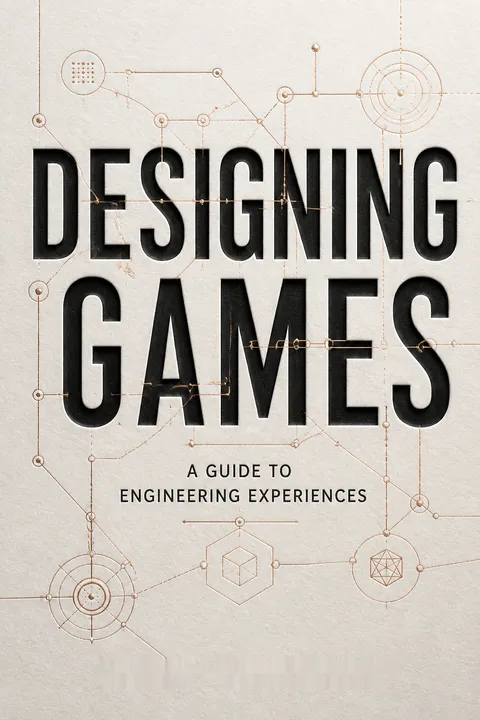
What's Designing Games: A Guide to Engineering Experiences about?
- Focus on Game Design: The book explores the principles and craft of game design, emphasizing the creation of engaging player experiences through mechanics and emotional triggers.
- Engines of Experience: It introduces the concept of games as "engines of experience," where mechanics generate events that provoke emotions, leading to a rich player experience.
- Iterative Process: Tynan Sylvester advocates for an iterative approach to game design, emphasizing continuous testing and refinement of ideas.
Why should I read Designing Games: A Guide to Engineering Experiences?
- Comprehensive Insights: The book offers deep insights into game design, valuable for both aspiring and experienced designers looking to enhance their skills.
- Expert Insights: Tynan Sylvester shares his experience from working on major titles like BioShock Infinite, providing practical advice grounded in real-world applications.
- Encourages Creativity: It promotes a culture of openness and experimentation, encouraging readers to think creatively and push the boundaries of traditional game design.
What are the key takeaways of Designing Games: A Guide to Engineering Experiences?
- Mechanics and Events: Understanding that mechanics define how a game works, while events are generated through player interaction with those mechanics.
- Embrace Uncertainty: Accepting uncertainty in game design is crucial, as designers can never fully predict how a system will play out.
- Importance of Iteration: The book stresses the significance of iteration in the design process, advocating for short-range planning and continuous testing.
What is the concept of "engines of experience" in Designing Games?
- Mechanics Generate Events: Games are described as engines that use mechanics to generate events, which in turn provoke emotions in players.
- Emotional Triggers: These events are designed to trigger specific emotions, creating a rich and engaging player experience.
- Player Interaction: The interaction between players and mechanics is central to this concept, as it shapes the overall narrative and experience.
How does Designing Games define "elegance" in game design?
- Efficiency in Design: Elegance is maximizing emotional power and variety while minimizing the player's comprehension burden and developer effort.
- Emergence and Interaction: Elegant designs allow simple mechanics to interact in complex ways, generating a wide range of experiences from minimal input.
- Example of Elegance: Games like checkers illustrate elegance, with simple rules creating countless unique experiences.
What is the "Goldilocks zone" in relation to game difficulty in Designing Games?
- Optimal Challenge Level: The Goldilocks zone refers to the ideal balance of challenge where a game is neither too hard nor too easy for players.
- Skill Barrier and Ceiling: Every game has a skill barrier (minimum skill needed) and a skill ceiling (maximum skill achievable), with the Goldilocks zone between these limits.
- Player Engagement: Maintaining this balance is crucial for keeping players engaged and ensuring they feel a sense of accomplishment without frustration.
What is the Dependency Stack method in Designing Games?
- Understanding Dependencies: The Dependency Stack analyzes relationships between game elements, helping designers identify component dependencies.
- Cascading Uncertainty: Changes in foundational elements can lead to cascading uncertainty, affecting higher-level designs.
- Building Upward: Designers are encouraged to start from the bottom of the stack and work upward, ensuring foundational elements are solid before adding complexity.
How does Designing Games address player motivation?
- Dopamine and Motivation: The book discusses how dopamine drives motivation, emphasizing that players are motivated by the anticipation of rewards.
- Intrinsic vs. Extrinsic Motivation: Sylvester argues that extrinsic rewards often undermine creativity, highlighting the importance of meaningful work.
- Fostering a Positive Climate: A supportive work climate enhances motivation, encouraging risk-taking and innovation.
What is the Progress Principle in Designing Games?
- Daily Progress Matters: Regular, visible progress is a key motivator for creative individuals, contributing to good inner work life.
- Small Wins: Achieving small wins boosts motivation and engagement, creating a sense of momentum and satisfaction.
- Visual Indicators: Organizing work to make progress visible, such as using to-do lists, helps maintain motivation and encourages continuous effort.
What is the Fallacy of Vision in Designing Games?
- Misleading Mental Movies: The fallacy refers to the misconception that a mental image of a game equates to a solid design.
- Ignoring System Complexity: This fallacy can lead designers to overlook complexities and trade-offs in creating a game.
- Encouraging Realism: Designers are advised to envision both best and worst-case scenarios, creating more realistic and robust designs.
What are flow gaps and how can they be avoided according to Designing Games?
- Definition of Flow Gaps: Flow gaps are periods when players have nothing to engage with, leading to boredom and frustration.
- Causes of Flow Gaps: They can occur due to delays in gameplay mechanics, such as long animations or menu transitions.
- Solutions: Designers should ensure players always have decisions to make, even during downtime, by introducing alternative actions or maintaining a steady pace.
What are the best quotes from Designing Games and what do they mean?
- "Flow feels good forever.": Emphasizes the importance of maintaining flow in a game for sustained player enjoyment and immersion.
- "Balancing means adjusting game mechanics.": Highlights the ongoing process of balancing mechanics to ensure fairness and depth, essential for engagement.
- "Nobody knows anything!": Reflects the unpredictability of the market and challenges designers face in anticipating player preferences and trends.
Download PDF
Download EPUB
.epub digital book format is ideal for reading ebooks on phones, tablets, and e-readers.








