

Key Takeaways
Judge architecture by how cheaply the next change fits
Design for change. Architecture earns its keep when a programmer can understand the relevant code, make a change, and leave the rest of the game undisturbed. Decoupling helps by reducing how much code must be understood at once, but every abstraction also adds code and mental overhead. Flexibility is useful when a change is likely, not simply because it is possible.
Keep experiments disposable. Early prototypes can be rough if the team understands they must be replaced. A playable experiment can answer a design question faster than polished architecture, but treating prototype code as production creates an accidental long-term cost. The practical aim is to move quickly without leaving a mess that future work must absorb.
This frames architecture as a cost-benefit decision rather than a measure of sophistication. The idea resembles information hiding: a module is valuable when it lets people reason locally and change internals safely. Yet abstraction is not automatically a reduction in complexity. Each interface creates another concept to locate and understand. A useful test is whether the abstraction protects a likely seam of change or merely anticipates an imagined future. Prototype code is similarly safest when its temporary status is explicit, since organizations often mistake a successful demo for a maintainable foundation.
Turn important actions into objects you can store, replay, or reverse
Make calls portable. The Command pattern represents an operation as data that can be passed around instead of executing a method immediately. A game can bind a button to a jump command, let AI produce commands for enemies, or send a sequence of commands across a network. The command producer need not know how the actor performs the action.
Remember what changed. In a turn-based game or level editor, each command can record the small piece of prior state it needs to undo. A move command, for instance, stores a unit’s old position. Keeping commands in order makes undo, redo, and replay practical without saving the entire game state for every moment.
Commands turn behavior into a recordable boundary, connecting gameplay input to ideas such as event logs and transactional histories. This is useful wherever actions need inspection, replay, or reversal. The design also makes ownership and timing questions visible: who creates a command, who executes it, and what state must it preserve? Undo is easiest when operations have clear inverses. Actions with external side effects, such as network requests or random outcomes, require extra recorded context or cannot be reversed cleanly.
Replace tangled state flags with explicit legal transitions
Name the current mode. A finite state machine (FSM) has a limited set of states, one active state at a time, and transitions triggered by inputs or events. A platform heroine might be standing, jumping, ducking, or diving. Separate Boolean flags can accidentally allow nonsensical combinations, such as being both airborne and ducking; one explicit state prevents that class of error.
Put state-specific work together. An enum and switch can be enough. When a state also owns private data, such as a ducking charge timer, separate state objects can contain its behavior and data. FSMs remain deliberately limited. Independent concerns can use separate machines, shared transitions can use hierarchical states, and a stack of states can restore the previous mode after a temporary action.
Explicit states make a system easier to test because its legal modes and transitions can be enumerated. That is a powerful constraint, not a universal model of behavior. A machine becomes cumbersome when many independent properties are combined into one enormous list of states. Separating largely independent concerns reduces that explosion, though interactions between them still need coordination. The design question is whether the behavior has a small, meaningful set of modes, not whether every conditional can be converted into a class.
Split game entities by domain, then compose the capabilities they need
Separate the responsibilities. A character class that handles input, physics, graphics, and sound can become a shared bottleneck and tangle. The Component pattern moves each domain into its own component, leaving the entity to hold and coordinate them. An input component can change velocity, physics can resolve movement, and graphics can render the result without each system owning the whole character.
Build by combination. A visible but intangible decoration needs graphics alone; an invisible trigger needs collision behavior; a movable prop may need both. Composition avoids a subclass for every possible combination. Components still need communication, through shared entity data, direct references, or messages, and each choice trades simplicity against tighter coupling.
Composition is especially useful when capabilities combine in many ways that do not fit a clean inheritance tree. It also creates a new architectural responsibility: coordinating component lifetimes, update order, and communication. The example of input changing velocity before physics runs shows that decoupled code can still depend on a sequence. Component boundaries reduce domain entanglement, but they do not eliminate system-level contracts. A good design makes those contracts explicit rather than hiding them in a fragile update order.
Choose synchronous observers for immediacy, queues for timing control
Notify without naming a listener. The Observer pattern lets a subject announce an event to registered listeners. Physics can report that an entity began falling; achievements and audio can react without being built into the physics code. This is a direct, synchronous call, so listeners should return quickly and unregister when they are no longer relevant. Otherwise, stale listeners can linger and receive unwanted notifications.
Queue when timing matters. An event queue stores requests until a receiver processes them, allowing work to be delayed, combined, or handled on another thread. That control comes with risks: the world may change before an event is handled, and messages can create feedback loops. Queues are useful when sender and receiver must be separated in time, not just in code.
The distinction is architectural, not cosmetic. A direct observer preserves immediate causality, which is easy to follow when the listener set is small. A queue introduces temporal distance, useful for workload management and thread boundaries but harder to debug because current state may differ from event-time state. Capturing enough event data and tracing event origins become essential. A central bus can quietly become global mutable infrastructure, so narrower queues often preserve more clarity than one universal messaging system.
Keep simulation time fixed even when rendering speed varies
Separate the clocks. A game loop repeatedly handles input, advances the simulation, and renders. If each update takes whatever time the previous frame happened to require, physics can become unstable and different machines may simulate different results. A fixed update step makes simulation more predictable. An accumulator can run several updates when the game falls behind, while rendering happens as often as the machine allows.
Hide work in progress. Double buffering keeps one version of state available to readers while another is modified. Graphics use a completed framebuffer while the next image is drawn, then swap buffers. Similar buffering prevents an actor updated early in a frame from changing what later actors observe, making results less dependent on their order in the update list.
This is a form of temporal decoupling: simulation prioritizes consistency, while presentation prioritizes smoothness. Separating them lets a game drop or interpolate rendered frames without changing the underlying step of the world. The trade-off is that interpolation is an estimate, and catch-up loops can consume enough time to worsen a slowdown. Double buffering likewise spends memory to obtain a clean boundary between versions. These tools work best when the system clearly defines which version is current and when that version becomes visible.
Move shared traits into data, not a subclass for every creature
Define types at runtime. A Type Object represents a conceptual kind of thing with an ordinary object. Instead of separate Dragon and Troll subclasses, monsters can share one class and refer to breed objects containing starting health and attack descriptions. Designers can add or tune breeds through data rather than requiring a code change for every variation.
Share only what is truly common. Flyweight separates shared, usually immutable information from instance-specific information. Thousands of trees can reuse one mesh and texture while keeping their own locations and sizes. Prototype-style delegation can also let a specialized data record inherit unspecified values from a more general record, reducing repetition among related monsters or items.
These approaches move part of the type system from compiled code into editable content. That expands who can create variations and reduces boilerplate, a major advantage when a game’s richness comes from many authored entities. The cost is that the engine must now manage validation, inheritance rules, and object lifetimes itself. Shared state must also stay immutable or carefully controlled. The best boundary is often stable mechanics in code and frequently tuned variation in data, rather than forcing every behavior into one representation.
Use bytecode only when designers need safe, editable behavior
Give content a small machine. Bytecode stores behavior as compact instructions executed by a virtual machine. In a spell system, instructions can read wizard statistics, perform arithmetic, and call approved game operations. A stack carries intermediate values between instructions. Because the VM exposes only a restricted set of operations, custom behavior can be separated from the game’s native code and limited in memory or execution time.
Budget for the toolchain. Designers need a usable way to author and inspect behavior, such as a graphical editor or a higher-level language translated into bytecode. The VM itself may be manageable, but authoring tools, error messages, and debugging are substantial work. Bytecode also runs slower than native code, so it is a poor choice for performance-critical engine routines.
A virtual machine is a governance mechanism as much as a performance technique: it defines which actions content creators are allowed to express. That restricted power can support modding and safer iteration. But a custom language creates a second software product, with its own usability and maintenance needs. A graphical authoring interface can prevent some invalid combinations, yet it still requires thoughtful design. The key question is whether the gain in independent content iteration justifies owning a language, compiler or editor, and debugging experience.
Arrange hot data for the CPU, then measure every optimization
Keep active work nearby. CPUs fetch memory in chunks, so processing objects scattered behind pointers can waste time waiting on memory. Contiguous arrays help; packing active particles together avoids repeatedly skipping inactive entries. Separating frequently used fields from rarely used data can further reduce needless memory traffic. The book reports a case where an otherwise identical cache-friendly loop ran fifty times faster, while stressing that results depend on hardware and workload.
Optimize specific bottlenecks. A dirty flag postpones an expensive recalculation until its result is needed. An object pool reuses preallocated objects to reduce allocation costs and fragmentation. A spatial partition, such as a grid, narrows nearby-object searches instead of comparing every pair. Each adds bookkeeping and failure modes, so profile before adopting it.
The broader lesson is that performance depends on the shape of data as well as the number of operations. This challenges the intuition that pointer-based abstractions are always cheap or that moving bytes is always expensive. Yet cache behavior is hardware-sensitive, and optimizations can make code less flexible or more difficult to verify. Measurement should include representative scenes and worst cases, not only a favorable microbenchmark. The patterns are most persuasive when they target a measured cost and preserve a simpler path for noncritical code.
Limit global services because convenience quietly expands coupling
Separate one instance from universal access. A Singleton combines a guarantee of one instance with global access. Those are different needs. A globally reachable audio system or logger is convenient, but any module can begin depending on it, making dependencies harder to see and changes harder to contain. Global mutable state also complicates concurrency and testing.
Use the narrowest workable path. Pass a service into the code that needs it when practical. A Service Locator can hide the concrete provider behind an interface and allow a substitute, such as a no-op audio service. But it also hides dependencies and can fail if initialization happens in the wrong order. Avoid creating manager classes when the objects themselves can own the behavior.
Global access is a form of authority: it lets any caller use a capability without declaring that dependency in its interface. That is useful for genuinely ambient facilities, but it can turn an architectural boundary into a suggestion. Service locators add replaceability, especially for testing and platform-specific implementations, yet do not make dependencies disappear. The strongest design is not necessarily the one with no globals; it is the one where exceptional global access is deliberate, limited, and easy to audit.
Analysis
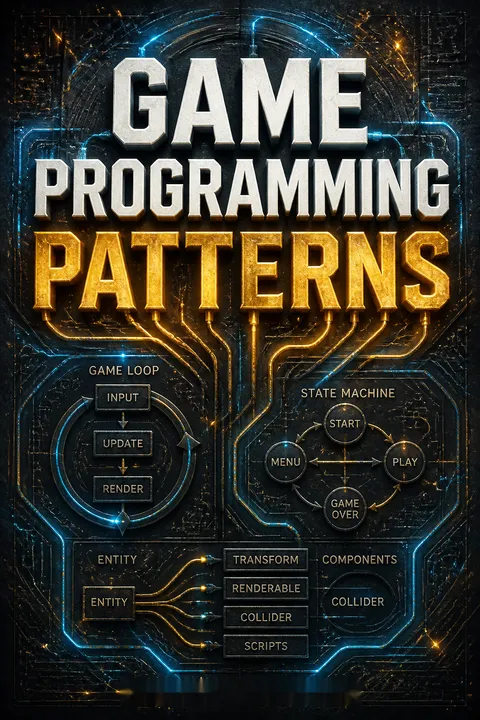
Game Programming Patterns is best read not as a catalog of prescriptions but as a field guide to recurring pressures in game software. Its central concern is the cost of change: how much code a programmer must understand, how many systems a feature touches, and how much iteration the architecture permits. The patterns are practical responses to those pressures, from commands that make actions portable to components that separate domains and data layouts that reduce memory stalls.
The book’s strongest organizing idea is that software has several competing clocks. Developers need rapid iteration, players need stable simulation and responsive presentation, and hardware imposes limits on memory and execution time. A flexible abstraction may speed design work while adding runtime indirection. A pool may reduce allocation costs while reserving memory that sits unused. A queue may protect a thread while making event causality harder to reconstruct. Good engineering therefore means choosing which cost matters in context, then revisiting the decision as the game changes.
That pragmatism also distinguishes a useful pattern from pattern worship. Simple switches can be clearer than state classes; direct calls can be easier to debug than observers; prototype code can be the right tool for a disposable experiment. Conversely, simplicity is not merely fewer lines. A carefully designed data structure or explicit state model can replace sprawling special cases with a smaller, more reliable system.
The book’s examples are intentionally game-shaped, but the underlying lessons apply wherever software combines real-time work, frequent change, and many interacting subsystems. Its advice is most convincing when treated as conditional: profile before optimizing, isolate only meaningful boundaries, and add flexibility where future variation is likely. Patterns provide vocabulary and tested options, not guarantees. The craft is recognizing the pressure at hand and choosing the smallest structure that relieves it without creating a new one.
Review Summary
Game Programming Patterns is highly praised for its clear explanations, engaging writing style, and practical examples of design patterns applied to game development. Readers appreciate the author's humor, insights into performance considerations, and balanced discussion of pros and cons for each pattern. Many found it valuable for both beginners and experienced developers, with some noting its relevance beyond game programming. A few criticisms mention outdated C++ examples and a focus on certain game types. Overall, most reviewers consider it an essential read for game developers.
People Also Read









Glossary
Command
Reified method callAn object or function that represents an operation rather than performing it immediately. A command can be stored, passed between systems, queued, transmitted, or recorded. Commands that preserve the state they change can support undo and redo. In a game, input handling or AI can produce commands while a separate actor or system executes them.
Finite State Machine
Explicit states and transitionsA model with a fixed set of states, one current state, and transitions triggered by inputs or events. If the current state has no transition for an input, that input is ignored. FSMs help prevent invalid combinations of Boolean flags and organize state-dependent behavior, but become awkward when independent dimensions multiply the number of possible states.
Component
Composable domain behaviorA pattern that divides an entity’s responsibilities into separate objects, often aligned with domains such as input, physics, graphics, and AI. The entity coordinates or contains the components, while components can be reused in different combinations. Communication and update order still require design, and excessive decomposition can add indirection and setup complexity.
Observer
Synchronous notificationA communication pattern in which a subject maintains a list of interested observers and directly notifies them when something happens. The subject does not need to know the concrete listeners. Notifications are synchronous, so a slow observer delays the subject, and listeners must be unregistered appropriately to avoid stale references or lingering objects.
Event Queue
Deferred message processingA first-in, first-out store of events or requests that separates sending from processing in time. A receiver can process messages when convenient, aggregate them, or handle them on a different thread. Queued events need enough captured information to remain meaningful after the world changes, and event cycles can be harder to spot than with synchronous calls.
Double Buffer
Swap complete state versionsA technique that keeps two copies of state. One copy is visible to readers while the other is modified; after the work is complete, the copies are swapped or their contents are copied. It makes incremental work appear atomic, as when rendering a whole frame before displaying it, at the cost of extra memory and a synchronization step.
Type Object
Runtime-defined object kindsA pattern that represents a conceptual type with a data object instead of a hard-coded subclass. Individual entities keep their changing instance state and refer to a shared type object for common properties or behavior. It allows new kinds to be authored or adjusted through data, but requires the program to manage those type objects and their relationships.
Bytecode
Instructions for a virtual machineA compact sequence of instructions interpreted by a virtual machine rather than executed directly as native machine code. A game can define a limited instruction set for editable behaviors such as spells, allowing content to use approved operations without unrestricted access to engine code. Bytecode requires an authoring or compilation path and debugging support, and usually runs slower than native code.
Data Locality
Keep processed data togetherAn optimization principle based on how CPUs fetch memory in blocks called cache lines. Programs often run faster when the data they process together is also stored close together, as in contiguous arrays of active objects. Pointer-heavy layouts can cause cache misses. Improving locality may require trading some abstraction or flexibility for better memory access.
Dirty Flag
Mark stale derived dataA Boolean marker indicating that cached or derived data no longer matches the primary data from which it was calculated. Changes set the flag; when the result is next needed, the program recomputes it and clears the flag. This avoids repeated work when inputs change more often than results are used, but missed invalidation creates stale-data bugs.
Object Pool
Reuse preallocated objectsA managed collection of objects allocated in advance and reused when needed, rather than individually created and destroyed during gameplay. Pools can reduce allocation overhead and memory fragmentation, particularly for frequently created effects such as particles. They impose a capacity limit, can reserve unused memory, and require reused objects to be fully reset.
Spatial Partition
Index objects by locationA data structure that organizes objects according to position so the game can find nearby objects without scanning the entire world. A grid places objects into fixed cells; other structures subdivide space hierarchically. Partitions speed location queries but require bookkeeping when objects move and consume additional memory.
Service Locator
Indirect access to servicesA globally accessible interface that returns a service while hiding the concrete implementation and how it is obtained. Callers can depend on an abstract audio or storage interface rather than a platform-specific class. A locator can support substitutable or null implementations, but it obscures dependencies and introduces initialization and availability concerns.
FAQ
What's Game Programming Patterns about?
- Focus on Game Development: Game Programming Patterns by Robert Nystrom is a comprehensive guide that delves into design patterns specifically tailored for game development.
- Patterns for Better Code: It presents various design patterns that help create cleaner, more efficient, and maintainable code, crucial as game projects grow in complexity.
- Practical Examples: The book includes practical examples and code snippets, primarily in C++, to demonstrate how these patterns can be implemented in real-world scenarios.
Why should I read Game Programming Patterns?
- Improve Code Quality: The book introduces design patterns that promote better organization and structure in your code, enhancing your coding skills.
- Learn from Experience: Robert Nystrom shares insights from his industry experience, particularly from his time at Electronic Arts, offering valuable lessons to avoid common pitfalls.
- Accessible to All Levels: Designed to be approachable, it is a great resource for both beginners and experienced developers looking to improve their game programming skills.
What are the key takeaways of Game Programming Patterns?
- Importance of Design Patterns: The book emphasizes how design patterns can lead to cleaner and more maintainable code, with detailed discussions on patterns like Command, Observer, and State.
- Decoupling Code: A major theme is the need to decouple code to make it easier to manage and extend, especially in games where different systems must interact.
- Performance Considerations: It addresses performance issues specific to games, such as efficient memory management and optimizing code for real-time execution.
What are the best quotes from Game Programming Patterns and what do they mean?
- "Every kid has dreamed of being a superhero...": This introduces the Subclass Sandbox pattern, emphasizing a data-driven approach to manage multiple behaviors without redundancy.
- "A virtual machine... is often as simple as a stack, a loop, and a switch statement.": Highlights the simplicity of creating complex behaviors through a well-structured virtual machine.
- "The more you can use stuff in that cache line, the faster you go.": From the Data Locality section, it underscores the importance of organizing data in memory to optimize CPU cache usage.
How does the Command pattern work in Game Programming Patterns?
- Encapsulating Requests: The Command pattern encapsulates a request as an object, allowing for parameterization of clients with different requests.
- Decoupling Actions: It decouples the sender of a request from the object that handles it, making code more flexible and easier to manage.
- Example Implementation: Nystrom illustrates this with an input handler example, using command objects to represent actions like jumping or firing a weapon.
How does the State pattern function in Game Programming Patterns?
- Behavioral Changes: The State pattern allows an object to alter its behavior when its internal state changes, useful for managing complex behaviors in game characters.
- Encapsulation of State Logic: Each state is represented by a class implementing a common interface, keeping the code organized and simplifying transitions between states.
- Example Usage: Nystrom provides an example of a game character in different states, each handling its own input and behavior.
What is the Game Loop pattern in Game Programming Patterns?
- Continuous Execution: The Game Loop pattern is essential for running a game continuously, processing user input, updating game state, and rendering graphics.
- Decoupling Time from Input: It decouples game time progression from user input and processor speed, ensuring consistent gameplay across different hardware.
- Implementation Example: The book outlines a basic game loop structure, providing a foundation for any game engine.
How does the Observer pattern work in Game Programming Patterns?
- Decoupled Communication: The Observer pattern allows one object to notify multiple observers about changes in its state without being tightly coupled to them.
- Event Handling: Useful for implementing event-driven systems, such as notifying different parts of a game when a player achieves something.
- Example Implementation: Nystrom illustrates this with a physics engine example that notifies an achievement system when an event occurs.
What is the Double Buffer pattern in Game Programming Patterns?
- Preventing Tearing: The Double Buffer pattern prevents visual tearing in graphics rendering by maintaining two buffers for displaying and drawing frames.
- Atomic Updates: By swapping buffers at the end of each frame, the game presents a complete image without showing intermediate states.
- Implementation Details: The book provides a simple implementation, demonstrating efficient buffer management for smooth visual results.
How does the Object Pool pattern work in Game Programming Patterns?
- Reuse Objects Efficiently: The Object Pool pattern allows for the reuse of objects from a fixed pool, reducing memory fragmentation and improving performance.
- Fixed Pool Size: It creates a collection of objects upfront, avoiding the overhead of frequent memory allocation.
- Manage Active Objects: Objects can be marked as "in use" or available, allowing the pool to manage reuse without new memory allocation.
What is the purpose of the Dirty Flag pattern in Game Programming Patterns?
- Track Changes Efficiently: The Dirty Flag pattern avoids unnecessary recalculations by deferring updates until derived data is needed.
- Set and Clear Flags: When primary data changes, the dirty flag is set, and recalculations occur only if necessary when derived data is requested.
- Improve Performance: This ensures expensive calculations are performed only when required, leading to smoother performance.
How does the Data Locality pattern enhance performance in Game Programming Patterns?
- Optimize Memory Access: The Data Locality pattern arranges data in memory to take advantage of CPU caching, reducing cache misses.
- Contiguous Memory Layout: Organizing data structures contiguously allows the CPU to load larger data chunks efficiently.
- Impact on Game Performance: Optimizing data locality significantly enhances game speed and responsiveness, crucial for performance.
Download PDF
Download EPUB
.epub digital book format is ideal for reading ebooks on phones, tablets, and e-readers.








