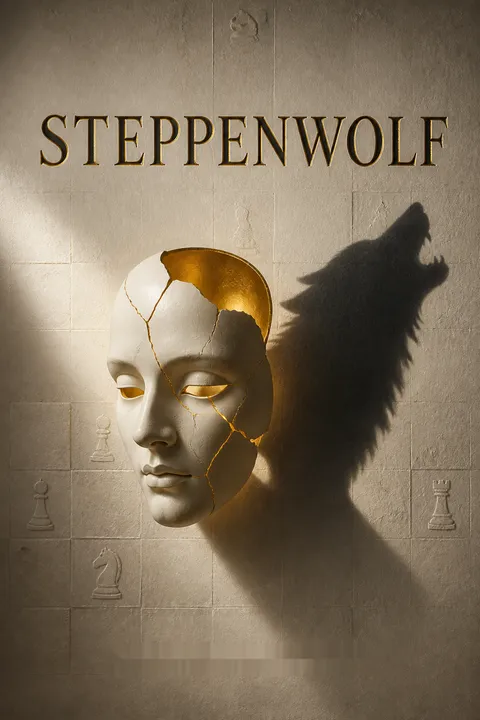


Plot Summary
The Wall's Impossible Door
Harry Haller, an aging writer who calls himself a Steppenwolf, spends his days reading, enduring gout, and resenting the ordinary comforts that keep him alive. Even a beautiful passage of music offers only brief relief from his conviction that he no longer belongs among other people. On a rainy walk, he sees colored letters flicker across an old wall, advertising a magic theatre reserved for outsiders like him.
The doorway vanishes when he looks again. A tired street hawker then gives him a cheap booklet about the Steppenwolf. Back in his attic room, Harry finds that its account seems to describe his private misery with unnerving precision, turning a passing mystery into a personal challenge.
Harry’s despair is not presented as simple rejection of society. He both despises bourgeois domestic order and seeks its shelter, pausing to admire a landlady’s immaculate landing before returning to his disorderly attic. The vanished portal gives this contradiction a plot form: an invitation appears precisely when his familiar explanations have failed, then refuses to become ordinary evidence. His brief response to music matters for the same reason. It suggests that feeling is still possible, though he cannot summon it by argument. The booklet transforms that fragile hope into a problem of self-knowledge, offering a diagnosis that may help Harry or deepen his habit of turning pain into theory.
The Wolf's Pamphlet
The booklet portrays Harry as a man split between cultivated human being and untamed wolf, each side mocking the other. It also argues that this division is too simple: a person contains many selves, and humour might let them coexist. Its account describes Harry’s fierce independence, which has left him without lasting attachments, and his habit of treating death as an escape he can choose.
Harry recognizes parts of his history in the tract, including the collapse of his marriage and earlier lives he rebuilt after personal ruin. Yet he resents being reduced to a type. He settles on suicide as a real option, to be taken when suffering next drives him toward his opiate, rather than waiting for the fiftieth birthday proposed by the tract.
The pamphlet works simultaneously as insight and provocation. Its account sees the cost of Harry’s independence, but its language of wolf and human gives him another polished identity to inhabit. The text itself later questions that binary, suggesting that Harry’s self-description is a defense against complexity rather than a complete explanation. His suicide plan follows the same pattern: by setting a condition for death, he converts an overwhelming crisis into a schedule he can control. That arrangement brings temporary steadiness, but it does not repair his isolation. The tract’s most consequential effect is therefore not a cure, but a new possibility: Harry may be more than the story he tells about himself.
The Professor's Dead Culture
After joining a funeral procession, Harry watches the mourners hurry through a ceremony that feels emptied of grief. He thinks the same hollow respectability surrounds the culture he once revered. Soon afterward, a university professor recognizes him and invites him to dinner.
At the professor’s home, a sentimental portrait of Goethe irritates Harry, while the professor’s approval of a nationalist newspaper attack on Harry’s antiwar views makes the visit unbearable. Harry reveals that the condemned writer is himself, rebukes his host, and leaves in anger. He wanders through the city, afraid to return to the razor waiting at home. At the Black Eagle tavern, a young woman sees his distress, makes room beside her, and begins caring for him.
The dinner is not merely a clash between an eccentric guest and polite hosts. Harry discovers that his public principles have no living place in the room: the professor can praise scholarship while accepting a newspaper’s attack on a pacifist, and the Goethe image reduces a difficult artist to domestic decoration. Harry’s outburst exposes the distance between his ideals and his ability to sustain human contact. At the same time, he is not simply rejected. The professor’s invitation briefly comforts him, and the young woman at the tavern notices his need without requiring him to perform intellectual competence. Recognition arrives in an unexpected social register.
Hermine's First Orders
The young woman, later named Hermione, cleans Harry’s glasses, orders him to eat, and teases him for treating life’s ordinary skills as beneath him. He admits that he cannot dance and has never tried to learn.
Hermione challenges his claim that life has offered nothing worth living, since he has avoided simple pleasures as carefully as he has pursued difficult books. When she leaves to dance, Harry obeys her instruction to rest and falls asleep at the noisy tavern.
He dreams of confronting Goethe, whose imagined playfulness loosens Harry’s rigid reverence. Hermione returns, gives him a Tuesday dinner appointment, and leaves him with a practical reason to expect another day. The following morning, even his kindly landlady’s tea feels less alien than usual.
Hermione’s first care is deliberately physical. She adjusts Harry’s glasses, feeds him, and tells him to sleep before attempting to answer his philosophy. This reverses his preferred order of operations: he wants a theory of life before participating in it, while she treats participation as the beginning of knowledge. Her teasing does not dismiss his suffering; it punctures the self-importance with which he has turned deprivation into proof that life is empty. The dream of Goethe extends the lesson into Harry’s inner world, loosening the solemn image that had helped him judge other people. A small appointment becomes a form of borrowed hope, anchored in time and action.
Lessons in the Foxtrot
At their dinner, Harry learns that Hermione’s name recalls Hermann, his boyhood friend, and she explains that she has recognized something of herself in his loneliness. She insists he learn to dance, so they buy a gramophone and she teaches him the foxtrot in his book-filled room.
At a hotel dance, Harry is jealous of Pablo, the handsome saxophonist Hermione favors, then finds that a confident young woman can guide him across the floor. His first successful dance surprises him more than any argument could.
Hermione encourages him to keep practicing, while Pablo’s music supplies a kind of pleasure Harry cannot assess by scholarly standards. The lessons begin to loosen Harry’s belief that his cultivated habits are the only authentic parts of him.
The foxtrot makes self-change measurable. Harry cannot hide behind aesthetic judgment when his feet keep striking chairs, and the dance floor gives him a concrete test of whether he can follow another person’s rhythm. Hermione does not ask him to abandon thought; she exposes the way thought has become a gatekeeper that excludes experience. Pablo offers a contrasting model. His value lies not in explaining music but in making people move, a function Harry initially dismisses. The encounter with the young dancer matters because success comes through responsiveness rather than mastery. Harry’s developing self is not yet harmonious, but it has acquired a body willing to learn.
Maria's Summer Education
Hermione introduces Harry to Maria, the beautiful dancer he has admired, and Maria soon visits him in his room. Her touch and attention awaken sensual pleasures that Harry has long subordinated to books and ideals.
As their affair develops, he learns to value fashionable clothes, perfume, flowers, dance tunes, and the pleasures Maria takes seriously. Her world is neither a moral failure nor a lesser version of his intellectual one. Harry’s recovered desire also releases memories of his mother, former wife, past friends, and women he loved.
Meanwhile, Pablo surprises Harry by caring tenderly for a sick violinist and offers him drugs that can alter pain or mood. Harry’s days with Maria bring happiness, but he senses that pleasure alone cannot settle his deeper unrest.
Maria expands Harry’s understanding by refusing the hierarchy that makes art spiritually serious and sensuality trivial. Her attention to a purse, a song, or a lover’s touch is not presented as empty consumption; these objects become instruments through which she experiences and communicates desire. Harry’s revived memories show that his life was not as barren as his current self-image claimed. The past returns through the body, not through scholarly reconstruction. Pablo’s quiet care for the ill violinist likewise complicates Harry’s first judgment of him. Both encounters unsettle the distinction between depth and shallowness, revealing that emotional intelligence can take forms Harry has trained himself not to recognize.
The Air of Eternity
As the masked ball approaches, Hermione tells Harry that both of them once expected lives of exceptional purpose, only to find themselves confined by the ordinary world. She argues that the value of authentic acts does not depend on public fame, because they belong to a timeless realm she calls eternity.
Harry recognizes in her account the quality he hears in Mozart and Bach, and writes a poem about the Immortals while waiting for Maria. That night Maria gives him an especially tender farewell before the ball, sensing that Hermione will draw him onward. Harry wakes late, visits his old tavern, and feels himself taking leave of the life he once inhabited. He enters the crowded ball alone, carrying both anticipation and reluctance.
Hermione’s account of eternity offers Harry a way to preserve meaning without demanding that history reward it. Her examples shift attention away from fame and toward the quality of an act or feeling, whether or not anyone records it. This provides a counterweight to Harry’s despair over public life and impending war, but it also risks becoming another beautiful abstraction. Maria’s farewell gives the idea an emotional cost: Harry’s passage forward requires him to leave a genuine source of comfort, not merely discard a mistaken belief. His nostalgic stop at the tavern shows that he can feel affection for what he is outgrowing. Transformation here means carrying the past, not pretending it never mattered.
The Ball's Hidden Door
At first Harry cannot join the masked ball. He wanders through its rooms, feels out of place, and decides to leave, only to discover that his cloakroom token has vanished. A small devil gives him another token, which carries a notice directing him to a late-night magic theatre. Harry turns back. The music and crowd now draw him into dancing, and he recognizes Maria beneath a Spanish dancer’s mask before saying farewell.
In the basement, he finds Hermione dressed as Hermann, the boyhood friend whose name she carries. They drink champagne, exchange flirtatious games, and Hermione’s disguise makes Harry fall in love with her. As the ball winds down, Pablo leads them away from the dancers and toward the theatre promised on the token.
The missing token changes the ball from a social failure into a threshold. Harry’s first response is to retreat, but the replacement ticket gives him a plot reason to re-enter the very crowd he had judged incapable of nourishing him. Dancing does not make him forget himself so much as let him temporarily participate without policing every gesture. The masked figures also turn identity into something playable: Hermione becomes Hermann, and Harry’s attachment crosses the boundaries he had treated as fixed. Maria’s farewell preserves tenderness without making her the destination of his journey. The ball is therefore both culmination and preparation, a lived experiment in multiplicity before the theatre makes that experiment literal.
Cars Against Humanity
Inside Pablo’s theatre, a small mirror first shows Harry as a shifting struggle between man and wolf. Pablo urges him to laugh at this narrow self-image, and a larger mirror then breaks him into many versions of himself.
Harry enters a room where cars have become targets in a violent revolt against machines and modern life. There he meets Gustav, a former schoolmate now fighting beside him, and they shoot drivers, wreck vehicles, and recruit Dora, a typist whose employer is injured.
The exhilaration fades when they encounter a peaceful pedestrian and recognize the ugliness of their own violence. As they climb down from their lookout, Harry and Dora fall into the void and return to the theatre corridor, leaving the rebellion exposed as one possible, not final, arrangement of his anger.
The car-war room gives Harry’s political disgust a fantasy of immediate action, but its apparent clarity collapses as soon as the violence reaches people who seem harmless. The scene does not absolve him by labeling the killings unreal. Instead, it shows how readily his humane convictions can coexist with a wish to destroy the world that frustrates him. Gustav’s theology and wartime history sharpen the contradiction: he has served institutions and now commits violence by choice. Harry’s fall interrupts the fantasy before it can become a stable identity. The theatre does not offer a morally pure self behind the angry one; it reveals that destructive impulses also belong to the range he must learn to recognize.
A Thousand Harrys
In another theatre room, a calm chess player shows Harry how his many selves can be rearranged into different patterns rather than forced into one permanent character. Harry receives miniature figures to use in future games.
A nearby performance reverses the roles of a wolf and its tamer, making each submit in turn and exposing the cruelty in both domestication and predation. Seeking relief, Harry enters a room where he relives his first love for Rosa, then revisits missed chances and remembered lovers as a young man able to act instead of retreat.
The sequence restores pleasure and regret together. When he returns to the corridor, he feels prepared for Hermione, but finds that the next doorway offers a far more dangerous test of what he believes love requires.
The chess lesson supplies the theatre’s clearest alternative to Harry’s fixed identity. Rather than choosing between wolf and human, he can change the relations among his inner figures, granting different parts different roles in different situations. The taming performance then prevents this flexibility from becoming a comforting ideal: both control and appetite can become forms of violence when treated as the whole truth. The Rosa episode uses memory not as nostalgia but as rehearsal. Harry receives the chance to inhabit choices he once avoided, yet the experience cannot erase the life he actually lived. His return to Hermione’s door marks a shift from exploratory play toward consequence, where self-knowledge will be tested by action.
Mozart's Gallows Laughter
The final doorway brings Harry to Hermione asleep beside Pablo. Remembering her earlier prediction that he would kill her, and seeing her with Pablo, Harry stabs her beneath the breast. Mozart then appears and condemns Harry’s attempt to turn the theatre’s images into a solemn act of punishment.
Through a distorted radio broadcast of Handel, Mozart shows him that imperfect appearances cannot erase the spirit within them, and that life must be met with humour as well as judgment.
A mock court finds Harry guilty of taking the illusion literally and sentences him to eternal life, barring him from the theatre for twelve hours. Pablo restores Hermione to the size of a chess piece. Harry accepts that he must return to the game and learn to laugh.
The climax exposes Harry’s most persistent evasion: he would rather commit a terrible act, or submit to execution, than tolerate uncertainty and continue living among contradictions. His claim that Hermione wanted this outcome gives him a moral script, but Mozart forces him to see that he has acted from jealousy and converted a symbolic scene into literal violence. The distorted Handel broadcast extends the lesson beyond music. Imperfect transmission does not abolish what is valuable; insisting on purity can make the listener deaf to the surviving signal. The court’s sentence is comic precisely because it denies Harry the grand finality he craves. He is not absolved or completed. He must keep playing.
Analysis
Steppenwolf follows a man who mistakes a powerful self-description for a complete account of his nature. Harry’s wolf-and-human division gives his suffering a memorable shape, but it also allows him to sort every impulse into two camps and condemn whichever one is currently inconvenient. The embedded tract first validates this model, then exposes its limits by proposing a self made of many shifting parts. The novel’s form enacts that correction: Harry’s notebook gives way to an impersonal psychological study, then to dreams and theatre scenes that turn inner states into separate rooms and roles.
The book does not treat social participation as an uncomplicated cure. Harry’s contempt for bourgeois routine is bound to a longing for its shelter, while the professor’s household shows how respectable life can become politically complacent and emotionally airless. Hermione and Maria offer alternatives, but not interchangeable solutions. Hermione makes Harry practice ordinary skills and question his solemnity; Maria gives him bodily pleasure and reopens memories he had mistaken for loss. Pablo’s music and care challenge Harry’s habit of confusing intellectual articulation with depth.
The Magic Theatre pushes this critique to its limit. It lets Harry experience rage, sensuality, recollection, and cruelty as possible arrangements of his own life. His stabbing of Hermione occurs when he treats a symbolic experience as a literal act and tries to turn confusion into a decisive punishment. Mozart’s response rejects both self-execution and grand penance. Harry must continue living, learning to recognize what is valuable amid imperfect forms and to laugh at his demand for purity. The ending offers no completed recovery. Its hope lies in a different practice of attention: not defeating one self, but learning to play among many.
Review Summary
Steppenwolf explores the inner conflict of Harry Haller, a middle-aged intellectual struggling with isolation and societal disillusionment. Readers praise Hesse's profound philosophical insights and vivid portrayal of the human psyche. The novel's structure, blending reality and fantasy, resonates with many, particularly those grappling with existential questions. While some find it dense and challenging, others consider it a masterpiece of 20th-century literature. The book's themes of self-discovery, alienation, and the search for meaning continue to captivate readers across generations.
People Also Read


Characters
Harry Haller
The divided intellectualHarry is an aging writer and music lover who regards himself as an outsider to respectable society, yet continues to seek its quiet rooms and familiar comforts. He values independence, cultural seriousness, and emotional intensity, but these ideals have hardened into habits that keep him isolated. His self-image as a wolf locked in conflict with a cultivated human side gives him a vivid account of his distress, while also limiting what he can imagine becoming. He is perceptive about politics and art, but often uses perception to judge experience before he enters it. Encounters with dancing, sensual pleasure, and theatrical fantasy challenge his belief that thought alone can define a life.
Hermione
The practical soul-guideHermione is a perceptive young woman who recognizes Harry’s loneliness and responds with practical care rather than reverence for his intellect. She feeds him, teaches him to dance, and draws him toward social and sensual experiences he has dismissed. Her shifts between seriousness and play allow her to understand suffering without making solemnity its only language. She sees a kinship between her frustrated ambitions and Harry’s, though she has learned to engage pleasures he avoids. Her name recalls Harry’s boyhood friend Hermann, giving their connection a mirror-like quality. Hermione guides him by setting tasks, not by offering a complete explanation of who he is.
Pablo
The musician of presencePablo is a handsome saxophonist and a friend of Hermione’s, initially dismissed by Harry as a shallow performer. He values music for what it does in the moment, especially its power to move listeners, rather than for its place in a hierarchy of artistic greatness. His friendliness is expressed through music, physical ease, and practical acts of care, including helping an ill fellow musician. He also offers drugs that alter mood and perception. Pablo’s apparent simplicity conceals an ability to guide Harry into experiences that Harry’s scholarly habits cannot reach.
Maria
The sensual instructorMaria is a beautiful dancer and lover who introduces Harry to sensual pleasure without treating it as shameful or intellectually inferior. She understands fashion, music, and physical affection as parts of a vivid social world, and her enthusiasm helps Harry approach experiences he had kept at a distance. Maria’s affection is warm but not exclusive; she maintains her own connections and freedom. Her relationship with Harry gives him pleasure and restores memories of earlier attachments, while showing that love can be genuine without becoming a permanent guarantee.
Erika
The distant belovedErika is Harry’s long-standing lover, though their relationship is unstable and they rarely meet without conflict. They share a solitary temperament, and their bond persists despite distance and mutual difficulty. Harry’s thoughts of her reveal that he remains attached to a life beyond his present isolation, even when he cannot make that attachment secure. Erika is part of the emotional history that complicates his belief that he has no meaningful ties.
The Professor
The respectable academicThe professor is a courteous scholar who remembers Harry’s earlier intellectual conversations and welcomes him into his home. His friendliness is sincere, but his comfortable respectability leaves him unaware of the political and personal tensions Harry brings to dinner. His approval of a nationalist newspaper’s attack on Harry exposes the distance between their values. He is less an antagonist than a figure whose ordinary assumptions make Harry feel both welcomed and profoundly unseen.
The Landlady
The kindly domestic witnessHarry’s landlady maintains a tidy home and treats him with gentle concern. He admires the domestic order he claims to despise, and her kindness lets him experience that order without having to pretend he belongs to it. She respects his need for solitude but does not mistake it for a reason to exclude him. Her tea and conversation offer a modest form of human contact.
Gustav
The boyhood anarchistGustav is Harry’s former schoolmate, remembered as energetic and unruly. In the theatre’s imagined revolt, he has become a theology professor turned fighter against machines. His presence links Harry’s adult anger to a more impulsive youth, while his choices reveal how easily ideals and violence can occupy the same person.
Rosa Kreisler
The first remembered loveRosa is the girl Harry falls in love with as a schoolboy. Their shy springtime encounter becomes a lasting image of the tenderness and possibility he believes he once failed to pursue. In the theatre, she represents not a perfect lost past but a chance to experience an old memory differently.
Hermann
Harry's boyhood friendHermann was Harry’s close childhood companion, associated with shared intellectual and imaginative pursuits. The memory of him gives Harry a personal reference point for recognizing Hermione’s name and boyish appearance. Hermann functions as part of Harry’s inner history rather than as an active presence in his adult life.
Goethe
The playful immortalGoethe appears in Harry’s dream as the revered writer Harry both loves and accuses of false optimism. The dream version is more playful and self-aware than the respectable portrait that provokes Harry at the professor’s home. He unsettles Harry’s tendency to turn cultural figures into unquestionable ideals.
Mozart
The immortal comic judgeMozart is one of Harry’s deepest musical loyalties and a figure associated with the Immortals. In the theatre, he combines artistic authority with irreverent humour, refusing to let Harry treat suffering, art, or punishment with self-important solemnity. His presence challenges Harry to hear value even through flawed forms.
Plot Devices
The Steppenwolf Tract
A diagnosis in miniatureThe anonymous booklet Harry receives from a street hawker presents his life as a conflict between a human self and a wolfish one. It also diagnoses his isolation, explains his fascination with suicide, and proposes humour as a possible means of living with contradiction. Its account initially feels uncannily personal, but the tract later questions its own two-part model and argues that a person contains many selves. It turns Harry’s private self-description into something he can examine, resist, and eventually outgrow. The booklet is a map, but the story makes clear that no map can substitute for experience.
The Magic Theatre
A stage for inner livesThe theatre first appears as a fleeting invitation on a city wall and later reappears on a token at the masked ball. Pablo presents it as a place where Harry can encounter images drawn from his own mind, rather than escape into a separate reality. Its many doors lead to fantasies of revolt, sensuality, memory, cruelty, and self-reconstruction. Each room gives a part of Harry’s nature temporary dominance, exposing both its appeal and its danger. The theatre turns psychological multiplicity into action, making Harry experience the selves he had compressed into his wolf-and-human story.
Mirrors and Chess Pieces
A self made changeableThe mirror initially reflects Harry’s familiar image of a man struggling with a wolf, then multiplies him into figures of different ages and temperaments. The chess player gives those figures form as pieces that can be rearranged into different configurations. Together, mirror and chessboard challenge the idea that a person must possess one permanent, unified character. The images do not promise effortless control: the wolf-taming performance shows how each arrangement can become oppressive or violent. Their purpose is to let Harry see identity as a changing relationship among many impulses, rather than a contest with one supposedly defining nature.
Dance and Jazz
Practice in present livingHermione’s dance lessons give Harry a practical way to loosen his self-consciousness, while Pablo’s jazz makes pleasure available without scholarly approval. At first Harry considers both beneath the seriousness of art. Learning the foxtrot forces him to respond to another person’s movement instead of retreating into judgment, and dancing at the masked ball lets him briefly share the energy of a crowd. The music does not replace Mozart or Bach in the story. It shows Harry that experiences need not compete for a single rank in order to matter, and that participation can teach what detached evaluation cannot.
FAQ
Synopsis & Basic Details
What is Steppenwolf about?
- Existential journey of Harry: Steppenwolf follows Harry Haller, a middle-aged intellectual, as he grapples with his feelings of alienation and his dual nature, feeling both human and wolf-like.
- Search for meaning and escape: The novel explores Harry's desperate search for meaning and escape from the bourgeois world he despises, leading him to a mysterious "Magic Theatre."
- Exploration of self and identity: Through surreal experiences and encounters, Harry confronts the fragmented aspects of his personality, ultimately seeking self-acceptance and a way to reconcile his inner conflicts.
Why should I read Steppenwolf?
- Deep psychological exploration: Steppenwolf offers a profound exploration of the human psyche, delving into themes of isolation, identity, and the search for meaning in a seemingly meaningless world.
- Unique narrative style: Hesse's blend of realism and surrealism creates a captivating and thought-provoking reading experience, challenging conventional notions of self and reality.
- Timeless relevance: The novel's themes of alienation and the struggle for self-discovery resonate with readers across generations, making it a timeless and relevant work of literature.
What is the background of Steppenwolf?
- Post-WWI disillusionment: Written in the aftermath of World War I, Steppenwolf reflects the disillusionment and existential angst of the era, questioning traditional values and societal norms.
- Influence of psychoanalysis: Hesse's exploration of the subconscious and the fragmented self is influenced by the rise of psychoanalysis, particularly the works of Carl Jung.
- Critique of bourgeois society: The novel critiques the shallowness and conformity of bourgeois society, contrasting it with the individual's search for authenticity and spiritual fulfillment.
What are the most memorable quotes in Steppenwolf?
- "For mad people only": This phrase, found on the Magic Theatre's sign, encapsulates the novel's theme of embracing the unconventional and exploring the depths of the human psyche.
- "The bourgeois is an attempt to balance between the countless extremes": This quote defines the bourgeois as a compromise, highlighting the novel's critique of middle-class conformity and its avoidance of intense experiences.
- "Every human being is an onion consisting of a hundred skins": This metaphor illustrates the complexity of human identity, emphasizing the multiplicity of selves within each individual and challenging the notion of a unified personality.
What writing style, narrative choices, and literary techniques does Hermann Hesse use?
- Blend of realism and surrealism: Hesse seamlessly blends realistic depictions of Harry's daily life with surreal and dreamlike sequences, blurring the lines between reality and fantasy.
- First-person narrative: The novel is primarily narrated from Harry's perspective, allowing readers to intimately experience his inner thoughts, emotions, and struggles.
- Use of symbolism and allegory: Hesse employs rich symbolism and allegorical elements, such as the wolf, the Magic Theatre, and the chessboard, to explore complex psychological and philosophical themes.
Hidden Details & Subtle Connections
What are some minor details that add significant meaning?
- The araucaria plant: The meticulously maintained araucaria plant on the landing symbolizes the bourgeois values of order and cleanliness that Harry both despises and is drawn to, highlighting his internal conflict.
- The old infirmary wall: The weathered infirmary wall, with its "cracked, worn surface," represents the beauty and depth that Harry finds in the forgotten and overlooked aspects of life, contrasting with the superficiality of modern society.
- The landlady's tea: The landlady's offer of tea and her genuine interest in Harry's well-being reveal a hidden kindness within the bourgeois world, challenging Harry's blanket condemnation of it.
What are some subtle foreshadowing and callbacks?
- The "golden trace": Harry's recurring metaphor of the "golden trace" foreshadows his eventual encounters with the Immortals and the possibility of transcending his suffering.
- The newspaper article about "Haller": The professor's condemnation of a journalist named "Haller" foreshadows Harry's own rejection of bourgeois values and his eventual embrace of his outsider status.
- The mention of Adalbert Stifter: Harry's contemplation of Stifter's suicide foreshadows his own suicidal tendencies and his struggle with the meaninglessness of his existence.
What are some unexpected character connections?
- Hermione and Hermann: Hermione's name and her ability to embody both masculine and feminine traits connect her to Harry's childhood friend Hermann, suggesting a deeper, more complex relationship than initially apparent.
- Pablo and the chess player: The similarities between Pablo and the chess player, both in appearance and their roles as guides, suggest that they may be different manifestations of the same force, leading Harry towards self-discovery.
- Maria and the saints: Maria's unexpected connection to the saints, despite her sensual nature, reveals a hidden depth and a shared longing for something beyond the material world.
Who are the most significant supporting characters?
- The landlady: The landlady, with her quiet understanding and acceptance of Harry, provides a counterpoint to his harsh judgments of the bourgeois world, suggesting that kindness and compassion can exist even within it.
- The professor: The professor, with his narrow-minded views and adherence to societal norms, represents the very bourgeois values that Harry despises, highlighting the conflict between the individual and society.
- The placard man: The man with the placard, who appears briefly and mysteriously, serves as a catalyst for Harry's journey into the Magic Theatre, symbolizing the hidden forces that guide his path.
Psychological, Emotional, & Relational Analysis
What are some unspoken motivations of the characters?
- Harry's self-sabotage: Harry's self-destructive behavior and his tendency to push away those who care for him stem from a deep-seated fear of intimacy and a belief that he is unworthy of love.
- Hermione's desire for transformation: Hermione's seemingly selfless guidance of Harry is motivated by her own desire for transformation and a longing to transcend the limitations of her own existence.
- Pablo's need for connection: Despite his carefree demeanor, Pablo's actions reveal a deep-seated need for connection and a desire to alleviate the suffering of others, particularly those who are as isolated as Harry.
What psychological complexities do the characters exhibit?
- Harry's dual nature: Harry's internal conflict between his human and wolfish sides reflects the complex interplay of reason and instinct, highlighting the challenges of integrating these opposing forces within the self.
- Hermione's androgyny: Hermione's ability to embody both masculine and feminine traits challenges traditional notions of gender and identity, reflecting the fluidity and complexity of the human psyche.
- Pablo's hidden depths: Pablo's seemingly superficial persona masks a deep understanding of human suffering and a desire to alleviate it, revealing the hidden complexities beneath his carefree exterior.
What are the major emotional turning points?
- Harry's encounter with the Magic Theatre: This encounter marks a turning point in Harry's emotional journey, as he begins to confront his inner demons and explore the possibilities of self-transformation.
- Harry's first dance: Harry's initial awkwardness and subsequent joy in dancing symbolize his gradual acceptance of life's chaos and his willingness to embrace new experiences.
- Harry's love for Maria: Harry's passionate but ultimately fleeting love for Maria represents his attempt to find solace in sensual pleasure, highlighting the limitations of this approach to fulfillment.
How do relationship dynamics evolve?
- Harry and Hermione's mentor-student dynamic: Their relationship evolves from a mentor-student dynamic to one of mutual understanding and shared destiny, as they both seek to transcend the limitations of their existence.
- Harry and Pablo's unlikely friendship: Their friendship challenges Harry's intellectual rigidity, as he learns to appreciate Pablo's carefree approach to life and his genuine compassion for others.
- Harry and Maria's sensual connection: Their relationship, while initially fulfilling, ultimately reveals the limitations of purely sensual love, highlighting the need for a deeper connection that transcends the physical.
Interpretation & Debate
Which parts of the story remain ambiguous or open-ended?
- The nature of the Magic Theatre: The Magic Theatre's true nature remains ambiguous, leaving readers to question whether it is a real place, a figment of Harry's imagination, or a metaphor for the human psyche.
- The role of the Immortals: The Immortals' true nature and their relationship to human suffering remain open to interpretation, raising questions about the nature of divinity and the possibility of transcendence.
- The meaning of laughter: The significance of laughter as a means of liberation and self-acceptance is left open to debate, prompting readers to consider the role of humor in navigating the complexities of life.
What are some debatable, controversial scenes or moments in Steppenwolf?
- Harry's killing of Hermione: The scene where Harry kills Hermione is open to multiple interpretations, raising questions about the nature of love, sacrifice, and the limits of human agency.
- The portrayal of sexuality: The novel's exploration of sexuality, particularly its depiction of Maria and her relationships, has been both praised and criticized for its frankness and its potential to objectify women.
- The critique of bourgeois society: The novel's harsh critique of bourgeois society has been interpreted as both a valid commentary on conformity and a potentially elitist dismissal of middle-class values.
Steppenwolf Ending Explained: How It Ends & What It Means
- Harry's sentence to eternal life: Harry's sentence to eternal life, coupled with the withdrawal of his entry permit to the Magic Theatre, symbolizes the ongoing nature of his journey and the impossibility of finding a final resolution to his inner conflicts.
- The importance of laughter: The ending emphasizes the importance of learning to laugh at the absurdity of life, suggesting that humor is a necessary tool for navigating the complexities of existence.
- The cyclical nature of self-discovery: The ending implies that Harry's journey is not a linear progression but a cyclical process of self-discovery, with moments of insight and regression, ultimately leading to a deeper understanding of himself and the world.
About the Author


Download PDF
Download EPUB
.epub digital book format is ideal for reading ebooks on phones, tablets, and e-readers.








