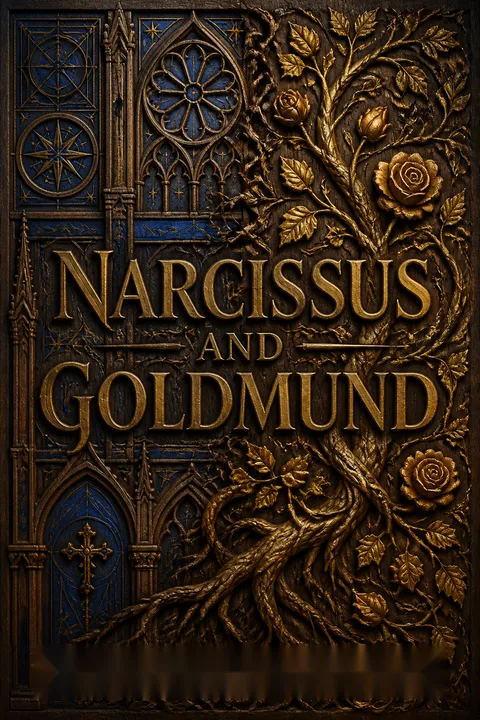


Plot Summary
Under the Chestnut Tree
Goldmund1 arrives at Mariabronn with his father,4 a stern man who wants the boy1 to become a monk and atone for his absent mother’s5 supposed sins. The father4 leaves the horse Bless behind as a gift, then rides away, leaving Goldmund1 tearful but comforted by the porter and the familiar animal.
In the classroom, Goldmund1 first sees Narcissus,2 a young novice whose intelligence and composure immediately fascinate him. He falls asleep during the lesson, classmates mock him, and a scuffle earns him their respect. Though Goldmund1 settles into school life, he has no close friend yet. His devotion to the gentle Abbot Daniel3 and his admiration for Narcissus2 pull him toward two very different ideals.
Goldmund’s entrance is shaped by an inheritance he cannot examine: his father defines his life as repayment for a maternal sin, while Goldmund accepts that burden as if it were his own vocation. The monastery offers genuine shelter, but it also turns paternal control into a spiritual duty. His response to the horse and the porter reveals an instinctive attachment to living beings and ordinary kindness, unlike his father’s abstract plan. Narcissus enters as a compelling model of mastery, while Abbot Daniel embodies humane authority. Goldmund’s early loyalties are therefore divided before he understands the conflict: he wants to belong, but the people he admires represent incompatible ways of living.
The Kiss at the Window
As Goldmund’s1 studies falter and his classmates begin to feel shut out by his devotion to Narcissus,2 Adolf invites him on a forbidden night excursion. Goldmund1 crosses the stream through the mill with Adolf and two other students, then enters a village kitchen where the boys visit two girls. He tries not to look at the younger girl, but she catches his attention and kisses him as he leaves.
Back at Mariabronn, guilt and longing leave him pale and unable to concentrate. Narcissus2 quietly escorts him to the infirmary, where Goldmund1 breaks down in tears. The release of that distress begins their friendship: Narcissus2 recognizes that the boy1 needs care, not another lesson in discipline.
The kiss matters less as a transgression than as the first bodily experience that resists Goldmund’s inherited story about himself. He believes desire would destroy his spiritual future, so he experiences attraction as a threat rather than as information. Narcissus’s response offers a different kind of authority: he protects Goldmund’s privacy and allows emotion to run its course instead of punishing it. The friendship begins through vulnerability, although Goldmund initially interprets it as another route toward becoming like his admired teacher. The scene also establishes the novel’s central contrast in practice: Goldmund is drawn to immediate sensation, while Narcissus reads sensation as evidence about character.
The Mother Returns
Narcissus2 gradually challenges Goldmund’s1 belief that he is destined for monkhood, tracing it to his father’s4 influence and Goldmund’s1 erased childhood. During a conversation about their opposing natures, Narcissus2 names the forgotten mother5 as the source of Goldmund’s1 buried pain.
Goldmund1 collapses in the cloister garden, where Abbot Daniel3 finds him and summons the physician. When Goldmund1 wakes, the living image of his mother returns with overwhelming force.
He learns from the Abbot3 that his father4 had described her as immoral and had urged the boy1 to atone for her. Goldmund1 now sees that his pious ambition may have been imposed on him. As Narcissus2 withdraws for religious exercises, Goldmund1 understands that their paths are separating.
The recovered memory changes the meaning of Goldmund’s discipline. What had seemed self-chosen virtue is exposed as a strategy for managing shame that belonged to his father. Narcissus’s insight is powerful, but the fainting spell shows its cost: interpretation can liberate a person while also destabilizing the defenses that kept them functioning. Abbot Daniel’s recollection confirms that Goldmund’s family story was deliberately edited, giving the revelation a social as well as psychological source. The friends do not simply disagree about ideas; they are oriented toward different forms of life. Narcissus can guide Goldmund toward self-recognition, but cannot accompany him into the world that recognition opens.
Across the Millstream
While gathering herbs for Father Anselm,18 Goldmund1 falls asleep in a field and wakes with his head in the lap of Lise,9 a wandering woman. Their encounter awakens his desire without the terror that had once accompanied the village girl’s kiss. Goldmund1 recognizes the meeting as a summons beyond Mariabronn and seeks Narcissus2 during the monk’s vigil to say farewell.
Narcissus2 understands that Goldmund1 has encountered a woman and does not try to restrain him. That night Goldmund1 leaves through the mill, crosses the cold stream, and follows Lise9 into the forest. In the morning she returns to her husband, leaving Goldmund1 alone. He walks onward without a destination, with the cloister behind him and the uncertain world now his responsibility.
Goldmund’s departure is not simply an escape from religion. It is the first decision made after he distinguishes his own desire from his father’s demands. Lise is important as an occasion, not as a promised companion: her return to her husband prevents Goldmund from confusing awakening with possession. Narcissus’s restraint completes his role as guide. He neither claims the boy’s dependence nor mistakes care for control. Goldmund leaves grateful for the friendship but newly aware that he must experience consequences without an interpreter beside him. The crossing of the stream turns an inward change into a physical point of no return.
Lydia’s Winter Farewell
After months on the road, Goldmund1 accepts shelter from a knight and earns his keep correcting the man’s Latin account of a pilgrimage. His attention settles on the knight’s daughters, especially Lydia,7 whose reserve makes their growing intimacy unlike his brief encounters with other women.
Lydia7 loves him but cannot imagine abandoning her protected home. When Goldmund1 flirts openly with a visiting married woman, Lydia7 sees the exchange and confronts him; his pursuit of her afterward confirms her feelings but deepens her jealousy.
Their secret meetings continue until Lydia’s sister8 Julie8 enters Goldmund’s1 bed and Lydia7 decides the danger has become intolerable. She tells her father, who banishes Goldmund1 at sword point. The next day Lydia7 sends a wool vest and a gold coin through the stableboy19 Hans.19
Lydia’s relationship teaches Goldmund that being desired is not the same as being loved. Unlike his earlier partners, she attaches meaning and consequence to intimacy, and her refusal to surrender her home marks a boundary he cannot charm away. Goldmund’s flirtation with the visiting woman is partly performance, but it wounds Lydia because she understands how easily his attention moves. The banishment exposes the unequal risks facing a sheltered young woman and a homeless young man. Lydia’s secret gift complicates the separation: she cannot choose his life, yet she acts to protect him within the limits available to her.
Blood on the Pine Boughs
In the winter after leaving the knight’s estate, Goldmund1 meets Viktor,10 a joking, experienced vagrant who teaches him practical ways to find food and shelter. The companionship soon becomes dangerous. Viktor10 tries to steal the gold coin Lydia7 sent, then attacks Goldmund1 when he catches him searching his clothes. Choking beneath Viktor,10 Goldmund1 draws his knife and stabs him repeatedly.
He flees, horrified by what he has done, and wanders through snow and hunger until he collapses near a village where a peasant woman, Christine,11 shelters him and returns the coin she found in his clothing. His survival leaves him with a lasting sense of the body’s fierce will to live, alongside the knowledge that he has killed a man.
The coin is at once Lydia’s keepsake and the immediate cause of Goldmund’s lethal struggle, linking intimacy to material vulnerability. Viktor is not a symbolic villain so much as a possible future: his hard-earned expertise shows what prolonged homelessness can demand, while his betrayal demonstrates how scarcity corrodes trust. Goldmund’s killing is self-defense, but it does not feel clean to him. The episode forces him to experience survival as an action with moral residue. Christine’s practical care returns him to life without erasing that residue, and Goldmund begins to understand that freedom is not innocence.
The Madonna in Wood
After recovering, Goldmund1 resumes wandering and encounters a wooden Madonna in a church. Its beauty moves him so deeply that he learns the sculptor is Master Niklaus,6 a respected carver in a nearby city, and seeks him out. Niklaus6 doubts that a grown wanderer can become an apprentice, so he asks Goldmund1 to draw. Instead of copying an object, Goldmund1 draws Narcissus2 from memory.
The portrait convinces the master6 that the young man has a genuine gift, though not a conventional apprenticeship ahead of him. Niklaus6 lets Goldmund1 learn in the workshop without contract or guarantee. Goldmund1 accepts, exchanging the open road for craft, tools, and the discipline needed to give lasting shape to the images he carries.
The Madonna provides Goldmund with something his wandering has not: a chosen destination. His response to the statue is not merely admiration for skill; he recognizes that carved form can hold pain, beauty, and spiritual meaning together. Drawing Narcissus for the test reveals that the friend remains a formative inner image even after separation. Niklaus’s compromise respects Goldmund’s age and independence rather than forcing him into a standard guild path. Art begins as a possible reconciliation between sensation and permanence, but the choice immediately requires sacrifice: Goldmund must stay, practice, and accept limits if he wants his visions to become visible.
The Saint John Statue
In the bishop’s city, Goldmund1 learns carving while living on his own terms, often neglecting routine work for pleasure and wandering. He studies Master Niklaus6 closely, admiring the power of his art but resisting the settled life behind it. Goldmund’s1 defining work is a wooden Saint John modeled on Narcissus.2 When he finishes it, Niklaus6 recognizes its unusual quality and wins him recognition as a master.
Rather than settle into the workshop, Goldmund1 questions whether disciplined craft is drying up the life that feeds his art. He visits Niklaus’s6 Madonna again, then decides that he needs further experience before he can create the larger maternal image he imagines. He refuses the security of a permanent position and leaves the city.
The Saint John turns memory into an object that can outlast the circumstances of the friendship. Goldmund’s success does not resolve his conflict; it intensifies it. Recognition offers a stable identity, but he fears that professional status will narrow the sensory life from which his images emerge. Niklaus embodies the genuine achievement and the cost of craft, not a simple cautionary failure. Goldmund’s departure is therefore both artistic ambition and avoidance: he hopes experience will deepen his work, while fearing that commitment will diminish him. The novel makes creative freedom inseparable from the constraints required to create.
A Cabin Among Corpses
Back on the road, Goldmund1 travels with Robert,12 a timid former pilgrim who is repeatedly frightened by the spreading plague. At an abandoned farmhouse they discover an entire family dead, including a child collapsed at the threshold. Goldmund1 studies the bodies while Robert12 recoils, and then insists that they remain together because either may need the other if sickness strikes.
In a deserted town, Goldmund1 finds Lene,13 a young servant who has survived amid the dead and agrees to leave with him. He, Lene,13 and Robert12 settle in an empty woodland cabin, where they build a partition, tend goats, and make a temporary home. Lene13 hopes it can last; Goldmund1 treats the shelter as provisional and refuses to promise a future.
The plague strips away the ordinary social protections that once framed Goldmund’s choices. His close attention to the dead is both artistic observation and an attempt to face what most people flee. Robert’s fear gives that confrontation a human counterpoint: survival requires practical cooperation, not only contemplation. Goldmund’s decision to take Lene from the town is compassionate, but his insistence that their home is temporary leaves her emotionally exposed. Their cabin briefly imitates domestic life without the commitment that gives a home security. The arrangement makes visible a recurring asymmetry: Goldmund can leave when desire changes, while others must live with the consequences.
The Cabin Burns
When a stranger attacks Lene,13 Goldmund1 kills him by smashing his head against rocks. Her admiring, horrified response haunts Goldmund,1 who recognizes the same proximity of desire and violence that he has been trying to understand in life and art.
Soon Lene13 develops plague boils. Robert12 withdraws in fear, leaving Goldmund1 to nurse her alone. After Lene13 dies, Goldmund1 burns the cabin and walks away, releasing the goat rather than killing it for food.
Across the plague-stricken region he witnesses mass graves, abandoned children, mob violence, and the burning of Jewish families. He helps Rebekka,14 a Jewish woman mourning her murdered father, bury his remains, but she rejects Goldmund’s1 attempt to take her with him. Her grief deepens his store of images.
The cabin’s destruction ends Goldmund’s experiment in domesticity through forces he cannot master: violence, contagion, and death. His killing of the attacker protects Lene, yet her reaction reveals that protection can contain a disturbing appetite for revenge. Her death makes that contradiction impossible to simplify. Goldmund’s later encounters with plague victims and persecuted Jews widen his attention from private loss to social cruelty. Rebekka refuses to let his desire convert her bereavement into an opportunity for intimacy, forcing him to recognize that kindness does not grant access to another person. Experience becomes artistic material, but it is gathered through real suffering.
A Locked Workshop
After the plague years, Goldmund1 reaches the city where he trained, expecting to find Master Niklaus6 and his workshop. Niklaus6 is dead, the workshop is closed, and Lisbeth, once beautiful and proud, has survived the plague but lost her former beauty. Goldmund’s1 return to the river and fish market brings grief for Niklaus,6 Lene,13 Rebekka,14 and the life he has squandered.
Marie,16 the limping daughter of his former landlord, recognizes him and brings him home. While staying with her, Goldmund1 fills pages with drawings of the dead, the living, and the faces he cannot forget. His artistic hunger returns. Then he sees Agnes,15 the governor’s mistress, and pursues her, drawn to her confidence and sensual force.
The city’s changed inhabitants confront Goldmund with the limits of memory: he returns expecting continuity and finds that death has altered the people and places that once anchored him. Lisbeth’s changed appearance makes time visible, while Marie offers a modest form of welcome that does not demand he become someone else. Drawing gives Goldmund a way to organize the images accumulated during the plague without pretending to undo loss. Agnes redirects his attention toward desire and the present. The sequence joins artistic return and erotic pursuit, showing that neither is a permanent cure for grief, but both can restore movement after emotional collapse.
Agnes’s Dangerous Invitation
Agnes15 notices Goldmund’s1 pursuit and arranges a clandestine meeting, warning him that the governor’s household is dangerous. Their night together revives his pleasure in desire, but the count discovers Goldmund1 inside the castle and has him arrested as a thief.
Goldmund1 is bound and sentenced to hang. In the cellar, he tries to accept his approaching death, then rejects that surrender and works his hands free by rubbing the ropes against stone. He plans to overpower the priest expected to hear his confession if no other escape appears.
Instead, the visitor arrives wearing Mariabronn’s habit: it is Narcissus,2 now Abbot John, who has negotiated Goldmund’s1 pardon. The friends reunite, and Goldmund1 leaves the city under the Abbot’s2 protection.
The arrest transforms Goldmund’s long intimacy with danger into an immediate confrontation with mortality. In the cellar he moves from attempted acceptance to fierce resistance, revealing that his earlier fascination with death has not extinguished his attachment to life. The plan to attack the priest shows how completely fear can overrule his usual moral boundaries. Narcissus’s arrival carries both personal and institutional force: the former friend now has authority to save him, and uses it. Their reunion shifts the relationship from teacher and pupil toward a more reciprocal bond, although the extent of Narcissus’s political bargain remains unknown to Goldmund.
Home Beneath the Chestnut
On the ride back to Mariabronn, Goldmund1 tells Narcissus2 about the plague, the murdered Jews, and the way art can preserve a life beyond the moment. Narcissus2 takes his experiences seriously and invites him to live at the monastery as a guest, not as a monk. Back at Mariabronn, Goldmund1 recognizes the buildings from his youth but now sees their art as part of a centuries-long unity.
He builds a workshop with help from Erich,17 the blacksmith’s son, and designs carved panels for the refectory lectern. Goldmund1 also confesses his wandering life and doubts about faith. Narcissus2 assigns prayer and mass as a practice of attention rather than a test of certainty, giving Goldmund1 a way to work without pretending his questions have disappeared.
The return does not restore Goldmund’s childhood; it lets him encounter the same place with a changed understanding. Mariabronn’s artistic unity offers a model of continuity that does not depend on one person’s survival. Narcissus’s invitation is carefully framed: Goldmund can work within the monastery without being forced into vows that would deny his nature. Erich provides a practical collaborator, while the commissioned lectern connects individual artistry to communal use. Goldmund’s confession and prescribed rituals give him structure, but not a simple return to belief. The section suggests that discipline can support freedom when it is chosen as a practice rather than imposed as an identity.
Images from the Road
Goldmund1 spends two years carving the refectory lectern, filling its stairway with plants, animals, and scenes from sacred history. He gives its evangelists the faces of Abbot Daniel,3 Father Martin, and Master Niklaus.6 When Narcissus2 sees the completed figure of Daniel, he recognizes the dead abbot3 and the kindness he represented, and understands that Goldmund1 has finally revealed himself through his work.
The two men begin to speak as equals about art, thought, and their different paths to meaning. Goldmund1 then carves a Madonna shaped by his memory of Lydia.7 Yet he grows restless as the work nears completion and fears that the monastery has made him too settled. He accepts travel money and a horse from Narcissus,2 then leaves again.
The lectern makes Goldmund’s private history part of the monastery’s daily life. His figures do not merely record faces; they translate relationships into forms that other people can encounter. Narcissus’s response to Daniel’s image marks a decisive change in their friendship: he recognizes that Goldmund’s sensory art produces knowledge, rather than standing below abstract thought. The Lydia Madonna then shows memory becoming a disciplined practice, not just a passing recollection. Still, completion reopens the old problem of freedom. Goldmund’s departure suggests that creative work can give experience shape without eliminating his appetite for movement.
The Last Road
Goldmund’s1 final journey begins with the hope of seeing Agnes15 again, but when he finds her she no longer wants him. He rides on, ashamed to return so quickly, then falls with his horse into a stream and breaks several ribs. After selling the horse, he spends a long time in a hospital, but continues wandering despite his injury.
At last, weakened and seriously ill, he returns to Mariabronn and collapses in his room. Narcissus2 brings him into the infirmary and stays beside him. In lucid moments Goldmund1 tells him that the pain feels like his mother reaching for his heart, and that he is ready to die. He also mourns the mother statue he never made. Narcissus2 confesses his love, and Goldmund1 dies in his care.
Goldmund’s last journey reverses his earlier pattern of leaving at the height of possibility. Agnes’s rejection makes him confront aging as a change in how others see him, not merely a private sensation. His decision to keep wandering after the fall turns pride into physical danger, yet illness eventually brings him back to the place where his life began. His maternal image now absorbs the pain of dying, joining desire, memory, and mortality without offering proof of an afterlife. Narcissus’s delayed confession answers Goldmund’s lifelong need for love, but arrives when Goldmund can no longer build a future from it. Their final intimacy is real precisely because it cannot undo loss.
The Unfinished Mother
During Goldmund’s1 final days, Narcissus2 listens as he recalls the mother5 he had forgotten, the women who awakened him, and the statue he hoped to carve but never completed. Goldmund1 understands his chest pain as part of his mother’s return, a final summons toward the source of life and death. He asks how Narcissus,2 who never knew a mother’s love, will face death.
Narcissus2 cannot answer before Goldmund’s1 strength fails. Afterward, the Abbot2 is left with the knowledge that Goldmund’s1 art and unruly life have changed his own understanding of what a worthy life can be. The novel closes not with a completed statue or a settled doctrine, but with Narcissus2 carrying the questions and affection his friend1 has left behind.
The ending refuses to let artistic achievement stand as a complete victory over time. Goldmund’s imagined mother remains uncarved, so the central image survives as possibility rather than possession. His question to Narcissus exposes the limit of the thinker’s discipline: intellectual order can interpret mortality, but it cannot substitute for the intimate experience Goldmund associates with maternal love. Narcissus’s transformation is therefore unfinished too. He must continue living with a form of knowledge acquired through friendship, not through argument. The novel grants neither man supremacy; it leaves their different ways of being in productive tension, joined by affection and absence.
Analysis
The novel builds its philosophical conflict through two lives that cannot be reduced to opposing slogans. Narcissus2 and Goldmund1 begin as a thinker and a dreamer, but their friendship repeatedly unsettles that division. Narcissus’s2 perceptiveness frees Goldmund1 from a vocation imposed by his father,4 while Goldmund’s1 art later forces Narcissus2 to recognize that sensory attention can produce knowledge, not merely distract from it. Each man changes through the other without becoming the other.
Goldmund’s1 wandering tests the price of freedom. He can move between lovers, households, and landscapes, but this mobility has consequences for people who cannot leave so easily. Lydia’s7 fear, Lene’s13 hope, and Rebekka’s14 refusal expose different limits on the idea that desire is innocent simply because it is spontaneous. Goldmund’s1 sympathy is real, yet it does not always prevent him from treating another person’s life as part of his own experience. His growth depends less on rejecting desire than on seeing the obligations and grief it creates.
Art becomes the novel’s answer to transience, though never a complete one. Goldmund’s1 sculptures preserve faces and relationships, but the works demand patience, repetition, and surrender to craft. He fears that such discipline will make him resemble the settled master6 he resists; his completed works show instead that form can emerge from, and retain, the pressure of unruly experience. The plague makes this problem unavoidable. Goldmund1 witnesses death and persecution that art cannot repair, yet his attention to the dead refuses their reduction to anonymous bodies.
The ending withholds a final synthesis. Goldmund1 never carves the universal mother, and Narcissus2 cannot convert his friend’s1 account of death into certainty. Their bond offers neither doctrine nor rescue from loss. It offers something more limited and human: recognition between people whose ways of knowing differ, and the possibility that a life can be meaningful without becoming orderly, complete, or safe.
Review Summary
Narcissus and Goldmund is a philosophical novel exploring the duality of human nature through two contrasting characters. Readers appreciate Hesse's beautiful prose and thought-provoking themes, including the struggle between intellect and sensuality, art and spirituality. Many find the book deeply moving and enlightening, praising its exploration of life's meaning. Some criticize the portrayal of women and repetitive elements. Overall, the novel is considered a masterpiece by many, particularly resonating with young readers seeking self-discovery and understanding of life's complexities.
People Also Read






Characters
Goldmund
The wandering artistGoldmund is a sensitive, observant young man whose father4 places him at Mariabronn with the expectation that he will become a monk. He is drawn to animals, natural forms, music, and the expressive beauty of people, especially women. His openness makes him capable of deep pleasure and deep exposure to harm. He initially treats learning and religious discipline as routes to belonging, but gradually discovers that his strongest gift is shaping images from lived experience. Goldmund resists settled authority and ownership, yet he is not untouched by the people and places he leaves. His central tension is between the freedom to experience life and the discipline required to give that experience lasting form.
Narcissus
The disciplined thinkerNarcissus is a brilliant novice and teacher at Mariabronn, distinguished by his command of Greek, self-control, and ability to read character. He values order, thought, and religious service, and is wary of allowing desire to rule his conduct. Goldmund1 fascinates him because the boy1 embodies a way of knowing that Narcissus cannot reach through scholarship. His care is expressed through attention and guidance, though his precision can wound when he mistakes insight for permission to define another person. Narcissus’s friendship with Goldmund1 tests his belief that reason is the clearest path to meaning and challenges the emotional reserve on which he has built his identity.
Abbot Daniel
The gentle spiritual fatherAbbot Daniel governs Mariabronn with humility, patience, and an instinct for when not to interfere. Unlike the scholars around him, he has little learning in Greek, but he understands the human cost of pride and rigid judgment. He is fond of both Narcissus2 and Goldmund1, though he does not immediately grasp Goldmund’s1 inner conflict. His kindness offers an alternative to the boy’s father’s4 controlling piety: authority can protect without claiming ownership of another person’s destiny.
Goldmund’s father
The architect of atonementGoldmund’s father is a stern, self-important man who places his son1 in the monastery and expects him to become a monk. He presents the absent mother5 as a source of shame and teaches Goldmund1 to view religious devotion as repayment for her supposed wrongdoing. His account of family history is emotionally forceful but incomplete, shaping his son’s1 self-understanding before Goldmund1 can question it. He represents a form of love that tries to control through duty and moral explanation.
Goldmund’s mother
The buried maternal imageGoldmund’s mother is absent from his daily life but remains central to the story’s emotional landscape. Her memory is obscured by her husband’s4 account of her, which presents her as shameful and dangerous. Goldmund’s1 recovered childhood image of her becomes a source of longing, desire, and artistic inspiration. Over time, the particular memory expands into a larger image of the life-giving and destructive forces he sees around him. She is both a real missing parent and a powerful inner presence.
Master Niklaus
The master carverNiklaus is a respected sculptor whose wooden Madonna draws Goldmund1 toward the craft. He is exacting, skilled, and capable of recognizing unusual talent, but he also lives within the guild’s practical world of commissions, money, and reputation. Goldmund1 admires the force of Niklaus’s work while questioning the settled life surrounding it. The master’s relationship with his daughter Lisbeth reveals his protective, possessive side, and his workshop becomes a place where Goldmund1 must weigh artistic discipline against independence.
Lydia
The first belovedLydia is the older daughter of a knight who gives Goldmund1 shelter and work. Reserved and observant, she is drawn to him but understands the social limits placed on a young woman in her position. She wants affection to carry seriousness and consequence, not merely become another passing encounter. Her jealousy and tenderness emerge together, and her attachment exposes the difference between Goldmund’s1 freedom and the security she is expected to preserve.
Julie
The watchful younger sisterJulie is Lydia’s7 younger sister, strikingly beautiful and guarded by the expectations of her household. She can appear innocent, proud, or unsettlingly perceptive, and her curiosity about Goldmund’s1 relationship with Lydia7 intensifies the danger surrounding the sisters. Julie’s presence reveals how desire, rivalry, and surveillance can coexist within a family whose rules leave little room for open choice.
Lise
The first worldly loverLise is a wandering woman Goldmund1 meets in a field while he is still living at Mariabronn. Her direct sensuality gives him an experience of desire unburdened by the terror he has attached to it. She has her own life and obligations, and does not become a permanent companion. Her brief encounter with Goldmund1 marks a threshold rather than a romance.
Viktor
The hardened wayfarerViktor is an older, sharp-witted traveler who survives by reading people, securing food, and adapting to danger. His humor is coarse and theatrical, but beneath it lies the knowledge of a man accustomed to hunger and mistrust. He becomes Goldmund’s1 first sustained companion on the road and offers a practical education in homelessness, while also embodying the hardening that Goldmund1 fears.
Christine
The peasant rescuerChristine is a peasant woman who shelters Goldmund1 after he collapses from cold and hunger. She helps him recover and discreetly secures the gold coin he has lost track of. Her practical kindness is paired with a wry understanding of his inexperience, making her one of the rare strangers who gives him care without demanding a lasting bond.
Robert
The fearful pilgrimRobert is a former cabinetmaker and pilgrim who returns from Rome without a stable place in his family’s household. He likes religious ceremonies and travel, but his instinct for self-preservation makes him fearful when the plague spreads. He admires Goldmund’s1 confidence and talent, while their differing responses to danger strain their companionship. Robert represents a more anxious, conventional form of wandering.
Lene
The cabin companionLene is a young servant who escapes a plague-stricken town with Goldmund1 and Robert12. She is affectionate and hopeful, and she wants their woodland shelter to become a lasting home. Goldmund’s1 reluctance to make promises leaves her vulnerable to uncertainty. Her brief domestic life with the travelers reveals the emotional cost of treating every refuge as temporary.
Rebekka
The bereaved survivorRebekka is a Jewish woman mourning her father after a Christian mob burns their community. Proud and grief-stricken, she accepts Goldmund’s1 help in burying her father but rejects his attempt to turn that assistance into a claim on her future. Her refusal forces Goldmund1 to confront the difference between offering care and assuming intimacy.
Agnes
The governor’s mistressAgnes is the governor’s mistress, a self-possessed and sensual woman accustomed to command and risk. She recognizes Goldmund’s1 desire and chooses to meet it on terms shaped by the danger of her household. Her confidence contrasts with the more sheltered women Goldmund1 has known, and her presence brings his wandering appetite into direct conflict with political power.
Marie
The patient-hearted hostMarie is the lame, sickly daughter of Goldmund’s1 former landlord. As a teenager she quietly cares for him before his departure; later, she welcomes him back when he returns to the city in grief. Her affection is humble and largely unspoken, and she offers a form of belonging that Goldmund1 values even when he cannot return her love.
Erich
The eager apprenticeErich is the blacksmith’s son at Mariabronn, a young man captivated by Goldmund’s1 skill and stories. He helps build the sculptor’s1 workshop, prepares tools, and becomes his assistant. Erich’s admiration gives Goldmund1 a chance to teach rather than merely be guided, while his practical help makes the artist’s1 work possible.
Father Anselm
The kindly healerFather Anselm is Mariabronn’s elderly physician and herbalist. He trusts Goldmund1 with errands in the fields and treats him with warmth, humor, and straightforward concern. His affection gives Goldmund1 a gentle connection to the monastery beyond study and religious discipline.
Hans
Lydia’s brave messengerHans is a young stableboy from the knight’s household. He risks displeasing his master by carrying Lydia’s7 parting gift to Goldmund1 after the banishment. His small act of loyalty links the sheltered household to the dangerous life Goldmund1 must resume.
Plot Devices
The chestnut tree
A marker of returnThe chestnut tree stands beside Mariabronn’s entrance, greeting Goldmund1 when he arrives as a boy and again when he returns as an adult. Its repeated presence gives the story a physical measure of time: Goldmund1 changes through desire, danger, and artistic work, while the tree remains rooted in the place he left. It is not simply a symbol of home, because Goldmund1 cannot recover his childhood home unchanged. Instead, the tree makes return possible while showing that return means seeing the familiar with altered eyes.
The mother image
A buried source of selfhoodGoldmund’s mother5 first exists for him through the story his father4 tells, a story that makes her a source of shame. Narcissus’s2 insight brings back a different childhood memory, and this recovered image gradually becomes a larger imaginative figure associated with birth, desire, pain, and death. It shapes Goldmund’s1 relationships and his ambition to create art, but never becomes a simple explanation for every choice he makes. The image functions as an inner compass that draws him toward experience while reminding him that life gives and takes away.
The carved figures
Experience made permanentGoldmund’s1 sculptures translate remembered people and lived experience into forms that can outlast their makers. The Saint John preserves his image of Narcissus2; later works bring Abbot Daniel3, Master Niklaus6, and Lydia7 into the shared space of Mariabronn. Carving does not erase the pain or contradictions behind these figures. It gives those contradictions a shape that other people can encounter. The works also test Goldmund’s1 central hope: that art can preserve something of transient life without severing the artist from the senses that made the work possible.
The wandering road
Freedom with consequencesGoldmund’s1 movement from monastery to road, workshop, and monastery again structures his search for a life that fits his nature. Travel brings him love, hunger, violence, art, and encounters with people whose circumstances differ from his own. The road is not pure liberation: it exposes him to betrayal, illness, and the insecurity of those who cannot choose departure as easily as he can. Each return shows that freedom has not erased his attachments, while each departure reveals how difficult it is for him to accept lasting obligations.
The plague
Death made publicThe plague converts Goldmund’s1 private fascination with mortality into a landscape of abandoned homes, mass graves, dying families, and communal violence. It also reveals how fear produces cruelty, especially when people search for scapegoats and attack Jewish neighbors. Goldmund1 responds by watching closely, helping where he can, and carrying the faces of the dead into his art. The epidemic does not offer a moral lesson with a neat resolution; it confronts the characters with suffering that cannot be explained away or controlled.
About the Author




Download PDF
Download EPUB
.epub digital book format is ideal for reading ebooks on phones, tablets, and e-readers.








