

Plot Summary
The Paper That Would Not Move
Antoine Roquentin, a solitary historian living in Bouville, notices that familiar things have begun to feel almost alive. A door handle catches his attention as if it has a presence of its own, and a handshake with the Self-Taught Man leaves him disturbed. The change becomes undeniable when Roquentin bends to pick up a sodden sheet of paper, a small pleasure he has indulged since childhood, but cannot make himself touch it.
Remembering a similar sickness while holding a pebble, he begins calling the sensation nausea. His diary records the immediate consequence: the objects around him no longer seem like neutral tools. Even a scrap of paper can confront him with a world he cannot comfortably explain.
The first rupture is deliberately modest. Roquentin does not encounter a monster or receive a revelation; he fails to perform a familiar gesture. The paper matters because it exposes how much his sense of control depends on objects remaining passive and usable. Once it refuses that role, he experiences the material world not as scenery but as an unsettling presence. His diary turns the episode into evidence, yet the evidence cannot restore his former confidence. The form suits the crisis: he writes to identify what is happening, while each entry shows that ordinary language and categories are already losing their authority.
Rollebon's Borrowed Past
Roquentin has come to Bouville to write about the Marquis de Rollebon, an eighteenth-century intriguer whose papers fill the municipal library. He once found purpose in reconstructing Rollebon's travels and political schemes, but the documents do not agree on what sort of man he was.
Roquentin recognizes that his explanations supply the coherence the evidence lacks. He also studies his own face in a mirror and finds no stable identity there, only features he cannot interpret without imagining how other people see him.
His history project and self-scrutiny begin to converge: both depend on turning scattered traces into a convincing person. The more carefully he works, the less certain he becomes that either Rollebon or himself can be recovered through description.
Rollebon's archive offers Roquentin a refuge from the contingency he fears. By arranging papers into causes and motives, he can imagine that a life becomes intelligible when viewed from a distance. But the documents resist, and his own face supplies no firmer ground. The mirror scene makes the problem personal: identity is not simply an interior fact waiting to be observed. Roquentin has no trusted social gaze to stabilize his self-image, so even his body appears unfamiliar. Historical interpretation and self-knowledge share the same temptation, to mistake a persuasive arrangement for something the evidence itself guarantees.
Jazz Holds the Room
At the Railwaymen's Rendezvous, Roquentin is seized by nausea among the cards, beer glasses, and customers. He asks the waitress, Madeleine, to play a record he knows from his travels. As the jazz builds toward the singer's voice, his physical revulsion briefly lifts; the music seems to possess a shape that the café's ordinary objects lack.
The record ends, and Roquentin walks into the cold, empty Boulevard Noir, where he encounters Lucie, the charwoman, crying after her husband leaves her. He does not comfort her, but her exposed grief shows him a kind of intensity he cannot summon for himself. The music offers a temporary reprieve, not an explanation, and the contrast leaves his isolation sharper.
The record matters because its form is not supplied by a story Roquentin tells afterward. Its notes arrive in an order that can be heard and felt, then disappear when the performance ends. For a moment, he experiences coherence without having to invent a historical explanation. Lucie's distress offers a different contrast: she is overtaken by a specific loss, while Roquentin remains detached from the grief he witnesses. Neither encounter cures him. Together they expose his hunger for an intensity that feels real without depending on the comforting fiction that life has been arranged toward a meaningful conclusion.
The Traveler Has No Adventures
The Self-Taught Man admires Roquentin's travel photographs and describes his own plan to explore the world after completing his self-appointed course of reading, which proceeds alphabetically through the library. His enthusiasm prompts Roquentin to test the stories he has told himself about his journeys.
He remembers a knife attack in Morocco and years spent moving between countries, but realizes that events did not feel like adventures while he lived them. They acquire beginnings and endings only when retold.
His memories, meanwhile, have thinned into names, anecdotes, and photographs he barely recognizes. Roquentin concludes that he has been borrowing the shape of adventure from books and hindsight. The discovery leaves him grieving not for a lost trip, but for a narrative promise his life never fulfilled.
The Self-Taught Man's optimism gives Roquentin a listener before whom he must account for his life. That pressure reveals the gap between experience and retrospective storytelling. An event becomes an adventure when its ending casts earlier moments as clues, but lived time offers no such guarantee. Roquentin has mistaken narrative form for a quality inherent in travel itself. His fading memories deepen the crisis: he cannot simply return to the past and check his interpretation against intact experience. The episode critiques not storytelling as such, but the demand that life resemble a finished story while it is still being lived.
Sunday Becomes a Story
On Sunday, Roquentin watches Bouville's inhabitants gather for their carefully ordered rituals. The wealthy greet one another along the Little Prado, while churchgoers, families, and workers fill the streets and the seaside promenade.
He notices how class and respectability are performed through clothes, greetings, and public habits. As evening falls, the crowd disperses, and a lighthouse flashes across the water. Roquentin suddenly feels that the day's events have been leading toward a significant encounter.
He follows this expectation through the streets until he sees the cashier at the Café Mably behind its window. The feeling vanishes almost as soon as it arrives. The next day he recognizes that no event created an adventure; he had briefly imposed a story's shape on an ordinary evening.
Bouville's Sunday rituals supply a social version of the narrative order Roquentin longs for. The townspeople know where to walk, whom to greet, and what their gestures signify. He can see that this order is partly theatrical, yet it still exerts a pull: for a moment he expects the city to assign him a role in a meaningful event. The expectation collapses at the café window, revealing that the feeling of destiny came from his own interpretation. His subsequent correction is important. He does not merely dismiss the experience; he learns to distinguish the sensation of narrative inevitability from the accidents that actually compose a day.
Anny Writes Again
After years without contact, Roquentin receives a letter from Anny, his former lover, asking him to meet her in Paris on February 20. The brief invitation revives memories of their relationship, especially Anny's insistence on arranging life into perfect moments, with every gesture and circumstance assigned a part.
Roquentin remembers how his clumsiness could spoil those carefully staged occasions and how their separation left him emotionally emptied. He is uncertain whether he wants to see her, yet the meeting becomes a point around which he organizes his days.
Before he can go, he encounters other forms of self-deception in Bouville, but the prospect of Anny remains a private hope: perhaps seeing her will reconnect him with a past he can no longer reach through memory alone.
Anny's letter gives Roquentin a future appointment at a time when his days otherwise feel unstructured. Its emotional force comes less from what it promises than from what he projects onto it: the possibility that a person from his past might make that past vivid again. His memory of Anny's perfect moments also introduces a central tension between spontaneous life and deliberate performance. She sought to transform situations into meaningful scenes; he often failed to cooperate, yet he was drawn to the intensity her method produced. The invitation thus reopens a relationship and a question: can a shared past still organize two people who have changed?
Experience Becomes a Shelter
At Camille's restaurant, Roquentin observes M. Achille, a lonely, unsettled customer, until the imposing Doctor Rogé arrives. Rogé treats Achille's strangeness as a familiar type and handles him with the confidence of someone who believes experience explains people.
Achille accepts the doctor's framing, visibly relieved to be reduced to a known case rather than face his uncertainty alone. Roquentin feels kinship with Achille and resents how easily the doctor restores social order by naming him.
He studies Rogé's carefully cultivated authority and sees a man using the past as protection against age, illness, and death. The encounter leaves Roquentin more suspicious of the wisdom people claim to gain from experience, especially when it turns another person's distress into a reassuring category.
Rogé's authority works through classification. By treating Achille as a recognizable case, he gives both the customer and the room a familiar explanation that quiets uncertainty. Roquentin sees the comfort in this maneuver and its cost: Achille's singular fear is absorbed into a type. His criticism of Rogé is not simply contempt for age or professional knowledge. He suspects that experience can become a retrospective defense, a way to claim mastery over a life that was never fully understood as it happened. The episode sharpens his alienation from social conventions while also exposing his own need to interpret other people from a distance.
Fog Makes Death Plausible
A heavy fog turns the Café Mably into a dim, muffled room. When the owner, M. Fasquelle, fails to appear, Roquentin imagines that he may have died upstairs. He leaves, but the possibility follows him through Bouville; ordinary streets seem unstable, and he hurries from one place to another seeking reassurance.
Near the public gardens, he sees a man in a cloak watching a young girl. Roquentin understands that the man may be preparing to expose himself to her, and he calls out, disrupting the encounter. The man retreats.
Roquentin later returns to the café and learns Fasquelle is merely ill with influenza. The episode gives him no lasting security: the world's apparent normality can be disturbed by fear, while reassurance depends on an ordinary explanation arriving afterward.
The fog does not create Roquentin's fear so much as remove the visual and social cues that usually keep it in check. He invents Fasquelle's death, then finds that the invented possibility has altered how every street and doorway appears. His intervention in the park is concrete and ethically different from his usual observation: he acts to interrupt a potential violation, though the danger never becomes an assault. Learning that Fasquelle is sick rather than dead restores a fact, not a stable worldview. The episode places imagined catastrophe beside actual vulnerability and shows that perception can become threatening before events confirm or disprove it.
Bouville's Painted Rights
At the Bouville museum, Roquentin studies portraits of the town's former leaders, whose composed faces seem to claim that wealth, family, and public authority are deserved. He recognizes how the portraits preserve their subjects as moral exemplars, detached from the accidents and compromises of their lives.
A satirical newspaper reveals that Olivier Blévigne, painted as a commanding figure, was in fact very short; the artist's staging has concealed the discrepancy. Roquentin sees how art can manufacture the dignity that civic history later treats as natural.
The portraits unsettle him because he lacks the family, status, and public duties that grant these men their sense of entitlement. He leaves the gallery newly suspicious of the town's claim that its social order reflects merit.
The museum turns Bouville's social hierarchy into an image that can be inspected. Its portraits do more than preserve likenesses: they convert wealth and authority into apparent evidence of character. Blévigne's concealed stature makes that construction visible in a comic, verifiable way. The civic myth is not simply false; it is carefully composed, using proportion, setting, and historical narration to make contingency look like destiny. Roquentin's response is both political and personal. He rejects the leaders' inherited claim to deserve existence, but their confidence also exposes his own absence of social anchors. The gallery confronts him with a world where belonging is publicly painted into permanence.
Rollebon Falls Away
Back at his desk, Roquentin finds that a small doubt about one of Rollebon's claims has made it impossible to continue his history. The problem is no longer whether his interpretation is accurate. He understands that Rollebon's past has depended on Roquentin's imagination, and that the dead man cannot confirm the person assembled from papers.
When the words on his page cease to feel connected to their writer, Roquentin experiences his own existence without the shelter of the historical project. He gives up the book and feels the bodily presence he had been using Rollebon to evade. Even a brief attempt to injure his hand changes nothing. The event leaves him without a borrowed purpose and unable to return to his old work.
Rollebon's disappearance is a collapse of mediation. Roquentin had used historical research to occupy his attention and to lend his own movements an external purpose. Once he recognizes that the archive cannot restore its subject, the arrangement fails, leaving him with the existence it had helped conceal. His small self-inflicted wound tests whether a sharp physical change can make that existence manageable; it cannot. The scene distinguishes knowledge about a life from the life itself. Documents may support hypotheses, but they do not resurrect their subject or confer necessity on the historian who studies them.
The Root Has No Reason
At lunch, the Self-Taught Man describes his faith in humanity, and Roquentin challenges the way broad ideals turn particular people into symbols. Their argument leaves him nauseated; on a tram, even a seat resists the ordinary name that should contain it.
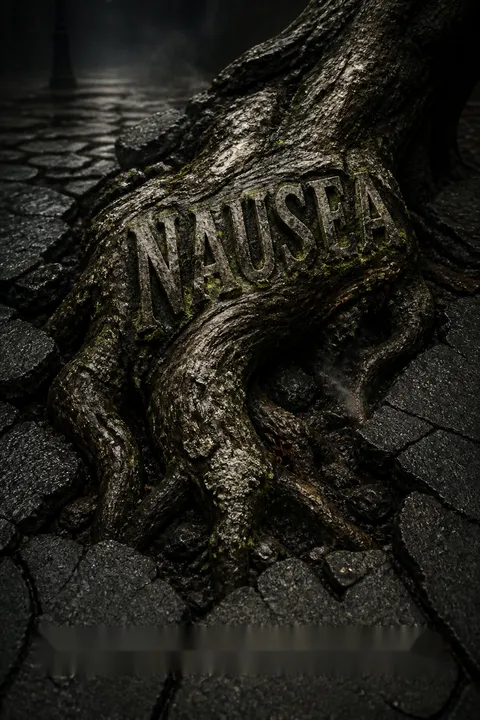
He gets off and enters the park, where a chestnut root becomes the focus of his attention. Its existence feels undeniable but impossible to explain through its function, color, or name.
Roquentin realizes that things do not need a reason to exist, and that human claims of rights and purpose cannot make existence necessary. The insight overwhelms rather than consoles him. Still, it clarifies his condition, and he decides to leave Bouville for Paris instead of continuing the Rollebon project.
The confrontation with humanism prepares Roquentin to reject abstractions that smooth away individual existence. The Self-Taught Man's benevolent categories are meant to connect people, but Roquentin experiences them as a substitute for encountering particular lives. In the park, the root defeats the same habit at a more fundamental level: naming and explaining do not account for the fact that anything is there at all. His insight is not a triumphant doctrine. It is bodily, distressing, and inseparable from the nausea that gives the novel its title. The decision to leave Bouville is practical, not a solution to contingency; it changes his location without claiming to change the conditions of existence.
Anny Cannot Return
In Paris, Roquentin finds Anny heavier, tired, and still alert to the details he has forgotten. She tells him that her pursuit of perfect moments has ended: the situations she once tried to arrange no longer seem capable of carrying special meaning.
Roquentin recognizes that he, too, has lost faith in adventures and privileged events, though Anny rejects his account as different from her own. She now lives by revisiting memories and staging them inwardly, while he has no confidence that memory can restore the past.
Anny is leaving for England the next day, and a painter is expected at her hotel. Roquentin watches her depart from the station. Their meeting confirms affection and shared history, but neither can resume the relationship that once gave those things shape.
The reunion tests whether intimacy can repair Roquentin's estrangement from the past. Anny remembers details with a precision he lacks, but memory does not make their former relationship available again. Her old method of perfecting situations has become a private exercise in recollection; his attempt to describe existence does not persuade her that they have arrived at the same understanding. Their difference matters as much as their resemblance. They have both lost faith in exceptional moments, yet they cope through distinct forms of retrospection. The affection remains real, but affection alone cannot restore the roles and expectations that once organized their shared life.
The Library Turns Cruel
On Roquentin's last day in Bouville, he returns to the library and sees the Self-Taught Man speaking quietly with two schoolboys. The Corsican librarian, Paoli, catches him touching one boy's hand and publicly accuses him of misconduct. The boys flee, while a woman reader joins Paoli in condemning him. When the Self-Taught Man refuses to leave immediately, Paoli punches him in the face and orders him out.
Roquentin grabs Paoli by the neck but releases him before striking back. He tries to help the bleeding Self-Taught Man, who pulls away and leaves alone. Their earlier disagreement over humanity now gives way to a painful recognition: the Self-Taught Man is isolated, but Roquentin cannot undo the humiliation or make him accept comfort.
The library scene makes social exclusion physical. Paoli turns suspicion into public certainty, and the crowd's approval helps convert punishment into a performance of moral order. The Self-Taught Man has previously sought connection through universal love; now he is exposed to the vulnerability of particular desire and the violence of others' judgment. Roquentin's brief grip on Paoli shows anger breaking through his detached habits, but his failure to retaliate or comfort his friend leaves the limits of his intervention visible. The episode complicates their earlier philosophical conflict. Roquentin can recognize another person's solitude without possessing a language or action capable of ending it.
A Song Opens Elsewhere
At the Railwaymen's Rendezvous, Roquentin says goodbye to the owner and waits for his train to Paris. Madeleine plays the old record he requested. The song does not erase the ugliness and contingency of the café, but its made, repeatable form moves him.
He imagines the unknown songwriter composing it in heat and difficulty, and feels tenderness for the labor that produced something able to outlast its maker. Roquentin begins to consider writing a novel rather than another history: fiction might give shape to experience without pretending to recover a dead person's life as fact.
He cannot know whether he has the talent to do it, but the possibility offers a direction. The novel ends with him still waiting, facing a beginning rather than claiming to have found a final answer.
The final record does not refute Roquentin's discovery that existence is contingent. Instead, it suggests that an artwork can achieve a kind of formal necessity without pretending to explain the world that produced it. The melody has been made by an ordinary person under ordinary pressures, yet its structure survives beyond the singer and songwriter. Roquentin's proposed novel borrows this possibility: not historical reconstruction, but an invented form that might lend his past a shape without claiming that life had always been destined to produce it. The ending remains tentative. Artistic work is neither salvation nor proof of inherent purpose; it is a chosen practice that could make a different relation to existence possible.
Analysis
Nausea follows a crisis in perception rather than a conventional chain of external dangers. Roquentin's days continue: he researches, eats in cafés, walks through Bouville, and meets people. What changes is his ability to treat these activities as self-explanatory. A paper he cannot pick up, a glass of beer, and a chestnut root each expose the gap between an object's name or function and the brute fact that it exists.
The novel makes that gap socially consequential. Bouville's elite present wealth, duty, and family as evidence that their authority is deserved. The museum portraits and Sunday rituals show how institutions turn contingent lives into apparently necessary histories. Roquentin's attack on such certainty is not a simple celebration of liberation. Recognizing that no inherited right can justify existence leaves him without the consolations that once organized his own life, including historical scholarship and the hope that travel would become adventure.
The relationships test different ways of coping. Anny tried to compose experience into perfect moments; the Self-Taught Man seeks belonging through an ideal of humanity; Doctor Rogé uses professional experience to classify distress. Roquentin distrusts these structures, yet his isolation prevents him from replacing them with easy intimacy. His treatment of the Self-Taught Man's suffering shows the moral limit of insight: seeing that another person is alone does not automatically teach him how to help.
Art offers the ending's cautious alternative. The jazz recording does not make existence necessary or erase the disorder of the café. Its beauty comes from a human act of composition that can outlast its maker without claiming to explain the world. Roquentin's thought of writing a novel is therefore not a cure or a triumphant discovery of purpose. It is a possible undertaking, chosen freely in a world that guarantees no reason for choosing it. The novel leaves him at that threshold, where clarity has not made life comfortable but has made evasion harder.
Review Summary
Nausea is a polarizing existential novel that explores themes of meaninglessness, freedom, and self-deception through the protagonist Antoine Roquentin's internal struggles. Many readers find the book's philosophical depth and introspective style compelling, praising Sartre's ability to capture existential angst. However, others criticize it as boring, pretentious, or overly pessimistic. The novel's impact on existentialist thought is widely acknowledged, though opinions on its literary merits and accessibility vary greatly.
People Also Read







Characters
Antoine Roquentin
The unsettled historianRoquentin is a thirty-year-old French historian living alone in Bouville while researching the Marquis de Rollebon. Travel has given him stories and places to remember, but little lasting attachment to other people. He records his thoughts in a diary because observation and writing are his main ways of testing what he experiences. His attention can be exacting, even ruthless, especially when he studies social rituals or other people's claims to wisdom. Beneath that detachment is a desire for experiences that feel consequential and a fear that his life lacks any necessary shape. His conflict is not simply between loneliness and companionship. He is trying to discover whether a person can choose a purpose without pretending that the world supplied one in advance.
Anny
The maker of momentsAnny is Roquentin's former lover, an intelligent and theatrical woman who once tried to turn exceptional situations into carefully composed moments. She notices clothing, gestures, setting, and timing, and expects other people to understand the role she has assigned them. This gives her a capacity for intensity, but also makes intimacy demanding: Roquentin often fails to meet the meaning she wants a scene to carry. She has pursued acting and travel, and thinks deeply about how people remember their lives. Beneath her self-command is a wish to find forms that can make experience matter. Her connection to Roquentin rests on affection, shared history, and a long-standing mismatch in how they interpret what happens between them.
The Self-Taught Man
The library humanistA bailiff's clerk and regular at the Bouville library, the Self-Taught Man is educating himself by reading through its collection in alphabetical order. He is polite, earnest, and hungry for conversation, with an idealistic faith that learning and human solidarity can overcome isolation. His devotion to books gives his solitary life structure, while his humanism offers him a way to feel connected to people he barely knows. Roquentin is both amused by his method and moved by his hopefulness, though he resists the broad categories through which the man understands others. Their relationship brings together two different responses to loneliness: one seeks belonging through universal ideals, the other distrusts any idea that claims to explain everyone.
Marquis de Rollebon
The historian's subjectRollebon is an eighteenth-century French aristocrat whose political intrigues, travels, and private dealings provide the subject of Roquentin's history project. He is encountered through letters, reports, memoirs, and other historical traces rather than through direct contact. Those records suggest a clever and adaptable figure, but they do not settle what he was truly like. For Roquentin, Rollebon becomes more than a research subject: the attempt to reconstruct him offers a way to organize the historian's own days. The relationship therefore reveals as much about Roquentin's need for purpose as it does about the elusive man whose life he studies.
Doctor Rogé
The authority of experienceA large, forceful doctor who frequents Bouville's cafés, Rogé carries himself as a man who understands people through professional experience. He is comfortable issuing judgments and expects others to accept his confidence. Roquentin watches him closely, reading his authority as both a social advantage and a defense against vulnerability. Rogé's presence shows how easily expertise and age can be treated as proof of wisdom, even when a person's certainty may also serve personal needs.
M. Achille
The anxious café regularM. Achille is a solitary customer whom Roquentin notices at Camille's restaurant. He seems unsure of himself and tries to appear more important than he feels. When Doctor Rogé classifies him as a familiar kind of eccentric, Achille accepts the explanation and appears relieved. Roquentin recognizes his own loneliness in Achille, but also sees how readily a person may prefer a reassuring label to facing uncertainty without support.
Lucie
The grieving charwomanLucie works as a charwoman at Roquentin's hotel and lives with a husband whose drinking consumes their household. She speaks about her unhappiness in a practical, self-controlled way, but the restraint does not make her suffering small. Roquentin first sees her as a familiar part of hotel life, then witnesses her grief more openly in the street. Her distress briefly shows him an intensity of feeling that his own detached existence seems to exclude.
Paoli
The library's enforcerPaoli is the Corsican librarian who oversees the reading room. He is vigilant about order and quick to use his authority when he believes a rule has been broken. His presence makes the library feel both protective and coercive: readers can study there, but they remain subject to his scrutiny. He represents the confidence of an institution that assumes it can decide who belongs and how its rules should be enforced.
M. Fasquelle
The reassuring café ownerFasquelle runs the Café Mably, a familiar refuge where Roquentin often eats and watches Bouville's residents. His steady manner makes the café seem dependable to Roquentin, who relies on its routine without forming a close relationship with him. When Fasquelle fails to appear one foggy morning, Roquentin's fear rapidly turns the owner's absence into a possible death. Fasquelle's ordinary life reminds the reader how little evidence Roquentin needs to construct a frightening possibility.
Madeleine
The café's record playerMadeleine serves customers at the Railwaymen's Rendezvous and operates its phonograph. Her practical, unhurried attention to café business contrasts with Roquentin's intense response to the music she plays. By putting on his requested record, she provides the occasion for one of his rare moments of relief.
Françoise
The hotel café proprietorFrançoise runs the Railwaymen's Rendezvous and is Roquentin's occasional sexual partner. Their relationship is transactional and largely wordless, offering physical contact without the intimacy of sustained conversation. She belongs to the routines Roquentin relies on even as he questions whether routine can make a life meaningful.
Plot Devices
Roquentin's diary
A record under pressureThe novel unfolds through dated diary entries written by Roquentin during his stay in Bouville. The form places readers close to changing perceptions, daily routines, and revisions of his own conclusions. Because he records events as he tries to understand them, an observation can first appear trivial and later become evidence of a larger crisis. The diary also exposes the limits of his control: he wants writing to clarify experience, but his entries sometimes show thought circling without resolution. Its chronology gives the story a clear sequence while its private voice makes that sequence feel uncertain from within.
The nausea
Existence made physicalRoquentin's nausea begins as a bodily disturbance around ordinary objects, such as a pebble, a glass, or a piece of wet paper. It develops through repeated encounters in cafés, streets, and the public park. Rather than functioning as a conventional illness with a simple cure, the sensation marks a change in how he perceives things: they no longer seem fully explained by their names or uses. Its intensification leads Roquentin toward a recognition about the contingency of existence. The physical response keeps the novel's philosophical questions grounded in touch, sight, smell, and discomfort.
Rollebon's archive
A borrowed purposeLetters, memoirs, reports, and other papers give Roquentin material for writing a history of the Marquis de Rollebon. Their conflicting implications invite him to build a coherent account from incomplete evidence. The archive functions both as a research problem and as an organizing structure for Roquentin's own life: while he interprets Rollebon, he can treat his days as serving a fixed project. The papers cannot provide direct access to the past, however, and the historian must supply connections that the sources do not prove. Their failure to secure certainty eventually forces Roquentin to confront the purpose he had borrowed from his subject.
The jazz record
A form that survivesThe old recording of Some of These Days appears at several important moments in Roquentin's experience. Its ordered melody briefly quiets his nausea, and its later return at the Railwaymen's Rendezvous helps him imagine a kind of creation different from historical research. The record is still a physical object, subject to wear and interruption, but the musical pattern reaches beyond the disorder Roquentin associates with ordinary existence. It does not prove that life has a purpose. Instead, it offers a model of form made through human effort, one that might endure without pretending to explain everything around it.
Anny's perfect moments
Life staged as meaningAnny's idea of perfect moments shapes how Roquentin remembers their relationship. She believed that exceptional situations could be transformed into meaningful scenes through the right gestures, words, and emotional discipline. Her method gives their shared past intensity, but it also makes ordinary mistakes feel like failures of performance. When they meet again, Anny explains how her understanding has changed and how little faith she now places in such moments. This device brings the novel's questions about experience and storytelling into a personal relationship, showing how two people can share a history yet assign it different meanings.
FAQ
Synopsis & Basic Details
What is Nausea about?
- Existential awakening in Bouville: Antoine Roquentin, a historian, experiences a disturbing sense of alienation and meaninglessness in the French town of Bouville, chronicling his descent into existential dread through diary entries.
- Confronting the absurdity of existence: The novel explores Roquentin's struggle to understand the nature of existence, as he grapples with the overwhelming feeling of "Nausea" triggered by everyday objects and situations.
- Search for meaning and justification: Roquentin's journey involves a rejection of conventional values and a desperate search for a way to justify his own existence in a world devoid of inherent purpose.
Why should I read Nausea?
- Philosophical exploration of freedom: The novel offers a compelling exploration of existentialist themes such as freedom, responsibility, and the search for meaning in a meaningless world.
- Intense psychological portrait: Readers are immersed in Roquentin's subjective experience, gaining insight into the complexities of human consciousness and the challenges of self-discovery.
- Influential literary work: Nausea is a seminal work of 20th-century literature that has shaped philosophical and artistic thought, prompting readers to question their own existence and values.
What is the background of Nausea?
- Post-WWI disillusionment: Written in the early 1930s, the novel reflects the widespread disillusionment and uncertainty that followed World War I, questioning traditional values and societal structures.
- Sartre's philosophical development: Nausea is considered a foundational text in Sartre's philosophical development, laying the groundwork for his later works on existentialism and phenomenology.
- Setting in provincial France: The choice of Bouville as the setting emphasizes the banality and alienation of modern life, contrasting with the romanticized ideals of the past.
What are the most memorable quotes in Nausea?
- "I exist. That is all.": This quote encapsulates Roquentin's fundamental realization of the brute, inexplicable fact of existence, stripped of any inherent meaning or purpose.
- "The Nausea has not left me and I don't believe it will leave me so soon; but I no longer have to bear it, it is no longer an illness or a passing fit: it is I.": This quote marks Roquentin's acceptance of his existential condition, recognizing the Nausea as an integral part of his being rather than an external affliction.
- "Every existing thing is born without reason, prolongs itself out of weakness, and dies by chance.": This quote highlights Sartre's view of the contingency of existence, emphasizing the lack of inherent purpose or justification in the world.
What writing style, narrative choices, and literary techniques does Jean-Paul Sartre use?
- First-person diary format: The novel is presented as Roquentin's diary, providing direct access to his thoughts, feelings, and perceptions, creating a sense of immediacy and subjectivity.
- Phenomenological descriptions: Sartre employs detailed, sensory descriptions to capture Roquentin's experience of the world, emphasizing the raw, unfiltered nature of perception.
- Philosophical digressions: The narrative is interspersed with philosophical reflections and arguments, exploring key existentialist concepts such as contingency, absurdity, and freedom.
Hidden Details & Subtle Connections
What are some minor details that add significant meaning?
- The Self-Taught Man's alphabetical reading: The Self-Taught Man's systematic, alphabetical approach to reading symbolizes the futility of seeking absolute knowledge and the arbitrary nature of intellectual pursuits.
- The recurring image of the mirror: Roquentin's frequent encounters with mirrors reflect his struggle with self-identity and the elusive nature of the self, highlighting the instability of personal identity.
- The description of hands: The detailed descriptions of hands, both Roquentin's and those of other characters, emphasize the physical and visceral aspects of existence, contributing to the overall sense of unease and alienation.
What are some subtle foreshadowing and callbacks?
- The pebble on the beach: Roquentin's initial experience with the pebble foreshadows his later, more intense encounters with the Nausea, establishing the theme of the disturbing nature of existence.
- The jazz record "Some of These Days": The recurring presence of this song serves as a callback to moments of fleeting transcendence and artistic inspiration, offering a temporary escape from the Nausea.
- The image of the Roquentin's red hair: The description of Roquentin's red hair as a "beautiful red flame" foreshadows his final decision to create something beautiful and lasting, suggesting a potential path towards self-affirmation.
What are some unexpected character connections?
- Roquentin and the Self-Taught Man: Despite their differences, Roquentin and the Self-Taught Man share a common struggle with alienation and a desire for meaning, highlighting the universal nature of existential angst.
- The portraits in the Bouville museum: The portraits of Bouville's elite, seemingly disconnected from Roquentin's experience, represent the societal structures and values that he rejects, underscoring his alienation from bourgeois society.
- Anny and Roquentin's shared disillusionment: Anny and Roquentin's shared disillusionment with "perfect moments" reveals a parallel trajectory in their lives, suggesting a common struggle with the limitations of human experience.
Who are the most significant supporting characters?
- The Self-Taught Man: He embodies the human desire for connection and meaning, even in the face of absurdity, serving as a foil to Roquentin's more detached and intellectual approach.
- Anny: She represents a lost ideal and a potential for connection, but ultimately reinforces Roquentin's sense of isolation and the impossibility of finding lasting meaning in relationships.
- The Patronne: She provides a fleeting sense of human warmth and connection, but ultimately highlights the superficiality and transience of human relationships in Roquentin's life.
Psychological, Emotional, & Relational Analysis
What are some unspoken motivations of the characters?
- Roquentin's desire for control: Roquentin's meticulous diary-keeping and his attempts to understand the Nausea can be seen as an effort to exert control over his chaotic and unpredictable inner world.
- Anny's fear of vulnerability: Anny's detachment and her emphasis on "perfect moments" may stem from a fear of vulnerability and a desire to maintain control over her emotions and relationships.
- The Self-Taught Man's need for validation: The Self-Taught Man's pursuit of knowledge and his desire to connect with others may be driven by a deep-seated need for validation and acceptance.
What psychological complexities do the characters exhibit?
- Roquentin's detachment and hyper-awareness: Roquentin oscillates between detachment from the world and an overwhelming awareness of its absurdity, creating a sense of internal conflict and instability.
- Anny's blend of cynicism and nostalgia: Anny's cynicism about "perfect moments" is tempered by a lingering nostalgia for the past, revealing a complex emotional landscape and a struggle to reconcile her ideals with reality.
- The Self-Taught Man's naiveté and repressed desires: The Self-Taught Man's naiveté and his repressed desires create a sense of vulnerability and foreshadow his eventual downfall, highlighting the dangers of suppressing one's true nature.
What are the major emotional turning points?
- Roquentin's experience with the chestnut tree root: This moment marks a profound shift in Roquentin's understanding of existence, triggering a deep sense of alienation and the realization of the absurdity of life.
- Roquentin's reunion with Anny: Their reunion shatters Roquentin's hopes for connection and reinforces his sense of isolation, leading to a deeper understanding of his own existential condition.
- Roquentin's decision to write a novel: This decision represents a turning point in Roquentin's journey, offering a potential path towards self-affirmation and a means of transcending the absurdity of existence.
How do relationship dynamics evolve?
- Roquentin's relationships are marked by distance: Roquentin struggles to form meaningful connections with others, maintaining a sense of distance and detachment even in his closest relationships.
- Power dynamics in Roquentin's relationships: Roquentin often finds himself in relationships where power dynamics are skewed, either feeling dominated by others or struggling to assert his own agency.
- Relationships as mirrors of existential angst: Roquentin's relationships often reflect his own existential angst, highlighting the challenges of human connection in a world devoid of inherent meaning.
Interpretation & Debate
Which parts of the story remain ambiguous or open-ended?
- The nature of Roquentin's artistic project: The specific nature of the novel Roquentin intends to write remains ambiguous, leaving the reader to speculate on the potential for art to provide meaning and redemption.
- The possibility of genuine connection: The novel leaves open the question of whether genuine human connection is possible in a world defined by absurdity and alienation, prompting readers to consider the limitations of human relationships.
- The ultimate significance of the jazz record: The meaning of the jazz record "Some of These Days" is open to interpretation, representing either a fleeting escape from existence or a potential source of artistic inspiration and self-affirmation.
What are some debatable, controversial scenes or moments in Nausea?
- The Self-Taught Man's actions in the library: The Self-Taught Man's inappropriate behavior raises questions about the nature of morality, the limits of tolerance, and the role of society in regulating individual behavior.
- Roquentin's violent thoughts and impulses: Roquentin's violent thoughts and impulses, such as his desire to stab the Self-Taught Man, challenge readers to confront the darker aspects of human nature and the potential for violence in the face of existential dread.
- Roquentin's misogynistic tendencies: Roquentin's objectification of women and his dismissive attitude towards their experiences raise questions about gender dynamics and the potential for sexism in existentialist thought.
Nausea Ending Explained: How It Ends & What It Means
- Roquentin's decision to leave Bouville: Roquentin's departure from Bouville symbolizes his rejection of a life defined by routine, conformity, and the illusion of meaning, marking a decisive break with his past.
- The possibility of artistic creation: Roquentin's contemplation of writing a novel offers a glimmer of hope, suggesting that art may provide a means of transcending the absurdity of existence and finding a sense of purpose.
- Uncertainty about the future: The ending remains open-ended, leaving Roquentin's future uncertain and prompting readers to consider the ongoing nature of the existential quest and the challenges of self-discovery.
About the Author
Other books by Jean-Paul Sartre

Download PDF
Download EPUB
.epub digital book format is ideal for reading ebooks on phones, tablets, and e-readers.








