

Plot Summary
One Becomes a World
Twelve-year-old Robert dreads sleep because his dreams trap him in endless slides and other humiliations. He also hates school arithmetic, especially Mr. Bockel's pretzel problems, which seem designed to make mathematics dull. One night, in a meadow of towering grass, a tiny, sharp-tempered Number Devil appears and claims that every number can be built from ones.
He uses a dream calculator to show Robert how repeated operations create new numbers, then insists that counting can continue without end. Robert challenges the Devil's certainty, and the Devil's attempt to extend one of his own number recipes collapses. Enraged at being caught guessing, he swells until he bursts, leaving Robert awake and pleased that he has not been fooled.
The first lesson is also a contest over authority. Robert is not won over by a patient expert; he is drawn in by the chance to test the Devil's claims and catch a mistake. That matters because the book makes skepticism part of mathematical learning rather than a defect to be corrected. The Devil's tantrum exposes a weakness beneath his theatrical confidence, while Robert's own guess happens to be right without being proof. Their encounter plants the central distinction between noticing a pattern and knowing why it holds.
Zero Makes Room
The Devil returns after Robert slides into a forest of ones, where numbers swarm like insects. He points out that zero is absent from the forest, then uses Roman numerals to show how difficult it is to represent Robert's birth year without a symbol for nothing. When Robert subtracts one from one, zero gives the result a name; when he compares positive and negative numbers, zero fills the missing place between them.
The Devil then teaches him place value: digits gain size by shifting left, while zero holds a vacant position. Robert assembles his birth year from powers of ten and wakes with the method still in mind. His mother hears him explain it over breakfast, though he keeps the dream's source to himself.
Zero changes the story's scale of possibility. Robert first treats nothing as an absence that need not be written, but the Devil shows that the empty position is an active part of the number system. This lesson also gives Robert an early, private success: he can carry an idea from a dream into waking life, even if he cannot yet tell his mother where he learned it. The forest image turns place value into something spatial, making an abstract convention feel like a structure Robert can navigate.
Prime Numbers Resist
On a later night, the Devil finds Robert in a cave and makes him confront division, remainders, and the impossibility of dividing by zero. Their argument turns to numbers divisible only by one and themselves. At the Devil's instruction, Robert crosses out multiples on a wall, leaving the prime numbers standing.
The simple sieve works for a small chart, but the Devil admits that much larger primes are difficult to identify. He then offers two striking claims: between a number and twice that number there is always a prime, and every even number greater than two can be written as the sum of two primes. Robert is impressed, but neither can explain why these patterns hold. For once, the Devil's uncertainty does not end in anger.
The prime numbers shift the lessons from calculation toward the limits of calculation. Robert can perform the sieve and see which numbers survive, yet the procedure does not answer every question about primes. The Devil's admission that powerful computers and clever tests still do not settle the larger claims complicates his role: he is not a magical source of complete knowledge. Mathematics becomes compelling precisely where a reliable method meets a question it cannot finish.
Endless Decimals, Hidden Roots
At a beach, a couch-sized calculator shows Robert that one divided by three produces a decimal that repeats forever. He resists the Devil's claim that an endless string of nines equals one, but eventually accepts that the infinite decimal leaves no final gap.
Dividing other fractions reveals repeating cycles, while the Devil contrasts them with decimals that do not settle into a pattern. He shows Robert how the diagonal of a square with unit sides has length equal to the square root of two, an irrational number whose digits continue without repetition.
Robert is startled when the Devil argues that irrational numbers outnumber the familiar fractions and whole numbers, but refuses to accept a magical demonstration. Their lesson ends before the Devil can provide a proof.
This dream makes infinity feel less like a faraway destination than a rule about what can never be completed. Robert's objection to the nines is intuitive and reasonable, but the endless process forces him to reconsider what equality means when there is no last digit. The square-root example then separates two kinds of endlessness: a decimal may repeat predictably or refuse any repeating cycle. Robert's refusal to accept conjuring as proof is a sign of growth. Curiosity now comes with standards.
Coconuts Draw the Sum
After the Devil has been absent for several nights, Robert stumbles through a desert dream and finds him in a palm tree. The Devil has Robert drop coconuts into the sand; without aiming, Robert's piles form triangles.
Counting their rows reveals the sequence 1, 3, 6, 10, and 15, with each new triangle adding one more coconut than the last. Robert spots that neighboring triangle numbers differ by successive integers, then learns that adding adjacent triangle numbers makes a square number.
The Devil uses the same patterns to show how a triangle number can give the sum of a run of counting numbers. When the lesson threatens to crowd out the swimming pool, Robert finally dives in among the floating numbers, choosing play over another demonstration.
The coconuts turn number patterns into something Robert can see before he can calculate them. The arrangement makes each new total emerge from a visible row, so the rule feels discovered rather than imposed. Just as important, Robert begins to set limits. He can enjoy the Devil's lessons and still insist on swimming. His willingness to leave a pattern unfinished marks a more balanced relationship with the teacher, who no longer controls every moment of the dream.
Rabbits Multiply by Rule
In a potato field, the Devil tells Robert about Bonacci, a mathematician whose numbers are built by adding the two before them. To demonstrate, he brings in a pair of rabbits and speeds up time with a special clock.
Each couple matures and eventually produces another couple, so the field fills in the sequence 1, 1, 2, 3, 5, 8, 13. Robert recognizes the pattern, but the rapid multiplication soon frightens him; he begs the Devil to run the clock backward until only the original pair remains.
The scene leaves Robert convinced that living things behave as though they follow number patterns. The next day, he fills pages with rabbit drawings and becomes distracted from his friends and ordinary routines, while his mother worries about his sudden obsession.
The rabbit model makes a numerical sequence feel alive, but its runaway growth gives the lesson an emotional cost. Robert's alarm is not a failure to understand; it is a response to what the pattern implies when it is allowed to continue unchecked. The Devil's backward clock restores the starting pair, showing that a process can be reversed even if its forward consequences become enormous. Robert's daytime fixation also signals that the lessons have moved beyond bedtime entertainment and begun reshaping his attention.
One Triangle, Many Patterns
Robert enters a white cube-shaped house where he and the Devil build a triangle from glowing electronic blocks. Each block receives the sum of the two above it, and the resulting rows contain familiar sequences: counting numbers, triangle numbers, and the rabbit numbers.
When the Devil lights whole rows, Robert sees that their totals are powers of two. Colored diagonals reveal the Bonacci sequence again, while lighting numbers divisible by two, three, or five produces smaller triangular patterns inside the larger one.
Robert recognizes that a single arrangement can hold several lessons at once. The Devil explains that mathematicians have studied the triangle for centuries, yet it continues to produce new patterns. Robert wakes after a long sleep, carrying the sense that the diagram is larger than any one lesson.
The triangle becomes a model of mathematical connectedness: separate rules appear as different paths through the same arrangement. Robert no longer receives each result as an isolated trick; he recognizes earlier lessons nested inside a new object. That recognition suggests a deeper kind of learning, where knowledge becomes reusable. The scene also quietly unsettles the idea that mathematics is a finished body of facts. The Devil's triangle has a history longer than his own, and even he cannot exhaust what it contains.
Eleven Seats, Forty Million
In a dream classroom, the Devil has Robert record every way Al, Betsy, and Charlie can change seats. Adding more classmates makes the arrangements multiply so quickly that Robert learns to represent them with factorials; eleven students would have nearly forty million possible seating orders.
The Devil then distinguishes arrangements from groups. If classmates shake hands, the total follows the triangle numbers, giving fifty-five handshakes among eleven people. A cleanup problem adds another layer: Robert uses the number triangle to count groups of three who could sweep the schoolyard.
The next day, the real yard is still filthy, and the classmates tease Robert about doing mathematics in his sleep. The Devil has announced a holiday from their lessons, leaving Robert with the patterns but no dream guide.
The classroom turns abstract counting into a problem of social possibility. A small change in what matters, order or membership, changes the method and the answer. Robert learns that mathematics can prevent an impossible task, such as listing millions of arrangements, by finding a compact way to count them. The dream's practical cleanup never alters the real schoolyard, a useful boundary between imagined solutions and waking consequences. When the Devil withdraws, Robert must keep the knowledge without the reassurance of another demonstration.
Infinite Crowds, Slow Sums
When Robert catches the flu, the Devil visits his fever dream and fills the bedroom with rows of numbered figures. He pairs every ordinary number with an odd number, showing Robert that two infinite collections can match one for one even when one seems half the size of the other. More rows represent primes and other familiar sequences, each endless but countable in the same way.
The Devil then turns to sums. Adding halves, quarters, eighths, and smaller pieces approaches one without passing it; a different series of shrinking fractions grows beyond any fixed total, though painfully slowly. Robert, exhausted, follows enough steps to see that endless addition can converge or diverge. When he wakes, his fever has broken.
Robert's old arithmetic instincts falter because infinity does not obey the rules of finite comparison. Pairing each number with an odd one makes a one-to-one match visible, but it asks him to accept that a whole infinite set can correspond to what looks like a half. The series lesson adds a second distinction: endless processes do not all behave alike. Some settle toward a limit; others keep growing without bound. The fever setting makes these ideas feel disorienting, while the Devil's quiet care frames learning as something Robert can endure without having to master everything at once.
The Star Behind the Snow
Robert dreams he is freezing in a snowstorm, then discovers that he is watching a film in a small theater. The Devil gives him a computer and asks him to divide successive Bonacci numbers by their neighbors.
The results wobble closer and closer to 1.618, an irrational number that also appears in the proportions of a five-pointed star inside a pentagon. Repeated stars and pentagons reveal the same ratio at smaller scales. The Devil then guides Robert through a different pattern: for flat shapes, counting vertices and spaces and subtracting edges gives one; for solid shapes, the result is two.
He demonstrates by unfolding and refolding polyhedra on screen. As the snow returns, Robert is no longer afraid of the dream, though he cannot retain the number's endless decimal.
The lesson links numerical approximation to visual form. Robert first sees the ratio emerge from a sequence, then finds it embedded in the geometry of a star, making the number feel like a relationship rather than a mysterious decimal. The counting rule for shapes extends that idea: a form can change through cutting and folding while a deeper structural relation remains stable. Robert's forgotten digits matter less than his changed response to uncertainty. The snowstorm that began as a threat becomes a setting he can understand and endure.
Proofs Need Safe Steps
After Mr. Bockel multiplies into a crowd chasing him through town, Robert is pulled into a rooftop garden by the Devil. He asks why the patterns in their lessons always work, and the Devil finally distinguishes conjecture from proof.
He compares proof to crossing a stream by tested stepping stones: each step must rest on a reliable statement. He admits that a formula Robert challenged on their first night eventually failed, and describes a mathematician whose heavily tested rule also had an exception.
The Devil then presents the traveling-salesman problem: finding the shortest route through twenty-five cities would require too many possible routes to check one by one. Robert learns that even mathematicians may not know whether a perfect solution exists, and leaves the roof less intimidated by unanswered questions.
This is the book's clearest correction to the Devil's earlier performance. His showmanship made mathematics look like an inexhaustible supply of certainties; now he explains that patterns can fail, proofs require disciplined steps, and some problems remain open. The stepping-stone image gives Robert a practical model of rigor: curiosity proposes a crossing, but evidence must support every move. The crowded Bockels also reveal that Robert's anxiety about school has not vanished. What changes is his sense that a teacher's authority and mathematical truth are the same thing.
The Secret Order of Numbers
When the Devil stops appearing, Robert misses him and keeps drawing diagrams through lessons and homework. At last the Devil arrives with an invitation to Number Heaven and carries Robert to a palace filled with mathematicians, including Bonacci, Lord Rustle, and Pythagoras.
A senior official recognizes Robert's growing knowledge and awards him the Order of Pythagoras, while the Devil prepares to return to his own work. Robert wakes with a tiny star from the ceremony on a chain.
In class, Mr. Bockel asks how many pretzels are needed if each of thirty-eight pupils receives one more than the pupil before. Robert begins by writing out the sequence, then uses triangle numbers to calculate the total: 741. His dream learning has become a method he can use awake.
The ending brings Robert's private apprenticeship into public life without turning him into a different person. The medal makes the dream's community tangible, but the more decisive recognition comes when he solves Mr. Bockel's problem himself. He does not defeat the teacher or reject school mathematics; he discovers a structure that makes the assignment manageable. The initial conflict was not simply that Robert disliked numbers, but that school had presented them as lifeless procedures. By using a pattern to reach 741, he takes ownership of the very kind of problem that once made him feel foolish.
Analysis
The Number Devil builds its story around a change in Robert's relationship to mathematics. At first, numbers belong to the same category as bad dreams and tiresome school assignments: they happen to him, and he has little control over them. The Devil's dream lessons alter that balance by giving Robert things to manipulate, test, and challenge. Gum can be divided, coconuts can be arranged, and classmates can be reordered. Each abstraction becomes an event with consequences Robert can inspect.
The Devil is an imperfect guide by design. He is theatrical and often right, but his certainty exceeds his knowledge. Robert's suspicion exposes the difference between a striking pattern and a proof, a distinction the Devil eventually accepts himself. That shift keeps the book from treating learning as the transfer of answers from an all-knowing adult to a child. Robert's objections are part of the method. The student becomes more capable not by silencing doubt, but by learning what doubt must demand: evidence, tested steps, and a willingness to leave some questions open.
The recurring lesson is that mathematical ideas connect. Zero makes place value possible; triangle numbers return in sums and handshakes; the rabbit sequence reappears in the number triangle and in a geometric ratio. These repetitions reward memory without making the chapters interchangeable. Each return adds a new use or unsettles an earlier assumption. Infinite processes can converge or diverge, and apparently equal collections can behave strangely when they never end.
The final classroom problem completes the emotional arc. Robert does not escape school or prove Mr. Bockel foolish. He uses a pattern to solve the teacher's assignment, showing that mathematical imagination can travel between a dream and an ordinary desk. The book's central promise is not that every difficult idea becomes easy, but that a subject once experienced as coercion can become a field of questions Robert chooses to explore.
Review Summary
The Number Devil receives mixed reviews, with many praising its engaging approach to mathematics for children. Readers appreciate the creative storytelling and accessible explanations of complex concepts. Some critics find the renaming of mathematical terms confusing and the plot thin. Parents and educators value the book for sparking interest in math among young readers. While not universally loved, it is generally regarded as a unique and entertaining way to introduce mathematical ideas to children and adults alike.
People Also Read


Characters
Robert
Reluctant math apprenticeRobert is a twelve-year-old who distrusts school mathematics because it feels tedious, confusing, and disconnected from anything he cares about. His imagination is active, but his dreams have usually made him feel powerless. The Number Devil's lessons appeal to Robert because they invite him to question, test, and notice patterns rather than simply obey instructions. He is quick to challenge overconfidence and increasingly willing to admit when a pattern intrigues him. His curiosity develops alongside a need for independence: he enjoys the Devil's company but still pushes back when lessons become exhausting. Robert's defining strength is not instant mathematical brilliance, but his readiness to think critically once numbers become meaningful.
The Number Devil
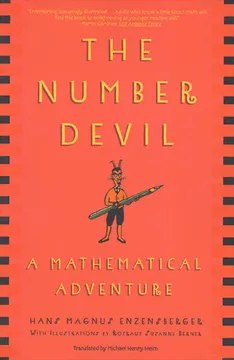
Dreaming math guideThe Number Devil is a small, theatrical teacher who appears in Robert's dreams with a walking stick that writes on almost anything. He makes mathematical ideas concrete through forests, coconuts, rabbits, glowing cubes, and other dream inventions. His confidence is enormous, and so is his temper when Robert questions him, yet he can also admit uncertainty and explain why mathematicians need proofs. He teaches by provoking Robert into noticing patterns rather than handing him a conventional lesson. Their relationship gradually becomes that of trusted companions, though the Devil still controls the pace of many encounters. His mixture of brilliance, pride, humor, and limitation makes him a guide rather than an infallible authority.
Robert's mother
Worried waking-world anchorRobert's mother notices his sleep, schoolwork, and changing habits, and worries when he begins drawing numbers and rabbits instead of spending time with friends. She responds with practical care, offering comfort when he is tired or sick, but she does not know what is happening in his dreams. Her ordinary concerns give Robert a waking life that exists alongside the Devil's vivid lessons. She is loving and attentive, even when she cannot understand the private source of her son's new interests.
Mr. Bockel
Pretzel-loving math teacherMr. Bockel is Robert's mathematics teacher, known for word problems involving pretzels and for disapproving of calculators. Robert sees him as the face of everything tedious about school mathematics. The Devil later gives Robert a more sympathetic view by reminding him that teachers also work within routines and demands. Mr. Bockel is not a villain, but his classroom methods help explain why Robert initially mistakes mathematics itself for a collection of joyless exercises.
Al
Robert's football friendAl is one of Robert's classmates and friends. His shifting seat in a dream classroom helps Robert explore arrangements and permutations. In waking life, Al belongs to the ordinary social world Robert sometimes neglects when his new interest in numbers takes over.
Betsy
Strong-willed classmateBetsy is Robert's classmate, recognizable by her pigtails and forceful opinions. Her insistence on particular seats drives much of the dream exercise in changing places. She makes an abstract counting problem feel like a small, lively classroom dispute.
Charlie
Easygoing classroom friendCharlie is one of Robert's friends and a classmate who often gives way when others argue over seats. He helps bring the classroom arrangement exercise to life and later covers for Robert when he tries to keep his mathematical work from Mr. Bockel.
Doris
Order-loving classmateDoris is a classmate who proposes arranging pupils alphabetically when the dream classroom becomes chaotic. Her suggestion offers an orderly alternative, though the class's many possible arrangements quickly overwhelm that simple plan.
Bonacci
Rabbit-sequence mathematicianBonacci is a mathematician in Number Heaven associated with the sequence Robert sees in the growing rabbit population. The Devil regards him as a valued colleague. His appearance connects an abstract numerical rule to a living process that Robert can watch unfold.
Lord Rustle
Relentless proof-makerLord Rustle is an elderly mathematician in Number Heaven who once undertook the elaborate task of proving a statement as basic as one plus one equals two. His work represents the extreme care that formal proof can demand, even when a result seems obvious.
Owl
Friendly palace scholarOwl is a genial, elderly mathematician whom Robert meets in Number Heaven. He is curious about prime numbers and speaks with the warmth of a scholar who enjoys exchanging ideas. His room also introduces Robert to the palace's collaborative intellectual culture.
Professor Horrors
Guarded number scholarProfessor Horrors is a stern mathematician in Number Heaven who is absorbed in his papers and reluctant to explain his work. The Devil associates him with a category of numbers that challenge ordinary expectations.
Professor Singer
Dancer of infinitiesProfessor Singer is a pale, energetic scholar in Number Heaven, absorbed in ideas about infinity. Robert sees him singing and dancing among an extraordinary dust of tiny particles, a comic image of a mind occupied by immense quantities.
Pythagoras
Ancient geometry pioneerPythagoras appears in the palace as one of the ancient thinkers associated with mathematical discovery. The Devil links him to the investigation of irrational numbers and to the word mathematics itself. His presence gives Robert a glimpse of how long mathematical questions have outlived their original discoverers.
Plot Devices
Dream lessons
Nightly imaginative classroomRobert's dreams provide a changing stage for each mathematical lesson. A cave, beach, desert, classroom, and palace make abstract ideas available as objects and actions. The dream frame also allows the Devil to reshape time, summon impossible tools, and turn a small example into an enormous spectacle. At the same time, waking scenes test whether Robert carries anything back with him. The device supports both comedy and emotional movement: dreams that once trapped Robert become places where he can question, learn, and choose when he has had enough.
The walking stick
A wand for visible mathematicsThe Devil's walking stick writes numbers on clouds, walls, sand, and other surfaces, turning explanations into demonstrations. It can also make objects appear or change, allowing the Devil to build a lesson around whatever Robert needs to see. Its most important function is practical rather than magical: it puts mathematical relationships outside Robert's head, where he can inspect and challenge them. The stick signals the Devil's showmanship, but it does not guarantee that his conclusions are correct. Robert's questions remain necessary.
Everyday objects
Concrete models for abstractionChewing gum, coconuts, rabbits, seats, handshakes, and pretzels give Robert familiar things to count, divide, arrange, or compare. Each object translates a mathematical relationship into an action with visible consequences: a gum portion is halved, a rabbit population grows, or classmates swap seats. These models lower the barrier to understanding, but they do not replace reasoning. Robert must still recognize what the model shows and where it stops being enough. The repeated use of objects helps him connect ideas across separate dreams.
The number triangle
One diagram, many connectionsThe number triangle is built row by row, with each entry formed from the two above it. Its arrangement gives Robert a compact way to see counting numbers, triangle numbers, powers of two, the rabbit sequence, and combinations. The Devil returns to it when Robert needs to count groups for the classroom cleanup problem, linking an elaborate dream image to a practical question. The triangle's visual structure makes it an especially effective symbol for the book's teaching method: one organized object can reveal several relationships without reducing them to unrelated formulas.
The Order of Pythagoras
A token of earned belongingIn Number Heaven, a palace official awards Robert a star-shaped medal recognizing his progress among the number apprentices. It gives physical form to his acceptance into the mathematical world the Devil has described. The medal also bridges dream and waking life, letting Robert carry evidence of the adventure into the classroom. Its importance is not that it makes Robert an expert, but that it marks a change in how he sees himself: someone who can work with numbers rather than merely endure them.
Download PDF
Download EPUB
.epub digital book format is ideal for reading ebooks on phones, tablets, and e-readers.








