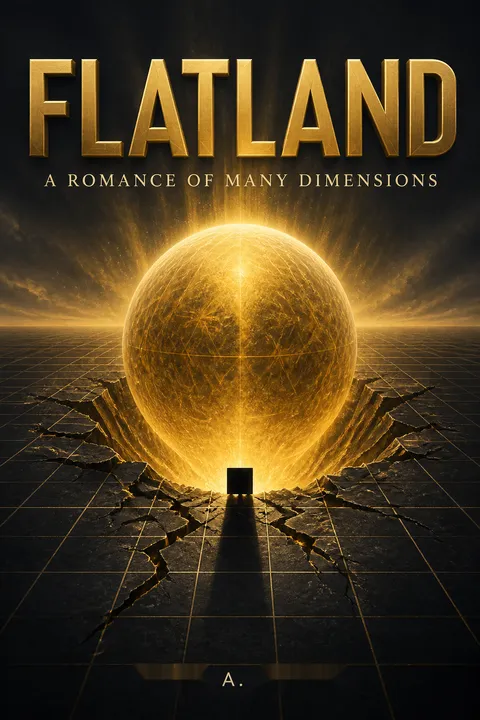


Plot Summary
Flatland Seen Edgewise
The narrator, a Square and lawyer, introduces Flatland, where every shape appears to its inhabitants as a line. People identify one another by voice, touch, or subtle changes in brightness through fog, but each method is shaped by class. The Square describes a hierarchy in which a figure’s number of sides determines status, while women and working-class triangles occupy the lowest positions.
A male child is generally expected to gain a side beyond his father, and carefully managed marriages help preserve the system. The Square presents these rules as natural and orderly. His account, however, makes clear that a person’s rank is not simply recognized: it is built into law, education, family life, and the dangerous ways bodies meet.
The opening makes perception a social institution. Because Flatlanders cannot see a figure whole, they rely on trained inference, and the state converts those limits into credentials: refined sight belongs to the elite, while touch is assigned to the lower orders. The Square’s confidence in this arrangement is part of the satire. He treats inherited hierarchy as geometry made moral, although his own explanations reveal that privilege depends on policing bodies and controlling access to knowledge. The reader is asked to notice not only what the Square sees, but the assumptions that determine what he is willing to call natural.
Angles Govern Every Life
The Square explains that regularity is treated as proof of civic worth. An irregular figure may be surgically corrected, confined, or destroyed, while the rare child of an Isosceles family whose shape qualifies as an Equilateral is removed from its parents and raised among the privileged.
Women, meanwhile, are described as straight lines: difficult to see end-on and dangerous if approached from the wrong direction. Their movement is tightly regulated, and their education is withheld.
The Square accepts these cruelties as safeguards for public order, even as he describes the fear and violence they produce. He also notes that the Circles teach that configuration determines conduct, a doctrine that excuses the ruling class from questioning the institutions it controls.
The Square’s world turns physical difference into a total explanation of moral and political life. By claiming that geometry fixes character, Flatland’s rulers can present exclusion as diagnosis rather than choice. The child removed from an Isosceles family embodies the system’s bargain: a narrow chance of advancement is offered, but only through separation and conformity. The narrator’s account of women is especially revealing because he repeats official contempt while describing laws that make their lives perilous. His contradictions expose how power can mistake the conditions it imposes for evidence of inferiority.
Color Nearly Breaks Order
The Square recalls a past upheaval that began when a figure named Chromatistes discovered paint. Color made Flatlanders easier to distinguish, so geometry lessons and traditional methods of recognition began to seem unnecessary.
Working-class rebels demanded equal rights and proposed painting women and priests as well, threatening both the hierarchy and the Circles’ monopoly on authority. The crisis shifted when an Isosceles disguised himself as a many-sided nobleman and deceived a noble orphan into marriage; she killed herself after learning the truth.
The Circles used the outrage to turn women against the reform. At an assembly, Chief Circle Pantocyclus appeared to concede, then arranged Chromatistes’ death and a slaughter that wiped out the rebel soldiers and purged the lower classes.
Color is more than a visual convenience here. It briefly separates recognition from inherited geometry, allowing people to imagine that social distinctions might be discarded. The counterfeit marriage gives the Circles a real danger to invoke, but their response exceeds protection and becomes a calculated restoration of power. Pantocyclus converts public grief into political force, while the ensuing massacre ensures that the reform movement cannot survive to make its case. The Square narrates this episode as a triumph of order, yet its sequence shows that order is maintained by controlling perception, exploiting fear, and destroying those who might interpret the world differently.
The King Beyond His Line
Before the central encounter, the Square dreams that he enters Lineland, a world consisting of a single line. Its King believes that line is all of existence; his subjects cannot pass one another or see anything beyond a point. The King explains that his people use voices to recognize one another and arrange marriages, a system he regards as complete.
The Square tries to describe movement and space outside the line, then briefly leaves the King’s field of vision to demonstrate it. When he returns, the King dismisses the disappearance as trickery and refuses the Square’s account. The dream ends with the monarch advancing against him, and the Square wakes before the threat can land.
The dream gives the Square a miniature version of the lesson he will soon resist. The King’s certainty is not foolish within his own experience; it is the limit of a world that supplies no evidence for sideways movement. Yet the Square initially treats the King’s failure as stubbornness rather than as a predicament of perception. That blind spot matters. His ability to imagine another dimension is still only theoretical, and his frustration at being disbelieved foreshadows how he will respond when someone challenges the boundaries of his own knowledge.
A Visitor at Millennium
On the final evening of the year 1999, the Square’s young Hexagon grandson asks what a number raised to the third power could mean in geometry. The Square rebukes him because Flatland recognizes only two dimensions, but the question stays with him. As the new millennium begins, a strange presence speaks inside the Square’s home.
His wife first mistakes the visitor for a woman, then discovers that touch reveals no angle at all. The newcomer identifies himself as a Circle, though his apparent size changes in a way the Square has never seen. He asks to speak privately with the Square, and the wife withdraws. The visitor’s arrival turns the grandson’s abstract puzzle into an immediate threat to the Square’s settled understanding.
The inciting question comes from a child who notices a gap in the Square’s teaching: the mathematical operation has been introduced, but its possible meaning has been ruled out in advance. The visitor arrives precisely where that gap opens. The wife’s misidentification and the Square’s uncertainty show that their usual tools of recognition cannot secure the encounter. At the threshold of a new millennium, the scene makes intellectual change feel both intimate and destabilizing. The Square’s embarrassment over his grandson’s question has prepared him to hear an answer, but not yet to accept one.
Words Cannot Lift a Plane
Once alone with the visitor, the Square feels him and confirms that the stranger has no angles. The visitor says he comes from a world with a third dimension, but the Square can understand only his own plane and mistakes the new direction for north or south.
The visitor tries to build an explanation by analogy: a moving point makes a line, and a moving line makes a square, so a square moved in a direction outside Flatland would produce a solid. The Square cannot picture that motion and grows convinced that the visitor is a magician or an impostor. Unable to make the visitor demonstrate the direction in words, he charges at him with his right angle, hoping to force the stranger to submit.
This encounter turns a problem of knowledge into a problem of trust. The Sphere offers a rigorous analogy, but it depends on the Square accepting a direction his senses cannot supply. Instead, the Square interprets the failure of explanation as evidence of deception. His attack is not merely comic aggression: it is an attempt to restore a familiar rule of contact, in which bodies can be tested by touch and angles can settle disputes. The scene shows how reasoning can become defensive when a person mistakes the limits of their own imagination for limits in reality.
The Locked Tablet Vanishes
The Square’s charge cannot pin the Sphere down. To prove that his perspective reaches inside closed objects, the Sphere removes an account tablet from a locked cupboard without opening its door, then places it in the room. He describes the Square’s household and belongings from a vantage point that should be impossible within Flatland.
When the Square still resists, the Sphere touches his interior, causing a sharp pain that ends as quickly as it began. The Square attacks again and calls for help. As his wife approaches, the Sphere warns that no one else must witness the event, then lifts the Square out of his plane. The familiar world disappears, and the Square finds himself forced to experience what he had denied.
The tablet is an effective proof because it changes the argument from abstract possibility to an alteration the Square can verify. Yet proof does not immediately produce consent. The Sphere’s ability to touch and transport him makes revelation inseparable from coercion, complicating the role of teacher and pupil. The Square’s resistance is understandable as a response to having his bodily security violated, but it also repeats the King of Lineland’s refusal to recognize what lies beyond experience. The transition is therefore both epistemic and ethical: the Square gains a new vantage point, but he does not choose the terms on which he receives it.
The Council Hides a World
From Spaceland, the Square sees Flatland as an open plane. He can look into houses, inspect their occupants, and observe his own family without entering a room. The Sphere takes him to the capital, where the High Council is meeting at the start of the millennium. Its records describe earlier visitors from another world and prescribe punishments for anyone who reports such revelations.
The Sphere appears among the Councillors to announce the existence of a higher realm, then vanishes as guards rush him. The Council President conceals the event, orders the guards silenced, and sentences the Square’s brother, who serves as clerk, to imprisonment. The Square watches this happen but cannot move independently or intervene.
Spaceland initially resembles omniscience: the Square sees into every enclosure that once defined his world. The Sphere immediately challenges the moral prestige attached to such vision, separating access to information from compassion or justice. That distinction becomes concrete when the Council suppresses the Sphere’s appearance and imprisons the Square’s brother to preserve state secrecy. The institution is not ignorant of prior anomalies; its records show that it manages them as political liabilities. The Square’s new perspective reveals both the physical interiors of Flatland and the way its rulers manufacture public ignorance.
A Cube Opens Further Questions
The Sphere next teaches the Square to understand a solid by stacking squares, and introduces him to the Cube through its faces and vertices. With help from perspective, light, and touch, the Square begins to distinguish a solid from the flat figure it first appeared to be. The discovery delights him, but it also sharpens his appetite.
He reasons that if a new direction raises a square into a cube, another direction might lift a cube into a still higher form. The Sphere refuses to claim knowledge of such a realm. The Square presses his analogy, citing reports of unexplained appearances in Spaceland, until the Sphere loses patience and returns him to Flatland. The Square falls back into his home, carrying wonder and frustration together.
The Cube is a genuine intellectual breakthrough, but it also gives the Square a method that outruns its evidence. Analogy has helped him imagine a third dimension, so he assumes that the same pattern must confirm a fourth. The Sphere’s refusal exposes a difference between possibility and knowledge, one the newly awakened Square is not ready to respect. His insistence is not simply vanity; it grows from the exhilaration of having a once-impossible world become visible. Still, the episode warns that emancipation from one limit can create a new certainty, and that curiosity can become dogma when it demands confirmation rather than remaining open to uncertainty.
Pointland Mirrors the Square
After returning home, the Square dreams that the Sphere takes him to Pointland, where a single point believes itself to be the entire universe. The Square tries to explain that the point occupies only a tiny part of a larger reality, but the creature interprets the warning as an idea produced by its own mind and grows more content with itself.
The Sphere uses this failure to show that some limits cannot be broken by argument alone. In the dream, the Sphere also relents about his own earlier certainty and introduces the possibility of still higher dimensions. The Square wakes renewed by the prospect of teaching others, although his conviction is already harder to preserve than it felt in the dream.
Pointland makes self-enclosure the sharpest form of ignorance: the point can absorb every challenge because it has no conceptual room for another being. The Square recognizes this as a cautionary tale, but its lesson also turns back on him. He has just demanded that the Sphere affirm a realm beyond his own knowledge, while the Sphere’s change of mind in the dream models a less final relationship to uncertainty. The dream offers encouragement without making the Square’s later teaching easy. Insight may widen what a person can imagine, but it does not automatically supply the language or evidence needed to persuade someone else.
The Grandson Rejects the Proof
The Square wakes intent on teaching his family, but a public proclamation warns that anyone promoting revelations from another world may be imprisoned or killed. He chooses his clever young grandson as a first pupil and tries to explain how a square might move outside Flatland.
Hearing the decree, the boy panics, denies that he meant his earlier question seriously, and laughs at the Square’s confused demonstration. The failed lesson leaves the Square without a disciple.
He spends months writing a treatise about a theoretical Thoughtland, but Flatland’s line-only diagrams cannot make his idea clear. He also struggles to recall the Cube vividly. His private excitement becomes isolation, and his inability to translate experience into proof begins to erode his confidence.
The grandson’s retreat shows how authority enters even a private lesson: the Council’s warning has made curiosity dangerous before the Square can teach its content. The boy is not simply obtuse; he is protecting himself by disowning the question that might implicate him. The Square’s written treatise encounters a parallel obstacle, since its medium cannot depict what it argues for. His weakening memory adds a further instability: the revelation is not a permanent possession but an experience he must continually reconstruct. Knowledge, the section suggests, depends on more than insight. It needs forms of communication and social conditions that do not punish inquiry.
Prison for a New Dimension
After months of restraint and several dangerous remarks, the Square finally recounts his journey at a meeting of the Speculative Society, then openly urges the audience to accept a third dimension. He is arrested and brought before the Council.
Its President asks him to demonstrate the direction he means and to provide a usable diagram of a Cube; the Square can do neither, so he entrusts his claim to truth rather than evidence the Council will accept. The Council sentences him to life imprisonment, where he has spent seven years by the time he writes his account.
His brother visits, but remains unconvinced despite witnessing the Sphere’s appearance. The Square ends with hope that his memoir may reach another world, alongside fear that his own memory is failing.
The ending refuses the easy consolation that direct experience guarantees persuasion. The Square has crossed the boundary that once defined reality, yet his testimony cannot escape the limits of Flatland’s language, images, and institutions. The Council’s demand for demonstration is reasonable on its face, but it arrives within a regime that has already chosen secrecy and punishment. His brother’s disbelief makes the failure intimate as well as political. The memoir itself becomes a fragile device for transmission: an attempt to preserve an experience that the author cannot fully reconstruct and that his society has no framework to receive.
Analysis
Flatland uses geometry as a comic model of social power. Bodies carry rank, rights, and presumed character, while education teaches people to perceive those rankings as obvious. The Square’s repeated praise of order makes him an unreliable moral guide: his own descriptions of class exclusion, violence against irregular figures, and restrictions on women expose the human costs that his doctrine of configuration tries to naturalize. The result is not a simple opposition between a bad society and an enlightened outsider. The Sphere possesses a wider view, but the story refuses to equate vision with virtue; he can reveal hidden interiors without automatically becoming more compassionate. The Square, in turn, gains access to a larger world but struggles to distinguish what he has experienced from what he can prove. His demand for further dimensions reveals a genuine hunger for knowledge and the danger of turning an analogy into certainty. Across the Lineland dream, the visit to Spaceland, and the Pointland vision, perspective expands by degrees, yet no observer can easily escape the limits of their own framework. The Color Revolt gives this epistemological problem a political counterpart: when a new way of seeing threatens privilege, the state does not merely argue against it, but controls its use and destroys its advocates. The ending leaves the Square unable to persuade his family or his society, and unsure whether his memory can preserve what he learned. The memoir itself becomes the book’s final experiment in transmission: a testimony sent beyond the world that has imprisoned its author, hoping that a reader in another dimension will recognize the limits of their own.
Review Summary
Flatland receives mixed reviews, with many praising its originality and mathematical concepts. Readers appreciate the satirical elements and thought-provoking ideas about dimensions. Some find the first part slow but enjoy the second half's exploration of different dimensions. Critics note outdated views on women and society. The book is often recommended for its unique premise and ability to explain complex mathematical concepts in an accessible way. Many readers wish they had discovered it earlier in their mathematical education.
People Also Read
Characters
The Square
Flatland's restless narratorA lawyer and mathematician, the Square begins as a confident defender of Flatland’s inherited order. He values geometry, disciplined observation, and social respectability, yet his explanations often expose the cruelty beneath the principles he accepts. His pride can make him impatient with those who cannot follow his reasoning, and he initially mistakes unfamiliarity for irrationality. At the same time, he is capable of genuine intellectual wonder: a child’s mathematical question unsettles him, and new experience expands what he can imagine. His central tension is between the desire to know and the need to make knowledge communicable. He is a perceptive observer of his society, though not always a reliable judge of its moral assumptions.
The Sphere
The visiting geometry tutorThe Sphere is a visitor whose composure and mathematical confidence set him apart from Flatland’s familiar authorities. He tries several ways to teach, shifting from explanation and analogy to demonstrations that directly challenge the Square’s assumptions. His patience has limits: he can be brusque, and his power over the Square complicates his role as a guide. He distinguishes seeing more from being morally better, refusing to treat expanded perception as proof of wisdom. The Sphere also acknowledges uncertainty when his pupil pushes beyond what he knows. His character tests the difference between teaching someone a new possibility and controlling what that person is ready to believe.
The Square's wife
The household's cautious voiceThe Square’s wife lives within the severe restrictions placed on women in Flatland, yet the narrator notes that she can be more perceptive and sensible than he expects. She responds practically when he becomes agitated and tries to understand the strange visitor using the recognition customs available to her. Her presence reveals the intimate effects of a political system the Square often describes as orderly. The gap between her knowledge and his reflects not a lack of intelligence, but the way education and authority are distributed in their household.
The young Hexagon grandson
The questioning pupilThe Square’s youngest grandson is a bright Hexagon with a particular gift for mathematical questions. His curiosity reaches beyond the assumptions of his lessons, prompting the Square to consider a meaning his society excludes. The boy is also raised to respect the Circles and the laws they enforce, so his intellectual boldness exists alongside a strong instinct for self-protection. He represents the uncertain passage from an original question to a publicly dangerous belief.
The Square's brother
A loyal clerk and witnessThe Square’s brother is a regular Square who works as clerk to the High Council. He is described as sensible, cheerful, and affectionate, with a strong regard for civic authority. His position brings him close to events that the Council would rather keep secret, while his later conversations with the Square reveal how difficult it is to accept an experience that cannot be recreated on demand. He serves as both family connection and a measure of the limits of testimony.
The King of Lineland
A ruler confined to one lineThe Lineland monarch regards his narrow world as complete because his senses and movement offer no access to anything beyond it. He is proud of the rules that organize his kingdom and dismisses the Square’s account as a trick. His confidence mirrors the Square’s own faith in Flatland’s limits, giving the narrator an early encounter with the kind of disbelief he will later face himself.
Pantocyclus
The crisis-managing Chief CirclePantocyclus is the Chief Circle who confronts the Color Revolt. A skilled political speaker, he presents himself as receptive to reform while redirecting public fear toward the preservation of the existing hierarchy. The Square remembers him as a guardian of order, but the events he recounts reveal the violence beneath that reputation.
Chromatistes
The paint-revolt's public leaderChromatistes is credited with introducing paint to Flatland and becomes the public face of a movement that challenges inherited distinctions. His innovation changes how people identify one another, making old systems of recognition appear less necessary. In the Square’s account, Chromatistes is less a developed individual than the focal point around which the ruling class organizes its response.
Plot Devices
Dimensional analogy
Reasoning across limitsThe Sphere uses analogy to build from forms the Square already understands. A point moving creates a line, and a line moving creates a square; from these steps, the Square is invited to imagine a square moving in a direction unavailable in Flatland. The method makes the unfamiliar thinkable without making it immediately visible. It later becomes the Square’s own tool for proposing still higher dimensions, where his argument outruns what he can establish. The device therefore carries both the book’s intellectual engine and its caution: analogy can open a door, but it cannot by itself prove that every imagined extension exists.
The Sphere's changing section
A shape made visibleBecause Flatlanders perceive only what intersects their plane, the Sphere appears to the Square as a circle whose size changes. As the Sphere moves beyond Flatland, the visible section shrinks and disappears; as he returns, it grows again. This changing appearance gives the Square observable evidence of a being that cannot be represented whole within his world. The same principle helps explain why Flatlanders mistake more complex figures for lines. The device turns a mathematical distinction into a dramatic event, while also emphasizing that what an observer can see depends on where the observer is positioned.
Recognition by geometry
Rank built into perceptionFlatland’s inhabitants rely on touch, voices, and fog-softened changes in brightness to recognize figures that otherwise look like lines. These methods are taught differently across classes, allowing the social hierarchy to reproduce itself through access to education and expertise. The system also makes regularity a public measure of character: an irregular body is treated as a civic danger, not merely a variation in shape. This device gives the world its distinctive physical logic and reveals how perception can become a political resource. It also prepares the Square’s difficulty in identifying the visitor, whose form defeats every familiar test.
Color as recognition
A reform that unsettles rankPaint once allows Flatlanders to distinguish one another without relying on laborious training in sight or touch. Its spread seems to weaken the practical value of inherited geometry, encouraging rebels to demand equal standing and to extend color to women and priests. The Circles recognize that this is not simply a new fashion: if everyone can be identified by paint, the elite’s mastery of recognition and its authority over education may lose force. The movement’s suppression turns color into a forbidden political memory. Its history shows how a technology that changes perception can threaten institutions even before it changes anyone’s formal status.
FAQ
Synopsis & Basic Details
What is Flatland: A Romance of Many Dimensions about?
- A Geometric Allegory: The novel introduces readers to Flatland, a two-dimensional world inhabited by geometric shapes, where a Square, our narrator, lives a life governed by strict social hierarchy and limited dimensional perception. This world serves as a satirical mirror to Victorian society, exploring themes of class, gender, and intellectual confinement.
- Journey of Discovery: The Square's mundane existence is shattered by a series of encounters with beings from other dimensions—first a dream of Lineland (one dimension), then a visit from a Sphere from Spaceland (three dimensions). These revelations challenge his fundamental understanding of reality and ignite a quest for higher knowledge.
- The Price of Enlightenment: Inspired by his journey to Spaceland, the Square attempts to evangelize his countrymen about the existence of a third dimension. However, his efforts are met with disbelief, ridicule, and ultimately, imprisonment, highlighting the resistance to new ideas and the suppression of truth by entrenched authorities.
Why should I read Flatland: A Romance of Many Dimensions?
- Mind-Bending Conceptualization: Flatland offers a unique thought experiment, forcing readers to grapple with the limitations of their own dimensional perception by imagining life in fewer dimensions. This intellectual exercise expands understanding of space, reality, and the nature of knowledge itself, making it a foundational text for exploring dimensional theory.
- Sharp Social Satire: Beyond its mathematical premise, the book is a biting critique of Victorian England's rigid class system, gender inequality, and intellectual dogmatism. Abbott uses the geometric society of Flatland to expose the absurdities and injustices of human society, offering timeless commentary on prejudice and power dynamics.
- A Call to Open-Mindedness: The Square's journey from ignorance to enlightenment, and his subsequent persecution, serves as a powerful allegory and satire for the struggle of scientific and philosophical progress against societal inertia. It encourages readers to question established norms, embrace curiosity, and remain open to truths beyond their immediate experience.
What is the background of Flatland: A Romance of Many Dimensions?
- Victorian Social Commentary: Edwin A. Abbott, a theologian and schoolmaster, wrote Flatland in 1884, a period marked by significant scientific advancements (like the burgeoning understanding of higher dimensions in mathematics) and rigid social hierarchy in Victorian England. The book reflects contemporary debates on social reform, women's rights, and the tension between scientific inquiry and religious dogma.
- Mathematical and Philosophical Roots: The concept of multiple dimensions was a topic of fascination in 19th-century mathematics and philosophy. Abbott's work popularizes these abstract ideas, making them accessible through an imaginative narrative, while also exploring the philosophical implications of limited dimensional perception and the nature of reality.
- Critique of Dogmatism: Abbott, a progressive educator, used the allegorical setting to criticize the intellectual narrow-mindedness and resistance to change he observed in society and even within the scientific community. The Flatlanders' inability to conceive of a third dimension, and their persecution of those who do, mirrors historical instances of new ideas being suppressed.
What are the most memorable quotes in Flatland: A Romance of Many Dimensions?
- "Upward, not Northward.": This phrase, uttered by the Sphere to the Square, encapsulates the core challenge of understanding higher dimensions. It signifies a direction entirely outside the known axes of Flatland, representing a conceptual leap beyond conventional thinking and becoming the Square's mantra for enlightenment.
- "To be self-contented is to be vile and ignorant, and that to aspire is better than to be blindly and impotently happy.": Spoken by the Sphere in Pointland, this quote serves as a profound moral lesson, directly contrasting the blissful ignorance of the Point-Monarch with the value of intellectual ambition and the pursuit of knowledge, even if it leads to suffering.
- "Once a Woman, always a Woman.": This decree of Nature, as stated by the Square, highlights the extreme gender inequality in Flatland, where women are denied intellectual development and social mobility. It underscores the rigid, deterministic view of identity and potential within their society, reflecting the patriarchal attitudes Abbott satirizes.
What writing style, narrative choices, and literary techniques does Edwin A. Abbott use?
- First-Person Allegorical Narrative: The story is told from the perspective of A. Square, a middle-class Flatlander, which allows for an intimate, yet biased, exploration of his world and his subsequent revelations. This narrative choice immerses the reader in the limited perspective before gradually expanding it, mirroring the Square's own journey.
- Didactic and Satirical Tone: Abbott employs a didactic tone, particularly in the early chapters, to explain the geometric principles of Flatland, often directly addressing the "Readers in Spaceland." This is interwoven with sharp satire, using the absurdities of Flatland's society to critique real-world social, political, and religious conventions of the Victorian era.
- Analogy and Metaphor: The primary literary technique is the extensive use of analogy, comparing the Flatlanders' perception of a Sphere to a Linelander's perception of a Square, and then extending this to the human perception of a fourth dimension. This systematic use of analogy makes complex mathematical concepts accessible and serves as a powerful metaphor for intellectual and spiritual awakening.
Hidden Details & Subtle Connections
What are some minor details that add significant meaning in Flatland?
- The "Peace-cry" of Women: Women are legally required to emit a "Peace-cry" in public, a seemingly minor detail that profoundly illustrates their subjugation and the male fear of their "stinging extremity." This constant vocalization is not just a safety measure but a symbol of their enforced visibility and the suppression of their silent, potentially dangerous, nature, as described in Section 4.
- The "Neo-Therapeutic Gymnasium": This institution, where "promising children" of higher Polygons undergo risky surgical procedures to increase their sides and approximate Circles, reveals the extreme lengths to which Flatland's aristocracy goes to maintain and accelerate social mobility within their elite. It's a chilling detail of eugenics and the artificial manipulation of "natural" evolution, as detailed in Section 11.
- The Annual Consumption of Workmen: In the sole factory producing color (after its prohibition), the workmen are "annually consumed, and fresh ones introduced" to prevent the secret of color-making from spreading (Section 10). This horrific detail underscores the Circles' ruthless maintenance of power and knowledge, sacrificing countless lives to preserve their monopoly on a once-revolutionary concept.
What are some subtle foreshadowing and callbacks in Flatland?
- Grandson's Early Inquiry: The Square's youngest grandson, a Hexagon, innocently asks about the meaning of "three-to-the-third" in geometry (Section 15), which the Square dismisses. This seemingly childish question directly foreshadows the Sphere's later revelation of the third dimension and the concept of a Cube, highlighting the innate curiosity that Flatland society actively suppresses.
- The King of Lineland's Ignorance: The Square's dream of Lineland (Section 13) serves as a direct callback and parallel to his own later experience with the Sphere. The King of Lineland's inability to comprehend a second dimension, despite the Square's attempts, perfectly foreshadows the Flatlanders' (and the Square's brother's) similar resistance to the idea of a third dimension, illustrating the universal difficulty of transcending one's perceived reality.
- The Council's Millennial Resolution: The recurring resolution of the Grand Council to "destroy all such as were Isosceles... scourge and imprison any regular Triangle... cause any Square or Pentagon to be sent to the district Asylum" for professing revelations from another world (Section 18) directly foreshadows the Square's own fate. This cyclical suppression of knowledge is a grim callback to past attempts at enlightenment and the enduring power of the ruling class.
What are some unexpected character connections in Flatland?
- The Irregular Circle and the Colour Bill: The "diabolical Bill" for universal color was not from an Isosceles, but an "Irregular Circle" (Section 9), revealing a deep internal division and cunning within the highest ranks. This suggests that even the ruling class is not monolithic, and that dissent or ambition can arise from unexpected, highly intelligent sources, aiming to destabilize the very system they ostensibly lead.
- The Square's Brother, the Chief Clerk: The Square's brother, a "perfectly Symmetrical Square" and Chief Clerk of the High Council, is condemned to perpetual imprisonment for merely witnessing the Sphere's manifestation (Section 18). This connection highlights the Circles' ruthless commitment to secrecy, punishing even loyal, high-ranking officials to prevent the spread of forbidden knowledge, and showing the personal cost of proximity to truth.
- Chromatistes, the Colour Revolution Leader: Chromatistes, the individual who first discovered color and initiated the Colour Revolt (Section 8), is later revealed to be the "leader of the Sedition" (Section 10) who is brutally executed by the Circles. This connection shows how innovation, initially embraced for its aesthetic and practical benefits, can quickly become a threat to established power, leading to the destruction of its originators.
Who are the most significant supporting characters in Flatland?
- The Square's Grandson: This "most promising young Hexagon" (Section 15) is significant as the only Flatlander who shows an innate, intuitive grasp of higher dimensions, asking about "three-to-the-third." His eventual rejection of the Third Dimension, influenced by the Council's proclamation (Section 21), tragically symbolizes the crushing of intellectual curiosity by societal pressure and fear.
- Pantocyclus, the Chief Circle: As the "queller of the Colour Revolt" and the architect of the "Doctrine of our Priests" (Section 12), Pantocyclus represents the ultimate embodiment of Flatland's authoritarian and dogmatic ruling class. His cunning rhetoric and ruthless actions in suppressing dissent are pivotal in maintaining the social order and illustrate the manipulative power of the elite.
- The Square's Wife: Though depicted with the biases of her time and Flatland's society, the Square's Wife is a crucial supporting character. Her "good sense" (Section 20) and emotional support, despite her inability to comprehend the Third Dimension, highlight the personal relationships that ground the Square's life, even as his intellectual journey isolates him. Her "Peace-cry" and limited understanding also serve as a constant reminder of Flatland's restrictive gender roles.
Psychological, Emotional, & Relational Analysis
What are some unspoken motivations of the characters in Flatland?
- The Circles' Fear of Obsolescence: While publicly maintaining their divine status, the Circles' extreme measures to suppress the Colour Bill and the concept of higher dimensions (Section 10) reveal an unspoken fear that their "Sacred Art of Sight Recognition" and intellectual superiority could be rendered obsolete. Their motivation is not just power, but the preservation of their unique intellectual capital and the social advantages it confers.
- The Square's Desire for Validation: Beyond pure intellectual curiosity, the Square's fervent attempts to evangelize Flatland about the Third Dimension (Section 21) are driven by a deep, unspoken need for validation and recognition for his profound discovery. His frustration when his grandson laughs at him, and his continued efforts despite imprisonment, suggest a personal yearning to share and be believed, rather than just a detached pursuit of truth.
- The Sphere's Ambivalence Towards Enlightenment: The Sphere, while a guide, shows impatience and ultimately anger when the Square pushes for a Fourth Dimension (Section 19). His unspoken motivation might be a desire to maintain his own perceived intellectual superiority, or perhaps a fear of the chaos that unchecked dimensional exploration could unleash, mirroring the Flatland Circles' own anxieties about societal disruption.
What psychological complexities do the characters exhibit in Flatland?
- The Square's Cognitive Dissonance: The Square, despite his own enlightenment, struggles with profound cognitive dissonance, particularly regarding his wife and the lower classes. He intellectually understands the limitations of his former two-dimensional perception, yet he continues to apply his Flatland biases, calling his wife "mindless" (Section 12) and his grandson a "fool" (Section 15), revealing the deep-seated nature of prejudice even in the face of new knowledge.
- The King of Lineland's Solipsism: The King of Lineland exhibits extreme solipsism, believing his one-dimensional world is "the whole of Space" and that any external input is "from my own intestines" (Section 13). This psychological state, where self is indistinguishable from the universe, highlights the profound difficulty of empathy and understanding when one's perceptual framework is utterly limited, making him incapable of grasping external realities.
- The Circles' Calculated Hypocrisy: The Priests, or Circles, demonstrate a complex hypocrisy, publicly espousing a doctrine of "Configuration makes the man" (Section 12) to justify their social order, while privately acknowledging "right" and "wrong" in their own homes. This reveals a sophisticated psychological manipulation, where a deterministic philosophy is used to control the masses, while the elite retain a more nuanced, self-serving understanding of agency.
What are the major emotional turning points in Flatland?
- The Grandson's "Three-to-the-Third" Question: This seemingly innocuous question (Section 15) is a pivotal emotional turning point for the Square, as it plants the seed of doubt about Flatland's dimensional limits and foreshadows the profound intellectual awakening he is about to experience. It represents the first crack in his established worldview, stirring a nascent curiosity that will soon consume him.
- The Sphere's Physical Demonstration: When the Sphere physically demonstrates his ability to vanish and reappear, and to touch the Square's "inside" (Section 17), it marks a dramatic emotional shift from skepticism and fear to awe and conviction for the Square. This tangible proof transcends mere words and analogies, solidifying the reality of the Third Dimension in a way that intellectual arguments alone could not.
- The Square's Imprisonment and Brother's Disbelief: The Square's arrest and perpetual imprisonment (Section 22) is a crushing emotional blow, but the subsequent revelation that his own brother, who witnessed the Sphere, still disbelieves him, is perhaps the most painful. This moment underscores the profound isolation of the enlightened and the enduring power of ingrained prejudice, leading to the Square's "martyrdom" for truth.
How do relationship dynamics evolve in Flatland?
- From Patriarchal Control to Intellectual Isolation: The Square's relationship with his wife initially reflects the patriarchal norms of Flatland, where he dismisses her as "mindless" and controls her access to information (Section 12, 21). However, as his intellectual journey progresses, he becomes increasingly isolated in his knowledge, unable to share his profound experiences with her, transforming their dynamic into one of emotional distance despite her continued domestic presence.
- Mentor-Pupil to Antagonistic Equals: The relationship between the Square and the Sphere evolves from a clear mentor-pupil dynamic, where the Sphere patiently guides the Square through the mysteries of Spaceland (Section 16-18). However, when the Square's ambition extends to a Fourth Dimension, the Sphere becomes "moodily" dismissive and even angry (Section 19), revealing a shift to a more antagonistic dynamic where the former pupil challenges the mentor's own perceived limits.
- Familial Affection to Societal Betrayal: The Square's relationship with his grandson begins with a tender, if condescending, affection, as he attempts to nurture the boy's mathematical curiosity (Section 15). This bond is tragically broken when the grandson, fearing the Council's proclamation, rejects his grandfather's "nonsense" (Section 21), illustrating how societal fear and conformity can override familial ties and lead to intellectual betrayal.
Interpretation & Debate
Which parts of the story remain ambiguous or open-ended in Flatland?
- The Nature of the Fourth Dimension: While the Square passionately argues for the existence of a Fourth Dimension based on analogy (Section 19), the Sphere vehemently denies it, calling the idea "utterly inconceivable." The story leaves the actual existence and nature of this higher dimension ambiguous, prompting readers to ponder whether the Sphere is genuinely limited, or if he is suppressing further truth, much like the Circles in Flatland.
- The Sphere's True Intentions: The Sphere's motivation for visiting Flatland and revealing the Third Dimension is stated as a "mission" to "preach once only in a thousand years" (Section 17). However, his subsequent anger at the Square's ambition for a Fourth Dimension and his swift return to Spaceland leave his ultimate goals and the extent of his benevolence open to interpretation. Was he a true enlightener, or merely a limited being fulfilling a prescribed duty?
- The Square's Final Mental State: In his prison cell, the Square admits to moments of "mental weakness" where "Cubes and Spheres flit away into the background of scarce-possible existences" (Section 22). This raises ambiguity about the enduring certainty of his revelations. Is his faith truly unwavering, or does his imprisonment and isolation lead to a profound, existential doubt about the very truths he suffered for?
What are some debatable, controversial scenes or moments in Flatland: A Romance of Many Dimensions?
- The Treatment of Women: The depiction of women as "mindless organisms" (Section 12), devoid of reason and memory, and subject to laws that mandate their destruction for involuntary movements (Section 4), is highly controversial. While a satire of Victorian patriarchy, the extreme nature of their subjugation and the Square's own misogynistic commentary spark debate on the effectiveness and ethical implications of such a portrayal, even within an allegorical context.
- The Suppression of the Colour Revolution: The brutal suppression of the Universal Colour Bill, culminating in the massacre of "seven score thousand of the Criminal Class slain by one another's angles" (Section 10), is a shocking and controversial moment. It highlights the Circles' ruthless authoritarianism and their willingness to commit mass violence to maintain social order, prompting debate on the justifications for political control and the cost of "stability."
- The "Consumption" of Irregular Figures: The practice of "painlessly and mercifully consumed" (Section 7) Irregular offspring, or imprisoning/executing those who fail university exams, is a clear allegory for eugenics and social control. This controversial policy, presented as a necessary evil for societal stability, forces readers to confront the ethical dilemmas of defining "normalcy" and the dangers of state-sanctioned elimination of perceived "deviants."
Flatland: A Romance of Many Dimensions Ending Explained: How It Ends & What It Means
- The Square's Perpetual Imprisonment: The story concludes with the Square imprisoned for seven years, condemned for preaching the Third Dimension, with his own brother, who witnessed the Sphere, still disbelieving him (Section 22). This ending signifies the tragic fate of prophets and innovators who challenge deeply ingrained societal dogmas, illustrating that truth, even when revealed, often faces overwhelming resistance and persecution.
- The Cycle of Ignorance and Suppression: The Council's millennial resolution to suppress "revelations from another World" (Section 18) and the Sphere's own denial of a Fourth Dimension (Section 19) reveal a cyclical pattern of ignorance and suppression across dimensions. The ending suggests that each dimension, in its turn, becomes dogmatic about its own limits, trapping its inhabitants in a self-imposed intellectual prison, and that enlightenment is a continuous, often solitary, struggle.
- Hope in the Written Word: Despite his despair and the lack of converts, the Square writes his memoirs, hoping they "may find their way to the minds of humanity in Some Dimension, and may stir up a race of rebels who shall refuse to be confined to limited Dimensionality" (Section 22). This final act transforms his personal tragedy into a universal message, suggesting that while individual efforts may be suppressed, the written word can transcend barriers and inspire future generations to seek higher truths, offering a glimmer of hope for intellectual progress.
Download PDF
Download EPUB
.epub digital book format is ideal for reading ebooks on phones, tablets, and e-readers.








