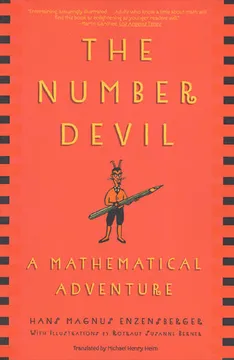


Plot Summary
The Devil in the Meadow
Robert is tired of nightmares and just as tired of Mr. Bockel, his teacher, whose pretzel-making word problems have convinced him that mathematics is pointless. In a dream meadow, a grasshopper-sized visitor introduces himself as the Number Devil and promises something better than school sums.
He shows Robert how numbers can continue without end, then divides a piece of imaginary gum among more and more people until every share becomes tiny but never quite disappears.
Robert learns that numbers can be built from ones, but when he challenges the devil’s method with a larger example, it fails. The Number Devil grows furious and bursts apart. Robert wakes amused that he has caught his visitor in a mistake, but the night has made mathematics harder to dismiss.
The opening makes Robert’s resistance understandable: his dislike is not a lack of intelligence but a reaction to mathematics presented as tedious procedure. The Number Devil offers wonder, yet his temper and failed calculation prevent him from becoming an unquestionable authority. That imperfection matters. Robert is invited to test claims rather than simply accept them, and his first success comes from skepticism. The gum-sharing image translates infinity into a physical problem, while the failed formula introduces the book’s central tension: patterns can look convincing long before anyone knows whether they hold.
Zero Gives Numbers Room
The next lesson begins in a forest where ones rise like trees and other digits swarm like insects. Robert notices that zero is missing, and the Number Devil explains why Roman numerals became cumbersome without it. Zero can mark the absence of a quantity, but it also preserves an empty place so other digits can shift in value.
By repeatedly multiplying ten, Robert sees how a one followed by zeros represents increasingly large numbers; he then uses the same place-value logic to assemble his birth year, 1986. The exercise turns a number he already knows into a construction he can understand. The Number Devil hints that stranger numbers remain, and Robert wakes with the new habit of breaking a large figure into parts.
Zero becomes more than a symbol for nothing: it is a structural tool that lets a numeral carry information through position. The lesson is carefully tied to Robert’s own birth year, shifting arithmetic from an imposed school exercise into a personal object he can take apart. The Number Devil’s insistence on starting from the final digit also models a useful form of problem solving: attend to place and relation, not just the intimidating whole. Robert’s confidence grows through reconstruction, although the visitor’s bullying still makes discovery feel like a contest.
The Cave's Prima Donnas
In a cave painted with animals, Robert says division is frustrating because remainders keep appearing. The Number Devil uses nineteen to distinguish numbers divisible only by one and themselves from numbers that can be factored, then warns that division by zero breaks the reverse relationship between division and multiplication.
He draws a chart and guides Robert through crossing out multiples of two, three, and five, leaving prime numbers behind. Robert sees a practical test, but not a simple way to identify every prime, especially among enormous numbers.
The Number Devil admits that even sophisticated computer searches cannot settle every question. He offers two striking claims about primes, including that every even number can be written as a pair of primes, without being able to prove why. Robert leaves intrigued by uncertainty itself.
The cave changes the lesson from recognizing patterns to confronting their limits. Robert can perform the sieve, yet the method’s simplicity does not scale into a universal answer; that distinction separates a procedure from a proof. The Number Devil’s pleasure in prime numbers is revealing, but so is his admission that he cannot explain the claims he presents. Mathematics here is not a finished warehouse of facts. It is a practice in which evidence, conjecture, and certainty remain distinct, and Robert begins to value a good question even when it has no immediate solution.
Decimals Without End
On a beach, Robert divides one by three on a screen large enough to display a repeating decimal, then questions whether the endless nines produced by adding thirds can ever equal one. The Number Devil presses the point: there is no final nine, so the decimal represents the same value as the fraction.
Robert also imagines how many decimals fit between zero and one and watches divisions such as seven over eleven and six over seven produce recurring patterns. The lesson turns when the Number Devil asks for the square root of two.
A square with sides of one unit has a diagonal of that length, but the decimal does not settle into a repeating pattern. Robert sees that some numbers cannot be written as ordinary fractions, and sleeps on the unsettling idea that they are abundant.
The beach gives Robert two different encounters with infinity: repetition that can be named exactly, and an irrational value that resists a finite or repeating decimal description. His initial objection to the endless nines is not foolish; it exposes the gap between a process that never finishes and a value defined by that process. The square’s diagonal makes the abstract problem spatial. A simple shape generates a number that ordinary notation cannot contain, unsettling Robert’s assumption that uncomplicated objects must yield uncomplicated answers.
Coconuts Make Triangles
After several nights without the Number Devil, Robert returns to the old nightmares, then finds his visitor waiting in a desert oasis. From a palm tree, he drops coconuts into triangular arrangements.
Robert counts one, three, six, ten, and fifteen, then recognizes that each new triangle adds the next counting number. Their differences therefore rise in order, and adjacent triangular numbers combine into squares. The Number Devil also shows that ordinary totals can be assembled from triangular numbers and uses the pattern to sum the integers from one through twelve without adding them one by one.
Robert grasps the shortcut, but chooses to swim instead of continuing through larger polygonal patterns. For once, he sets a limit on the lesson and follows his own curiosity.
The return after the Number Devil’s absence gives the lesson emotional weight: Robert has discovered that the frightening dreams have not been replaced permanently, and he now wants the visitor back. The coconuts make accumulation visible. Each new row changes the total by a predictable amount, turning a growing collection into a pattern Robert can reason through rather than count laboriously. His choice to swim is equally important. Curiosity no longer means submitting to every demand; he can enjoy mathematics and still decide when he has had enough.
Rabbits Keep the Count
In a potato field, the Number Devil introduces the Bonacci numbers, each formed from the two numbers before it. To make the rule visible, he sets a rabbit clock running. One mature pair produces another pair after the young have grown, and the number of couples rises through one, one, two, three, five, eight, and thirteen.
Robert recognizes the sequence as the field fills with rabbits, eventually counting thousands of couples. He begs the Number Devil to reverse the clock, which clears the field until only the original pair remains.
The episode makes a pattern feel both elegant and alarming: each new count depends on earlier generations, so growth accelerates. The Number Devil leaves Robert with a further suggestion that living things, including trees, seem to follow numerical arrangements.
The rabbit model makes recursion concrete by giving each new generation a dependence on earlier ones. Robert does not merely see the sequence written down; he experiences its accelerating consequences as the field becomes unmanageable. His panic punctures the Number Devil’s tendency to celebrate endless growth as harmless. The backward clock offers relief but does not erase the rule: once restarted, the pair would reproduce again. The lesson therefore links mathematical recurrence to a psychological ambivalence about growth, which can be fascinating at one scale and frightening at another.
A Triangle Lights Up
Robert’s new fascination with rabbits worries his mother, and at school he ignores football with his friends to think about patterns. That night, the Number Devil takes him to a white house where they stack electronic cubes into a triangle.
Each cube receives the sum of the two above it, producing rows that contain ordinary counting numbers, triangular numbers, and larger sums. When the Number Devil lights the rows, their totals reveal powers of two; colored diagonals reveal the Bonacci sequence. Other colorings create smaller triangles within the larger one, including patterns formed by multiples of selected numbers.
Robert recognizes several ideas from earlier dreams, now gathered in one construction. The Number Devil says the triangle has been studied for centuries, and Robert wakes knowing mathematics can keep yielding patterns from the same arrangement.
The triangle serves as a memory structure: ideas that first arrived as separate spectacles now occupy connected diagonals and rows. Robert’s recognition of the rabbit sequence shows learning as transfer, not rote recall. The lights make relationships visible before they are named, an approach suited to his visual imagination and impatience with school drills. His mother’s concern also reminds us that fascination has a cost: Robert is withdrawing from ordinary play. The lesson rewards his attention while leaving open the question of how to bring that new inner world back into daily life.
The Classroom Has Eleven Vrooms
In a dream classroom, Al, Betsy, and Charlie keep changing seats until Robert records every possible order. Doris arrives and proposes an alphabetical arrangement, but the class erupts into further rearrangements.
The Number Devil shows that eleven classmates would have nearly forty million possible seating orders, so he sends the others away before the exercise becomes endless. He then turns to handshakes: each pair needs one, and the totals form the triangular numbers Robert met among the coconuts.
For cleanup crews, Robert uses the number triangle to count possible groups of three or four. In the morning, his friends tease him about solving problems in his sleep, and the real schoolyard remains messy. The Number Devil has announced a holiday, leaving Robert to face Mr. Bockel’s ordinary classroom again.
This night turns mathematics into a tool for organizing people rather than merely describing numbers. Seating arrangements and handshakes make different counting questions feel distinct: order matters in one, while selecting a group matters in another. Robert’s earlier knowledge becomes useful when he recognizes triangular totals and reads combinations from the number triangle. Yet the dream does not magically clean the real schoolyard. That contrast checks the fantasy’s power and keeps the book grounded in Robert’s actual life, where understanding must eventually meet a teacher and a class that do not share his private lessons.
Infinity Marches Indoors
Fever keeps Robert in bed, where the Number Devil stages a parade of numbered crowds. White-shirted counting numbers pair one by one with red-shirted odd numbers, showing Robert that an infinite set can match a part of itself.
Green-shirted primes join them, followed by other familiar families, each presented as equally numerous. The crowd empties, but the lesson continues with series. Robert sees that repeatedly adding halves of the remaining distance approaches one, yet never reaches it.
A different series, built from shrinking fractions, keeps growing despite each new term becoming smaller; its growth is so slow that reaching large totals would take an immense time. Exhausted, Robert recovers and wakes in sunlight. He has glimpsed how infinity can behave in radically different ways, from exact pairing to slow accumulation.
The paired rows challenge Robert’s everyday assumption that a whole must be larger than any part of it. The demonstration is not a trick so much as a change in what counting means: correspondence replaces ordinary subtraction. The two series then distinguish convergence from unbounded growth, although both involve endlessly shrinking contributions. Placing these abstractions inside a fever dream gives the concepts a bodily pressure; Robert is tired, crowded, and unable to stop the lesson. The episode makes infinity less like one enormous quantity than a family of behaviors requiring careful distinctions.
Snowflakes Reveal a Ratio
Robert first thinks he is freezing in a blizzard, then discovers that the snow is a projected film in a private auditorium. The Number Devil gives him a computer and asks him to divide successive Bonacci numbers by their neighbors. The results wobble toward a fixed irrational value.
A five-pointed star inside a pentagon displays that same ratio in its intersecting segments, and Robert discovers that a simple calculation involving it produces five.
The Number Devil then turns the screen to dots, lines, and spaces: for flat figures, their counts combine to one; for solid shapes such as a cube, they combine to two. Robert is no longer frightened by the falling snow. He wakes under a blanket, carrying the memory of a number that appeared in sequences, geometry, and shape.
The ratio’s recurrence across a sequence and a pentagram dramatizes the book’s claim that mathematical structures can appear in seemingly unrelated places. The computer supports experimentation, while the geometric construction gives Robert something he can inspect rather than merely calculate. The dots, lines, and spaces extend that movement from number to shape, showing how an invariant can survive changes in appearance. Robert’s calm response to the snow signals a meaningful shift: an image that began as danger can now be understood as a display, because he knows how to look for structure.
Proofs Have Missing Stones
Robert’s next dream turns Mr. Bockel into a crowd of identical pursuers before the Number Devil leads him to a rooftop. Robert admits that examples and clever tricks are not enough; he wants to know why mathematical claims hold.
The Number Devil explains proof as a sequence of tested steps, while admitting that even his earlier formula for building numbers from ones eventually failed. He describes a route-finding problem among twenty-five cities: checking every possible tour would require more routes than a practical computer could examine.
A calculation repeated many times can still miss an exception, especially with primes. The Number Devil leaves to work on another problem, and Robert is left rocking on the rooftop with a new understanding: uncertainty belongs even to experts.
Robert’s demand for proof marks the intellectual turning point of the book. At first, he wanted escape from school mathematics; now he challenges the Number Devil to justify his own claims. The river-crossing analogy frames proof as disciplined movement between reliable premises, not a performance of confidence. The failed formula and the impractical tour search show two different limits: a conjecture can collapse, and a correct brute-force method can be unusable. Robert gains respect for mathematics not because every problem is solved, but because its practitioners must live with the boundary between what can be tested and what can be established.
The Star Comes to School
When the Number Devil stops appearing, Robert worries that their lessons are over and keeps drawing diagrams at school. At last the visitor arrives with an invitation to Number Heaven, where Robert sees mathematicians from different eras, including the elderly Lord Rustle, the inventor of a curious one-sided bottle, and the Greek Pythagoras.
A ceremony admits Robert as a beginner and gives him a small five-pointed star. The Number Devil must return to his work, leaving Robert moved but alone.
In the morning, Mr. Bockel asks the class to calculate how many pretzels are needed if thirty-eight students receive increasing amounts. Robert begins to add them individually, then remembers the triangular-number shortcut and gets 741. His dream knowledge has finally altered what he can do in class.
The final lesson converts private wonder into public competence. Robert’s initiation is modest, not a claim that he has become a master; the star matters because it recognizes a learner who can now carry ideas without the Number Devil beside him. Their separation gives the moment tenderness, while the pretzel problem returns the story to the source of Robert’s original frustration. He does not defeat Mr. Bockel or reject school mathematics. Instead, he finds a structure inside the exercise and solves it efficiently, turning a once-hated classroom problem into evidence of his own growing agency.
Analysis
The book’s central transformation is not that Robert becomes a prodigy, but that he changes his relationship to difficulty. Mr. Bockel’s word problems initially make mathematics feel like a test designed to expose incompetence. The Number Devil offers a competing pedagogy built from images, experiments, and questions, but he is not a perfect replacement for school authority. His tantrums and failed formulas show that confidence can outrun knowledge. Robert’s growing habit of challenging him is therefore as important as the lessons themselves.
The nightly structure turns abstract concepts into episodes with distinct emotional textures. Infinite division becomes unease, the rabbit sequence becomes comic panic, and the classroom permutations become playful disorder. Each image externalizes a mathematical relation, allowing Robert to move from seeing a pattern to asking what supports it. The shift from examples to proof is the book’s intellectual climax: computation can suggest a rule, but it cannot guarantee that the rule holds forever. The Number Devil’s own mistakes make that distinction credible rather than moralistic.
The story also unsettles the boundary between mathematics and the world. Rabbits, trees, snowflakes, stars, and polyhedra give numerical structures visible forms, while the characters’ dream language lowers the barrier to entry without denying that formal language matters. The warning at the end preserves both registers: playful images can invite understanding, but technical terms are useful in shared study.
Robert’s final success with the pretzel problem is deliberately modest. He does not escape school or defeat his teacher; he recognizes a triangular-number structure inside a familiar exercise. The resolution suggests that confidence grows when learners can see how an idea works and carry it into a new setting. Mathematics becomes neither magic nor drudgery, but a disciplined curiosity that tolerates uncertainty and keeps asking what follows.
Review Summary
Reviews for The Number Devil are mixed, averaging 3.92 stars. Fans praise its creative approach to making mathematics engaging and accessible, particularly for children who struggle with the subject. The dream-based narrative featuring Robert and the Number Devil is charming and imaginative. Critics, however, argue the plot is thin and repetitive, the prose feels like a math textbook in disguise, and the invented terminology for mathematical concepts—like "prima donna numbers" and "Bonacci numbers"—may confuse readers by omitting proper mathematical names.
People Also Read


Characters
Robert
Reluctant number explorerRobert is a schoolboy whose impatience with repetitive word problems masks a lively, testing intelligence. He dislikes being made to feel foolish, so he approaches the Number Devil with suspicion and often challenges claims that sound too easy. His dream life gives him a space to ask questions without the usual classroom pressure, although the Devil’s temper creates a different kind of challenge. Robert learns best when he can see a pattern, test it, and connect it to something tangible, such as gum, coconuts, rabbits, or classroom seating. His curiosity grows alongside his independence: he is willing to question both the teacher who frustrates him and the guide who fascinates him.
The Number Devil (Teplotaxl)
Mercurial dream tutorThe Number Devil visits Robert’s dreams with a walking stick that writes on clouds, walls, sand, and screens. He translates mathematical ideas into vivid objects and games, from dividing gum to counting breeding rabbits. His enthusiasm is infectious, but so is his impatience; he can swell with anger when Robert misunderstands or questions him. Beneath his certainty, however, he admits that some problems defeat him and that proofs can expose a failed idea. That mixture makes him a more useful guide than a flawless authority. He wants Robert to enjoy numbers, yet his best lessons happen when Robert pushes back, notices a pattern, or insists on asking why.
Mr. Bockel
Pretzel-loving math teacherMr. Bockel teaches Robert’s class through word problems about bakers, pretzels, and quantities that Robert finds disconnected from real mathematical ideas. Robert sees him as a source of school frustration, especially because he distrusts calculators and expects students to work through conventional exercises. The dream version of Mr. Bockel becomes a crowd of pursuers, reflecting Robert’s anxiety rather than establishing the teacher as a literal villain. The glimpses of Bockel eating from his briefcase also make him comic and ordinary, a tired adult with habits and lesson plans rather than an enemy with grand intentions.
Robert's mother
Concerned home anchorRobert’s mother notices his sleep, school performance, and growing absorption in numbers. She offers practical care, including hot chocolate and attention when he is ill, but cannot see the private dream world that has begun to matter so much to him. Robert withholds the Number Devil from her because he expects she would not believe him. Her concern gives the story a grounded domestic counterpoint to the extravagant dream lessons, and it shows how a child’s intense curiosity can appear troubling to adults before they understand what is driving it.
Al
Robert's football friendAl is one of Robert’s friends and a familiar presence in the schoolyard and classroom. His place in the seating exercises helps turn permutations into a social problem Robert can picture. He represents the ordinary play and peer life that Robert sometimes neglects while thinking about numbers.
Betsy
Strong-willed classmateBetsy is a classmate with pigtails and firm opinions about where she should sit. Her insistence on changing places creates the escalating classroom puzzle that lets Robert see how quickly arrangements multiply. She is drawn as forceful and comic, not as a deep antagonist.
Charlie
Easygoing classmateCharlie is Robert’s friend and an accommodating classmate who gives up his seat when others want to move. Later, he helps Robert avoid Mr. Bockel’s scrutiny by taking a crumpled paper. His practical loyalty makes him one of Robert’s most dependable connections at school.
Doris
Classroom organizerDoris is a classmate who knows the class size and proposes arranging everyone alphabetically when the seating changes become chaotic. Her orderly suggestion does not end the dream’s rearrangements, but it gives Robert another concrete way to think about the possible arrangements.
Bonacci
Rabbit-sequence mathematicianBonacci is a deceased mathematician whom the Number Devil admires and visits in Number Heaven. He is associated with the sequence built by adding the two previous terms and with an early understanding of zero. In the dream lessons, rabbits make his pattern visible as a model of generational growth.
Lord Rustle
Relentless proof seekerLord Rustle is an elderly resident of Number Heaven who represents the labor hidden behind apparently obvious mathematical truths. The Number Devil recalls his attempt to prove that one plus one equals two, and Robert later sees him caught in a logical puzzle. He embodies the strange persistence of foundational questions.
Dr. Happy Little
One-sided bottle makerDr. Happy Little is a tiny figure in Number Heaven associated with a bottle whose inside and outside cannot be cleanly separated. His unusual object lets Robert encounter a mathematical surface that behaves unlike an ordinary container. The brief visit expands the dream world beyond arithmetic into the study of shape and space.
Professor Singer
Infinity's dust counterProfessor Singer lives in a dust-coated room in Number Heaven and sings about different scales of infinity. His strange ritual gives Robert a glimpse of how mathematicians can distinguish kinds of infinite collections, even when ordinary counting no longer applies.
Owl
Elderly number sageOwl is a lively elder in Number Heaven who discusses prime numbers with Professor Horrors. His friendly manner contrasts with the seriousness of the questions they pursue. He represents the long, collective life of mathematical inquiry.
Professor Horrors
Guarded number researcherProfessor Horrors is an austere mathematician in Number Heaven who has helped discover a new category of number. He is so absorbed in his work that he barely engages with Robert. His silence makes mathematical research seem less like a polished performance and more like solitary concentration.
Pythagoras
Ancient geometry authorityPythagoras appears in Number Heaven as a revered Greek mathematician associated with the relationship between geometry and numbers. Robert sees evidence of his work in the palace’s pentagons and stars. His presence links the dream’s playful lessons to a much older tradition of asking what shapes and quantities have in common.
The General Secretary
Keeper of the orderThe General Secretary oversees the ceremony that recognizes new mathematical apprentices in Number Heaven. Formal and reserved, he evaluates Robert’s knowledge and presents the insignia of the order. He gives the dream world an institutional structure alongside its playful, unruly lessons.
Plot Devices
Robert's recurring dreams
A classroom beyond wakingThe dreams provide the frame for each lesson and allow mathematical questions to become physical scenes. A forest of ones, a beachside calculator, a rabbit-filled field, and a lit triangle give Robert images he can inspect and manipulate. The dream form also protects the story’s playfulness: objects can grow, crowds can become infinite, and a blackboard can turn into a stage. At the same time, the dreams reflect Robert’s emotional state. His early nightmares embody helplessness, while later mathematical dreams become places where he can question, solve, and choose when to stop.
The Number Devil's objects
Abstractions made tangibleThe Number Devil repeatedly turns ideas into objects that Robert can handle or watch: gum is divided into vanishingly small shares, coconuts fall into triangular totals, rabbits reproduce according to a sequence, and electronic cubes build a number triangle. These objects are not decoration. Each one gives a different concept a visible mechanism, so Robert can reason from what happens rather than memorize a definition. Their comic scale also lets the story make mathematical growth emotionally legible: a tiny fraction feels harmless, while thousands of rabbits feel overwhelming.
Patterns in nature
Numbers leave the pageRabbits and tree branches connect number sequences to living forms. The rabbit clock models how each new generation depends on earlier generations, making the Bonacci sequence visible as expanding pairs. Later references to branching trees extend the same idea beyond the dream field. These examples help Robert see mathematics as a way to describe relationships that appear outside school exercises. The story does not claim that animals consciously calculate; instead, it presents nature as behaving in patterns that mathematical models can reveal.
The number triangle
One chart, many answersBuilt by placing the sum of two neighboring entries beneath them, the triangle gathers multiple mathematical patterns in one structure. Its rows yield powers of two, its diagonals contain ordinary and triangular numbers, and selected colorings reveal the Bonacci sequence and smaller triangles. Robert later uses it to count handshakes and possible cleanup teams. Because the same diagram answers different questions, it gives the story a concrete image of mathematical connection: separate-looking problems can share an underlying arrangement.
Number Heaven
A history of unfinished questionsThe palace gives Robert a dreamlike meeting place for mathematicians associated with ideas he has encountered. Its visitors are not presented as an orderly chain of discoveries; they are eccentric workers, absorbed in puzzles that remain difficult even for experts. The ceremonial setting makes Robert’s apprenticeship feel consequential, while the rooms and gathering also broaden his sense of mathematics beyond one teacher or one era. Number Heaven’s inhabitants continue to investigate, argue, and struggle, reinforcing the book’s view that mathematical knowledge is both inherited and unfinished.
Download PDF
Download EPUB
.epub digital book format is ideal for reading ebooks on phones, tablets, and e-readers.








