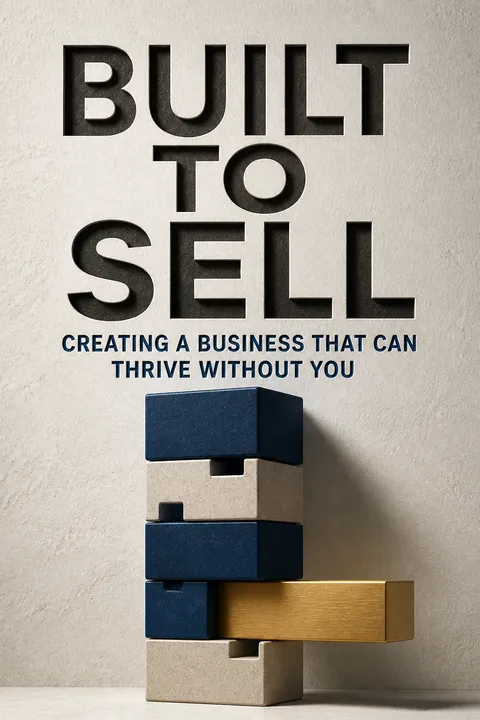


Key Takeaways
Build a company that can run without its founder, not just a job with payroll.
The owner was the bottleneck. Alex Stapleton’s advertising agency looked successful from the outside, but its largest client supplied 40 percent of its revenue, customers insisted on dealing with Alex, and the team was stretched across work it could not consistently do well. When his best designer quit after another punishing client revision, Alex decided to sell. His mentor Ted’s verdict was blunt: the agency was nearly worthless to a buyer in its current form. The problem was not that it made no money. The business depended too heavily on Alex, a single customer, and hard-to-repeat custom work.
Build an asset, not dependence. A sellable company can keep delivering and earning when its founder steps away. Alex’s project is to replace personal heroics with a focused offering, reliable processes, and people who can operate them.
A founder-dependent company resembles a job with unusually high stakes: its income may be real, but much of its value disappears when the owner leaves. Buyers care about transferability because it reduces the risk that customers, knowledge, or decisions walk out with the seller. The same lens is useful even without a sale in mind. A business that works without its founder gives that person more choices, including taking leave or changing roles. Still, removing the founder from every customer relationship is not automatically wise. The goal is resilience and a deliberate handoff, not the loss of personal trust that may distinguish the company.
Turn your strongest repeatable work into a named, teachable product.
Make expertise repeatable. Ted asks Alex to inspect which projects the agency delivers well, which customers value, and which work can be taught to employees. Logo design stands out: the team already follows a consistent method, and customers often return when launching another product or division. Alex gives the method a name and explains it as a defined offering. A productized service is work sold through a consistent, documented process rather than a fresh custom solution for every customer.
Standardize the delivery. Alex’s method guides customers from clarifying a product’s identity through rough visual concepts to a finished logo and usage guide. The exact creative choices vary, but the stages and handoffs can be taught. That lets specialists improve the work, reduces confusion, and gives customers something distinct from a generic agency promise.
The shift is more than clever packaging. It converts tacit knowledge, the judgment people carry in their heads, into routines others can learn and improve. That is a familiar challenge in organizational design: reliable performance requires both explicit procedures and room for skilled judgment. The logo process keeps the sequence stable while leaving creative decisions open. Too much standardization can make a service feel mechanical, as Alex’s employees fear. The useful boundary is to standardize repeatable decisions and customer handoffs, while protecting the expert discretion that produces genuinely valuable work.
Cap any customer's share before one relationship becomes your company's single point of failure.
Diversify the revenue. MNY Bank supplied 40 percent of Alex’s agency revenue, giving one client unusual leverage and making a sale riskier. Ted recommends keeping any single customer below 10 to 15 percent of revenue. The point is not simply to collect more names. A buyer wants evidence that losing one relationship will not cripple the company.
Favor repeat business. Alex’s logo customers can return as they launch products or divisions, creating repeat demand without relying on one giant account. The implementation guide distinguishes occasional repeat purchases from more predictable arrangements such as subscriptions, automatic renewals, and term contracts. Each can make future revenue easier to estimate, though a logo service does not automatically become subscription revenue. The practical question is whether customers have a credible reason to buy again, and whether the business can demonstrate that pattern.
Customer concentration is a form of correlated risk: one decision by one organization can affect revenue, staffing, and bargaining power at once. Diversification limits that exposure, while repeat purchasing makes demand less dependent on constant new-customer acquisition. These are related but distinct protections. A company can have many customers who buy only once, or a few customers locked into recurring contracts. The book’s 10 to 15 percent threshold is a useful warning line, not a universal law. In some industries, a major account is unavoidable; the key is to understand the exposure and build credible replacements before a crisis forces the issue.
Collect cash before delivery so growth funds itself instead of draining the bank.
Fix the timing gap. Alex used to finish a project, invoice the customer, and wait about 60 days for payment. A logo could take 8 to 12 weeks to complete, leaving several months between winning the work and collecting the cash. More sales could therefore worsen his cash shortage. Once the offering is standardized, Alex asks customers to pay the $10,000 fee when they sign.
Cash changes the buyer’s calculation. Prepayment gives the company customer cash to use while it delivers the work, rather than forcing the owner to finance every project. Alex’s mentor explains that an acquirer must also fund the business’s working capital, the money needed for day-to-day bills. A company that consumes cash can require a larger funding cushion and leave less for the seller; one that generates cash can be more attractive. Upfront billing only works if customers understand and trust the defined offer.
Cash timing is a strategic variable, not just a bookkeeping detail. A business can be profitable on paper and still run out of cash if it pays employees and suppliers long before customers pay. Prepayment shifts some financing burden to the customer and can support growth without borrowing. But it also creates an obligation: the company must deliver what it has already been paid for. Deposits, milestones, and clear refund terms can balance customer protection with healthier cash flow. The general lesson is to design payment terms alongside delivery, rather than treating invoicing as an administrative step after the real work.
Say no to custom work that unbuilds the business you are standardizing.
Focus costs real revenue. Alex is tempted when Urban Sports Warehouse offers his agency a contract worth $50,000 a month. Ted points out that the work would pull the company back into customized advertising, require different skills, and reinforce Alex’s old dependence on bespoke projects. Alex turns it down, even though the prospective customer angrily calls him foolish.
A clear offer is easier to refer. If the agency keeps accepting every kind of assignment, customers and employees have little reason to believe its new focus. Alex’s team must stop doing the bank’s brochures and other work outside logo design. That is uncomfortable, particularly while the new model is young. Yet a narrow promise is easier for customers to remember, for salespeople to explain, and for the company to deliver consistently.
This is a choice about organizational attention. Every exception consumes capacity, creates precedent, and teaches the team what leadership truly rewards. Saying no protects the time needed to build a repeatable capability. It can also expose a weakness in the offer: if customers will buy only when it is heavily customized, the standardized version may not solve a sufficiently important problem. The discipline is not to reject all adaptation. It is to distinguish useful feedback that improves the core product from one-off requests that quietly recreate the old business.
Make sales a system two people can run, not the founder's personal magic.
Measure the route to a sale. Alex and Ted calculate that two of 44 prospects became customers, a 4.5 percent conversion rate. Discounting that result because the prospects already knew Alex, they estimate a 2 percent rate for cold prospects. Their assumptions produce a local market estimate of about 1,160 potential logo sales, or $11.6 million at $10,000 each. These are projections, not guaranteed demand, but the method makes the sales argument testable.
Prove the method travels. Alex hires two salespeople, Angie and Seamus, who track appointments and sales on a shared board. Two reps help show that the results do not depend on one unusually talented seller. The company can estimate how many prospects and salespeople it may need, then test those estimates against actual results.
A sales funnel turns optimism into a set of assumptions that can be challenged: how many prospects respond, how many meetings occur, and how often meetings become sales. That is valuable to an owner and a buyer because it makes growth planning less dependent on charisma. The arithmetic should not be mistaken for market proof, however. Alex’s estimate assumes that firms above a revenue threshold need logos and that his early conversion rate generalizes. A disciplined business tests those assumptions across new prospects, tracks acquisition costs, and revises its forecast when the evidence disagrees.
Give managers a reason to stay, without making ownership a legal tangle.
Let the team carry the work. After customers praise Rhina and designer Chris for delivering the logo process without Alex, he assigns them operating responsibility and hires sales staff. As the agency grows, he promotes Angie, Rhina, and Chris into management roles. Their work becomes proof that the company has people who can keep it running after a sale.
Reward longer-term commitment. Ted describes a long-term incentive plan: managers receive performance-related bonuses, with matching amounts held in a pool and released over time. In his example, managers can withdraw one-third after a three-year wait, giving them a reason to remain. Alex uses a version of this approach and later promises his managers a sale bonus. Ted favors cash incentives over equity because shares in a private company can complicate a transaction and may be hard for employees to sell.
Delegation is incomplete if managers have responsibility but no reason to protect the company’s future. Incentives can connect retention to continuity, particularly during an ownership transition. Yet deferred compensation is not a substitute for fair pay, autonomy, or credible career paths. Poorly designed plans can feel like golden handcuffs, especially if employees have little control over the targets. The useful principle is alignment: reward outcomes managers can influence, make the rules understandable, and ensure the company can afford the commitment. Equity can be appropriate in some businesses, but it is not the only way to share value.
Prove the model in financial statements before asking buyers to believe the growth story.
Expect a transition dip. When Alex shifts from varied projects to a standardized logo service, customers pay upfront but the work spans months. His accountant recognizes the revenue across the delivery period, so reported revenue and profit initially look weaker even as cash accumulates. The book warns against confusing that temporary accounting transition with the actual cash position, while still emphasizing accurate records and professional accounting advice.
Build a track record. Ted says buyers will want at least two years of financial statements showing the standardized model in operation. Alex’s first year ends with about $2.7 million in revenue and $490,000 in pretax profit. He then plans for $5 million in revenue and a 20 percent margin. For a potential acquirer, the projections matter most when supported by results, a repeatable sales process, and managers able to deliver the work.
The gap between cash received and revenue recognized is a useful reminder that different financial measures answer different questions. Cash flow indicates whether the company can pay its bills; accounting profit helps describe performance over a period under applicable rules. Neither should be dismissed. A buyer will want a coherent reconciliation, not an owner’s assurance that the numbers will catch up. Two years of evidence also make it easier to separate a durable operating improvement from a short-lived burst of sales. The book’s specific timeline is guidance for its scenario, not a guarantee of how every buyer or transaction will behave.
Choose an adviser who creates buyer competition, not one who delivers you to a friend.
Avoid a single-buyer shortcut. One adviser quickly proposes introducing Alex to a large agency holding company, but Ted worries the adviser may be serving that buyer’s interests more than Alex’s. A buyer presented without competition has less reason to make its strongest offer. Alex chooses a mergers and acquisitions adviser who understands the company’s focused model and helps identify a group of plausible buyers.
Make the opportunity legible. The adviser prepares a teaser, a brief anonymous description of the company, and a fuller information package, called the Book, for interested parties who sign a nondisclosure agreement. Strategic buyers may pay more when the business complements their existing assets; financial buyers primarily evaluate the investment return. Alex also learns to explain the sale as a chance to create liquidity and grow with a partner, rather than sounding eager to abandon a failing business.
An adviser’s incentives shape the process as much as their contacts do. A network is valuable only when it is used to create informed competition, protect confidentiality, and represent the seller’s interests. The distinction between strategic and financial buyers is also a reminder that price depends on context: the same company may be more valuable to a buyer that can use its customer access, capabilities, or distribution. Strategic fit should be demonstrated rather than asserted. And a seller’s explanation should remain truthful. Presenting a credible future for the company is different from promising to stay indefinitely or pretending to want what the buyer wants.
Set your minimum before diligence, then judge the deal against it.
An initial offer is provisional. Print Technology Group offers Alex $6 million upfront, plus up to $3 million tied to future performance. The letter of intent is nonbinding, and the buyer gets a due diligence period to inspect the business. Its team questions Alex’s market estimate and, close to the planned closing, cuts the upfront amount to $5.2 million while leaving the earn-out unchanged.
Know what is enough. Before the sale process, Alex wrote down that $5 million would give him the financial freedom he wanted. When the offer falls, he remembers that number and accepts the lower upfront price on the condition that the buyer close by the agreed date. His preparation does not prevent a price cut, but it gives him a basis for deciding whether to walk away instead of negotiating from panic.
A reservation price protects decision-making when a seller is tired, excited, or already emotionally committed to a deal. It also clarifies the difference between guaranteed proceeds and contingent earn-out payments, which depend on future targets and often on the seller’s continued involvement. The threshold should be informed by taxes, debt, working capital, and personal needs, not chosen as a dramatic round number alone. Due diligence can uncover real issues as well as create leverage for renegotiation. A seller needs to assess the evidence, consult qualified advisers, and decide whether the revised terms still meet the original purpose.
Analysis
The book’s central insight is that a sale is not primarily a transaction to prepare for at the end. It is an operating design problem. Alex begins with a business whose value is trapped in personal effort: he sells the work, interprets every client demand, and compensates for a team spread across unrelated services. Specialization narrows the promise. Documentation makes the promise teachable. Upfront payment supports the delivery cycle. A measured sales process and management layer then reduce dependence on Alex. Each change solves an immediate weakness while also making the company easier for an outsider to understand and evaluate.
The narrative works because the financial strategy is inseparable from the emotional one. Alex is not simply chasing the highest possible valuation. He wants control over his time and a defined amount of financial security. The card on which he records his minimum gives him an anchor when the actual negotiation becomes stressful. His choice to accept $5.2 million upfront, after a $6 million offer is reduced, is therefore not framed as winning every dollar. It is a decision against his own stated threshold and priorities.
The approach has limits. A standardized service can become sterile, and refusing custom work can sacrifice valuable learning or important revenue. A low customer concentration target may not fit every market. Revenue projections based on a small number of early sales require validation, not just confident arithmetic. Likewise, two years of cleaner financial statements can improve credibility, but no checklist guarantees a buyer or a fair price. The strongest reading is not that every firm should imitate Alex’s logo business. It is that owners should identify what truly creates customer value, make that work transferable, and build enough evidence to distinguish a durable business from a founder’s demanding job.
The book also reframes sellability as an options strategy. A company able to operate without its owner can be sold, passed on, managed at a distance, or retained. That flexibility has value before any deal closes. The practical test is whether the business can sustain customer trust, cash generation, and decision-making when its founder is absent, rather than whether its owner can imagine a buyer someday.
Review Summary
Built to Sell receives high praise for its actionable advice on creating a sellable business. Readers appreciate the engaging story format and clear steps for transitioning from a service-based to a product-oriented company. Key takeaways include specializing, creating standardized offerings, charging upfront, and building a sales team. The book is seen as valuable for entrepreneurs looking to make their business less dependent on themselves, whether they plan to sell or not. Some criticize the simplification of complex issues, but most find it a practical and insightful read.
People Also Read






Glossary
Productized service
Standardized service offeringA service packaged around a defined, repeatable method rather than redesigned from scratch for each customer. In the book, Alex turns logo design into a named offering with consistent delivery stages, pricing, and instructions. The aim is to make the service easier to explain, sell, teach, and deliver without relying on the founder.
Five-Step Logo Design Process
Repeatable logo methodAlex’s named method for delivering logo design through a consistent sequence, from understanding a customer’s product identity to providing the finished logo and usage guidance. The book presents the method as an example of work that can be documented and delegated. Its significance is the repeatability of the service, not a claim that every design decision can be mechanized.
positive cash flow cycle
Customer cash arrives earlyA pattern in which the business receives customer payment before it must cover the full cost of delivering the product or service. Alex creates this pattern by charging for a defined logo service when the customer signs. The cash can fund operations during delivery and reduce the need for the owner to finance growth through borrowing.
earn-out
Payment tied to future resultsA portion of a purchase price that the seller receives only if the acquired business meets specified performance conditions after the sale. The book cautions that earn-outs can leave sellers dependent on decisions made by the buyer, even when the seller bears much of the performance risk. Sellers should distinguish contingent proceeds from cash paid at closing.
long-term incentive plan
Deferred manager rewardA compensation arrangement designed to encourage managers to meet performance goals and remain with the company over time. Ted describes paying annual bonuses while placing a matching amount into a pool that becomes available after a delay. The structure is offered as an alternative to issuing equity, which can complicate ownership and a future sale.
options strategy
Preserve future choicesA way of building a company so the owner can choose among selling, stepping back into a different role, or continuing to run the business. The aim is not necessarily to sell immediately. Systems, managers, and transferable customer relationships create the freedom to make that decision when circumstances and priorities are clearer.
letter of intent
Preliminary deal outlineA document that records proposed transaction terms and outlines steps such as exclusivity and due diligence. In the book, the buyer’s letter of intent sets out an upfront payment and a possible earn-out, but it is nonbinding. The proposed price can still change as the buyer investigates the company.
FAQ
What's "Built to Sell: Creating a Business That Can Thrive Without You" about?
- Focus on Sellability: The book by John Warrillow is about transforming a business into one that can operate independently of its owner, making it more attractive to potential buyers.
- Fictional Narrative: It uses a fictional story of Alex Stapleton, a business owner, to illustrate the steps and challenges involved in creating a sellable business.
- Practical Advice: The narrative is interspersed with practical advice and tips from a mentor character, Ted Gordon, who guides Alex through the process.
- End Goal: The ultimate goal is to create a business that can be sold for a significant profit, providing financial freedom to the owner.
Why should I read "Built to Sell"?
- Entrepreneurial Insight: It offers valuable insights for entrepreneurs looking to build a business that can thrive without their constant involvement.
- Step-by-Step Guide: The book provides a clear, step-by-step guide to making a business more sellable, which is useful for both new and seasoned business owners.
- Real-Life Application: Although fictional, the story reflects real-life challenges and solutions, making it relatable and applicable.
- Financial Freedom: It emphasizes the importance of creating a business that can be sold, offering the owner financial freedom and the ability to pursue other interests.
What are the key takeaways of "Built to Sell"?
- Specialization Over Generalization: Focus on doing one thing exceptionally well rather than offering a wide range of services.
- Create a Repeatable Process: Develop a standardized process that can be easily taught to employees, ensuring consistency and scalability.
- Build a Sales Team: Remove yourself from the sales process by hiring a team that can sell your product or service independently.
- Positive Cash Flow Cycle: Charge customers upfront to create a positive cash flow cycle, making the business more attractive to buyers.
How does the Five-Step Logo Design Process work in "Built to Sell"?
- Visioning: Start by understanding the client's vision and how they differentiate themselves from competitors.
- Personification: Use creative exercises to personify the product, helping to define its personality and style.
- Sketch Concepts: Create rough sketches to focus on high-level ideas rather than details.
- Black-and-White Proofs: Develop a black-and-white version to evaluate the design's merits before adding color.
- Final Design: Present color options and provide the client with digital files and a brand standard guidebook.
What is Ted's role in "Built to Sell"?
- Mentor and Guide: Ted Gordon acts as a mentor to Alex Stapleton, providing guidance and advice on making his business sellable.
- Experience-Based Advice: Ted shares insights from his own experience of building and selling multiple businesses.
- Strategic Thinking: He encourages Alex to think strategically about his business, focusing on specialization and scalability.
- Supportive Role: Ted supports Alex through the emotional and practical challenges of transforming his business.
What are Ted's Tips in "Built to Sell"?
- Specialize: Focus on doing one thing well to stand out among competitors.
- Diversify Revenue Sources: Ensure no single client accounts for more than 15% of revenue to reduce risk.
- Standardize Processes: Create a repeatable process to make the business scalable and independent of the owner.
- Positive Cash Flow: Charge upfront to create a positive cash flow cycle, enhancing the business's value.
How does "Built to Sell" suggest handling client dependency?
- Standardize Offerings: Develop a standardized service or product that doesn't rely on the owner's personal involvement.
- Train Employees: Train employees to handle client interactions and deliver the service independently.
- Set Boundaries: Clearly define the scope of services to avoid over-customization and client dependency.
- Focus on Process: Emphasize the process rather than the owner, making the business less reliant on any single individual.
What is the significance of the "options strategy" in "Built to Sell"?
- Flexibility: The options strategy allows business owners to have multiple choices for the future, whether selling, stepping back, or continuing to grow.
- Build Systems: Create systems and a management team that can operate the business without the owner's constant involvement.
- Sellable Business: Ensure the business is sellable at any moment by maximizing its value and reducing owner dependency.
- Strategic Planning: Focus on strategic planning to keep the business adaptable and ready for potential opportunities.
What are the challenges Alex faces in "Built to Sell"?
- Client Dependency: Alex struggles with clients who demand his personal attention, making the business overly reliant on him.
- Cash Flow Issues: He faces cash flow challenges due to delayed payments and a negative cash flow cycle.
- Team Management: Managing a team of generalists rather than specialists leads to mediocre results and employee turnover.
- Emotional Decisions: Alex grapples with the emotional aspects of letting go of certain clients and changing his business model.
How does "Built to Sell" address the concept of recurring revenue?
- Importance of Recurring Revenue: Recurring revenue is crucial for increasing a business's value and making it more attractive to buyers.
- Types of Recurring Revenue: The book outlines different types, from consumables to contracts, and their impact on business valuation.
- Focus on Repeatability: Emphasizes creating a product or service that customers need to purchase regularly.
- Strategic Advantage: Recurring revenue provides a strategic advantage by ensuring a steady cash flow and reducing reliance on one-time sales.
What are the best quotes from "Built to Sell" and what do they mean?
- "Don't generalize; specialize." This quote emphasizes the importance of focusing on one area of expertise to stand out in the market.
- "Owning a process makes it easier to pitch and puts you in control." It highlights the value of having a standardized process that can be easily communicated and sold.
- "Avoid the cash suck." This advises business owners to create a positive cash flow cycle by charging upfront, reducing financial strain.
- "You need at least two years of financial statements reflecting your use of the standardized offering model before you sell your company." It underscores the importance of demonstrating a proven, scalable business model to potential buyers.
How does "Built to Sell" suggest preparing for a business sale?
- Create a Sellable Business: Focus on building a business that can operate independently of the owner, with a standardized process and a strong management team.
- Engage a Broker: Hire a broker or M&A firm with experience in your industry to help find potential buyers and negotiate the sale.
- Prepare Financials: Ensure you have at least two years of financial statements reflecting your standardized offering model.
- Communicate with Management: Inform your management team about the potential sale and offer incentives to retain them through the transition.
About the Author


Download PDF
Download EPUB
.epub digital book format is ideal for reading ebooks on phones, tablets, and e-readers.








