

Key Takeaways
Read the Bible as one unfolding plot, not seventy-three disconnected books.
Find the connecting story. The Bible gathers many books, authors, genres, and centuries into a single narrative of God seeking a relationship with humanity. This book makes that plot easier to follow by organizing Scripture into twelve historical periods and focusing on fourteen narrative books. The remaining books can then be understood in the settings of that storyline, rather than as isolated material to memorize.
Christ is the center. The narrative begins with creation and human rebellion, follows Israel’s covenants, kingdom, and exile, and reaches its climax in Jesus. The Emmaus story offers the model: Jesus helps despairing disciples understand his death by reading it within the larger scriptural story. The point is not merely to know what happened, but to see how the story gives meaning to faith and human life.
The book’s central move is to treat biblical reading as orientation, not just information gathering. Narrative comprehension helps readers remember events by connecting them through causes, consequences, and recurring patterns. That is useful well beyond religious study: people also make sense of personal experience through stories that identify what matters and where they belong. The risk is that a unifying interpretation can make differences among biblical books seem smaller than they are. The book acknowledges historical study, but readers should still notice each text’s distinct voice while tracing the larger arc.
Treat Genesis as theological poetry about creation, dignity, and worship.
Read the genre carefully. The book argues that Genesis’s creation accounts are not scientific reports but theological poetry. Their seven-day pattern first gives the world form, then fills it, before setting apart a seventh day of divine rest. Read in its ancient context, the account challenges nearby creation myths: the world is not born from divine violence, and people are not created as disposable labor.
Human worth is universal. Genesis presents every man and woman as made in God’s image, a status the book links to royal representation and divine sonship. The world is also portrayed as a cosmic temple, with humanity serving within creation and the seventh day directed toward worship. Two creation accounts offer different perspectives: one gives the panorama, the other zooms in on human relationship and marriage.
The book’s reading makes an ethical consequence follow from its literary interpretation: if divine image-bearing belongs to all humanity, no ruler can claim exclusive sacred status. That is a striking reversal of ancient royal privilege, and it gives the creation story continuing force. Its distinction between theological purpose and scientific description also helps prevent a category error. Still, calling the text poetry does not settle every question about its relation to history or science. Genre clarifies what a passage is doing, but it cannot by itself resolve all disputes about what it claims.
Notice how distrust of God turns freedom into exile.
The first rupture is relational. In the book’s reading of Eden, the serpent’s temptation works by portraying God as a jealous tyrant withholding good. Adam and Eve already bear God’s image, yet grasp for a likeness they believe has been denied them. Their disobedience breaks trust not only with God, but also between themselves, within their own lives, and with the created world. Exile from Eden makes that fracture visible.
The pattern spreads. Cain’s murder of Abel turns rivalry into violence; the flood becomes a response to widespread corruption; and Babel’s city represents human unity organized around pride rather than God. Each fresh start is followed by renewed disorder. Yet Genesis also introduces hope: God promises that the serpent’s power will be defeated. The rest of Scripture, in this account, asks how that wound can be healed.
This interpretation locates wrongdoing beneath rule-breaking, in the story people tell themselves about the character of the lawgiver. That insight connects naturally to psychology: when a boundary is understood as hostile control, resistance can feel like the only route to agency. When it is understood as protection within a trustworthy relationship, obedience can carry a different meaning. The analogy has limits, since human authorities often do abuse power, and suspicion can be warranted. The book’s claim is most persuasive when trust is not demanded blindly but considered alongside the relationship and the consequences of action.
See Abraham's family as a vehicle for blessing every nation.
The promise has three parts. After Babel scatters humanity, God calls Abram from his homeland and promises land, a great family and dynasty, and blessing for all nations through his descendants. The book treats these promises as the outline of the biblical plot: Israel’s land and national life develop through the Exodus, the royal promise through David, and worldwide blessing through Jesus.
Faith grows through failure. Abraham does not trust perfectly. He brings Lot despite being told to leave his kin, goes to Egypt during famine, and has a child with Hagar while waiting for the promised heir. Isaac is born to the aged Abraham and Sarah, and the near-sacrifice of Isaac tests Abraham’s trust. The book reads this story alongside Hagar’s expulsion, emphasizing that God’s justice and mercy reach both sons. Joseph’s eventual forgiveness of his brothers preserves the family through famine.
The election of one family is framed here as a responsibility toward everyone else, not a prize that makes other peoples irrelevant. That distinction resembles the strongest forms of representative leadership: privilege is justified by service, not by exclusion. The narrative also resists a simple hero story. Abraham’s fear, Jacob’s deception, and Joseph’s brothers’ violence make the family’s survival depend on repair and mercy, not flawless virtue. Some of the book’s detailed symbolic readings are interpretive rather than universally accepted. The larger theme of blessing moving outward, however, is clear in the narrative itself.
Ask what liberation is for: Israel leaves Egypt to worship.
Freedom has a destination. The Exodus is not only escape from forced labor. Moses first asks Pharaoh to let Israel make a journey into the wilderness to worship. The Hebrew word avad can mean both work and worship, sharpening the question of whom Israel will serve: Pharaoh or God. The plagues challenge Egypt’s gods, while Passover requires the Israelites to mark their own break with Egyptian worship by sacrificing a lamb.
A people is formed. At Sinai, Israel accepts a covenant, receives the Ten Commandments, and is called to become a priestly nation serving the wider world. The law is presented as part of a relationship God has already initiated, not as a way to earn liberation. The tabernacle then makes divine presence portable. Yet the golden calf reveals how quickly Israel can return to familiar idols, and the wilderness generation’s fear prevents it from entering the land.
The distinction between freedom from something and freedom for something is the chapter’s practical force. Political release alone does not supply shared purpose, habits, or institutions; those must be built after the chains are removed. The book’s account of worship, law, and the tabernacle shows how a liberated community tries to give freedom a durable shape. It also depicts the danger of mistaking deliverance for completed transformation. A community can escape one authority while carrying its old loyalties and fears into the new life.
Measure leaders by covenant fidelity, not military success or royal grandeur.
The land exposes character. Joshua’s victories bring Israel into Canaan, but the tribes fail to fully occupy their inheritance. Judges then traces a worsening cycle: idolatry, oppression, cries for help, and temporary rescue. The book also addresses the moral problem of the conquest. Its interpretation is that the harsh warfare rules reflect concessions after Israel’s earlier failures and the wickedness of the inhabitants, rather than God’s original plan. This is a contested reading, and the difficulty of the violence remains.
Kings can repeat the failure. Israel demands a ruler like other nations. Saul loses his dynasty through disobedience; David receives an enduring royal promise, but his adultery and arranged murder bring family violence and revolt. Solomon builds the Temple, yet accumulates wealth, horses, and foreign wives, then turns to other gods. His kingdom divides, showing that splendor cannot substitute for fidelity.
The book judges political authority by whether it serves a covenant community, rather than by victory, wealth, or impressive building projects. That standard can be applied to any leadership system: success is not self-validating if its costs are borne by the people it governs. The account of David also avoids equating moral seriousness with moral perfection; his response to confrontation differs sharply from Saul’s evasions. The conquest interpretation is a more difficult case. A theological explanation can locate the passage within a larger story, but it should not make the human violence disappear or prevent readers from asking hard ethical questions.
Read exile as the covenant's failed harvest, not God's final word.
Idolatry ends in displacement. The northern kingdom’s rejection of Jerusalem’s worship and the southern kingdom’s repeated unfaithfulness lead, in the book’s account, to conquest and exile. Assyria scatters the northern tribes, while Babylon destroys Jerusalem and the Temple. Exile reverses the Exodus: instead of leaving a foreign land for home, Judah’s people are carried away from their land. Daniel and Ezekiel show that the story is not simply abandoned. Daniel’s fidelity under pagan rulers and Ezekiel’s visions sustain hope that God remains present beyond Jerusalem.
Return begins, but remains incomplete. Persia’s Cyrus permits the Jews to return. Zerubbabel leads the rebuilding of the Temple, Ezra teaches the Torah, and Nehemiah rebuilds Jerusalem’s walls. The return echoes a new Exodus, but the community still lives under foreign rule and awaits the fuller restoration promised by the prophets.
Exile is presented as both consequence and interpretive crisis: people must reckon with the gap between their inherited claims and their actual conduct. That makes the return more than a geographic homecoming. Rebuilding a sanctuary, recovering law, and restoring city boundaries are also attempts to reconstruct communal identity. The framework is powerful because it links institutional collapse to moral choices without reducing every historical disaster to individual guilt. The book itself presents exile as a collective covenant consequence; modern readers should be cautious about applying that logic to other communities’ suffering without evidence.
When power demands apostasy, faithful witness may cost more than revolt.
Identity is put under pressure. Under Antiochus IV, Jews are ordered to abandon the Torah, stop worshipping in the Temple, and adopt Greek religious practices. Mattathias and his sons lead armed resistance, and Judas Maccabeus recaptures and rededicates the Temple. The annual Hanukkah celebration remembers that rededication. Yet the Hasmonean rulers eventually take on features of the culture they opposed, and their political maneuvering draws Rome deeper into Judea.
Martyrdom offers another response. Second Maccabees recounts Eleazar and a mother with seven sons choosing death rather than publicly violate the law. The book reads their suffering as a plea for mercy on behalf of the nation. This does not erase the Maccabees’ military role; it places beside it a different kind of courage, one centered on refusing to let coercion define faithfulness.
The Maccabean story poses a sharp question about resistance: can a movement defeat oppression without adopting its methods and ambitions? The Hasmonean turn toward power gives the question concrete weight. Martyrdom, in this account, is not passive endorsement of injustice but a refusal to make survival the highest good. That distinction matters, though the book’s claim that suffering helps turn divine wrath to mercy belongs to its theological interpretation, not a general formula for explaining persecution. No community should treat victims’ pain as proof that their suffering was necessary.
Read Jesus as Israel's faithful king, whose cross begins a new Exodus.
The old story reaches its climax. Jesus is presented as David’s promised heir, the Son of God, and the faithful Israel who succeeds where earlier generations failed. His forty days in the wilderness recall Israel’s forty years; his public ministry announces a new kingdom and a Jubilee, a release from captivity that the book understands chiefly as freedom from sin. His welcome of outsiders extends Abraham’s promised blessing beyond Israel, provoking resistance from those who expect a purely political victory.
The cross reverses the curse. At Passover, Jesus offers himself as the new lamb. The book connects his suffering to Eden’s thorns and toil, and to Israel’s covenant curses. His death and resurrection become the decisive passage from sin and death to new life. At Emmaus, the risen Jesus interprets Scripture for two disciples, then becomes known to them in the breaking of bread.
The book’s Christ-centered reading works through layered echoes rather than treating the New Testament as a detached sequel. Passover, Jubilee, kingship, exile, and the first garden converge in a single life, giving familiar images a new relationship to one another. This approach also clarifies why Jesus’ kingdom is more than a program for replacing one earthly ruler with another. Its claim is that the deepest bondage is moral and spiritual. The interpretation is theological, and it will not persuade every reader as historical proof. Its narrative coherence can still be appreciated as a careful account of how early Christians read their Scriptures.
Let Scripture's whole story shape worship, identity, and public allegiance.
The story continues in the Church. In Acts, Pentecost gives Jesus’ followers the Holy Spirit and sends them to witness from Jerusalem outward. People from many places hear the message in their own languages, a reversal of Babel’s division. The apostles carry the mission through persecution, welcome Gentiles without requiring circumcision, and establish communities across the Roman world. Paul’s proclamation of Jesus as Lord challenges the imperial claim that Caesar is the ultimate source of peace and salvation.
Reading becomes participation. At Emmaus, Scripture is opened before bread is broken. The book sees this sequence as a pattern for Christian worship: the story is explained, then encountered sacramentally. The Church is not the end of the narrative but its continuing witness, with baptized people called to embody the new life they proclaim. The final horizon is the New Jerusalem, where the restoration begun in Christ reaches completion.
The book closes by connecting interpretation with allegiance. Its readers are not asked merely to recognize a pattern but to decide which account of power, community, and hope will guide their lives. That political edge is easy to miss when the Bible is treated as private inspiration alone. The Roman setting of Acts makes clear that worship and public loyalty can conflict. At the same time, the Church’s claim to carry the story deserves scrutiny through its treatment of people, not just its declarations. A community’s witness is credible when its practices match the welcome and mercy it proclaims.
Analysis
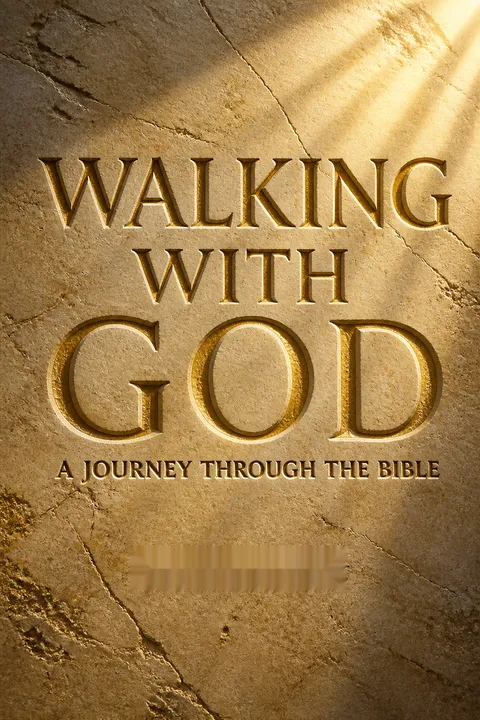
Walking With God is a Catholic, story-driven guide to the Bible’s overarching plot, not a commentary on every biblical book. Its main contribution is organizational and interpretive: twelve periods and a small set of narrative books create a route through a sprawling canon, while recurring ideas such as covenant, exile, worship, and blessing connect events across centuries. This makes the adaptation especially useful for readers who know isolated biblical episodes but cannot see how they relate.
Its strongest method is close attention to literary repetition. A word, name, setting, or parallel scene can carry the story’s meaning: the Exodus reverses in exile; the Temple recalls Eden; Jesus’ wilderness testing echoes Israel’s failures. The result is a compelling account of continuity, culminating in Christ and the Church. The method is also openly theological. The book reads Scripture canonically, through Catholic tradition, and often treats New Testament events as the intended fulfillment of Old Testament patterns. Readers from other traditions, or those approaching the Bible as historical literature, may not accept every connection or conclusion.
That tension is most visible when the book addresses morally difficult passages, particularly the conquest of Canaan. Its explanation places the warfare rules within a larger account of Israel’s prior failures and the limits of later law. This preserves the book’s theological coherence, but coherence is not the same as a complete moral resolution. A serious reader can follow the proposed interpretation while continuing to examine the violence and its historical setting.
The book’s larger insight is that Scripture is not presented as a catalogue of timeless maxims. It is a story of a people repeatedly losing trust, receiving mercy, and being called back to a shared vocation. Its account of faith therefore depends on memory: Israel must remember the Exodus, the Church must remember Israel, and readers must locate their choices within a story larger than themselves. That is the book’s most durable reading practice, even for those who do not share all its theological conclusions.
Review Summary
Walking with God receives overwhelmingly positive reviews, praised for its accessible yet profound approach to understanding the Bible's narrative. Readers appreciate how it connects Old and New Testaments, revealing God's plan throughout history. Many find it eye-opening, making Scripture more engaging and coherent. It's highly recommended for both beginners and experienced Bible readers, often described as a page-turner that deepens faith and Biblical knowledge. Some use it alongside Bible study programs, finding it enhances their understanding and appreciation of Scripture.
People Also Read
Glossary
canonical approach
whole-Bible readingA way of interpreting an individual biblical passage in relation to the Bible’s complete form and larger story. In this book, it means reading the many scriptural books as parts of a unified account of God’s plan, centered on Christ, while recognizing that historical study remains important.
covenant
bond of pledged kinshipA solemn relationship established by an oath, creating a lasting bond between parties. The book emphasizes that biblical covenants are more than agreements: they establish family-like ties and shape obligations, worship, and identity. Its narrative follows the covenant bond widening from creation and a couple to families, Israel, a kingdom, and the Church.
avad
work and worshipA Hebrew verb used in the book to mean both working or serving and worshipping God. Its double meaning sharpens the Exodus conflict: Israel is to serve Pharaoh through forced labor or serve God through worship. The word links liberation to its purpose, a life ordered toward the covenant relationship.
Shema
hear and obeyThe name of the central Jewish prayer beginning with a call to hear that the Lord is one and to love him wholly. The book highlights that the Hebrew sense of hearing includes obedience: listening to God means putting his teaching into practice. The prayer summarizes Deuteronomy’s connection between love, covenant, and faithful action.
New Exodus
renewed passage from bondageA pattern of redemption that echoes Israel’s departure from Egypt. The book applies it to the return from Babylon and, most fully, to Jesus’ work of freeing people from sin and death. The image emphasizes that salvation is both release from oppression and movement into a renewed relationship with God.
Deuteronomic destiny
covenant-shaped futureThe book’s term for the future set out in Deuteronomy’s covenant blessings and curses. Israel’s fidelity is associated with life and flourishing in the land, while infidelity is associated with calamity and exile. The framework explains how later biblical histories interpret national success and disaster in relation to covenant obligations.
Messianic secret
concealed messianic identityThe pattern in the Gospels in which Jesus’ identity and mission are not always stated openly. The book connects this restraint to the political danger of a public claim to kingship under Herodian rule. Jesus reveals his identity through prophetic signs and teaching while avoiding premature arrest and death.
Body of Christ
Church united to JesusPaul’s description of the Church as a real spiritual and sacramental union with Christ, not merely a loose association of believers. The book connects this identity to baptism and Eucharist: Christians are joined to Christ’s death and resurrection, and their unity with him also binds them to one another.
Download PDF
Download EPUB
.epub digital book format is ideal for reading ebooks on phones, tablets, and e-readers.








