

Key Takeaways
Read the Mass as Calvary made present, Christ received, and lives joined to him.
Three mysteries, one liturgy. The book presents the Mass through three connected Catholic beliefs: it is the memorial of Christ’s sacrifice, Christ is truly present in the Eucharist, and Communion unites the faithful with him. Here, memorial means more than recalling a past event. The Church understands the liturgy to make Christ’s once-for-all sacrifice sacramentally present, so its saving power can be applied to worshipers. The Mass does not repeat Calvary as a new historical event.
Presence leads to communion. Catholic teaching holds that the bread and wine become Christ’s Body and Blood while retaining their outward appearance. Receiving Communion is therefore not simply remembering Jesus, but sharing in his life. The book’s governing claim is that understanding these beliefs changes the Mass from familiar ceremony into a profound encounter with Christ.
The argument gains force by treating sacrifice, presence, and communion as a single sequence rather than competing descriptions. Ritual studies help explain why this matters: shared actions can make a community’s central story tangible and give participants a role within it. The distinction between remembrance and sacramental presence is specifically Catholic, however, and other Christian traditions interpret Communion differently. Readers benefit from recognizing both the internal coherence of the Catholic account and the fact that its claims depend on theological commitments, not merely on what can be observed at the altar.
Make the opening gestures deliberate: they train attention for a holy encounter.
The body helps prepare. The sign of the cross invokes the Father, Son, and Holy Spirit and recalls baptism. The book connects its cross-shaped mark to Ezekiel’s vision of a sign on the foreheads of the faithful, understood as distinguishing and protecting them. The greeting, “The Lord be with you,” echoes biblical moments when God strengthens people facing difficult missions, such as Moses and Gideon.
Preparation includes honesty. In the Confiteor, worshipers admit wrongdoing in thought, speech, action, and omission, and ask the community to pray for them. The Kyrie turns that recognition into a plea for mercy and help. The Gloria shifts the tone toward praise, echoing the angels’ announcement of Jesus’ birth. Together, these rites prepare worshipers to approach Scripture and Eucharist with attention rather than habit.
Embodied ritual can focus attention in ways that purely verbal instruction often cannot. A repeated gesture becomes a small, physical reminder of identity and intention, while public confession acknowledges that wrongdoing affects relationships, not only private conscience. The book’s interpretation of the cross as protection also expresses a religious understanding, not a guarantee against physical harm. Likewise, the communal Confiteor is not a replacement for the sacrament of reconciliation when that is required. Its particular value here is to make humility and responsibility part of the assembly’s shared preparation.
Hear Scripture as God’s address, with the Gospel as its interpretive climax.
Two tables nourish faith. The Liturgy of the Word feeds worshipers with Scripture; the Liturgy of the Eucharist feeds them with Christ in Communion. The book describes them as one act of worship, not unrelated services. Sunday readings follow a three-year cycle, while weekday readings follow a two-year cycle. The selection draws on the Old Testament, Psalms, New Testament, and Gospel, with the Gospel given special ceremony and prominence.
The story moves toward Jesus. The Old Testament reading often illuminates the Gospel through a theme or a pattern that Christians see fulfilled in Christ. Standing, singing the Alleluia, and processing with the Gospel book mark the reading as a special encounter. The homily explains Scripture and applies it, while the seasons of the Church year revisit different parts of Jesus’ life and the story of salvation.
The lectionary’s recurring cycle offers a counterweight to the tendency to choose only familiar or personally appealing passages. It puts listeners inside a larger narrative and invites connections across texts and seasons. This approach also depends on interpretation: reading Israel’s Scriptures as pointing toward Christ is a Christian theological lens, not a neutral summary accepted by every tradition. The book’s strongest practical point is that attentive listening requires context. A difficult reading can become clearer when heard alongside its place in the Bible and in the Church’s calendar.
Say the Creed as allegiance, not merely a checklist of Catholic propositions.
Belief involves trust. The Creed compresses the biblical story from creation through Jesus’ incarnation, death, and resurrection, to the Church and the promised future. The book distinguishes intellectual assent to Christian teaching from personal reliance on God. Saying “I believe” therefore means more than agreeing that certain claims are true; it also expresses a commitment to entrust one’s life to God.
Faith turns outward. After the Creed, the Prayer of the Faithful asks for the needs of the Church and the wider world. The book notes that Christian intercession is documented in the second century and understands these prayers as an exercise of the faithful’s shared priestly role. The movement is significant: the assembly professes what it believes, then prays beyond its own immediate concerns for people in authority, those in need, and the salvation of all.
The Creed functions as both a compact account of belief and a public act of belonging. Social identity research helps illuminate why reciting a common story can shape a group’s sense of purpose: participants repeatedly place individual lives inside a shared narrative. Yet the language of allegiance should not erase the reality of doubt or disagreement. A person may sincerely participate while still wrestling with a claim. The intercessions offer a useful corrective to purely inward faith, because they make the community’s stated beliefs answerable to concern for people beyond the congregation.
Offer your work with the bread and wine, not just money.
Ordinary labor enters worship. In the Preparation of the Gifts, bread and wine represent both creation and human work. In the biblical world, bread was essential food and wine belonged to meals and offerings; giving them up therefore carried personal cost. The book extends the symbolism to money, which represents time and labor. The gifts do not supply something God lacks. They give worshipers a way to offer their lives to God.
The offering is shared. The water mixed with wine recalls Christ sharing human nature and the faithful’s call to share divine life. The priest’s hand-washing recalls the ritual cleansing of Old Testament priests before approaching the sanctuary. When the priest asks the people to pray that the sacrifice be accepted, the book explains that Christ’s offering and the Church’s self-offering are united in the liturgy.
This account makes the offertory more than a practical pause or a collection. Material gifts carry traces of labor, resources, and dependence on the earth, so bringing them forward gives economic life a place in worship. That connection also raises a useful question: what does an offering mean if it is detached from generosity toward others? The book links gifts to self-giving, not to purchasing divine favor. This distinction matters because ritual offerings can be misunderstood as transactions. Their richer significance is that they express gratitude and a willingness to give oneself.
Treat the Eucharistic Prayer as the Church’s shared entry into Christ’s sacrifice.
Thanksgiving opens the central prayer. The Preface dialogue calls the assembly to focus and give thanks. The Sanctus joins the worship of the angels in Isaiah’s vision and Revelation’s heavenly liturgy. In the Epiclesis, the priest asks the Holy Spirit to sanctify the gifts and, in a second petition, to unite those who receive them.
Memorial becomes participation. The Words of Institution recall the Passover setting of the Last Supper, where Jesus speaks of his Body and Blood in sacrificial and covenant language. The book uses anamnesis, meaning a liturgical memorial that makes a saving event present to the worshiping community. The Church then offers itself with Christ, prays for the living and dead, and concludes with praise. The people’s Great Amen affirms the whole prayer, not just its final sentence.
The Eucharistic Prayer gathers several dimensions of ritual into one movement: gratitude, biblical memory, invocation, offering, and communal assent. Anamnesis is especially important because it describes a different kind of remembering from private recollection. The community does not claim to travel backward in time; it understands itself as participating sacramentally in Christ’s saving act. This is a sophisticated theological account, though it cannot be verified in the same way as a historical claim about the Last Supper. Its practical consequence is clear: the prayer asks the assembly to join, not merely observe.
Approach Communion as the invited bride, not a spectator at supper.
The meal completes the offering. The book connects Communion with the biblical pattern of sacrifice followed by a shared meal. The Lord’s Prayer prepares the assembly by asking for daily needs, forgiveness, and deliverance from evil. The sign of peace expresses fellowship, and the breaking of the bread recalls Jesus’ meals and the early Church. In the Agnus Dei, worshipers address Jesus as the Lamb whose self-offering takes away sin.
The invitation is intimate. The words inviting people to the supper of the Lamb draw on Revelation’s image of Christ and the Church as bridegroom and bride. The book presents Communion as a foretaste of that union and urges quiet attention after receiving. The prayer adapted from the Roman centurion joins humility with confidence: the recipient recognizes unworthiness while trusting that Christ can heal.
The wedding image gives Communion an emotional register that doctrinal language alone may not convey. It frames reception as relationship, welcome, and mutual belonging, while the Passover image keeps the meal tied to sacrifice and liberation. Such metaphors can deepen attention, but they should not be mistaken for literal equivalence between marriage and the sacrament. The book’s emphasis on silence after Communion also offers a concrete discipline: an intimate encounter needs time to be noticed. The image becomes most useful when it leads to reverence rather than sentiment alone.
Let the dismissal turn Eucharistic communion into a mission of daily service.
The ending sends people out. The Mass closes with a blessing and a dismissal, echoing the form of an assembly being formally sent away. The book notes that the word Mass is connected to this sending. The congregation’s final response of thanks does not signal that worship has become irrelevant outside the church; it acknowledges the gift received and the responsibility that follows.
Worship continues in daily life. The Eucharist is understood to unite people more deeply to Christ, whose mission was given by the Father. The dismissal therefore sends worshipers to carry Christ’s life and love into their ordinary roles and relationships. The liturgy’s conclusion is not an escape from the world but a charge to live differently within it.
A ritual’s ethical significance is tested partly by what participants carry into ordinary life. The dismissal makes that connection explicit: worship is not complete if it remains an experience contained by the church building. This also gives the book a practical measure of participation, beyond knowing the prayers or performing the gestures correctly. Still, a sending does not automatically produce service. Communities need habits of reflection and concrete opportunities to act on the commitments their worship names. The closing rite supplies a purpose; daily choices determine whether that purpose takes form.
Analysis
The book’s most effective idea is also its organizing method: treat the Mass as a biblical world that participants enter through words, gestures, readings, and shared food. The result is not a simple inventory of Catholic customs. It is a guided change in perception. A hand-washing becomes an approach to holiness; a repeated response becomes participation in a communal voice; bread and wine become signs of human work joined to Christ’s offering. Familiarity, the book argues, can obscure meaning, and scriptural context can restore it.
Its strongest narrative thread moves from preparation to encounter to sending. The assembly acknowledges sin, listens to Scripture, professes faith, offers gifts, enters the Eucharistic Prayer, receives Communion, and is sent into daily life. Each stage interprets the next. In particular, the two tables of Scripture and Eucharist prevent the sacrament from appearing detached from the story that gives it meaning. The culminating claim is not merely that the Mass recalls biblical events, but that Catholic worship understands those events as active in the present through sacramental participation.
The method is deliberately confessional. Its readings of the Passover, Ezekiel, Isaiah, and Revelation reflect Catholic theology and typological interpretation, in which earlier biblical patterns are read in light of Christ. That approach makes the liturgy coherent for Catholic readers, while readers from other traditions may dispute the premises or conclusions. A careful adaptation should therefore distinguish the book’s account of Catholic belief from claims all Christians or historians necessarily share.
The book also invites a broader observation about ritual: repetition can either dull attention or train it. The same words can become mechanical, yet their regularity can also teach a community what it values. This makes the work most useful not as a codebook for spotting biblical references, but as a guide to active attention. Its practical test is whether understanding the Mass deepens gratitude, humility, unity, and responsibility beyond the service itself.
Review Summary
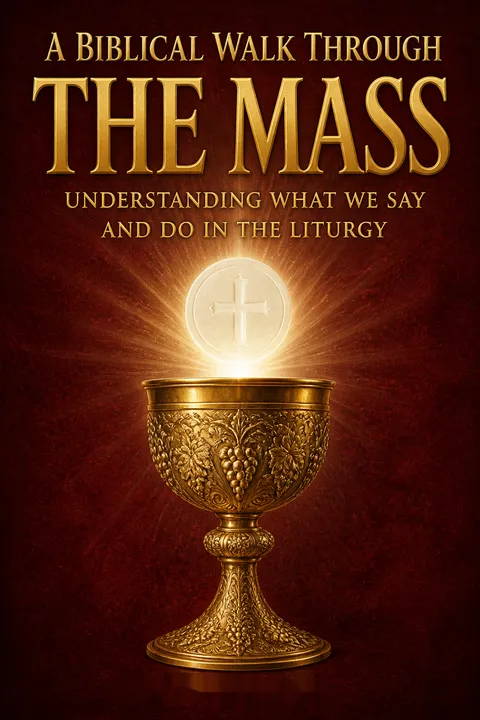
A Biblical Walk Through the Mass receives overwhelmingly positive reviews, with readers praising its accessibility and depth. Many highlight how it enhances their understanding and appreciation of the Mass, revealing biblical roots and historical context for each element. Cradle Catholics and newcomers alike find value in Sri's explanations, noting improved engagement during Mass. Reviewers appreciate the book's thoroughness, biblical references, and insights from Church leaders. Some mention it pairs well with accompanying study materials. Overall, readers express gratitude for a renewed reverence and connection to the liturgy.
People Also Read


Glossary
Eucharist
Christ’s sacramental presenceIn Catholic teaching, the Eucharist is the sacrament in which bread and wine become the Body and Blood of Jesus Christ. The Mass celebrates this sacrament as a memorial of Christ’s sacrifice and as a communion meal through which the faithful are united to Christ and to one another.
Transubstantiation
Change of substanceThe Catholic theological term for the change of the whole substance of bread and wine into the Body and Blood of Christ at consecration. The outward appearances, such as taste and appearance, remain those of bread and wine. The term describes a doctrinal claim, not a chemical alteration detectable by the senses.
Anamnesis
Liturgical memorialA Greek term used for the Eucharistic memorial of Christ’s death and resurrection. In the book’s explanation, anamnesis means more than recalling an event from the past: the liturgical celebration makes that saving event sacramentally present to the worshiping community, so participants can share in its meaning and power.
Epiclesis
Invocation of the Holy SpiritThe part of the Eucharistic Prayer in which the priest asks the Father to send the Holy Spirit upon the gifts of bread and wine so they may become the Body and Blood of Christ. A further petition asks that those who receive Communion be united more deeply as one body in Christ.
Confiteor
Communal confession of sinThe penitential prayer that begins with a confession of wrongdoing before God and the gathered community. It names failures in thought, speech, action, and omission, and asks Mary, the saints, angels, and fellow worshipers to pray for the speaker. It prepares the assembly through humility and repentance.
Agnus Dei
Lamb of God prayerThe Latin name for the prayer addressed to Jesus as the Lamb of God. It is said or sung as the bread is broken before Communion. Drawing on biblical images of Passover and the suffering servant, the prayer asks Christ for mercy and peace and identifies his self-offering with the removal of sin.
About the Author


Download PDF
Download EPUB
.epub digital book format is ideal for reading ebooks on phones, tablets, and e-readers.








