

Key Takeaways
Attend Mass as participation in heaven, not an hour of religious service.
A startling discovery. Scott Hahn begins with a story from 1985. Then a Protestant minister, he attended a Catholic Mass to investigate early Christian worship, expecting to remain a skeptical observer. Instead, he recognized Scripture throughout the prayers, then heard the congregation name Jesus as the Lamb. Revelation’s heavenly worship and the activity at the altar seemed to him like one event. This experience helped draw him into the Catholic Church.
More than a feeling. Hahn’s central claim is that every Mass joins earthly worship to the worship of Christ, angels, and saints in heaven. Poor music or distracted worshipers do not, in this account, cancel that reality. The claim rests on Catholic teaching about the Eucharist, not on whether an attendee feels transported.
What's striking is how the book makes a familiar ritual newly visible by changing the question. Instead of asking whether a service feels inspiring, it asks what the tradition says is happening within it. That shift can deepen attention even when the experience is ordinary. It also marks a limit: Hahn's conversion story explains the force of his conviction, but personal recognition cannot by itself establish the doctrine for every reader. The argument depends on the Catholic account of sacrament and authority, which readers can assess separately from the story's emotional power.
Let Revelation and the Mass illuminate one another.
A two-way key. Hahn argues that Revelation becomes more intelligible when read alongside Catholic liturgy, and that Revelation in turn reveals the Mass as participation in heavenly worship. The book’s images of an altar, incense, robed elders, hymns, Scripture readings, and the Lamb are not decorative interruptions in his reading. They make the visions look like a liturgical world.
A different starting point. Hahn describes earlier efforts to treat Revelation mainly as a coded forecast of future events. He found that such schemes often depended on matching symbols to current rulers, then lost force when those rulers fell. A liturgical reading instead connects the book’s images to worship shared by Christians across generations. It does not require every symbol to be decoded as a news report.
The interpretive payoff is coherence: recurring images can be understood as parts of a worship scene rather than as disconnected puzzles. That is a useful reading practice beyond this particular text. A strong interpretation should explain how many details work together, not merely identify one striking symbol. Still, the liturgical pattern is a theological lens, not a neutral proof that every image has only one meaning. The book is most persuasive when it shows how the lens illuminates the text, rather than implying that all competing readings are simply mistakes.
See Jesus as both the sacrifice's victim and its priest.
The Lamb's history. Hahn traces the image of Jesus as Lamb through Israel’s sacrifices. In the Passover, a lamb’s blood marked the households to be spared, and the family ate the lamb as part of the covenant meal. He also connects Jesus with Isaac, who carried wood toward his intended sacrifice, and with Melchizedek, the priest-king who offered bread and wine.
One offering, renewed participation. Hahn reads John’s account of Jesus’ death as the fulfillment of Passover details, including the unbroken bones. Jesus is both the one offered and the high priest who offers himself. The Mass, in this theology, does not repeat Calvary as a second death. It makes the Church a participant in Christ’s single, enduring sacrifice.
The paired roles of priest and victim prevent the sacrifice from being reduced either to a private act of suffering or to a ritual performed by someone else. The image also explains why the book gives the Lamb such prominence: power is expressed through self-offering, not merely force. The theological reading depends on seeing the biblical episodes as connected patterns, a practice central to Christian interpretation but not self-evident to every reader. Its strength lies in showing how sacrifice, meal, and covenant converge rather than treating them as separate themes.
Trace the Eucharist through the earliest Christian communities.
A continuous practice. Hahn points to early Christian writings as evidence that the Eucharist was central from the Church’s beginning. The Didache, an early guide to Christian practice, describes Sunday gathering, confession, and the breaking of bread. Around 107, Ignatius of Antioch links the Eucharist to Church unity and ordained leadership. In the mid-second century, Justin Martyr describes a Sunday gathering with Scripture readings, teaching, prayers, bread and wine, thanksgiving, and Communion.
More than a recent custom. These sources share features with the Mass: Scripture, a gathered community, a Eucharistic prayer, and Communion. Local rites differed, Hahn notes, but he sees continuity in their core convictions about Christ’s presence and the sacrificial character of the meal. The early documents help explain why he rejects the idea that liturgical worship was a late departure from Christianity’s origins.
Historical continuity is a powerful argument because it shifts the question from whether a modern practice seems plausible to how early communities understood their own worship. The sources also show that ritual and theological belief developed together: shared forms gave communities a way to preserve and transmit meaning. Continuity, however, does not mean every detail remained unchanged, and ancient evidence can be interpreted in more than one way. Hahn’s case is strongest when it distinguishes stable patterns from local variation instead of treating the early Church as liturgically uniform.
Use repeated ritual to train attention and everyday faith.
The body participates. Hahn presents the Mass as more than words to hear. Its signs and actions engage sight, sound, smell, taste, and touch: Scripture is proclaimed, incense rises, worshipers make the Sign of the Cross, and Communion is received. He argues that repeated forms can educate attention, much as familiar words of affection or gratitude can express commitment even when they are not spontaneous.
A structured journey. The Mass moves through two broad movements, the Liturgy of the Word and the Liturgy of the Eucharist. Readings, confession, a creed, offerings, the Eucharistic prayer, and Communion each contribute to one act of worship. Routine becomes mindless when people stop attending to its meaning. For Hahn, understanding each part makes repetition a practice of love rather than a reason to tune out.
This account treats ritual as a kind of embodied memory: a person does not only think a commitment, but rehearses it through gesture, speech, and shared action. That is a compelling answer to the assumption that sincerity must always be spontaneous. Repetition can steady attention, though it can also dull it; the difference is not ritual alone but the participant’s understanding and engagement. Hahn’s practical emphasis is therefore important: the form can carry meaning, but it cannot force a person to notice.
Read Revelation's crisis historically without reducing it to prediction.
Hahn's historical emphasis. Among several approaches to Revelation, Hahn favors a reading centered on the crisis surrounding Jerusalem and the Temple’s destruction in 70 CE. He sees the book’s Temple imagery, covenant language, plagues, and warnings as addressing the first Christians’ world, while also speaking to later generations. On this account, the fall of the old order marks a transition toward the New Covenant and a new form of worship.
Not a closed forecast. Hahn does not say that Revelation has no future dimension. Rather, he resists making its main purpose the identification of tomorrow’s political leaders or disasters. He interprets its visions as addressing a real first-century crisis and as patterns that can recur in the life of the Church. The date and historical referents of Revelation remain debated, so this is a reading to consider, not an uncontested conclusion.
The historical emphasis restores urgency to a text often treated as a distant timetable. It asks what the visions could have meant to people facing upheaval, rather than assuming that their meaning begins with modern headlines. The approach also preserves a moral and spiritual application without requiring every detail to predict a later event. Its vulnerability is that the proposed link to Jerusalem can become too comprehensive if every symbol is made to fit it. Careful readers should distinguish textual evidence, historical reconstruction, and theological interpretation.
Treat judgment as a covenant warning, not divine spectacle.
A family bond at stake. Hahn defines a covenant as a sacred bond that makes people members of God’s family. Sin, then, is more than breaking a rule: it damages that relationship and turns a person away from the life the covenant offers. Revelation’s judgments warn what can happen when a community persists in rejecting its obligations.
Mercy can be severe. Hahn presents divine punishment as discipline intended to turn people back, not as cruelty for its own sake. He uses the image of entrenched vice: repeated wrongdoing can distort a person’s sense of good and make repentance harder. He applies the same logic to societies. The argument makes judgment personally relevant, but it does not mean every disaster can be confidently identified as God’s punishment for a specific sin.
The covenant model makes judgment relational: its central question is not only what rule was broken, but what kind of relationship has been refused. That can make moral accountability more vivid than a purely legal metaphor. Yet interpreting suffering as corrective discipline requires restraint. A general theology of consequences does not give observers permission to label another person’s illness or a community’s disaster as deserved punishment. The book’s strongest use of judgment is inward-facing, as a call to examine one’s own conduct and return to the responsibilities of belonging.
Fight evil through worship, prayer, and self-reform.
A different battlefield. Revelation’s beasts represent, in Hahn’s reading, spiritual forces working through corrupt political and religious authority. The book depicts a conflict between the Lamb’s kingdom and powers that imitate or oppose it. The Church’s response is not to copy those powers with worldly violence. Hahn presents worship, prayer, the saints’ intercession, and fidelity under pressure as the weapons of the Lamb’s people.
Start close to home. Spiritual combat also means resisting pride, greed, anger, and other habits that undermine love. Hahn urges readers to prepare for Mass through prayer, study, repentance, and attention. Even small moments of restraint during worship count: choosing not to judge a distracted neighbor, for instance, is part of the struggle. The point is not to deny evil, but to resist becoming its mirror.
The book’s strongest contribution here is its refusal to equate religious seriousness with domination. The Lamb’s victory is defined by faithful self-giving, so the believer’s first task is not to seize control but to become less governed by destructive habits. That makes the idea of spiritual warfare ethically demanding rather than merely dramatic. The martial language still needs care: taken literally or politically, it can encourage the very enemy-making the book warns against. Its most coherent application remains disciplined self-examination and nonviolent fidelity.
Treat parishioners as family, not an audience you chose.
A wider household. Hahn argues that the Eucharist renews the Church’s covenant bond with God and with one another. He presents the Trinity as the divine family into whose life Christians are invited, and the Church as a community that includes believers on earth and the saints in heaven. The Mass is therefore not a private encounter attended alongside strangers; it is a shared family meal.
Belonging has obligations. Family language changes how worshipers regard difficult neighbors. The person who irritates, distracts, or disappoints is still part of the community to which the worshiper belongs. Hahn argues that communion with Christ cannot be separated from responsibility toward Christ’s people. This does not require warm feelings toward everyone. It requires patience, service, and a willingness to treat fellow worshipers as more than background characters.
The family metaphor widens the meaning of belonging beyond personal preference. A congregation is not simply a group assembled because its members already like one another; shared obligations can precede affection. That is a demanding but useful correction to consumer habits in religious life. The metaphor also has limits: families can hide unequal power or pressure people to tolerate harm. The book’s emphasis on service and patience is most constructive when paired with honest boundaries and accountability, rather than treated as a demand for uncritical harmony.
Carry the altar's self-offering into ordinary work.
Worship continues outside church. Hahn describes the offertory as more than the presentation of bread, wine, and money. It symbolizes offering one’s work, family life, prayer, leisure, and suffering to God, joined to Christ’s sacrifice in the Eucharist. The Mass then sends worshipers back into ordinary life to live what they have celebrated.
A daily practice. Cooking, working, caring for family, or serving a neighbor can become acts of self-giving when performed with love rather than only for status or reward. This does not make every task pleasant or automatically holy. It changes the intention and the way a person treats others while doing it. The book’s final movement is practical: heaven’s worship is not an escape from earthly responsibilities, but a pattern for carrying them with greater generosity.
This connection prevents the Mass from becoming a sealed sacred hour detached from ordinary conduct. It gives daily labor a direction: routine tasks can express the same self-giving that worship celebrates. The idea is especially useful because it does not require dramatic religious activity; it asks for a changed quality of attention in familiar responsibilities. Still, spiritualizing work should not obscure material conditions or unfair demands. Calling labor an offering must never become a reason to excuse exploitation. The principle is strongest when it dignifies service while preserving the need for justice.
Analysis
The book’s central move is a change of scale. A weekly parish service becomes a meeting point between earthly time and heavenly worship, while Revelation shifts from an obscure forecast to a vision that makes liturgy legible. Hahn builds this case through a personal conversion narrative, biblical patterns of sacrifice, early Christian testimony, and Catholic teaching. The sequence matters: the reader is first invited to see the Mass differently, then given textual and historical reasons for that perception.
Its most distinctive insight is the two-way relationship between Revelation and worship. Liturgical imagery helps organize the book’s strange scenes, while Revelation gives theological depth to familiar gestures and prayers. The account also makes sacrifice intelligible as more than loss: it is self-offering, covenant, thanksgiving, and shared meal. This explains why the Eucharist is both gift and obligation, and why worship should reshape conduct beyond the church building.
The method is confessional rather than neutral. Hahn’s reading of Revelation as primarily concerned with Jerusalem’s destruction in 70 CE, and his identification of several symbols with Catholic beliefs and practices, are theological interpretations, not settled conclusions that all readers must accept. His insistence that several interpretive approaches can coexist is generous, though it can also make the framework difficult to falsify. Historical arguments, sacramental claims, and personal experience should therefore be weighed on their own terms. The book is most compelling when it moves from interpretation to practice: attention, humility, repentance, solidarity, and service. Its danger is that sacramental confidence can become overconfident judgment if suffering is too quickly explained as divine discipline, or if family language suppresses legitimate disagreement. Read with those cautions, the book offers a coherent Catholic vision in which worship is not an escape from history. It is a way of inhabiting history with a different account of power, belonging, and hope.
Review Summary
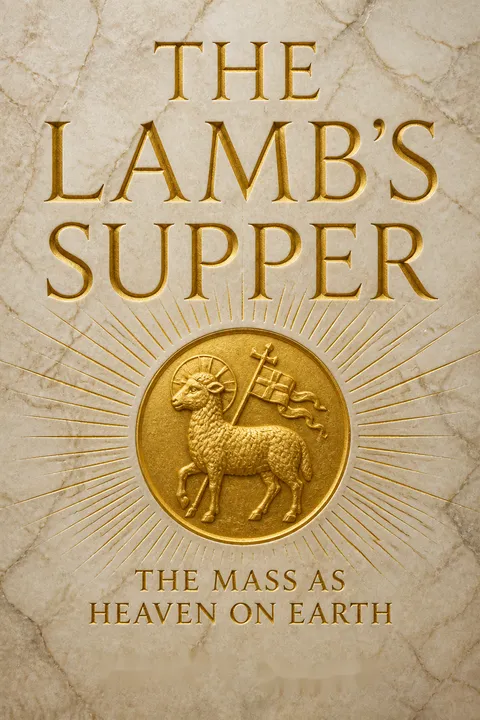
The Lamb's Supper explores connections between the Catholic Mass and the Book of Revelation, arguing the liturgy represents heaven on earth. Reviews praise Hahn's accessible writing and how the book deepened understanding of Mass symbolism and structure. Many readers, including converts, found it transformative for their faith and worship experience. Critics note excessive proof-texting, taking scripture out of context, and lack of scholarly footnotes. Some felt the organization was disjointed and explanations occasionally superficial. Despite mixed scholarly assessment, most reviewers appreciated gaining fresh perspective on the Eucharist and Revelation's apocalyptic imagery as liturgical framework.
People Also Read




Glossary
Parousia
Christ's active presenceA Greek term commonly used for Christ's coming or return. Hahn emphasizes its sense of presence, arguing that Christ is present in the Eucharist as well as expected at the end of history. In this account, the Mass anticipates the final revelation of Christ while making his presence real within the Church's worship.
todah
A thanksgiving sacrificeA Hebrew term for thanksgiving or a thank offering. Hahn describes the todah as a sacrificial meal in which a worshiper recalls danger and celebrates deliverance with a shared meal. He connects this pattern to the Eucharist through its themes of thanksgiving, sacrifice, bread and wine, and confidence in God's rescue.
Real Presence
Christ present in the EucharistThe Catholic teaching that Jesus Christ is truly present in the Eucharist under the appearances of bread and wine. Hahn treats this presence as central to the Mass and to his reading of Revelation: the Lamb worshiped in heaven is the same Christ received in Communion.
Eucharistic Prayer
The Mass's central prayerThe prayer at the heart of the Liturgy of the Eucharist. In Hahn's description, it includes calling upon the Holy Spirit, recalling Jesus' words at the Last Supper, offering Christ's sacrifice, praying for the living and the dead, and giving glory to God. Its exact form varies across Catholic rites.
Epiclesis
Invocation of the Holy SpiritThe part of the Eucharistic Prayer in which the priest invokes the Holy Spirit upon the bread and wine. Hahn highlights it as a point where earthly worship is understood in relation to divine action. Its place and wording differ among liturgical traditions, especially between Eastern and Western rites.
New Covenant
God's bond through ChristThe relationship between God and his people established through Jesus Christ, whom Hahn presents as fulfilling Israel's earlier covenants. The Mass renews this bond through Christ's sacrifice and the Eucharistic meal. It brings both a gift of communion with God and an obligation to live according to that relationship.
sacramental imagination
Seeing grace through signsA way of interpreting material signs and ritual actions as participating in spiritual realities. Hahn uses this approach to connect the Mass's altar, bread, wine, incense, prayers, and gestures with the heavenly worship portrayed in Revelation. It asks readers to see liturgy as more than symbolic illustration.
About the Author
Download PDF
Download EPUB
.epub digital book format is ideal for reading ebooks on phones, tablets, and e-readers.








