

Key Takeaways
Tidy first only when structure work makes the next behavior change easier.
Separate two kinds of change. A behavior change alters what a program does. A structural change alters how its code is organized without changing its behavior. Beck calls small, behavior-preserving structural improvements tidyings. They can make a feature easier to implement, but cleanup has a cost, so the book's title is a real question, not an order.
Use the immediate task as evidence. If a messy function obscures the logic you need to change, a small tidying may pay off at once. If the cleanup will not help this change, save it or skip it. The practical aim is neither speculative perfection nor reluctant neglect. Improve the design near the point where the need for improvement becomes visible, then return to delivering behavior.
The distinction between what software does and how its code is arranged gives teams a useful way to discuss work that is often mislabeled as either feature delivery or delay. It also makes the trade-off concrete: structure is valuable when it changes the cost or risk of a real task. The limit is that the payoff is partly counterfactual. A developer cannot directly observe how hard the feature would have been without the cleanup, so small steps and clear intent matter more than confident predictions.
Turn the understanding you just earned into code the next reader can use.
Make your reading visible. Tidying works by moving useful knowledge out of a programmer's head and into the code. If a nested conditional hides the main path, use guard clauses to expose the exceptional cases. If a long expression has a meaningful part, give that part a well-named variable. Put related declarations near their initialization, and group statements into readable chunks.
Choose one small move. Other useful moves include replacing a confusing interface with a clearer wrapper, grouping code that changes together, and extracting a helper whose name explains its purpose. Normalize inconsistent ways of doing the same thing. Remove code that is truly unused, and delete comments that merely repeat the code. Add comments when they preserve context the code cannot express.
These techniques are small acts of externalized cognition. A meaningful variable name or a clear guard clause reduces what a reader must hold in working memory, while consistent patterns let readers predict what unfamiliar code is doing. The important discipline is restraint: several individually sensible edits can interact and obscure the reason for a change. One-purpose edits make the new structure easier to assess and easier to undo if the supposed improvement turns out to be confusing.
Keep structural cleanup separate so reviewers can judge behavior changes clearly.
Make intent inspectable. When a feature change and several tidyings are mixed together, reviewers must work out which lines alter behavior and which only reorganize code. Beck recommends putting tidyings in their own pull requests or clearly separate commits, with behavior changes in separate units. A tidying should be small enough that its purpose is apparent, not a sprawling campaign to make the whole codebase pristine.
Batch size has trade-offs. Large batches take longer to integrate and raise the chance of merge conflicts, accidental interactions, and speculative cleanup. Tiny batches, however, can impose repeated review and deployment overhead. If reviews are slow, contributors have an incentive to bundle more changes, which can make reviews slower still. Improving review speed and team trust can make smaller, safer batches practical.
Separating kinds of change is a form of information design: it lets a reviewer evaluate one claim at a time. The discussion also shows that workflow is an incentive system, not just a set of rules. When review is costly, people rationally bundle work, even when that increases technical risk. The suggested escape is cultural as well as procedural. Teams need enough confidence in tests, tooling, and one another to treat routine, behavior-preserving edits differently from changes with user-visible consequences.
Choose first, after, later, or never by where the payoff lands.
Match timing to value. Tidy first when cleanup will immediately clarify the code or reduce the effort of the behavior change. Tidy after when the change has already revealed an obvious improvement, the same area is likely to change again, and doing the cleanup now is cheaper than returning later. Tidy later when the work is worthwhile but too large to justify delaying the current task. A personal list of cleanup opportunities can preserve those discoveries.
Sometimes leave it alone. Never tidy code that genuinely will not change again, unless improving it has some other clear benefit. Beck expects personal tidying to happen in bursts of minutes, sometimes up to an hour, not as an open-ended detour. He also notes that changes tend to cluster: frequently modified areas become the natural places to improve.
The four timing choices make room for the realities of delivery without treating urgency as a permanent excuse. The idea of recording deferred work is useful because it converts a vague intention into a choice that can be revisited. Still, a cleanup list can become another backlog that no one has time to address. Its value depends on selective use: record items with a plausible payoff, and do not mistake a longer list for better design.
Track coupling by the changes it spreads, then bring those elements closer.
Define the relationship precisely. Coupling means that a particular change to one code element requires a change to another. The important question is not simply whether two components interact, but which changes connect them. A function call couples caller and callee if a change to the callee's interface also requires edits at the call site. A change to the callee's internal formatting may not.
Use structure to reduce the pain. If several routines or files repeatedly change together, place them near one another or make the shared responsibility clearer. This is cohesion: organizing related elements within a focused boundary. Sometimes removing the dependency is worthwhile; sometimes it is too expensive or too disruptive. Even grouping coupled code together can make a change less scattered while preserving the option to decouple it later.
This change-specific definition prevents a common design discussion from collapsing into slogans about systems being coupled or decoupled. It asks for evidence in the work itself: which elements repeatedly appear together when changes are made? That makes commit history a potentially useful diagnostic. But observed patterns are not destiny. A cluster of past changes may reflect current product priorities, not an enduring dependency, so reorganizing around historical data should remain incremental and open to revision.
Treat design as buying future choices, not merely polishing code.
Structure creates options. A program can produce the same result whether it is a single tangled function or a collection of well-organized parts. Structure matters because it changes how easily programmers can add different behaviors in the future. Beck describes this future flexibility as optionality: the value of retaining the ability, but not the obligation, to make a change when its usefulness becomes clearer.
Balance that value against timing. Financial thinking supplies a counterweight: money earned sooner is generally more valuable than money earned later, so delaying a useful feature for cleanup has a cost. A tidying is attractive when it reduces the cost of the change at hand or creates valuable future choices. The more uncertain future needs are, the more flexibility may matter, but uncertainty alone is not a reason to build elaborate abstractions.
The options analogy explains why code can gain value without changing its immediate output: a system that is easier to adapt preserves responses to future information. It also exposes a real tension between flexibility and present delivery. The analogy should guide judgment, not masquerade as a precise valuation method. Developers rarely know the probability or payoff of future changes well enough to calculate an exact premium. A modest structural improvement near a credible change is a more defensible investment than designing for every imaginable scenario.
A few cascading changes can dominate the cost of an entire system.
Follow the expensive tail. Beck presents Constantine's Equivalence as a chain of approximations: software's cost is largely the cost of changing it, the biggest changes account for a disproportionate share of that cost, and coupling helps make those changes expensive. When one edit forces several others, which in turn force more edits, the cascade can turn an apparently small request into a major undertaking.
Design against propagation. This is why reducing coupling can matter more than shaving time from routine edits. A rename with automated support may be cheap even across many callers, while a subtle change that ripples through dependent components can be costly. The goal is not to eliminate every connection. It is to reduce the likelihood and reach of harmful cascades, especially around changes the system is likely to face.
The focus on costly outliers is a useful corrective to optimizing only the average change. A system can feel efficient during ordinary work and still be fragile when an unusual requirement arrives. The argument is strongest as a design model, not as a measured law: the text presents its cost relationships as approximations, and real costs also depend on testing, deployment, coordination, and domain knowledge. Still, asking where changes propagate helps direct limited design effort toward consequential risks.
Experiment freely with reversible structure, but slow down before decisions spread.
Treat undoability as an advantage. Many small structural changes are reversible: a helper can be inlined, and code can be reordered again. Because these decisions are relatively easy to undo, they do not need the same level of deliberation as changes that can harm users or are expensive to reverse. Small steps make mistakes easier to identify and recover from.
Watch for propagation. A choice that seems reversible in one place can become difficult to undo after it spreads across a codebase or shapes many interfaces. A large architectural move, such as separating a component into a service, deserves more investigation than extracting a helper. Beck suggests making uncertain, high-impact changes more reversible where possible, for example by prototyping the path into production with a limited ability to switch back.
Reversibility is a practical way to allocate attention. It supports experimentation where the downside is limited and encourages deliberation where commitments accumulate. The subtle point is that reversibility is not an intrinsic label attached to a decision. It depends on scale, adoption, and the cost of changing dependent systems. A local choice can harden into a global constraint through repetition, so teams should notice not only whether a decision can be undone now, but how quickly its reach is growing.
Make software design part of daily work, not a grand cleanup project.
Design serves people. Beck frames software design as arranging elements so they benefit one another, but the immediate beneficiary of tidying is often the programmer trying to understand and change the code. Clearer reading order, cohesive helpers, and explicit inputs reduce the mental work required of the next person. Comments belong when they explain context or a constraint that the code does not make clear, not when they restate a line beneath them.
Keep the purpose in view. Tidying should make a real task easier, not become an excuse to avoid user needs. The author treats modest cleanup as a form of care for one's own working conditions, while emphasizing that it also helps colleagues who inherit the code. Small improvements can accumulate, but each should remain connected to making the next behavior change safer or more understandable.
The human-centered framing usefully rejects the idea that code quality is merely an aesthetic preference. Readability affects how reliably knowledge passes between people, especially when the original author is unavailable. It also recognizes that developers are not interchangeable processors: frustration and confusion shape the work they can do. The counterweight is accountability to users. Treating cleanup as care is persuasive when it supports delivery, but less so when personal satisfaction becomes the only measure of whether the work was worth its cost.
Analysis
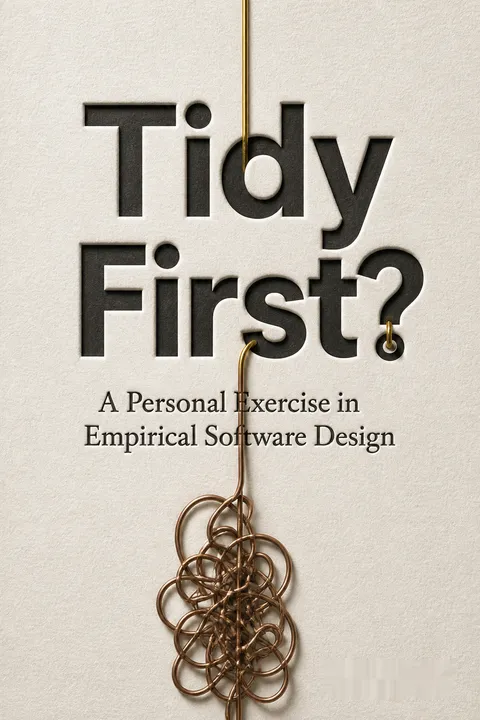
Tidy First? is a practical argument against two familiar extremes: designing far ahead for needs that may never arrive, and postponing design until change becomes painful. Its alternative is empirical in a literal sense. Start with the code and the change in front of you, make a small structural adjustment when the need is visible, and use the result to improve judgment. The question mark matters because no universal rule can resolve the timing trade-off.
The book's most useful conceptual move is separating behavior from structure. This makes design work discussable without pretending every line changed has the same purpose. Its catalog of tidyings then gives that distinction a low-friction practice: clarify intent, group related code, and expose hidden assumptions in small steps. The economic argument deepens the case. Structure can preserve future options, while delaying a feature can postpone value. Neither consideration wins automatically.
The framework is strongest as a way to reason, not as a formula. Optionality is hard to quantify, the costs of future changes are uncertain, and historical coupling may not predict every future requirement. Beck acknowledges that the decision depends on taste and judgment. That is not a flaw to eliminate so much as a condition to manage with reversible edits, short feedback loops, and attention to actual change patterns.
One practical implication is that teams should evaluate design work by its local evidence: Did it make the next change clearer, safer, or cheaper? That question avoids both aesthetic absolutism and the assumption that only user-visible behavior creates value. It also gives cleanup a boundary. Tidy enough to improve the work at hand, preserve useful flexibility, and stop before design becomes its own deliverable.
Review Summary
Tidy First? receives mixed reviews, with an average rating of 3.95/5. Readers appreciate its concise insights on code refactoring and software design economics. Many find the first part on "tidyings" useful for beginners but basic for experienced developers. The book's strength lies in its discussion of when and why to tidy code, offering a unique perspective on software design using financial concepts. Some criticize its brevity and high price, suggesting it could have been a blog post. Overall, it's valued for its practical advice and thought-provoking ideas on software development.
People Also Read










Glossary
Tidying
Small behavior-preserving cleanupA tidying is a small structural change to code that does not change the program's behavior. It is a subset of refactoring, focused on practical improvements such as clarifying a conditional, extracting a helper, or removing unused code. The purpose is to make understanding or a nearby behavior change easier, not to launch an open-ended redesign.
Empirical software design
Design guided by observed needA way of deciding when to improve software structure based on observation and experience rather than designing far in advance or refusing design until change becomes difficult. The programmer responds when a class of changes proves hard, making enough structural improvement to ease useful feedback and subsequent work. Timing remains contingent and requires judgment.
Coupling
Changes that require other changesTwo software elements are coupled with respect to a particular change when changing one requires changing the other. The definition depends on the change being considered: two components may interact without being coupled for a specific edit. Coupling becomes costly when dependencies spread changes across many elements or trigger further changes in a cascade.
Cohesion
Related code kept togetherCohesion describes how strongly the elements within a code unit belong together, especially because they change together. Improving cohesion can mean gathering related routines into one focused element or moving unrelated routines elsewhere. The aim is to make the scope of understanding and change more concentrated, not merely to make files smaller.
Constantine's Equivalence
Software cost tracks couplingBeck's name for a chain of approximate relationships: the cost of software is largely the cost of changing it, the largest changes account for a disproportionate share of that cost, and coupling contributes to the expense of those changes. It is presented as a conceptual model for why reducing costly change propagation matters, not as a precise measured equation.
Optionality
Value of future choicesOptionality is the value of preserving the ability to make a future behavior change without being obligated to make it. In the book's financial analogy, structure can act like a premium paid now to retain choices whose value may become clearer later. Flexibility is especially useful when future needs are uncertain, but speculative design can cost more than the options it creates.
FAQ
What's "Tidy First?" about?
- Focus on Design: "Tidy First?" by Kent Beck emphasizes the importance of software design over tools and technology, advocating for a focus on creating clean, readable code.
- Practical Tips: The book provides practical tips for developers at any level to improve their codebases, making them easier to understand and modify.
- Incremental Improvement: It introduces a realistic approach to incrementally improving production code, moving away from traditional top-down design theories.
- Human Relationships: Beck highlights that software design is an exercise in human relationships, starting with the programmer's relationship with themselves.
Why should I read "Tidy First?" by Kent Beck?
- Expert Insights: Kent Beck is a renowned figure in software design, and his insights are valuable for anyone interested in improving their coding practices.
- Practical Application: The book offers actionable advice that can be applied immediately to make codebases more manageable and maintainable.
- Empirical Approach: It presents an empirical approach to software design, focusing on real-world application rather than theoretical concepts.
- Personal Development: Reading this book can help developers enhance their skills, making them more effective and efficient in their work.
What are the key takeaways of "Tidy First?" by Kent Beck?
- Tidy First Concept: The book introduces the concept of tidying code before making changes to improve clarity and ease of modification.
- Small Changes, Big Impact: It emphasizes making small, incremental changes that can lead to significant improvements in code quality.
- Balancing Design and Behavior: Beck discusses the balance between investing in code structure and changing system behavior for optimal results.
- Human-Centric Design: The book underscores the importance of considering human relationships in software design, starting with the programmer's self-care.
What is the "Tidy First" method in Kent Beck's book?
- Initial Tidying: The method involves tidying messy code before making changes to its functionality, ensuring a cleaner and more understandable codebase.
- Safe and Efficient: It provides guidelines on how to tidy code safely and efficiently, minimizing the risk of introducing errors.
- Stopping Tidying: The book also addresses when to stop tidying, preventing over-investment in code cleanup at the expense of delivering features.
- Why Tidying Works: Beck explains the benefits of tidying, such as improved code readability and easier future modifications.
How does Kent Beck define software design in "Tidy First?"
- Beneficially Relating Elements: Beck defines software design as the process of beneficially relating elements within a codebase to improve its structure and functionality.
- Focus on Relationships: The definition emphasizes the relationships between code elements and how they can be organized to reduce complexity.
- Human-Centric Approach: It highlights the importance of considering human factors in design, such as how code changes affect team dynamics and individual productivity.
- Incremental Improvement: The definition supports the idea of making small, incremental improvements to code structure to enhance overall design.
What are some practical tips from "Tidy First?" by Kent Beck?
- Guard Clauses: Use guard clauses to simplify nested conditions and improve code readability.
- Delete Dead Code: Remove unused code to reduce clutter and potential confusion in the codebase.
- Normalize Symmetries: Ensure consistent patterns in code to make it easier to read and understand.
- Explaining Variables: Use well-named variables to clarify the purpose of complex expressions.
What is the significance of coupling and cohesion in "Tidy First?" by Kent Beck?
- Coupling Definition: Coupling refers to the degree of interdependence between code elements, with high coupling leading to more complex and costly changes.
- Cohesion Definition: Cohesion measures how closely related the responsibilities of a single module or element are, with high cohesion indicating a well-organized codebase.
- Cost of Software: Beck explains that the cost of software is closely tied to the level of coupling, as it affects the ease of making changes.
- Design Strategy: The book advocates for reducing coupling and increasing cohesion to make code easier to maintain and modify.
How does "Tidy First?" by Kent Beck address the economics of software design?
- Time Value of Money: The book discusses the concept that a dollar today is worth more than a dollar tomorrow, influencing decisions on when to tidy code.
- Optionality: Beck highlights the value of creating options in software design, allowing for future changes and adaptations.
- Balancing Act: The book explores the balance between spending money on tidying now versus the potential future benefits of having a cleaner codebase.
- Economic Incentives: It encourages developers to consider economic incentives when deciding whether to tidy code, balancing immediate costs with long-term gains.
What are the best quotes from "Tidy First?" by Kent Beck and what do they mean?
- "Software design is an exercise in human relationships." This quote emphasizes the importance of considering the human aspect of software design, including how code changes affect team dynamics and individual productivity.
- "Tidy first is a bit of an exception. When you tidy first, you know you will realize the value of tidying immediately." This highlights the immediate benefits of tidying code before making changes, such as improved readability and easier modifications.
- "The structure of the system doesn’t matter to its behavior. One big function, a whole bunch of itty bitties, same paycheck comes out." This underscores the idea that while structure doesn't affect behavior, it significantly impacts the ease of making future changes.
- "Coupling drives the cost of software." This quote points to the critical role of coupling in determining the cost and complexity of software development and maintenance.
How does "Tidy First?" by Kent Beck suggest managing tidying in a development workflow?
- Separate Tidying: Beck advises separating tidying from behavior changes in pull requests to make reviews more manageable and focused.
- Chaining Tidyings: The book discusses how tidyings can lead to further tidyings, creating a chain of improvements that enhance code quality.
- Batch Sizes: It explores the trade-offs of batching tidyings together versus handling them separately, considering factors like review latency and integration costs.
- Rhythm of Tidying: Beck emphasizes finding a rhythm for tidying that balances immediate needs with long-term code quality goals.
What is the role of reversibility in "Tidy First?" by Kent Beck?
- Reversible Decisions: Beck highlights that most structure changes in software are reversible, allowing for experimentation without long-term commitment.
- Contrast with Behavior Changes: Unlike structure changes, behavior changes can have irreversible consequences, making careful consideration essential.
- Design Strategy: The book encourages treating reversible decisions differently, focusing on quick iterations and learning from mistakes.
- Reducing Risk: By emphasizing reversibility, Beck suggests reducing the risk associated with design changes, making it easier to adapt and improve code.
How does "Tidy First?" by Kent Beck address the timing of tidying?
- First, After, Later, Never: The book categorizes tidying into four timing strategies, each with its own set of considerations and trade-offs.
- Tidy First: This approach is recommended when tidying can immediately simplify a behavior change, making it more efficient.
- Tidy After: Beck suggests tidying after a change when it can enhance future modifications without delaying current work.
- Tidy Later: The book acknowledges that some tidyings can be postponed, especially when immediate benefits are not apparent.
Download PDF
Download EPUB
.epub digital book format is ideal for reading ebooks on phones, tablets, and e-readers.








