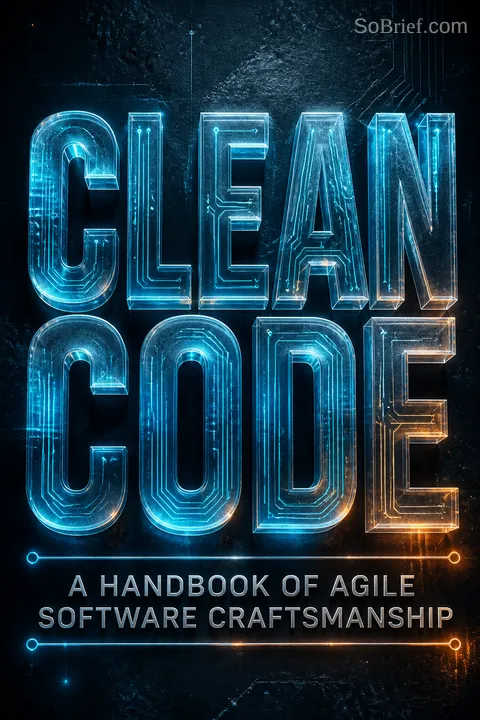


Key Takeaways
Keep code clean, because the shortcut that ships today taxes every change
The apparent shortcut compounds. Martin argues that rushed, tangled code slows every later change. He recalls a once-popular software product whose releases grew slower, bugs lingered, and crashes increased. A former employee traced the decline to a codebase made difficult to extend. As the mess grows, changes become riskier, teams slow down, and adding staff can deepen the problem because newcomers must work inside a design they do not understand.
A rewrite is no magic reset. In the book's redesign scenario, a new team builds a replacement while the old system keeps changing. The race can last years, and the replacement can inherit the same disorder. The practical alternative is to keep improving the code as it changes, rather than treating cleanup as a future project.
What's striking is the economic argument beneath the craftsmanship language: every unclear decision creates work for future readers, and that cost is distributed across the life of the product. This resembles preventive maintenance in engineering, where small inspections reduce the chance of expensive failure. The argument is strongest when code will be maintained by a team over time. A prototype intended to be discarded has a different cost profile, so cleanliness should serve expected use rather than become ceremony for its own sake.
Write for code's reader, not just the compiler, and make intent searchable
Reading dominates the work. Martin estimates that programmers spend more than ten times as long reading code as writing it. The next change depends on understanding what is already there, so readability is not decoration. Names should tell readers what a value represents, what a function does, and how a result is used. For instance, a time variable should identify both the interval and its unit, rather than leaving those facts for a comment to explain.
Make meaning easy to find. Prefer pronounceable, distinctive names over cryptic abbreviations, arbitrary number series, or names that merely satisfy the compiler. A loop counter may be brief within a tiny scope; a value used widely needs a searchable name. Consistent formatting and team conventions help readers recognize structure without relearning each file.
Readable code reduces the amount of information a person must hold in working memory while tracing a change. That makes naming a form of interface design: the identifier is often the first explanation a collaborator sees. The book also connects local style to team trust, since consistent layout lets readers predict where concepts belong. There is a limit, however. Longer names are not automatically clearer, and excessive naming detail can obscure a simple local operation. Clarity depends on the concept and its scope.
Keep functions small enough to tell one clear step at a time
One function, one level. A function should describe a single operation, with its internal steps expressed at the next level of detail. Martin demonstrates this by turning a tangled HTML rendering routine into a brief sequence that identifies test pages, includes setup and cleanup material, and returns the rendered result. The smaller functions make the purpose visible without requiring readers to decode low-level string handling first.
Reduce interpretive overhead. Prefer few arguments, avoid Boolean flags that make one function behave in two ways, and keep commands that change state separate from queries that return information. Hidden side effects are especially costly: a function named as a password check should not quietly reset a user's session. Exceptions can also separate failure handling from the ordinary algorithm.
The narrative structure is more than a stylistic preference. A well-ordered sequence lets a reader move from policy to mechanism, much as a good explanation introduces a claim before its evidence. Small functions also make testing and reuse easier. Yet extraction can go too far: a program split into countless trivial wrappers can force readers to jump between definitions. The useful test is not a universal line limit, but whether each unit has a coherent purpose that can be named without merely repeating its implementation.
Give each class one reason to change, then choose its shape deliberately
Count responsibilities, not methods. The Single Responsibility Principle says a class should have one reason to change. A dashboard with only a handful of methods can still combine unrelated work, such as managing a window and reporting software version numbers. Separating the version behavior creates a smaller unit with a clearer purpose. High cohesion means a class's data and methods belong together; unrelated clusters suggest another class is hiding inside.
Choose objects or data structures by the change you expect. Objects hide data and expose behavior, making new types easier to add. Data structures expose their fields and allow new operations to be added without changing every type. Neither style wins everywhere. Mixing the two produces hybrids that hide neither data nor responsibility, while making both kinds of change harder.
This is a useful corrective to the idea that object-oriented design means turning every noun into an object. The deeper issue is where change is likely to occur. If new kinds of behavior arrive often, exposed data with separate operations may be simpler; if new data types arrive often, polymorphic objects may localize change. The responsibility test is similarly practical, but it can be subjective. A class boundary is a hypothesis about future change, not a law that guarantees the right architecture.
Make tests clean enough to protect change, not become another legacy system
Tests preserve the freedom to improve. Test-Driven Development, or TDD, means writing a failing test before the production behavior, adding only enough code to pass it, then refining the result while tests remain green. Martin describes a rapid cycle of test and implementation. The tests are not disposable scaffolding. One team allowed its test code to become tangled; eventually developers discarded the suite, lost confidence in changes, and stopped improving the production code.
Make tests readable and dependable. The book recommends tests that are fast, independent, repeatable, self-checking, and written close to the code they specify. Build-operate-check structure helps readers see the setup, the action, and the expected result. Test one main concept at a time, and keep assertions focused enough that failure points to a clear behavior.
Tests function as executable memory. They preserve what a team believes the software must do, even after the original developers have moved on. Their value is partly technical and partly social: an understandable test gives a reviewer evidence for accepting a change. The caution is that passing tests cannot establish total correctness. A test suite reflects the cases its authors anticipated, so boundary checks, failure patterns, and human review remain important complements to automation.
Refactor in tiny verified steps, not heroic rewrites
Working is only a draft. In the command-line parser case study, the first version handled Boolean options cleanly. Adding string and integer options multiplied special cases until the implementation became unwieldy. Rather than add more features, Martin paused and extracted a common argument-handling abstraction. Tests ran after small changes, keeping behavior stable as responsibilities moved and duplicated logic disappeared.
Let evidence direct cleanup. In a separate date-class review, the original tests covered roughly half the executable statements. Additional tests exposed boundary mistakes, including a weekday calculation that returned the current date when it should have found the next occurrence. The book's simple-design priorities are to keep tests passing, remove duplication, make intent clear, and avoid needless classes or methods. The case studies show that refinement often includes trying a change, checking it, and revising it.
Incremental refactoring resembles controlled experimentation: change one variable, observe the result, and preserve a known-good baseline. That makes the work less dependent on memory and confidence. It also exposes a key distinction between a rewrite and a transformation: behavior is protected while structure changes. Still, green tests are only as informative as their coverage and assertions. The date example is valuable precisely because broader tests revealed defects the original suite had left invisible.
Use comments for rationale, never as camouflage for confusing code
Code should carry its own explanation. A comment that restates an obvious statement adds clutter, while one that drifts out of sync can mislead more than silence. If a comment explains that a condition checks benefit eligibility, the condition may be clearer as a well-named function. Names, small functions, and explicit intermediate values often explain intent more reliably than prose beside dense code.
Keep the comments that add missing context. Legal notices, public API documentation, warnings about non-obvious consequences, and explanations of why a surprising decision was made can help. Remove stale change logs, commented-out code, noisy headers, and TODO notes that no one reviews. Version control can preserve deleted code; the source file need not serve as its own history archive.
The strongest distinction here is between describing what code does and explaining why a decision exists. The former often duplicates the implementation; the latter can preserve context that the implementation cannot reveal. This aligns with documentation practice in safety-critical work, where rationale matters because future maintainers may face constraints that are no longer visible. The anti-comment stance can be overapplied, though. Clear code cannot always communicate policy, domain assumptions, or a deliberate workaround, so concise rationale deserves a place when it remains accurate.
Make failures explicit, while keeping the normal path uncluttered
Separate error handling from the algorithm. Return codes force callers to check every operation, often nesting success conditions around the main work. Exceptions can move failure handling to a distinct path, while useful error context identifies what operation failed and why. Wrapping a third-party API can translate several vendor-specific exceptions into one type that the application can handle consistently.
Do not make absence ambiguous. Returning null pushes a hidden obligation onto every caller and invites missed checks. When no employees exist, for example, an empty list lets the caller safely iterate without branching. For a legitimate special situation, a dedicated object can supply the normal behavior, such as a meal-expense result that provides a per-diem amount when no meal claim exists. Avoid accepting null inputs unless the interface explicitly requires them.
This approach treats errors as part of the interface rather than as inconvenient implementation debris. It is especially effective when callers can respond meaningfully to a failure and when exceptions carry enough context to diagnose it. The special-case approach also reduces branching by representing a valid absence as a usable value. Modern type systems can make such choices more explicit, but no representation removes the need to decide whether an event is exceptional, expected, or recoverable.
Put seams around libraries and startup so change stays local
Keep outside assumptions at the edge. A general-purpose collection such as a map may permit operations or values the application does not want. A small application-specific wrapper can expose only the needed behavior and keep casting, type rules, and library details in one place. Learning tests are small experiments that check how an unfamiliar API behaves before production code depends on it. Tests for log4j, for instance, revealed configuration details that documentation alone had not made obvious.
Separate construction from use. Build and connect major objects in a startup area, a factory, or a dependency-injection container. The application can then use plain domain objects without knowing how every dependency is assembled. For an API that does not yet exist, define the interface the application needs and bridge to the eventual provider with an adapter.
A boundary is both a technical seam and a place to manage uncertainty. Wrappers reduce the number of locations affected by a vendor change, while learning tests turn undocumented behavior into repeatable evidence. Separating startup from runtime also makes application logic easier to test without constructing the whole world. The tradeoff is abstraction overhead: wrapping every library type or adopting a large framework prematurely can create more machinery than protection. Encapsulate a boundary when it limits misuse or meaningfully reduces change cost.
Treat concurrency as a separate design problem, not a speed switch
Shared state creates hidden execution paths. Two threads incrementing the same identifier can both read the old value before either writes, producing a duplicate and losing an update. The book calculates 12,870 possible bytecode interleavings for one simple increment with two threads, illustrating why a line that looks indivisible may not be atomic. Concurrency helps when work can overlap with waiting, such as network access; it does not automatically speed up processor-bound work.
Reduce the opportunities for interference. Keep thread-aware code separate, limit shared data, use copies or independent task data where possible, and keep synchronized regions small. Learn the relevant execution model and library tools. Test under varied thread counts, platforms, and loads, and treat rare failures as real evidence rather than dismissing them as one-offs.
The chapter's central insight is that concurrency expands the set of possible histories the program must survive. This makes isolation and controlled interfaces more valuable than clever locking scattered across application code. The performance case is conditional: parallel work can hide waiting, but extra threads also add coordination and contention. The most responsible design starts by identifying the bottleneck and shared state, then uses testing to challenge assumptions about scheduling rather than assuming a successful run proves safety.
Analysis
Clean Code is best understood as a book about controlling the cost of change. Its specific techniques, from precise names to narrow interfaces, all reduce the amount of hidden context a future developer must reconstruct. The book's narrative reinforces that thesis through damaged products, sprawling functions, a command-line parser rescued through refactoring, and date logic whose defects appeared only under broader tests. The cases matter because the advice is presented as a practiced craft, not a checklist that magically produces quality.
The most durable synthesis is a feedback loop: express intent clearly, test behavior, make a small structural improvement, and verify that behavior remains intact. Readability makes defects and responsibilities easier to inspect. Tests make cleanup less frightening. Small boundaries keep external changes from spreading. These practices reinforce one another, which is why treating tests or formatting as optional polish undermines the larger system.
The book is deliberately opinionated, and some of its rules are better treated as defaults than absolutes. Very small functions can fragment control flow. Abstractions can multiply without adding useful flexibility. Comments can preserve domain rationale that names cannot carry. Even the best architecture depends on what kinds of change a system actually faces. The book's own case studies model a healthier standard than rigid compliance: inspect the code, test assumptions, make a local change, and judge the result.
Its broader professional claim is that speed and care are not opposites when software must evolve. The relevant measure is not how quickly code is typed, but how readily a team can understand, safely modify, and verify it. Cleanliness is therefore not visual perfection. It is a continuing investment in keeping the next change comprehensible and affordable.
Review Summary
Clean Code receives mostly positive reviews for its principles on writing readable, maintainable code. Readers appreciate the practical advice on naming, functions, and testing. The book's Java focus and some overly strict guidelines are common criticisms. Many consider it essential reading for developers, though some find it less useful for experienced programmers. The case studies and refactoring examples are praised by some but criticized by others as overdone. Overall, reviewers agree the book offers valuable insights on code quality, even if not all suggestions are universally applicable.
People Also Read





Glossary
Code-sense
refactoring judgmentThe practiced ability to recognize unclear or tangled code, imagine better alternatives, and choose a sequence of behavior-preserving changes to improve it. The book treats this as a skill developed through repeated practice, not as an instinct supplied by memorizing rules.
The Boy Scout Rule
leave code improvedA maintenance principle that asks developers to make a small improvement whenever they work in a code area. The change need not be large: a clearer name, a shorter function, or the removal of duplication can prevent gradual deterioration when the practice is repeated.
The Step-down Rule
order by abstractionA way to organize functions so a reader can move from a high-level operation to the lower-level steps that implement it. Each function calls or introduces the next level of detail, making a source file read like a progressively more specific explanation.
Single Responsibility Principle
one reason to changeA design principle stating that a class or module should have one responsibility, understood as one primary reason it would need to change. It guides class boundaries: behaviors that change for unrelated reasons are candidates for separate units.
Law of Demeter
limit object navigationA design heuristic that discourages a method from navigating through several other objects to reach an internal detail. A module should mainly communicate with its own methods, objects it creates, arguments it receives, and objects it directly holds, rather than depending on a collaborator's object graph.
F.I.R.S.T.
five test qualitiesAn acronym for the qualities of clean unit tests: fast, independent, repeatable, self-validating, and timely. Together, these qualities make tests practical to run often, straightforward to diagnose, and closely connected to the code whose behavior they specify.
Learning tests
probe external APIsSmall tests written to explore and confirm how a third-party library behaves when used in the way an application expects. They make assumptions about an unfamiliar interface executable, help distinguish library behavior from application mistakes, and can detect incompatible changes after a library upgrade.
Dependency Injection
supply dependencies externallyA dependency-management approach in which an object does not construct or locate its own collaborators. A startup routine or container creates the needed objects and supplies them through constructors or setters, separating object construction from the application's runtime behavior.
SPECIAL CASE PATTERN
encapsulate expected exceptionsA technique for representing a legitimate exceptional situation with an object that provides appropriate behavior, so callers do not need a separate branch. For example, an expense query can return a meal-expense object that supplies a per-diem total when no meal expenses were recorded.
Command Query Separation
separate change from inquiryA design principle that gives a function one role: either change an object's state or return information about it. Combining both can make a call ambiguous, especially when a state-changing operation is used as a condition. Separating the roles makes both the code and its intent easier to understand.
FAQ
What's "Clean Code: A Handbook of Agile Software Craftsmanship" about?
- Focus on Clean Code: "Clean Code" by Robert C. Martin emphasizes writing code that is easy to read, understand, and maintain.
- Professionalism in Coding: It argues that clean code is a hallmark of professionalism in software development.
- Practical Advice: The book provides guidelines, examples, and case studies to help developers write clean and efficient code.
Why should I read "Clean Code: A Handbook of Agile Software Craftsmanship"?
- Improve Coding Skills: It teaches how to write code that is clean, efficient, and maintainable.
- Learn from Experts: Part of the Robert C. Martin series, known for its technical and pragmatic approach.
- Long-term Benefits: Writing clean code reduces maintenance costs and makes you a more valuable developer.
What are the key takeaways of "Clean Code: A Handbook of Agile Software Craftsmanship"?
- Code Readability: Emphasizes that code should be easy to read and understand.
- Single Responsibility Principle: Advocates for each class or function to have one reason to change.
- Continuous Improvement: Encourages developers to continuously improve their code, following the Boy Scout Rule.
How does "Clean Code: A Handbook of Agile Software Craftsmanship" define clean code?
- Elegance and Efficiency: Clean code is described as elegant and efficient, with minimal dependencies.
- Readable and Maintainable: It should read like well-written prose, making the designer's intent clear.
- Focused and Single-minded: Each function, class, and module should have a single, clear purpose.
What is the Single Responsibility Principle in "Clean Code: A Handbook of Agile Software Craftsmanship"?
- One Reason to Change: A class or module should have one, and only one, reason to change.
- Improves Cohesion: Ensures that classes are cohesive, with closely related methods and variables.
- Facilitates Maintenance: Makes the code easier to maintain and extend, reducing the impact of changes.
What is the "Boy Scout Rule" mentioned in "Clean Code: A Handbook of Agile Software Craftsmanship"?
- Continuous Improvement: Suggests leaving the codebase cleaner than you found it.
- Small, Incremental Changes: Encourages making small improvements, like renaming variables or breaking up functions.
- Professional Responsibility: Presented as a professional responsibility to ensure maintainability.
How does "Clean Code: A Handbook of Agile Software Craftsmanship" approach Test-Driven Development (TDD)?
- Fundamental Discipline: TDD is crucial for writing clean, reliable code.
- Three Laws of TDD: Write a failing test first, write code to pass the test, then refactor.
- Benefits: Helps catch bugs early and improves code design.
What are "code smells" according to "Clean Code: A Handbook of Agile Software Craftsmanship"?
- Definition: Indicators of potential problems that hinder readability or maintainability.
- Examples: Long methods, large classes, and duplicated code.
- Addressing Smells: Provides heuristics and refactoring techniques to improve code quality.
How does "Clean Code: A Handbook of Agile Software Craftsmanship" suggest handling exceptions?
- Prefer Exceptions: Use exceptions instead of error codes for better context and management.
- Provide Context: Include meaningful messages and context when throwing exceptions.
- Avoid Checked Exceptions: Suggests using unchecked exceptions for cleaner code.
What role do unit tests play in "Clean Code: A Handbook of Agile Software Craftsmanship"?
- Ensure Code Quality: Unit tests ensure code works as intended and remains maintainable.
- Test-Driven Development: Advocates writing tests before production code.
- Clean and Readable Tests: Tests should be as clean and readable as production code.
What is the role of refactoring in "Clean Code: A Handbook of Agile Software Craftsmanship"?
- Continuous Improvement: Refactoring improves code structure and readability without changing functionality.
- Techniques: Provides techniques like Extract Method and Rename Variable to enhance code quality.
- Fearless Refactoring: With comprehensive tests, developers can refactor confidently.
What are the best quotes from "Clean Code: A Handbook of Agile Software Craftsmanship" and what do they mean?
- "Clean code does one thing well." Emphasizes focus and clarity in code.
- "Leave the campground cleaner than you found it." Encourages continuous improvement of the codebase.
- "You know you are working on clean code when each routine you read turns out to be pretty much what you expected." Highlights the importance of readability and predictability.
About the Author
Download PDF
Download EPUB
.epub digital book format is ideal for reading ebooks on phones, tablets, and e-readers.








