

Key Takeaways
Keep code clean now, because a working mess taxes every future change.
Mess compounds quietly. A rushed feature may work today, but tangled code makes the next change slower and riskier. Martin describes a popular product whose releases stretched, bugs accumulated, performance worsened, and the company eventually failed. As the mess deepens, adding staff can make things worse: newcomers do not know the design, and pressure to move quickly encourages more patchwork.
Maintenance is the real workload. The book's foreword estimates that maintenance accounts for 80 percent or more of software work. A complete rewrite is no easy escape either. A replacement team must reproduce the old system while the old one keeps changing, and the new code can become tangled too. Clean code is not decoration. It is a way to preserve the team's ability to change the product.
The economic argument is strongest when understood as a feedback loop: poor structure raises the cost of change, which creates pressure for shortcuts, which further degrades structure. This makes cleanliness a risk-management practice, not a stylistic preference. The warning about hiring into a mess is also organizationally sharp: headcount cannot instantly transfer tacit knowledge. Still, cleanliness is not a guarantee of commercial success, and polishing code without regard to customer value can waste effort. The useful standard is whether a cleanup reduces the cost or danger of plausible future changes.
Make names and layout tell the story before comments have to.
Names carry meaning. A variable called `d` forces readers to guess; a name that identifies what is measured and in which units supplies useful context. The same principle turns an opaque list of integer arrays into recognizable game-board cells with named status and a clear flag check. Prefer names that are pronounceable, searchable, consistent, and appropriate to their scope. Use technical vocabulary when programmers share it, and domain language when the concept belongs to the user's world.
Layout guides attention. Blank lines separate ideas, indentation reveals structure, and related functions placed near one another reduce needless searching. Martin compares a source file to a newspaper: introduce the main idea first, then let detail accumulate. Teams should agree on formatting and automate it where possible, so readers do not have to decode a new visual dialect in every file.
Naming and layout act like a map of the program's conceptual terrain. A good map does not contain every fact, but it helps a reader predict where the next relevant fact will be. That predictive quality matters because maintenance involves repeatedly building a mental model while navigating unfamiliar code. The caution is that longer names and smaller files are not automatically clearer. A name can become a paragraph, and excessive fragmentation can scatter a simple idea. The test is practical: does the choice help a new reader understand intent without repeatedly consulting distant context?
Shrink each function until its name describes one clear step.
Keep one level of thought. A function should express a single operation, with its statements working at roughly the same level of abstraction. In the book's FitNesse example, a long routine mixed page lookup, path rendering, string assembly, and HTML output. Extracting named steps made its purpose legible: decide whether the page is a test, add setup and teardown content when needed, then render it. Small blocks that call descriptive functions also reduce nesting and make the code read in a top-down sequence.
Make the interface modest. Each argument adds information a reader must track, so prefer none or few. Boolean flags often conceal two different jobs. Hidden side effects create surprises, while a function that both changes state and reports a result blurs commands and queries. Returning a transformed value is usually clearer than quietly modifying an output argument.
The design principle here is not merely short code. It is controlled attention: each function should ask the reader to hold only one kind of problem in mind. That is especially useful during debugging, when the reader is already tracking state and cause. The book's preference for tiny functions can be over-applied, however. A function extracted only to repeat an implementation detail may add navigation without adding meaning. Extraction earns its place when it names a real concept, establishes a useful abstraction boundary, or makes an important sequence easier to understand.
Use comments sparingly, and let consistent formatting expose the code's structure.
Comments age away from truth. Code changes, but its explanations can remain behind, becoming inaccurate or detached. A note that merely restates a function or variable adds noise; commented-out code is especially costly because readers cannot tell whether it is history or a future plan. Source control preserves old versions, so obsolete code need not clutter the working file. Comments still have a role when they explain intent, warn about consequences, or clarify information that the code cannot express economically.
Formatting is communication. Consistent spacing, indentation, and ordering help readers distinguish a class's main ideas from implementation detail. The book recommends short files and lines as useful tendencies rather than laws, and emphasizes that a team's shared style matters more than any one programmer's favorite brace placement. Formatting tools can enforce the agreement and keep code review focused on substance.
The key distinction is between documentation that explains a decision and commentary that paraphrases syntax. The former can preserve reasoning that would otherwise disappear; the latter competes with the code for attention and can become false. This makes comment maintenance part of design, not clerical cleanup. Similarly, formatting conventions are a coordination tool: consistency lowers the small interpretive costs paid across every file. Yet comments can be essential for non-obvious constraints, especially where intent cannot be inferred safely. The goal is not silence, but a dependable hierarchy in which code is authoritative and comments add genuinely missing context.
Treat tests as the safety net that makes redesign survivable.
Tests protect change. A suite that runs automatically lets developers alter structure while checking that established behavior remains intact. The book describes a team that treated test code as disposable. As the tests grew tangled, maintenance became painful, the suite was abandoned, and developers became afraid to improve the production code. Defects rose, and the code deteriorated. Tests therefore need the same care as the code they protect.
Make tests readable and dependable. A useful test makes its setup, action, and expected result easy to see. Keep tests fast, independent, repeatable, self-checking, and written close to the code they exercise. Test one meaningful concept at a time, and probe boundaries rather than trusting the happy path. Test-driven development puts a failing test before the production change, then adds only enough implementation to satisfy it, keeping feedback frequent.
Tests do more than catch regressions. They create permission to refactor by making the consequences of change visible. That is a powerful connection between verification and design: code that is difficult to test often has hidden dependencies or unclear responsibilities. But a passing suite is not proof that the software meets the user's needs. Tests can be clear, fast, and comprehensive while encoding the wrong assumption. Their authority depends on the quality of the behavioral questions they ask, so ambiguous requirements should be surfaced rather than silently converted into assertions.
Refactor in tiny verified steps, not one heroic rewrite.
Working is only a draft. Martin's command-line parser, Args, began as a modest Boolean parser. Adding string and integer options caused repeated logic and tangled error handling to spread. Instead of continuing to pile on features, he added a common argument-marshalling abstraction and reshaped the program through small changes, checking tests between steps. The finished design emerged through refinement, not a clean-sheet rewrite.
Tests reveal defects as well as protect changes. In the SerialDate case study, an initial coverage review showed that the existing tests exercised only about half the executable statements. An independent suite raised coverage to about 92 percent and exposed date-boundary errors, including a weekday calculation that returned the starting date when it should have returned the next occurrence. The repair process also improved names, moved responsibilities, and removed unused code.
Incremental refactoring resembles controlled experimentation: change one variable in the design, observe whether behavior remains stable, and keep the useful result. That limits the number of possible causes when a regression appears. The case studies also show why coverage is diagnostic rather than a quality score. Executing more lines can reveal blind spots, but only well-chosen assertions establish meaningful behavior. A disciplined sequence therefore needs both mechanical safety and critical judgment about what the program should do, particularly at boundaries where intuitive rules often fail.
Give each class a clear responsibility, and hide details behind useful abstractions.
Count reasons to change. The Single Responsibility Principle says a class should have one principal reason to change. A dashboard that both manages a user interface and reports software version details can be split so each concern evolves independently. Cohesive classes keep related data and behavior together, while small classes make it easier to locate the part affected by a change.
Choose objects or data structures deliberately. Objects hide their representation and offer behavior; data structures expose their fields for direct use. Neither style wins every situation. A shape system that frequently adds new shapes benefits from polymorphic objects, while a system that frequently adds new operations may be simpler with data structures and external functions. At system startup, keep object construction and dependency wiring separate from runtime behavior. This makes architecture easier to test and change.
The central architectural benefit is local reasoning. When a class owns a coherent responsibility, a reader can understand a change without mentally loading the whole application. The distinction between objects and data structures prevents design from becoming a matter of fashion: the right choice depends on whether types or operations are more likely to vary. There is a countervailing cost. Too many tiny classes can make navigation harder, and an abstraction with no foreseeable variation may be needless machinery. A good design reduces the complexity of likely changes rather than maximizing abstraction for its own sake.
Let error handling protect the main logic instead of swallowing it.
Separate failure paths. Returning error codes makes callers inspect every result, often nesting conditionals around the main operation. Exceptions can move recovery into a distinct handler, leaving the normal sequence easier to follow. Error types should reflect what callers need to catch, and messages should identify the failed operation with useful context. Wrapping a third-party library can translate its many exceptions into a smaller interface the application controls.
Design away routine exceptions. If an ordinary absence, such as no meal expenses, can be represented by a special object that supplies the per-diem value, the main calculation no longer needs a special branch. Likewise, returning null pushes repeated checks onto callers and creates opportunities for failure. Prefer an explicit empty result or a meaningful exception, and avoid passing null where the method has no sound way to recover.
Error handling is clearest when it distinguishes unusual failure from ordinary variation. The special-case object is valuable because it moves a domain rule to the boundary where the exceptional condition is understood, rather than forcing every caller to repeat it. Wrappers also create a stable seam around volatile external APIs. Still, exceptions have costs: broad catches can hide defects, and using exceptions for routine control flow obscures expected behavior. The practical question is whether the caller can take meaningful recovery action. If not, the design may need a better normal representation or a clearer failure boundary.
Minimize shared state, because concurrent code can fail between ordinary steps.
Concurrency separates what happens from when. It can improve throughput when one task waits on input or a network while another can use the processor. But even a simple increment is not necessarily indivisible: two threads may read the same value, each calculate the same next value, and overwrite one another. The problem is hard to reproduce because thread scheduling creates many possible execution orders.
Reduce the danger at its source. Keep thread-aware code separate from ordinary business logic, restrict access to shared data, and prefer independent work or copies when practical. Use established thread-safe collections and execution libraries rather than inventing synchronization casually. Keep protected sections small, plan shutdown behavior early, and test under varied loads and platforms. Deliberately changing thread timing can help expose failures that routine tests miss.
The most useful shift is to stop treating concurrency as a faster version of ordinary code. It changes the space of possible behavior, so correctness depends on interleavings that a reader cannot infer from a single linear pass. Isolation and narrow ownership are therefore stronger tools than simply adding locks everywhere. Stress tests and timing perturbations can expose rare faults, but a test that passes repeatedly cannot prove safety. The strongest practice combines deliberate state design, library knowledge, and repeated testing, while treating sporadic failures as evidence rather than bad luck.
Analysis
Clean Code is best read as a manual for preserving a team's ability to understand and alter software. Its central claim is economic: readability, tests, and disciplined structure are not polish added after delivery. They are part of the machinery that keeps future delivery possible. The book makes this case through a progression from small decisions, such as a variable name, to larger structures, such as class boundaries, system startup, and concurrent execution. Its recurring narrative is repair: inspect working but awkward code, identify the source of friction, make a small transformation, and verify that behavior survives.
The strongest contribution is the connection between code quality and change risk. Names reduce interpretive work. Small functions make intent and control flow visible. Tests make structural change less frightening. Boundaries contain uncertainty from libraries, infrastructure, and external services. These are not independent rules so much as mutually reinforcing ways to reduce the number of facts a developer must hold in mind at once. The Args and SerialDate case studies make that method concrete, showing that design improves through successive, tested decisions rather than a single burst of inspiration.
The book's prescriptions should not all be treated as universal laws. Tiny functions, few arguments, minimal classes, and comments kept to a minimum can become dogma when detached from their purpose. Excessive decomposition may scatter a concept; terse comments may omit rationale; a large test suite may preserve outdated assumptions. The text itself acknowledges schools of thought and tradeoffs, especially in choosing between object-oriented and procedural representations. That openness is important.
The 2007 Java examples also place some advice in its historical setting. Modern language features, static analysis, automated formatting, dependency tooling, and concurrency libraries can reduce certain burdens, but they cannot decide whether a name communicates intent or a boundary reflects a real change seam. The durable lesson is therefore not to imitate every example. It is to practice making code understandable, testable, and inexpensive to change, then use judgment to decide which cleanup genuinely serves that aim.
Review Summary
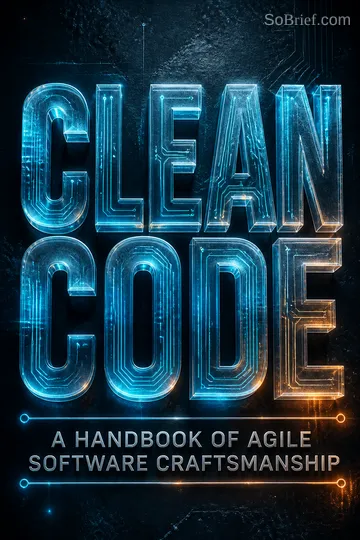
Clean Code is highly regarded as an essential read for software developers, offering valuable insights on writing readable and maintainable code. While praised for its practical advice on naming conventions, function design, and testing, some readers found it overly Java-centric and occasionally extreme in its recommendations. The book's case studies received mixed reactions, with some finding them helpful and others less impressed. Despite its flaws, many developers consider it a must-read that has significantly improved their coding practices and understanding of software craftsmanship.
People Also Read





Glossary
Single Responsibility Principle
one main reason to changeA class or module should have one principal responsibility, meaning one main reason it would need to change. The principle encourages grouping behavior that changes for the same reason and separating behavior likely to evolve independently. It is a guide to cohesion and change management, not a demand that every class contain only one method.
Law of Demeter
limit knowledge of collaboratorsA method should communicate with objects it directly owns, creates, receives, or is closely associated with, rather than navigating through chains of other objects. The aim is to reduce knowledge of internal structure. Instead of reaching through several objects to obtain a detail, a caller asks a collaborator to perform the needed operation.
Dependency Injection
supply dependencies from outsideA design technique in which an object receives the services or collaborators it needs rather than constructing or locating them itself. A constructor, setter, or container supplies those dependencies during setup. This separates object construction from application behavior and makes implementations easier to replace, configure, and test.
F.I.R.S.T.
qualities of dependable testsA mnemonic for five traits of clean tests: fast, independent, repeatable, self-validating, and timely. Fast tests are run often; independent tests do not rely on execution order; repeatable tests work across environments; self-validating tests clearly pass or fail; timely tests are written close to the production code they exercise.
SPECIAL CASE PATTERN
represent an exception as normal dataA design technique that supplies an object with sensible behavior for an unusual but expected condition. Client code then uses the same operation without repeatedly checking for the special condition. The book's example is an expense object that returns a per-diem amount when no meal expenses exist, keeping that rule out of the caller's main calculation.
Learning tests
tests that explore an external APISmall, focused tests written to discover and record how a third-party package behaves. They serve as controlled experiments while developers learn an unfamiliar interface, and they can be rerun after an upgrade to reveal incompatible changes. They test the team's understanding and intended use of the dependency, rather than attempting to verify its entire implementation.
Simple Design
design refined through four prioritiesA design approach presented as an ordered set of priorities: ensure the system passes its tests, remove duplication, express the programmer's intent clearly, and avoid unnecessary classes and methods. The sequence matters. Tests and clarity take priority over minimizing the number of program elements, while refactoring helps the design emerge through small verified changes.
FAQ
What's Clean Code: A Handbook of Agile Software Craftsmanship about?
- Focus on Software Craftsmanship: The book emphasizes the importance of writing clean, maintainable code as a hallmark of professionalism in software development.
- Principles and Practices: It outlines various principles, patterns, and practices that help programmers write code that is not only functional but also easy to read and understand.
- Real-World Examples: Numerous examples of both good and bad code are included, demonstrating how to transform messy code into clean code through refactoring and disciplined practices.
Why should I read Clean Code by Robert C. Martin?
- Improve Coding Skills: Reading the book can significantly enhance your programming skills by teaching you how to write code that is easier to maintain and understand.
- Professional Development: It is a valuable resource for anyone looking to advance their career in software development, instilling a mindset of craftsmanship and quality.
- Practical Advice: The book provides practical advice that can be applied immediately in your coding practices, making it a useful guide for both novice and experienced programmers.
What are the key takeaways of Clean Code?
- Meaningful Names: The book stresses the importance of using intention-revealing names for variables, functions, and classes to enhance code readability and maintainability.
- Small Functions: Functions should be small and focused on a single task, adhering to the principle of "Do One Thing" to improve clarity and reduce complexity.
- Error Handling: Martin advocates for using exceptions rather than return codes for error handling, which helps keep the main logic of the code clean and unobscured.
What are the best quotes from Clean Code and what do they mean?
- "Clean code is a matter of discipline.": This quote emphasizes that writing clean code requires consistent effort and adherence to best practices, rather than relying on luck or talent alone.
- "Comments do not make up for bad code.": This highlights the idea that if code is poorly written, no amount of commenting can compensate for its lack of clarity and structure.
- "Leave the campground cleaner than you found it.": This metaphor encourages developers to improve the codebase with every change, ensuring that the code remains clean and maintainable over time.
How does Clean Code define clean code?
- Readable and Understandable: Clean code is defined as code that is easy to read and understand, allowing other developers to quickly grasp its purpose and functionality.
- Minimal Complexity: It should have minimal complexity, with each function and class focused on a single responsibility, making it easier to test and maintain.
- Well-Structured: Clean code is well-structured, following consistent formatting and naming conventions that enhance its clarity and reduce the cognitive load on the reader.
What is the Boy Scout Rule in Clean Code?
- Continuous Improvement: The Boy Scout Rule states that developers should "leave the campground cleaner than you found it," meaning that every time you work on code, you should strive to improve it.
- Small Changes Matter: This can be as simple as renaming a variable for clarity or refactoring a small function, which contributes to the overall cleanliness of the codebase.
- Professional Responsibility: Adhering to this rule reflects a professional attitude towards code quality and maintenance, fostering a culture of continuous improvement within a team.
What is the Single Responsibility Principle (SRP) in Clean Code?
- Definition of SRP: The SRP states that "a class should have one, and only one, reason to change." This means that each class should focus on a single responsibility or functionality.
- Benefits of SRP: Adhering to SRP leads to better organization of code, making it easier to understand, test, and maintain. It reduces the risk of changes in one area affecting unrelated parts of the code.
- Implementation Guidance: Martin provides practical advice on how to identify responsibilities and refactor classes to adhere to SRP, ensuring that code remains clean and manageable.
How does Clean Code address error handling?
- Use Exceptions: The book advocates for using exceptions rather than return codes for error handling, which helps keep the main logic of the code clean and unobscured.
- Separation of Concerns: Error handling should be separated from the main logic of the code, allowing developers to focus on the primary functionality without being bogged down by error-checking clutter.
- Provide Context: Exceptions should provide enough context to understand the source and nature of the error, making it easier to diagnose and fix issues when they arise.
What role does testing play in Clean Code?
- Foundation of Clean Code: Testing is considered a fundamental discipline in writing clean code. It ensures that the code behaves as expected and helps catch issues early in the development process.
- Fast and Reliable Tests: The book emphasizes that tests should be fast and reliable to encourage frequent execution. This helps maintain a clean codebase and reduces the risk of introducing bugs.
- Self-Validating Tests: Tests should be designed to be self-validating, meaning they should clearly indicate whether the code is functioning correctly. This reduces ambiguity and increases confidence in the code.
How does Clean Code suggest handling dependencies?
- Dependency Inversion Principle (DIP): The book explains that "high-level modules should not depend on low-level modules. Both should depend on abstractions." This principle encourages the use of interfaces and abstract classes to reduce coupling.
- Use of Dependency Injection: Martin recommends using dependency injection to manage dependencies, allowing for more flexible and testable code. This approach decouples the creation of dependencies from their usage.
- Benefits of Managing Dependencies: By managing dependencies effectively, developers can create systems that are easier to maintain and extend, leading to cleaner and more robust code.
What are some common code smells identified in Clean Code?
- Duplicated Code: This is a major code smell that indicates a lack of abstraction. The book advises eliminating duplication to improve maintainability and reduce errors.
- Long Methods: Methods that are too long can be difficult to understand and maintain. The book suggests breaking them down into smaller, more manageable functions.
- Excessive Comments: While comments can be helpful, excessive or redundant comments often indicate that the code itself is not clear. The goal should be to write self-explanatory code that requires minimal comments.
How can I apply the principles from Clean Code in my own projects?
- Start with Small Changes: Begin by applying the principles of clean code to small sections of your codebase. Refactor one class or function at a time to improve readability and maintainability.
- Write Tests First: Adopt Test-Driven Development (TDD) practices by writing tests before implementing new features. This ensures that your code is always covered by tests and helps maintain quality.
- Regularly Refactor: Make refactoring a regular part of your development process. Continuously look for opportunities to improve code structure and eliminate duplication, keeping your codebase clean and efficient.
About the Author
Download PDF
Download EPUB
.epub digital book format is ideal for reading ebooks on phones, tablets, and e-readers.








