

Key Takeaways
Treat expertise as a skill-specific climb, not a personality label
Skill changes perception. The Dreyfus model describes a progression from novice, who needs clear rules, through advanced beginner and competent practitioner, to proficient and expert. The climb is specific to a skill: someone may be an expert programmer and a novice cook. Progress means more than collecting facts. Practitioners learn to interpret context, choose what matters, and recognize patterns without consciously listing every step.
Experience must change you. Repeating the same year of work does not equal a decade of learning. Research on fields from chess to music suggests that expertise takes sustained, challenging practice, with useful feedback and chances to correct errors. The Beatles, for instance, had years of club performance before their celebrated breakthrough.
What's useful here is the separation of expertise from identity. A person is not simply an expert or a novice; competence depends on the task, the conditions, and the feedback available. That makes the model a practical coaching tool rather than a ranking of human worth. Its stages are best treated as a map, not a diagnostic instrument: people can show expert judgment in familiar situations and revert to rule-following when the context changes. The decade-of-practice idea also needs care. Time alone does not create mastery; access to coaching, feedback, and meaningful practice matters.
Match rules to skill: recipes help beginners, but constrain experts
Rules are useful scaffolding. A novice benefits from explicit instructions because there is not yet enough experience to judge which details matter. An advanced beginner can handle familiar cases but may miss the larger picture. Competent practitioners can troubleshoot; proficient practitioners can reflect and adjust; experts recognize patterns in context and often act intuitively.
One policy cannot fit all. In a study described by the book, experienced pilots performed worse when required to follow rules they had created for novices. The parallel at work is clear: rigid processes may support newcomers while limiting experienced people. Conversely, throwing novices into ambiguous work without guidance sets them up to fail. Teams need both clear entry points and room for judgment.
The strongest implication is organizational: process should help people grow, not flatten every role into the same checklist. Safety-critical work shows why rules still matter, even for experts. Checklists can prevent omissions, while judgment handles conditions the checklist cannot anticipate. The productive question is not whether rules or intuition are better, but which decisions should be standardized and which require discretion. Teams also need to avoid treating experts as automatic teachers. Deep tacit knowledge can be difficult to explain, so a capable intermediate practitioner may sometimes be the better mentor.
Let intuition propose, then use evidence to decide
Two styles cooperate. The book calls deliberate, verbal, step-by-step thought L-mode, and holistic, often nonverbal pattern recognition R-mode. These are presented as a thinking model, not literal independent processors. Experts draw on accumulated experience to notice a meaningful pattern before they can explain it. That can produce a strong hunch, but a hunch can also reflect bias or a misleading resemblance.
Turn hunches into tests. A developer might sense that one design is simpler or more robust. Rather than accept the feeling as proof, build a small prototype, write tests, or compare performance. The sequence matters: intuition can generate possibilities, while analysis and feedback help evaluate them. Capturing an idea when it arrives also matters, since useful connections may surface away from the desk.
This is a valuable middle ground between worshipping data and romanticizing gut instinct. Research on expert decision-making often finds rapid recognition in domains where people have repeated exposure and receive reliable feedback. The same intuition is less dependable in unstable settings where patterns shift or feedback is delayed. The book's L-mode and R-mode labels help readers notice different kinds of thought, but contemporary neuroscience describes cognition as more distributed and interactive than a two-part computer analogy suggests. The practical lesson survives the simplification: generate freely, then check carefully.
Schedule learning as work, not as whatever time remains
Make learning concrete. The book recommends turning broad ambitions into SMART objectives: specific, measurable, achievable, relevant, and time-boxed. Instead of hoping to learn a language, define a small capability to demonstrate by a chosen date. Its Pragmatic Investment Plan treats knowledge like a portfolio: make a plan, diversify what you study, reassess progress, and invest regularly rather than waiting for spare time.
Practice retrieval. Reading again can feel productive without proving what has stuck. The SQ3R method prompts a learner to survey a text, form questions, read, recall its ideas in their own words, and review. Writing a small program, explaining a concept to a colleague, or teaching a topic forces retrieval and exposes gaps. A single intensive training course cannot replace repeated use and feedback.
The shift from attendance to demonstrated capability is especially important in technical work, where tools change faster than course catalogs. Retrieval practice is also a robust learning principle: recalling an idea strengthens access to it more than repeatedly seeing the same page. Still, plans should remain revisable. A rigid objective can preserve yesterday's priorities after the work has changed. The book's portfolio metaphor helps balance depth with exploration, but a learning plan earns its value through periodic review, not merely through being written down.
Invite insight with play before demanding a polished answer
Explore before explaining. The book argues that people often learn more readily by handling a problem than by receiving a lecture first. During an introductory rock-climbing lesson, participants tried the wall before hearing formal instruction; the brief experience gave the later explanations a place to land. Similarly, children using the Logo programming language learned mathematical ideas by directing a virtual turtle and observing what happened.
Give thought more routes. Sketching, building a rough model, acting out a system, taking a walk, or writing freely can surface relationships that verbal analysis misses. The sewing-machine inventor Elias Howe reportedly connected a dream image of a spear with a hole near its tip to a better needle design. The story illustrates how an idea can arrive in an image before it becomes a reasoned explanation.
Play here means purposeful exploration without demanding an immediate answer, not simply entertainment. It resembles divergent thinking: first create and test a wider set of possibilities, then evaluate them. Physical models and sketches can make relationships visible to a whole group, especially when participants have different ways of expressing ideas. Multisensory activity is not automatically superior, however. It helps when the added activity clarifies the material, not when decoration competes with it. The useful test is whether the playful method reveals something that a discussion alone would have missed.
Make practice safe enough for errors to teach you
Build a safety net. Seymour Papert's Logo exercises let learners experiment, make mistakes, and inspect what the turtle did. The book argues that this cycle is more instructive than memorizing rules before attempting the task. In software, version control, automated tests, and repeatable builds make experiments easier to reverse and compare. The same principle applies to any learning project: create a setting where trying an alternative does not create disproportionate harm.
Notice before correcting. In an Inner Game tennis exercise, a beginner first watched the ball and attended to its timing rather than trying to memorize a string of instructions. The learner improved by noticing what happened and adjusting. For debugging, that means observing the failure carefully before rushing to change code. Mental rehearsal can also prepare a person for performance, but it complements real practice rather than replacing it.
The core mechanism is a short feedback loop: act, observe, adjust. Psychological safety in teams supports this kind of learning because people are more willing to report errors and test ideas when the cost of being wrong is not humiliation. Safety is not permission to be careless. In surgery, aviation, and production systems, experimentation belongs in simulations, prototypes, and controlled releases. The distinction is between making failure informative and making its consequences acceptable. A strong practice environment does both.
Audit certainty: your brain confuses confidence, familiarity, and truth
Thinking has predictable traps. The book names anchoring, confirmation bias, the preference for familiar methods, and the urge to close uncertain questions too early. It also warns that people often explain another person's actions as personality while excusing their own through circumstances. Labels can create the feeling of understanding without explaining a behavior.
Add a reality check. Ask what evidence supports a confident belief, what would count against it, and whether a colleague with a different perspective sees the same thing. The book also draws on the black-swan idea: rare events are not impossible, and simplified models can conceal consequential surprises. Keep notes rather than relying on memory, which can change as current beliefs reshape recollection. Intuition deserves attention, but it should be tested against observable results.
The section's practical strength is its demand for competing explanations. A team can use a pre-mortem, asking how a project might fail before it begins, to make hidden assumptions discussable. However, knowing the names of biases does not immunize anyone from them. Broad warnings about generational types or personality categories can themselves become shortcuts that stereotype colleagues. Such frameworks are most useful as prompts to ask better questions, not as labels that explain people in advance. Evidence, context, and direct conversation remain stronger than a typology.
Protect focus by treating every interruption as a context reset
Attention has a narrow budget. Switching from a difficult task to an unrelated message does not simply consume the message's duration. The book reports estimates that multitasking can reduce productivity by 20 to 40 percent, and that returning to a complex task may take about twenty minutes. The exact cost varies, but the mechanism is familiar: the worker must reconstruct the problem, the relevant details, and the next step.
Design for concentration. Agree on interruption rules with a team, silence nonessential alerts, and check email at planned times. If an interruption cannot be avoided, leave a brief note about the current state and next action. Meditation is offered as practice in noticing distraction and returning attention, while task-based workspaces and a larger visible work area reduce needless switching.
The important reframing is that focus is not solely a matter of personal discipline. Notification systems, meeting norms, and open-office expectations shape the attention available to do difficult work. Organizations that demand constant responsiveness should not be surprised when complex work slows down. The book's specific switching costs are useful as warnings, though they should not be treated as universal measurements: task complexity and interruption type matter. A practical experiment is to protect one predictable block of uninterrupted work and compare the quality of output, not just the number of hours spent.
Put ideas in an external system, then connect them
Give memory a partner. The book calls an external store of notes and tools an exocortex: support for remembering and developing ideas beyond the biological brain. A pocket notebook, personal wiki, or searchable note system can capture insights before they disappear. A wiki's links let one thought connect to several topics, unlike a strict folder structure. Revisiting and reorganizing notes helps reveal relationships that were not obvious when each fact first appeared.
Writing is part of thinking. The author distinguishes useful documentation from documents produced merely to satisfy a process. Sketching a mind map, rewriting rough notes, or making a short screencast can clarify the material for the creator as well as communicate it to others. The point is not to preserve every thought forever, but to create a dependable place where promising ideas can be found and refined.
This is an early, practical version of distributed cognition: people routinely think with notebooks, diagrams, search tools, and colleagues, not with unaided memory alone. External records reduce the burden of recall and make connections inspectable. Yet capture can turn into accumulation. A system becomes useful only when ideas can be retrieved, revised, and discarded. The book's emphasis on linking notes addresses this risk better than a pile of isolated files, but even a wiki needs periodic gardening. The goal is a working model of one's thinking, not a museum of unfinished thoughts.
Keep expert eyes curious by looking at familiar work anew
Habits can obscure change. Repeated practice makes useful responses easier, but old patterns do not simply vanish when a better approach is learned. Under pressure, people can fall back on the familiar. The book recommends small next steps, regular review, and tracking progress rather than expecting a dramatic overnight transformation.
Expertise needs openness. The closing challenge is to retain curiosity after becoming skilled. An expert who dismisses unfamiliar tools or methods to protect a hard-won identity may stop learning. The book's example is the practitioner who masters one programming language so thoroughly that a more suitable newcomer is rejected without serious evaluation. Pay attention to what is actually happening, ask what could be different, and judge new approaches in their context.
This is a useful corrective to the idea that mastery ends in certainty. Expertise is strongest when it combines fast recognition with the willingness to notice disconfirming evidence. That resembles scientific practice: established knowledge guides inquiry, but claims remain open to revision when observations change. Curiosity alone is not enough, since novelty can be mistaken for progress. The disciplined version is to test new methods against real needs while preserving what already works. A beginner's outlook is valuable not because it forgets experience, but because it refuses to let experience become an excuse for not looking.
Analysis
The book's central argument is that professional performance depends less on accumulating technical facts than on improving the learner who uses them. Its narrative moves from a model of expertise, through a portrait of thinking and bias, into concrete learning practices, and finally toward the management of attention and change. The most valuable thread is the insistence that context determines whether a rule helps or hinders. Novices need structure; experienced practitioners need discretion, feedback, and meaningful responsibility. Learning, in turn, is not a one-time transfer of information. It is a cycle of exploration, practice, reflection, and application.
The work is strongest when it translates cognitive ideas into experiments: try before formal instruction, capture unexpected insights, teach to test understanding, observe before correcting, and protect uninterrupted work. Its programming examples make abstract claims tangible, while its stories from nursing, music, aviation, and sport suggest that the same problems recur across professions.
Some of its explanatory neuroscience should be read as metaphor rather than settled architecture. The book's L-mode and R-mode vocabulary is an accessible way to contrast analytical and holistic thought, but contemporary research does not support a simple division of complex cognition into separate left and right brain personalities. Likewise, its discussion of learning preferences and generational traits is more persuasive as a prompt to accommodate difference than as a predictive classification. The strongest claims are therefore not that a particular mental model perfectly describes the brain, but that varied practice, timely feedback, external notes, and reduced distraction improve the conditions for learning.
For today's knowledge worker, the book's enduring practical challenge is to treat attention and learning as work that must be designed. Expertise grows when feedback is close, experimentation is safe, and one's own confidence remains testable. The goal is neither rigid procedure nor unexamined intuition, but a practitioner who can move between them as the situation demands.
Review Summary
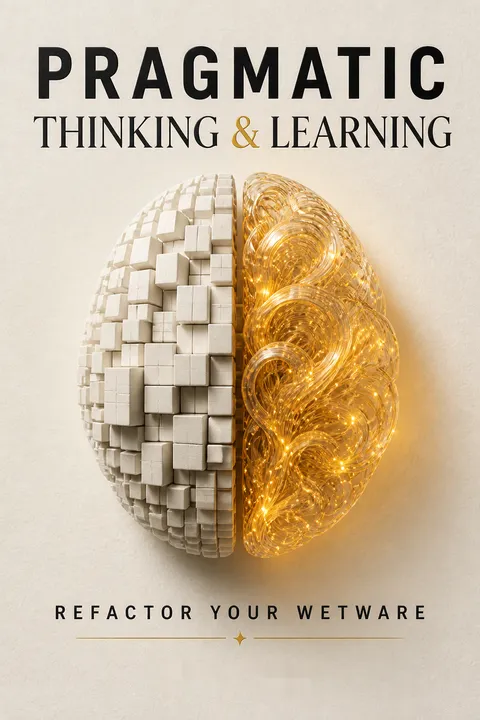
Pragmatic Thinking and Learning is highly praised for its practical advice on improving cognitive skills and learning techniques. Readers appreciate the book's blend of cognitive science, psychology, and programming concepts. Many find it transformative, offering valuable insights into brain function, focus management, and skill acquisition. The Dreyfus model and tips on deliberate learning are frequently highlighted. While some criticize its simplistic style or outdated references, most reviewers recommend it for programmers and knowledge workers seeking to enhance their mental capabilities and problem-solving skills.
People Also Read










Glossary
Dreyfus model
Stages of skill developmentA model describing five stages of skill acquisition: novice, advanced beginner, competent, proficient, and expert. It applies to a particular skill rather than rating a whole person. As practitioners gain experience, they move from relying on context-free rules toward recognizing patterns, interpreting context, and making increasingly intuitive judgments.
L-mode and R-mode
Two styles of thoughtThe book's labels for contrasting cognitive styles. L-mode refers to deliberate, verbal, sequential, and analytical processing. R-mode refers to holistic, often nonverbal processing associated with imagery, pattern recognition, and intuition. The author presents these as a useful analogy for thinking, not as two literal independent processors or a strict division between brain hemispheres.
Pragmatic Investment Plan
A plan for learning investmentsA method for managing professional knowledge as a portfolio. It asks learners to set concrete goals, diversify what they study, actively review whether their choices remain useful, and invest time regularly. The plan is meant to make learning deliberate rather than dependent on spare time, while allowing goals to change as circumstances and opportunities change.
SQ3R
A deliberate reading sequenceA study method whose name represents Survey, Question, Read, Recite, and Review. The learner first previews material, then identifies questions, reads with those questions in mind, recalls and restates the main ideas, and reviews the material and notes. Its purpose is to replace passive reading with structured attention and active retrieval.
SMART objectives
Measurable steps toward goalsObjectives designed to be specific, measurable, achievable, relevant, and time-boxed. They translate an attractive but vague goal into manageable actions with evidence of completion and a deadline. In the book, SMART objectives support ongoing learning by clarifying what a person intends to be able to do, rather than merely naming a subject to study.
exocortex
External support for thinkingThe author's term for memory and processing support that resides outside the brain, such as notebooks, books, personal wikis, and digital tools. These resources help capture, organize, retrieve, and connect ideas that would be difficult to maintain in memory alone. They are most useful when information can be revisited and developed, not merely stored.
Inner Game
Awareness-led skill practiceA family of learning approaches that reduces distracting self-instruction and emphasizes attention to what is happening during performance. Learners observe relevant feedback, such as the timing and sound of a tennis stroke, then adjust through experience. The method favors awareness and discovery over a flood of verbal corrections.
second-order incompetence
Not knowing what you lackA failure of self-assessment in which a person lacks the skill needed to recognize their own errors or limitations. The book connects this idea to overconfidence among less-skilled practitioners. Improving the underlying skill can also improve the ability to judge one's performance, making honest feedback and practice important routes to better calibration.
FAQ
What's Pragmatic Thinking and Learning about?
- Cognitive Science Focus: The book delves into cognitive science, neuroscience, and learning theories to improve thinking and learning skills.
- Refactoring Wetware: It humorously refers to the brain as "wetware," suggesting that mental processes can be optimized like software.
- Broad Audience: While targeted at programmers, its insights are applicable to anyone seeking to enhance problem-solving and learning abilities.
Why should I read Pragmatic Thinking and Learning?
- Enhance Learning Skills: Offers practical techniques to improve learning and adaptability to new challenges.
- Real-World Applications: Emphasizes the importance of context in learning, crucial for success in any field.
- Expert Insights: Authored by Andy Hunt, it draws on extensive research and personal experience for valuable advice.
What are the key takeaways of Pragmatic Thinking and Learning?
- Active Learning: Learning should be an active process, engaging with material through exploration and practice.
- Embrace Mistakes: Mistakes are valuable learning opportunities, essential for growth and improvement.
- Diversity in Learning: Embracing diverse perspectives enhances creativity and problem-solving abilities.
What is the Dreyfus Model of Skill Acquisition in Pragmatic Thinking and Learning?
- Five Stages: The model outlines stages from novice to expert, each representing different skill levels.
- Contextual Learning: Progressing through stages involves applying knowledge in context, crucial for expertise.
- Practical Application: Helps individuals recognize their current skill level and what they need to advance.
How does Pragmatic Thinking and Learning define "wetware"?
- Brain Analogy: "Wetware" humorously refers to the human brain and its cognitive processes.
- Refactoring Mental Processes: Suggests that thinking and learning processes can be improved through practice.
- Focus on Improvement: Encourages active work on mental processes to enhance problem-solving and learning.
What are some techniques for enhancing learning mentioned in Pragmatic Thinking and Learning?
- Mind Mapping: Visualizes relationships between concepts, aiding understanding and memory.
- SQ3R Method: A reading strategy promoting active engagement for better retention.
- Deliberate Practice: Focused, intentional practice is emphasized for skill development.
How can I manage focus and attention according to Pragmatic Thinking and Learning?
- Increase Focus: Techniques like setting goals and minimizing distractions enhance concentration.
- Defocus to Focus: Allowing the mind to wander can lead to creative insights and solutions.
- Manage Interruptions: Creating a conducive environment for work improves focus significantly.
What cognitive biases should I be aware of according to Pragmatic Thinking and Learning?
- Anchoring Bias: Initial information unduly influences subsequent judgments and decisions.
- Confirmation Bias: Tendency to seek information that confirms preconceptions, leading to flawed decisions.
- Self-Serving Bias: Attributing successes to oneself and failures to external factors distorts self-assessment.
How does Pragmatic Thinking and Learning suggest I harvest insights from my R-mode?
- Image Streaming: Verbalizing mental images taps into the subconscious for insights.
- Free-Form Journaling: Writing without censorship clarifies thoughts and surfaces hidden ideas.
- Walking and Reflection: Physical activity like walking frees the mind to explore ideas.
What are some effective ways to integrate L-mode and R-mode thinking in Pragmatic Thinking and Learning?
- R-mode to L-mode Flow: Start with R-mode activities for idea generation, then transition to L-mode for analysis.
- Pair Programming: Collaborating integrates different cognitive styles, enhancing problem-solving.
- Use of Metaphors: Metaphors bridge abstract concepts and concrete understanding, facilitating insight.
How does Pragmatic Thinking and Learning address the concept of failure?
- Failure as Learning: Frames failure as essential for learning, providing valuable feedback.
- Safe Environment: Emphasizes creating an environment where failure is accepted as a learning opportunity.
- Resilience Building: Coping with failure builds resilience and adaptability, encouraging experimentation.
How can I apply the concepts from Pragmatic Thinking and Learning in my daily life?
- Implement Learning Techniques: Use mind maps and SMART goals for organizing thoughts and tracking progress.
- Practice Mindfulness: Incorporate meditation to enhance focus and reduce stress.
- Embrace Mistakes: View failure as a learning opportunity, reflecting on mistakes for future improvement.
Download PDF
Download EPUB
.epub digital book format is ideal for reading ebooks on phones, tablets, and e-readers.








