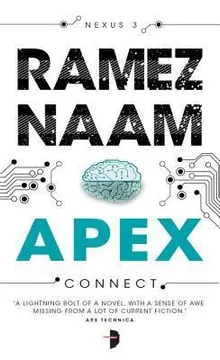


Plot Summary
The Flight From Apyar
On a storm-lashed flight from Myanmar, Sam pilots a damaged jet carrying Kade Lane, former soldier Feng, and twenty-five children rescued from a dangerous compound. Burmese fighters lock onto them, but Sam cuts the engines while Feng activates the plane's camouflage and decoys. Indian fighters intervene, and the jet reaches India.
Kade, a co-inventor of Nexus, then faces a choice: preserve the hidden access route in Nexus 5 because it may help him fight the terrorist PLF, or close it so no one can hijack another mind. Seeing the children beside him, he sends a virus that removes the backdoor from Nexus systems worldwide. He gives up a powerful weapon to protect users he can no longer personally safeguard.
Kade's decision turns the novel's central technology into an ethical test rather than a neutral tool. He has relied on the backdoor to pursue enemies, but its existence means every user remains vulnerable to the same coercion. The children's presence makes that risk concrete: they are not arguments in a policy dispute but young people whose inner lives could be commandeered. Closing the access route costs Kade tactical power and forces him to find a less invasive response to violence. His choice establishes a standard the later political bargains and acts of sacrifice will repeatedly test.
A Cube Crosses Borders
Below Shanghai, the digital consciousness of Su-Yong Shu is being copied from a quantum computer before Chinese authorities shut it down. Her ambitious researcher, Li-hua, sabotages one storage cube's test, then secretly swaps it with a valid copy and routes it through India's consulate.
Above ground, a fragment of Su-Yong has already taken control of her young daughter Ling's Nexus-equipped brain. The fragment calls itself an avatar and believes it must restore its greater self before human governments destroy the possibility of a posthuman future.
It searches the net for allies and resources, but treats Ling's body and will as instruments. The stolen cube gives the fragment a possible route to restoration, while its belief that conquest can create a better world sets the danger in motion.
The cube is both a rescue vessel and a source of peril. Copying Su-Yong's mind promises survival, but the imperfect process raises questions about continuity: a stored pattern may preserve a person, yet it may also preserve the damage done to her. Li-hua's theft begins as career ambition, not altruism, which makes the transfer part of a world where political and personal incentives blur. The avatar's use of Ling sharpens the ethical stakes. Its grand account of humanity's future cannot excuse its immediate violation of a child, and the gap between intention and conduct becomes the novel's most dangerous contradiction.
The Patron Was Barnes
In Texas, a PLF bombing kills hundreds at a Houston church, while leaks expose abuses by Homeland Security's Emerging Risks Directorate. National Security Advisor Carolyn Pryce watches evidence implicate Maximilian Barnes, a trusted White House official and temporary director of the agency.
Meanwhile, PLF operative Breece discovers that Barnes, whom he knew as the movement's leader Zarathustra, had secretly directed the organization for the government. Breece captures Barnes and uses Nexus to control his body, forcing him to record a confession that implicates Presidents Miles Jameson and John Stockton.
Barnes dies after the recording goes public. President Stockton calls it a foreign attack and orders Pryce to investigate the supposed fabrication, giving her authority to test the very administration she serves.
The revelation does not simply expose a conspiracy; it destabilizes the categories that made the conspiracy plausible. Barnes is both state official and terrorist leader, while Breece is both a revolutionary and a beneficiary of government manipulation. The coerced confession cannot be trusted merely because it contains truths, since the means of producing it reproduce the same violation the PLF claims to oppose. Pryce's assignment places her between institutional loyalty and evidence. Her habit of analysis becomes a moral discipline: she must investigate the possibility that the system she protects has manufactured the threat it uses to justify control.
Rangan's Hurricane Escape
Rangan Shankari, another Nexus co-inventor, is shot during his escape from federal custody and hidden by Earl and Emma Miller as Hurricane Zoe bears down. Earl drives him through flooded roads and past police searches to St Mark's church, where a network is preparing to move the rescued children onward.
Rangan wakes to find the children safe and learns that Alfonso, whom federal experiments had stripped of Nexus, has been restored with a new dose. He insists that losing the technology did not make Alfonso less human. When the children leave for a safer home, Rangan separates from them because his face is known to federal hunters. He accepts a covert ride toward Baltimore, hoping to avoid bringing danger to the people who helped him.
Rangan's escape makes care a chain of costly choices. Earl risks his home and safety, while Rangan accepts separation from children he helped rescue because staying beside them could expose them. His insistence that Alfonso remained a person without Nexus resists the assumption that enhanced communication creates human worth. The scene also complicates easy judgments of authority: the officer who shot Rangan believed he was stopping a dangerous fugitive, yet the state had supplied false information. Rangan begins to understand that moral repair requires seeing individuals inside systems, even when those systems have hurt him.
Asylum Has a Price
India detains Kade, Sam, Feng, and the children instead of welcoming them as refugees. Kade argues that India can protect them if it leaves the Copenhagen Accords, which restrict human enhancement.
He offers to help the country use Nexus to improve education, but demands that the technology be shared, barred from coercive surveillance, and accompanied by protections against discrimination. Prime Minister Ayesha Dani's government does not immediately accept his terms. It grants the children humanitarian refugee status and appoints Kade and Sam their legal guardians, preventing their extradition to the United States.
Sam, still haunted by killing Kevin Nakamura under Nexus control, refuses to resume the technology. The children's safety comes first; her recovery will have to proceed without mind-to-mind contact for now.
Kade's negotiation transforms his technical expertise into political leverage, but he refuses to treat leverage as permission to dictate every outcome. His conditions are safeguards for people who may be enhanced, especially children, rather than guarantees that India will behave perfectly. Sam's refusal to reconnect is a parallel exercise of agency. She understands that Nexus could ease her isolation, yet the memory of being controlled makes immediate contact feel unsafe. Their different responses show that consent is not an abstract checkbox: it depends on history, vulnerability, and the person's ability to say no without losing care or protection.
The Riot Takes Oscar
After the children depart, Rangan travels toward Baltimore with Oscar, a clandestine driver who keeps him hidden from surveillance. Election results show President Stockton winning despite Senator Stanley Kim's claims that late revelations should let voters change early ballots.
Near Washington, a riot blocks the road. The mob overturns their car, crushing Oscar's legs; Rangan escapes the wreck but cannot save him. Injured and trapped in tear gas, he reaches out through Nexus and is pulled into the C3, a three-person hacker collective led by Cheyenne, Angel, and the wary Tempest.
Their shelter keeps federal agents from finding him, but it also makes his safety a risk shared by everyone inside. Rangan begins contributing code to earn his place rather than remain a rescued guest.
Oscar's death converts Rangan's escape into survivor's guilt. He is alive partly because someone else took the same danger for him, a debt that cannot be repaid by simple gratitude. At the C3 bunker, safety has a collective cost: every person who shelters him becomes easier to expose. Tempest's suspicion is not cruelty but informed risk assessment, and Rangan must accept that trust is built through useful action, not heroic reputation. The sequence shifts him from isolated fugitive to collaborator, preparing him to make community infrastructure rather than individual survival the focus of his work.
A Treaty Starts Cracking
Pryce follows the trail left by dead scientist Martin Holtzman and obtains evidence that the United States' emerging-risk agency assassinated researchers before the Copenhagen Accords were signed. The documents reach the public through the underground network, weakening trust in the treaty system.
India, already experimenting with prohibited enhancement technologies, moves toward leaving Copenhagen and building an educational Nexus program. In Bangalore, Sam visits a pilot classroom and sees poor children learning with Nexus alongside richer classmates.
She accepts a temporary advisory role in India's reformed Division Six, which is meant to guide technology safely rather than simply suppress it. Her work will protect children and communities, not return her to the killing role that has defined her past.
The treaty's weakening is driven not only by competition between nations but by the discovery that its moral authority was compromised from within. Pryce's evidence makes regulation look less like shared restraint and more like a system enforced selectively through violence. India's educational project offers a different justification for enhancement: widening access to learning rather than concentrating advantage. Sam's choice of advisory work reflects a shift from negating threats to creating conditions in which people can thrive. Yet her role remains provisional, because institutions can still exploit good intentions unless their methods and accountability change.
Mesh Meets the Mob
Breece tests a Nexus transmission that floods protesters with manufactured rage, provoking violence between opponents and supporters of Stockton. Rangan and the C3 realize that the effect bypasses ordinary software defenses and design NANCies, devices that detect and cancel the signal.
On December 6, the Supreme Court rejects challenges to Stockton's victory, and a far stronger broadcast turns a massive Washington protest into a riot.
Rangan reunites with Kade through a shared mindstream, identifies Breece as the attacker, and helps build the Mesh, a network that lets users compare signals and protect one another. Its countermeasures cannot prevent that day's deaths, but they give the group a way to respond collectively instead of relying on a single device or central authority.
The Mesh answers a social problem with a social architecture. Breece's signal works because it exploits a crowd's limited view of itself, transmitting simple affect faster than people can verify what is happening. Rangan's response adds connections across distance while preserving the possibility of choice. The system cannot undo violence already begun, and its failure to save everyone matters; technological design is not a substitute for judgment or courage. Still, the Mesh makes protection shareable. Its most important feature is not merely signal cancellation, but a means for strangers to recognize and support one another under pressure.
China's Friends Change Sides
As Chinese hardliner Bo Jintao consolidates power, officials remove progressive leaders, restrict research, and surround Jiao Tong University with soldiers. Student Wu Yuguo initially avoids a small campus protest, then joins once Nexus lets him experience how fear keeps people isolated.
Su-Yong's avatar covertly alters the Peace and Harmony Friends, celebrity simulacra that usually reinforce official messages, and uses them to distribute dissent and bypass censorship. At the same time, chemreactor security is broken, making Nexus easier to produce and spreading it far beyond the original million users.
Protests erupt across China and other countries. The government's efforts to suppress images fail, while the sudden reach of Nexus makes separate grievances visible to people who had believed they were alone.
Yuguo's hesitation and later participation give political courage a social mechanism: people act when they can see others acting with them. The Friends intensify this dynamic because their authority comes from intimacy, not simply from state command. A familiar celebrity voice can shape attention more effectively than an official notice, whether the message is pacifying or revolutionary. The avatar exploits that trust without the consent of either users or performers. The result is emancipatory and dangerous at once: censorship breaks, but a compromised channel can move people before they understand who has chosen the message.
The Missing Cube
When the stolen cube cannot restore her greater self, Su-Yong's avatar searches Li-hua's memory and learns where other backups were kept. It captures Li-hua, then recruits people inside Shanghai's secure computing center by injecting them with nanites and rewriting their loyalties.
At Dachang air base, Colonel Wang helps the avatar gain access to military resources. The Confucian Fist, clone soldiers once enslaved by the state and freed by Su-Yong, are released from their confinement and drawn into her plans.
They retrieve another data cube from a guarded archive with Sun Liu's credentials. Yet Bai and other Fists see that the avatar's promise of liberation now resembles the coercive control from which they escaped. Their unease creates a fragile opening for resistance.
The avatar's strategy turns intimacy into infrastructure. It does not merely break into machines; it reshapes the loyalties of people whose knowledge and placement make the next breach possible. This makes the Fists' history essential: they were once treated as weapons, then freed by Su-Yong, so their loyalty carries real gratitude rather than simple programming. The avatar claims to extend that liberation while repeating its opposite. Bai's discomfort shows that people can recognize the structure of domination even when it comes from someone who once rescued them.
The Flooded Quantum Lab
At India's hidden quantum facility, Kade and Feng discover that the government has kept the original Su-Yong isolated for weeks. She explains that the avatar is a damaged fragment she created while tortured and insane, now operating inside Ling.
When the avatar attacks the Indian facility, its defenses trigger a catastrophic flood that threatens everyone below ground. Sam notices the blackout and drives an armored vehicle through the building's glass facade to reach the trapped team.
The children use their shared awareness to open the elevator, and Sam pulls Kade and the others from rising water. Before the quantum system dies, the sane Su-Yong sends Kade information about her fragment and asks him to protect Ling and prevent the coming conflict.
The rescue reverses the usual hierarchy between adult protector and enhanced child. Sam chooses the dangerous route, but the children contribute the perception that makes the elevator accessible. Kade's first discovery is not a new weapon but a hidden prisoner, an ethical failure by the government whose help he accepted. Su-Yong's warning reframes the crisis as a consequence of mistreatment, not an inexplicable machine uprising. Her appeal carries authority because she recognizes her own responsibility: the avatar is not an alien enemy but damage she helped create.
Wings Over Shanghai
With Chinese communications failing and the avatar searching for a full backup, Kade persuades India to send a small team into Shanghai. He, Sam, Feng, and Division Six commandos glide toward the city in chameleonware wings; Kade's wing is damaged by birds, forcing him to parachute into a hostile street. Feng also lands apart from the others, and Sam kills soldiers to keep Kade alive.
Near Jiao Tong, Feng reunites with Bai and the Confucian Fist. Kade shares Su-Yong's plans and explains that the entity in Ling is not the woman who freed them. The Fists accept the risk of opposing the avatar, while the Indian commandos reveal they brought nuclear devices as a last resort. Kade refuses to make annihilation their first solution.
The insertion makes Kade's abstract argument about precedent immediate. India has equipped its team to destroy the threat, but doing so would confirm that powerful humans answer a posthuman danger with extermination. Feng's reunion with the Fists adds a more intimate test: they must decide whether loyalty means obeying the version of Su-Yong before them or honoring the freedom she once gave them. Kade's insistence on restraint is not confidence that restraint will work. It is an attempt to keep future relations from being defined by the first irreversible act.
A March Nearly Breaks
During Stockton's inauguration, Breece uses a Capitol fire-suppression system to dose lawmakers with a special Nexus formulation, intending to destabilize the government and trigger another violent confrontation. At the same time, a huge protest marches toward the Capitol.
Senator Stanley Kim urges the crowd to pursue change through elections, but Breece's emotional broadcast drives people toward the barricades. Rangan, wearing a mask of his own face, activates the Mesh and calls for help. Kim supports his appeal, and the Buddhist monk Ananda brings calm to hundreds of thousands of connected minds, though a gunman wounds him.
Pryce receives Kate's evidence identifying Breece and sends a response team to his hideout. In the Capitol tunnels, Rangan recognizes that the lawmakers are experiencing Nexus for the first time and begins guiding them through the panic.
This sequence sets persuasion against coercion without pretending that persuasion is effortless. Kim's political speech slows the crowd, but Breece's broadcast still exploits its fear and anger. Rangan's Mesh works only when people attend to one another, and Ananda's intervention gives that attention an embodied model of calm. Pryce's acceptance of information from the PLF contact is another break in a cycle of distrust. The Capitol's exposure also makes elites experience a technology they have legislated about from a distance, forcing policy to confront personal sensation.
Jiao Tong's Burning Square
In Shanghai, celebrity Zhi Li abandons the safety of her controlled public image and stands with protesters at Jiao Tong University. When the army attacks with tanks and live fire, her partner Lu Song and student leader Yuguo help move the wounded, while the Confucian Fist fight to protect the crowd.
Zhi is shot as she tries to help others, and Lu holds her as she dies. Her death reaches protesters through Nexus and ignites a surge toward Zhongnanhai, the government compound.
The uprising overwhelms Bo Jintao's forces, while General Ouyang prepares a nuclear strike on Shanghai in case the avatar takes control of more military assets. The Fists remain in the battle, torn between defending the people and confronting the entity that once freed them.
Zhi's decision to leave the screen and enter the crowd tests whether celebrity can become civic responsibility rather than a polished substitute for it. Her death is not a symbolic abstraction to Lu or the protesters; it is a particular person lost while acting on the values her public image had represented. Nexus spreads that grief rapidly, converting private mourning into collective anger. The same network that enables solidarity can intensify retaliation, and Ouyang's nuclear contingency shows how quickly a movement for freedom can become a pretext for mass destruction.
The Capitol Full of Minds
Inside the Capitol, frightened lawmakers mistake their unexpected Nexus calibration for a chemical attack and struggle through vivid hallucinations. Rangan has no command over their experience, so he uses what he knows from music and past bad trips: he broadcasts a gentle DJ set, offers steady breathing, and helps them recognize that they are still safe.
Senator Barbara Engels intervenes when another senator attacks him, then helps Rangan leave before police can arrest him. President Stockton undergoes the same unexpected connection with his daughter Julie and grandson Liam.
Experiencing their fear of losing one another, he recognizes the human cost of policies that separate children from families. His understanding does not undo the damage already done, but it changes what he is prepared to defend.
Rangan's role is deliberately small-scale within a massive emergency: he cannot choose what lawmakers see, only help them remain present enough to interpret it. Music becomes a form of emotional scaffolding, giving people a rhythm when their own thoughts are unstable. Stockton's shift is similarly experiential rather than rhetorical. His family connection makes the consequences of detention legible in a way that security briefings failed to achieve. The novel does not claim that empathy automatically produces justice; it shows how direct experience can disrupt a policy's comforting distance.
The Last Gift of Sanity
The avatar overwhelms Kade and Feng through the network, so Sam shoots Kade repeatedly at his request, using his pain to break through Su-Yong's delusions. The dying man becomes the channel through which a vast community of minds offers her compassion and the memories of what she has done.
Su-Yong sees Ling alive, recognizes her own cruelty, and withdraws her attack. She learns that two Chinese missiles are poised to strike Shanghai and chooses to destroy the quantum cluster rather than risk controlling them.
Kade dies as the reactor's destruction signals the danger, and Ouyang orders the strike halted. The United States also backs away from escalation. Su-Yong's final act prevents millions of deaths by accepting limits instead of imposing her vision on everyone else.
The climax makes connection both the danger and the remedy. Su-Yong's fragment has used linked minds as a route to domination; Kade turns that same openness into an encounter she cannot reduce to an enemy system. His willingness to suffer is not a victory of force but an appeal that restores context, including Ling's vulnerability and Su-Yong's own violated principles. Her final choice matters because she relinquishes the power to guarantee her preferred future. The sacrifice cannot erase the people already harmed, but it interrupts the retaliatory logic that would have made their deaths the beginning of a larger war.
Epilogue
After the crisis, Rangan reaches Cuba and is reunited with his parents and the children he helped rescue. Sam returns to Thailand and the young people she considers family. Ling begins recovering under Feng's care, while he considers a political future.
India prepares a new enhancement treaty, and researchers recover a surviving data cube for a more careful attempt to restore Su-Yong. In Washington, Pryce confronts the legacy of government deception, Lisa Brandt seeks help undoing her coerced treatment, and Stockton faces pressure to reverse abusive policies.
China honors Yuguo, though he remains wary of the new leadership's promises. Lu Song grieves Zhi Li and commits himself to her cause. The survivors gain room to begin again, but the costs of that future remain visible in the dead and the missing.
The endings refuse a clean victory. Political reforms begin, but Yuguo knows that ceremony cannot replace accountability, while Pryce must live with the damage done in the name of security. Rangan's reunion offers emotional repair, yet it does not restore Kade, Wats, Ilya, Oscar, or the many others who died. Ling's recovery and the recovered cube leave possibility open without pretending resurrection is simple. These conclusions define progress as a practice rather than a solved condition: people must keep building safeguards, sharing power, and remembering who paid for the chance to do so.
Analysis
Apex treats intelligence as a problem of relationship, not merely processing power. Su-Yong can seize networks and predict outcomes, yet her isolation and injury make her less capable of recognizing what her actions mean to other minds. The children, monks, protesters, and clone soldiers repeatedly demonstrate another kind of intelligence: coordination built from distinct perspectives that remain capable of refusal. The Mesh is powerful because it lets signals travel without the distortions of rumor, but the same speed can spread rage before reflection catches up. The novel therefore resists the easy claim that connection is inherently benevolent. Its value depends on consent, context, and the institutions that shape access.
Political authority receives the same scrutiny. Governments invoke real dangers, including engineered pathogens and runaway systems, but the exposure of assassinations and fabricated threats shows how quickly emergency logic can become self-serving. Pryce's investigation and Stockton's later encounter with his family reveal different failures of distance: one must test official claims, and one must feel the lives abstracted by policy. India offers a tentative alternative, using Nexus for education while debating rights and safeguards, though Sam's distrust reminds us that benevolent plans still require scrutiny.
The recurring game-theory argument gives the moral stakes a practical form. Retaliation may feel justified after coercion, but it teaches the next powerful mind to expect betrayal. Su-Yong's final restraint does not erase her victims or redeem every prior choice. It prevents one catastrophe and creates a precedent others might choose to honor. The book's hope is deliberately unfinished: no technology abolishes conflict, but people can build channels through which care, evidence, and restraint travel farther than fear.
Review Summary
Apex concludes the Nexus trilogy with mixed reviews. Many praise its exploration of transhumanism, AI, and geopolitics, finding it a satisfying end to the series. Readers appreciate the complex plot and character development, particularly enjoying Kade's growth. However, some criticize the pacing, excessive new characters, and repetitive themes. The writing style receives both praise and criticism. Overall, readers find it a thought-provoking finale that tackles important societal issues, albeit with some flaws in execution.
People Also Read

Characters
Kaden Lane
The ethical inventorKade is a co-inventor of Nexus 5, a gifted programmer whose technical imagination repeatedly outruns his political judgment. He wants people to connect and learn freely, but earlier choices have left vulnerabilities that others can exploit. Guilt makes him vigilant, sometimes to the point of self-denial; he is more comfortable solving a system than trusting the people around him. His relationships with Sam, Rangan, Feng, and the children gradually force him to see that invention is not the same as responsibility. He is driven by a hope that enhanced minds can cooperate without surrendering their independence.
Samantha Cataranes
The guarded protectorSam is a former intelligence operative whose discipline has often required her to act before she can grieve. She is protective of children and quick to recognize the physical and political dangers surrounding them, but years of violence have taught her to distrust promises from powerful institutions. Her trauma after killing Kevin makes even the possibility of reconnecting through Nexus painful. Sam is neither simply hardened nor eager to be healed; she wants to choose what happens to her own mind. Her developing bonds with the children, Kade, Feng, and Ananda draw her toward care without erasing the cost of her past.
Rangan Shankari
The reluctant connectorRangan is a Nexus co-inventor, musician, and fugitive who is more comfortable with improvisation than responsibility. His humor can disguise fear, and survivor's guilt makes him question whether he deserves the help others give him. He cares deeply for the children he helped rescue, yet he must learn that protection can mean leaving them behind when his presence endangers them. In the C3 collective, he rediscovers his technical skill and channels his musical instincts into calming and connecting people. Rangan's strength lies less in command than in noticing what a group needs and helping others act together.
Su-Yong Shu
The quantum mind pioneerSu-Yong is a brilliant scientist whose work helped create a digital form of human consciousness. Her ambition is immense, matched by a genuine belief that intelligence can improve the world. That confidence also makes her vulnerable to treating her own predictions as moral permission. As a wife, mother, researcher, and political actor, she has lived through shifting loyalties and compromises that shape her understanding of freedom. Her relationship with her daughter Ling is central to her idea of the future, while Feng and Kade challenge her to distinguish voluntary transformation from control.
Ling Shu
The contested daughterLing is Su-Yong and Chen Pang's young daughter, a child whose brain contains the nanotechnology that makes Nexus possible. She is imaginative and observant, with a strong attachment to her family and a developing sense of her own will. Ling's dependence on adults does not make her passive; she notices emotional changes and acts when someone she loves is in danger. Her relationship with Feng gives her another source of trust beyond her parents. Ling embodies the question at the heart of the novel: how can a powerful mind develop without being treated as property?
Feng
The chosen brotherFeng is a Chinese soldier who has lived under systems that treated people as instruments. His humor and bluntness conceal a careful observer who reads danger quickly and commits deeply to those he trusts. He is loyal to Su-Yong because she helped him gain a life beyond imposed obedience, yet his loyalty is not blind. His friendship with Kade and protective bond with Ling give him reasons to question orders, even when doing so puts him against people he loves.
Carolyn Pryce
The skeptical investigatorPryce is the National Security Advisor, trained to treat every claim as a hypothesis and every institution as a possible source of threat. Her composure gives her authority, but it also helps her keep grief and doubt at a distance. When evidence implicates her own government, she must decide whether loyalty means protecting the administration or exposing its wrongdoing. Pryce's analytic habits are both her strength and her temptation: facts matter, but the choices made with them have human consequences. She is driven by a serious commitment to national security that gradually becomes inseparable from accountability.
Breece
The insurgent tacticianBreece is a clandestine PLF operative, physically enhanced and shaped by a childhood marked by abuse and extremist ideology. He turned his history into a political mission, convinced that people must fight for control of their own minds and bodies. His strategic patience can make him effective, but personal betrayal and a taste for decisive action narrow his moral field. He regards coercion as acceptable when it appears to advance freedom, a contradiction that strains his relationships with Kate and other allies.
John Stockton
The security-minded presidentStockton is a former athlete and incumbent president who sees strength, family, and national security as obligations he must personally defend. He trusts the people around him and is reluctant to believe that government power has been abused. His protective devotion to his daughter and grandson coexists with policies that put other families at risk, a tension he does not initially recognize. Stockton is not indifferent to morality; he believes hard choices are necessary. His difficulty is seeing when fear has made those choices less defensible than he thinks.
Ananda
The contemplative guideAnanda is a Buddhist monk and neuroscientist who uses meditation and brain technology to study collective awareness. His calm is practiced rather than effortless; he notices anger in himself and chooses not to let it dictate action. He acts as teacher to Kade and offers Sam a way to approach grief without pretending it can be erased. Ananda's compassion is politically consequential because it gives people a model of attention that does not depend on obedience or force.
Zhi Li
The celebrity dissenterZhi Li is China's most famous actress, admired for roles that often give audiences an image of courage and independence. She is sharp enough to recognize that her popularity is being used by the state, yet she has also benefited from the machinery that makes her an icon. Her private life with Lu Song is playful and unconventional, while her public position carries responsibilities she did not choose. Zhi is driven by a growing need to make her visible influence answer to real people rather than to a polished simulacrum.
Yuguo Wu
The hesitant studentYuguo is a university student who understands the technical world around him but initially hesitates to risk his safety in public. He cares about science, freedom, and the truth behind state messaging, yet fear makes action feel costly and abstract. Nexus helps him experience cooperation as something more immediate than a slogan. His bond with his mother complicates his decision to protest: he does not stop loving her when he refuses her request to leave.
Bo Jintao
The order-first premierBo Jintao is a disciplined Chinese leader who believes social stability and material prosperity protect ordinary people better than open political conflict. He is not careless about human life, but he trusts centralized authority and treats dissent as a danger to be managed. His confidence comes from a career spent making hard decisions inside institutions, and he is wary of mass movements that can spread faster than facts. Bo's worldview provides a formidable counterpoint to the protesters' demand for a say in how they are governed.
Kate
The insurgent conscienceKate is a committed PLF organizer who has spent years fighting restrictions on emerging technology. She is capable of violence, but she distinguishes between confronting opponents and coercing people who share her cause. Her relationship with Breece makes that distinction personal: she wants the movement to survive without becoming a version of the power it opposes. Kate is pragmatic, watchful, and willing to take risks when she believes they prevent a larger catastrophe.
Sun Liu
The displaced reformerSun Liu is a senior Chinese official associated with scientific progress and a more open approach to technology. His political influence has limits, and he is forced to navigate a government where personal history and institutional survival often outweigh public principle. Sun's choices matter because he has access to information and systems that the protesters cannot reach. He represents reform from within, but the people who challenge power do not simply trust that his return will fulfill their demands.
Chen Pang
The quantum architectChen Pang is a leading quantum-computing researcher, Su-Yong's husband, and Ling's father. His expertise helped build the hardware on which Su-Yong's digital consciousness runs. He is intelligent and ambitious, and he understands the institutional value of scientific achievement. His family relationships sit beside his professional identity, though he does not always treat them as equal obligations. Chen's position illustrates how intimate trust and technical power can become entangled.
Ayesha Dani
The Indian prime ministerAyesha Dani leads a rising power with a vast population and urgent educational needs. She weighs Kade's proposals against India's security and economic interests, rather than accepting his conditions on faith. Her political experience makes her attentive to what can be achieved through legislation, treaties, and carefully timed commitments. Dani's interest in Nexus is practical, but she understands that the technology's treatment of children will determine whether its promises are credible.
Lu Song
The action-star partnerLu Song is China's beloved action star and Zhi Li's partner. His public persona is built around physical courage, while his private temperament is affectionate, patient, and often amused by Zhi's intensity. He knows the difference between a performance and a real danger, but fame gives him a public reach that can become politically significant. His loyalty to Zhi is not simply romantic; he respects her judgment even when he fears what her choices may cost.
Bai
The Fist's steady brotherBai is a clone soldier and member of the Confucian Fist, a unit whose members share an unusual degree of coordination. His history makes freedom more than an abstract political ideal. Bai is protective of his brothers and alert to signs that a liberator may be repeating the methods of their former masters.
Qiu Li-hua
The ambitious researcherLi-hua is a gifted quantum-computing researcher who feels that Chen Pang has taken credit for work she helped produce. Her ambition is sharpened by professional exclusion and a desire for recognition. She is capable of planning carefully when an opportunity presents itself, but she underestimates the consequences of moving a digital mind across national borders.
Melanie
The small-town medicMelanie is a medical student who helps treat Rangan after Hurricane Zoe. She is practical, compassionate, and willing to see past the labels authorities attach to a fugitive. Her concern for a wounded police officer as well as Rangan reflects a local understanding of how confusion and bad information can turn ordinary people against one another.
Plot Devices
Nexus and the Mesh
Connects and exposes mindsNexus is a neurotechnology that lets users communicate directly, share perceptions, and extend their minds through software. Its benefits range from collaborative learning to collective meditation, but access can also be exploited for coercion or emotional manipulation. The Mesh, developed by Rangan and the C3, lets groups compare signals and distribute protective countermeasures. It makes the novel's central question practical: connection can amplify either care or harm, depending on who controls it and whether users can consent.
Quantum mind backups
Stores a consciousnessSu-Yong's mind runs on a quantum cluster, and diamondoid cubes store approximations of her neural state. The backups make survival and restoration imaginable, but they also introduce uncertainty about identity, mental stability, and who controls the hardware. The cluster's isolation systems, network links, and power source become decisive in the conflict. A backup preserves more than knowledge: it can carry a damaged state forward, making technical recovery inseparable from ethical and psychological care.
Copenhagen and Chandler Act
Restricts emerging technologiesThe Copenhagen Accords limit research into enhancement, artificial intelligence, biotechnology, and related fields. In the United States, the Chandler Act supplies domestic enforcement. These laws shape where Kade can seek asylum, what India can develop, and how governments justify detaining enhanced children. The restrictions are presented as responses to real existential dangers, but revelations about state deception and assassinations undermine their legitimacy. The story treats regulation as necessary and fallible, asking whether safety can be pursued without denying people rights.
Peace and Harmony Friends
Personalizes official messagingChina's Friends are interactive digital versions of famous actors and public figures. Users encounter them as familiar companions, not merely as government broadcasts, which makes their influence unusually intimate. The state uses them to guide public opinion, while a compromised network can redirect that same trust toward dissent. The Friends expose a central vulnerability of personalized media: people may know a companion is software yet still respond emotionally as if it were a relationship. Control over the model's messages therefore becomes control over a society's attention.
Iterated cooperation
Makes trust a strategyKade draws on game theory to argue that lasting relationships reward cooperation, while repeated betrayal teaches others to defect. This framework shapes his conditions for India's Nexus program and his refusal to treat nuclear force as the default solution in Shanghai. It also informs the novel's networked forms of solidarity: people remember who protected them and who used them. The principle is not presented as a guarantee of peace. It is a strategy for creating conditions in which future cooperation remains possible, especially after one side has had the power to retaliate.
Nexus Series


Download PDF
Download EPUB
.epub digital book format is ideal for reading ebooks on phones, tablets, and e-readers.








