

Key Takeaways
Treat entrepreneurship as art: create what customers cannot yet request.
Creation comes first. Gage opens with a confession: after relapsing into meth use, he feared his creativity might be gone. He concludes that drugs were not the source of his ability to create, and turns the low point into a reason to examine how entrepreneurial creativity works. His central metaphor is the entrepreneur as artist: someone compelled to make things that did not exist before, not merely to earn money or fit into an industry.
Possibility before proof. At a conference, Swatch founder Nicolas Hayek described entrepreneurship as an artistic vocation. Gage connects that mindset to products such as the iPad, which customers could not have asked for before they had seen one. Entrepreneurial genius, in this view, means imagining a new desire and giving it form.
The artist metaphor usefully restores imagination to a business culture that often treats creativity as decoration added after strategy. It also clarifies why customer research cannot be the only source of innovation: people can describe frustrations, but they may not be able to picture a new category. Still, invention is not self-justifying. A founder's conviction can produce a genuinely useful product or an expensive vanity project. The strongest interpretation combines vision with contact: create what customers cannot yet request, then test whether the creation improves their lives enough to earn adoption.
Start with the customer's benefit, not the feature or campaign tactic.
The big idea first. At a retreat in Mo’orea, nine successful entrepreneurs each proposed a tactical topic, such as updating a website or choosing a book title. Gage interrupted the exercise because the group was skipping the more important question: what larger idea or outcome should those tactics serve? His point is that tactics without a clear purpose tend to produce busy, forgettable work.
Translate features into value. A product description can list what an item contains, but persuasive marketing explains what changes for the buyer. Gage contrasts feature-heavy campaigns for beer cans with a physical therapist’s simple invitation to identify what hurts. The therapist offered a short treatment, demonstrated a benefit, and signed Gage up for five sessions at $95 each. The lesson is not that every business needs a whiteboard, but that a clear customer problem can make a small campaign more compelling than a huge budget.
This distinction resembles a useful product-design discipline: describe the change a customer seeks, not just the object being sold. It also gives teams a practical test for marketing ideas: can a prospect understand the benefit quickly, and does the campaign make that benefit believable? The therapist’s demonstration works because the service can be experienced directly. That approach will not transfer unchanged to every product, especially complex or high-risk purchases, but the underlying sequence still applies: identify a need, make the value concrete, and choose tactics that serve that story.
Treat failed experiments as tuition, and mediocrity as the real defeat.
Failure is part of the work. Gage argues that failure is not the opposite of success. It can reveal which assumptions were wrong, help refine a strategy, and build the resilience required for ambitious work. The real trap is settling for safe, average performance or quitting before learning from a setback.
A career can change direction. After Steve Jobs was pushed out of Apple in 1985, he founded Pixar. The company took nearly a decade to release its first feature film, which used digital animation; its eventual sale to Disney became a major source of Jobs’s wealth. Gage uses the story to show that a public defeat need not end a person's ability to create. Experimentation, he argues, is especially valuable when it happens quickly enough to teach before too much time or money is committed.
The useful distinction is between a failed attempt and a failed identity. When an experiment produces an unwanted result, the result can still improve the next decision. This is close to the logic of iterative design: make a test, observe what happened, and revise the approach. The caution is that celebrating failure can conceal poor judgment or encourage risk without learning. A failure earns its value only when it changes what someone knows or does. The book’s message is strongest when read as permission to test boldly, not as proof that persistence alone guarantees success.
Audit inherited beliefs before trusting the rules everyone repeats.
Ideas shape the defaults. Gage uses the word meme for an idea that spreads and influences how people think or act. Related memes can reinforce one another into a meme complex, or belief system. For example, ideas that wealth is shameful may conflict with an entrepreneur’s conscious effort to build a successful business. Once a belief is accepted, people often notice evidence that supports it and overlook evidence that challenges it.
Question the system. Gage’s Heathrow taxi story describes passengers waiting in a long queue while many cabs sit idle, because staff follow a cumbersome procedure. He sees the same habit in organizations that copy industry practices without asking whether they still help customers. His JetBlue example adds a warning: a company that once differentiated itself through better passenger service began adopting the airline industry’s familiar fees and cramped seating after pressure from financial analysts.
The book’s idea of mental viruses is most useful as a prompt to examine how beliefs reproduce, not as a clinical explanation of thought. People inherit assumptions from workplaces, families, and professional communities, then encounter social pressure to repeat them. Yet not every conventional practice is foolish: some encode hard-won knowledge about safety, cost, or coordination. Critical thinking therefore requires more than rebellion. It asks who benefits from a rule, what problem it originally solved, and whether the conditions that justified it still exist.
Build for customer control as technology turns company data outward.
The balance of information shifts. In this 2016 book, Gage predicts that mobile apps, social platforms, and digital payments will reshape business by giving customers more ways to compare offers and share experiences. He expects third-party services to matter because they can help people use a product on their own terms, even when that means exposing weaknesses a company would rather keep quiet.
Make transparency useful. One example is Rental Pics, an app that helps renters photograph a car before and after use, giving them records if a rental company claims the vehicle was damaged. Gage also argues that businesses should use social media to listen, not simply broadcast promotions, and move their audience toward channels they control, such as an email list. The technological predictions are scenarios, but the strategic question remains practical: what would customers build to make buying easier, safer, or fairer?
The deeper shift is not simply that firms gather more data. Customers and intermediaries can also organize information, compare providers, and coordinate pressure. That changes the source of market power: a business may own its product while no longer controlling the story around it. Transparency can reward dependable service, but it also raises questions about privacy, accuracy, and who moderates user-generated claims. The best response is not to resist every comparison tool. It is to improve the underlying offer and treat customer information as a responsibility, not just a targeting asset.
Shape culture around the influenceable middle, not perks or slogans.
Culture has different effects. Gage’s 20/70/10 Formula divides a workforce into three rough groups: 20 percent who tend toward minimal effort, 10 percent who naturally show strong ownership, and 70 percent whose behavior can be shaped by the workplace. He argues that leaders should address persistent poor fits, make room for highly accountable people, and build conditions that help the large middle take initiative.
Design for ownership. Some companies Gage advises use pay-to-quit offers to encourage employees who do not want to stay to leave. He cites programs offering $5,000 after a new hire’s second week or a larger buyout after a year. He also warns that snacks, games, or profit-sharing alone cannot create a responsible culture. What matters is how leaders set expectations, respond to good judgment, and empower staff to solve customer problems.
The formula is best treated as a managerial heuristic, not a measured law about how every workforce divides. Its durable insight is that employee motivation is not uniform, and workplace design can make initiative easier or harder. Perks may improve comfort or help attract candidates, but they cannot substitute for trust, clear authority, and fair accountability. The model also leaves an important question: do employees have the tools and permission to act, or are they blamed for outcomes they cannot control? Culture becomes credible when everyday decisions match the values printed on the wall.
Feed creativity with new experiences, capture ideas, then make something.
Three ingredients support creation. Gage calls this sequence the Creativity Triad: experience, a way to capture what experience suggests, and action that turns an idea into something real. Repeating the same routines can narrow the material available to the mind. Travel, conversation, reading, art, and unfamiliar settings provide different inputs. Journaling or sketching helps preserve observations that might otherwise disappear.
Ideas need a test. Gage describes keeping a paper journal despite using digital devices, and setting aside a separate desk with sketchpads and colored pencils. He also tells of opera singer Plácido Domingo, who performed 134 roles because of his love for the music, far more than the few roles many singers repeat. The practical point is not to imitate his workload, but to pursue work that engages genuine interest and then act on the ideas that interest produces.
This model joins curiosity to production. Novel experiences supply raw material, reflection makes patterns visible, and action reveals whether an idea can survive contact with the world. It also avoids treating creativity as a lightning strike reserved for a gifted few. Still, novelty alone does not guarantee insight; constant stimulation can become another form of distraction. The capture step matters because it gives attention somewhere to return. The action step matters because an idea is not yet a contribution until someone tries to build, share, or test it.
Generate outrageous options before asking how to make them practical.
Separate invention from judgment. Gage recommends beginning with deliberately wild questions: imagine the goal without familiar limits, then ask which benefits could be made real under ordinary conditions. This keeps feasibility objections from killing an idea before it has developed. He also describes analogy thinking, in which a practice from an unrelated field is adapted to a new context, and mind mapping, which lets associations spread outward from a central idea.
Vary the parts. The SCAMPER technique is another prompt set in the book. It asks people to consider changing an element, combining it with something else, adapting or reshaping it, finding a different use, removing part of it, or changing its order. Applied to an umbrella, such prompts might lead to a larger canopy or a design that folds in a different direction. The point is to generate options before choosing one.
Creative work benefits from two different modes: expanding the number of possibilities, then narrowing them against real constraints. Mixing those modes too early can make a team censor itself; never switching into evaluation can leave it with entertaining but unusable ideas. The book’s methods help mark that transition. Analogy is especially powerful when teams borrow a principle rather than copy a surface feature. A practice that works in one industry may fail in another unless its underlying conditions also transfer.
Break rules deliberately, simplify the offer, and invite honest dissent.
Difference must serve the work. Gage argues that a business can stand out by acting unlike competitors, but distinctiveness alone is not enough. He describes an Apple product meeting where Steve Jobs reduced a complicated software proposal to a single, simple user action. He also recounts a provocative direct-mail campaign for a client that, according to Gage, increased responses by more than 10,000 percent before the publication pulled the ad after three runs. The response shows how unusual creative can attract attention, while the complaints show that attention has a cost.
Keep a reality check. Gage advises entrepreneurs to know why they are breaking a rule and to keep at least one trusted person who will say when an idea is weak. He welcomes criticism that improves the work, while warning against letting fear or a desire for universal approval dictate every decision.
Boldness and simplicity work best together: an unfamiliar idea can earn attention, while a clear offer helps people understand what to do with that attention. Provocation is not a universal strategy, though. It can strengthen a brand that welcomes a particular audience and alienate customers who feel mocked or excluded. A trusted critic helps distinguish purposeful friction from needless offense. The useful test is not whether everyone approves, but whether the choice communicates the intended value and whether the business is prepared for the reaction it creates.
Analysis
Mad Genius is a business manifesto rather than a tightly bounded operating manual. Its three-part arc moves from diagnosing conformity, through speculative portraits of technological disruption, to a collection of habits and exercises for creative work. The unifying claim is that entrepreneurship depends on seeing possibilities beyond current customer requests and institutional routines, then taking risks to make those possibilities tangible. The book’s most memorable stories make that claim concrete: a retreat of wealthy founders drifting into minor tactics, a therapist attracting customers by naming a specific pain, and a major airline losing its distinctive service as it follows industry expectations.
The book is strongest as a generator of questions. What customer problem does this feature actually address? Which procedure exists for the customer, and which exists to protect the organization from making a decision? What would a person outside the industry notice? These questions interrupt imitation and redirect attention toward value. The practical techniques, including journaling, analogies, speculative questions, and structured idea variation, also make creativity more like a repeatable activity than a mystical trait.
Its weaker ground is certainty. The book’s forecasts about artificial intelligence, virtual reality, genetics, and other developments are best read as imaginative scenarios that expose unexamined assumptions, not as reliable timelines. Its account of government and free enterprise is also sharply one-sided: incumbents can use regulation to restrict competition, but rules can serve public interests too. Likewise, the workforce percentage formula is a useful prompt for managers, not established evidence about a universal employee distribution. The book’s exhortation to take risks therefore benefits from disciplined testing, ethical limits, and attention to who bears the downside. Its lasting contribution is less a promise of genius than a challenge to examine defaults, imagine alternatives, and bring promising ideas into contact with real customers.
Review Summary
Mad Genius receives mixed reviews, with an average rating of 3.69 out of 5. Some readers find it motivational and insightful, praising Gage's energy and entrepreneurial advice. Others criticize the book for being disjointed, self-absorbed, and lacking substance. Positive reviews highlight the book's emphasis on creativity, questioning the status quo, and embracing failure as part of success. Negative reviews point out repetitive content, bragging, and inconsistent flow. Some readers appreciate Gage's unconventional thinking, while others find his ideas cliché or offensive.
People Also Read










Glossary
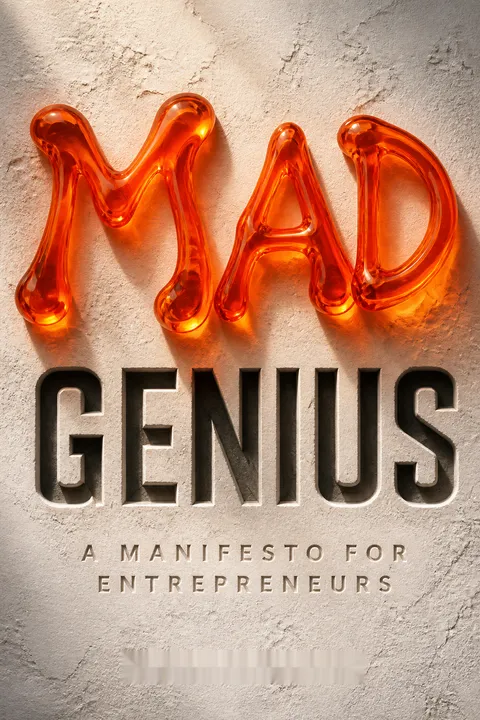
Mad Genius
trained entrepreneurial creativityGage’s term for the developed ability to see possibilities others miss, question familiar assumptions, and create new products, services, or ways of working. It is not presented as a rare gift someone either has or lacks. The book treats it as a process strengthened through curiosity, varied experience, imaginative thinking, risk-taking, and practical action.
meme
self-replicating cultural ideaAn idea that spreads between people and influences their beliefs or behavior. In the book, examples range from slogans to assumptions about money and business. Gage uses the term to explain how people can adopt a way of thinking, then seek experiences that appear to confirm it. The concept is adapted from Richard Dawkins’s use of the term for cultural transmission.
meme complex
mutually reinforcing beliefsA cluster of connected memes that support one another and form a broader belief system. Gage argues that such clusters can conflict with a person’s conscious goals. For instance, beliefs that wealth is morally suspect may undermine someone’s effort to build a prosperous business. The term directs attention to how individual assumptions combine into a larger worldview.
20/70/10 Formula
workforce influence heuristicGage’s rough model for thinking about employee behavior. It assigns 20 percent of workers to a low-accountability group, 10 percent to a naturally entrepreneurial group, and 70 percent to a group whose behavior can be influenced by organizational culture. The proposed management response is to address poor fits, support high-accountability people, and build conditions that encourage the middle group to take ownership.
Creativity Triad
experience, capture, actionGage’s three-part account of creative work: gather varied experiences, record or internalize what they suggest, and act on the resulting ideas. Experience supplies material for new connections, a capturing practice such as journaling helps preserve those connections, and action turns imagination into an experiment or creation. The model emphasizes that daydreaming alone is not finished creative work.
whole-brain synchronicity
cross-hemisphere thinkingGage’s phrase for communication between the brain’s two hemispheres during thought. He associates this activity with creativity, learning, memory, and intuition, and urges readers not to label themselves as exclusively logical or creative. The book presents the term as a way to describe integrated thinking, though its claims about hemispheres and genius should not be mistaken for a settled scientific explanation.
SCAMPER technique
structured idea variationA creativity method discussed by Gage and attributed in the book to Bob Eberle and Alex Osborne. It prompts people to reconsider an existing idea by changing, combining, adapting, or reshaping elements, finding new uses, removing parts, or changing the arrangement. The aim is to generate alternatives for a product, process, or concept before judging which options are practical.
possibility thinking
future-oriented idea creationAn approach that begins by imagining a desired outcome rather than merely analyzing an existing problem. Gage contrasts it with problem-solving that looks backward to explain what is broken. Possibility thinking asks what could exist, including options that do not yet have all their pieces, then works toward creating the missing pieces and testing the idea.
About the Author

Download PDF
Download EPUB
.epub digital book format is ideal for reading ebooks on phones, tablets, and e-readers.








