

Key Takeaways
Test the riskiest customer-facing idea before spending months building it
Make uncertainty testable. A sprint is a focused five-day team process for answering an important question by designing, prototyping, and testing a solution with potential customers. Instead of debating an idea until it feels safe, a team creates a realistic version and sees how people respond before committing to a full build.
The robot test. Savioke worried hotel guests might find its delivery robot awkward or too human-like. The team chose the guest-room delivery as its test, then mocked up expressive eyes, sounds, and a small celebratory dance. Guests reacted warmly, while some details, including games on the screen, fell flat. The test helped Savioke make a riskier design choice with evidence in hand. It did not guarantee success, but it made the next decision less like a guess.
What's powerful here is the shift from arguing about imagined reactions to observing actual ones. The method resembles a scientific experiment: make an uncertain assumption explicit, expose it to evidence, and revise. It also limits the emotional and financial cost of being wrong. Still, a prototype test answers only the question it is designed to answer. Delight at a hotel-room demonstration does not establish repeat use, operational reliability, or profitability. Its strongest role is as an early filter, not a miniature guarantee of market success.
Give a small, empowered team five protected days to solve one problem
Authority matters. A sprint needs a Decider, the person empowered to make final calls, and a Facilitator, who manages time and keeps the process moving. The team should generally have seven or fewer people, with a mix of skills and knowledge. A sprint without its decision-maker can produce a well-tested solution that leadership later abandons, as happened when a company's absent product chief rejected the problem the team had chosen.
Protect attention. The book recommends reserving Monday through Friday, typically from 10 a.m. to 5 p.m., with about six working hours each day. Participants put away devices, take regular breaks, and return to normal work outside sprint hours. The point is not longer hours. It is a shared block of attention that routine meetings and message checks rarely allow.
This setup treats organizational design as part of problem-solving, not administrative overhead. A small group reduces coordination costs, while a named decision-maker prevents the familiar failure in which everyone contributes but no one owns the choice. Protected time also makes the process credible: a team cannot claim focus while remaining on call for every routine interruption. The tradeoff is real, especially in understaffed teams. A sprint is useful only when leaders can make the absence of participants survivable and give the Decider genuine authority.
Map the customer journey backward from success, then target its riskiest moment
Begin with the destination. On Monday, the team states its long-term goal, then imagines what could make the project fail. It turns those risks into questions the sprint might answer. A simple map then shows the main actors and the steps between the beginning of a customer experience and its desired outcome. The map is a working diagram, not a complete technical specification.
Choose one moment. Flatiron Health wanted to help more cancer patients find clinical trials. Its team mapped the process from a patient's arrival at a clinic through trial matching and treatment. The Decider chose research coordinators searching for matching trials as the target, because they did that work directly and were better positioned to try an imperfect early tool than doctors. The map made a sprawling challenge small enough to investigate in a week.
Starting from a desired outcome and tracing the path backward is a practical form of systems thinking. It discourages teams from polishing a visible feature while ignoring the customer journey that gives it meaning. Maps also create a shared external reference, so disagreements can focus on the process rather than competing recollections. Their simplicity is a strength, but it can hide power dynamics and exceptions. A map should expose the important path, not be mistaken for a complete account of every customer's experience.
Borrow the whole team's expertise before deciding where the real problem lives
Knowledge is distributed. Monday's Ask the Experts conversations draw out what leaders, frontline employees, technical specialists, and customer-facing staff know. The team updates its map and questions as new information appears. At one company, a sales leader pointed out where customers would distrust the business or get stuck locating a tax number. Her knowledge substantially changed a map that the CEO had considered accurate.
Turn problems into openings. During interviews, teammates write How Might We notes: short questions that recast a specific obstacle as something the team could address. Similar notes are grouped, then prioritized with votes and placed beside relevant moments on the map. This process keeps observations visible and helps the team identify a promising target without assuming that the highest-ranking executive has the fullest picture.
The method recognizes a basic feature of organizations: expertise is often local. The person closest to a customer friction may understand it better than the person accountable for the whole business. Writing those observations down gives quieter or less senior contributors a way to shape the work. The optimistic wording of How Might We questions can encourage possibility, but it should not soften serious constraints into cheerful slogans. Teams should preserve the original evidence alongside the reframed question, especially when the problem involves trust, access, or unequal consequences.
Generate stronger options alone, using old ideas as raw material
Look beyond your industry. Tuesday begins with Lightning Demos, short presentations of useful ideas from existing products, services, or unfinished internal work. The purpose is to gather ingredients, not copy a competitor. Blue Bottle Coffee wanted to help online shoppers choose beans. A flavor guide on a chocolate wrapper inspired a simple vocabulary for describing coffee, an idea customers later found useful.
Think before presenting. Team members then work independently through a sequence of notes, rough ideas, rapid variations, and a detailed solution sketch. In Crazy 8s, each person rapidly sketches eight versions of an idea. The finished sketch uses words and simple drawings to show a customer experience. Blue Bottle's customer-support lead produced a strong concept despite believing he could not draw. The process values a clear solution, not artistic skill or a persuasive pitch.
Independent sketching changes the social conditions of idea generation. It gives people time to develop a thought before a senior colleague's enthusiasm or a group's first suggestion sets the direction. Examples from unrelated fields can also loosen assumptions about what a solution must look like. Yet individual work is not automatically more creative for every person or every challenge. Its value here comes from the sequence: gather shared context, think privately, then make ideas visible enough for collective evaluation.
Let silent critique and one accountable Decider beat endless consensus
Make ideas comparable. On Wednesday, the team posts its anonymous sketches and reviews them quietly, marking promising elements with small dots. A brief, timed discussion captures strengths and concerns. Each person then votes for a preferred solution, and the Decider makes the final choice. This reduces the influence of charisma, seniority, and lengthy sales pitches while still drawing on the group's knowledge.
Keep incompatible bets alive. Slack's team could not agree whether to explain the product with a guided tour or let customers try a simulated team of automated characters. Rather than force a compromise, it built both as competing prototypes, a test called a Rumble. In Friday's interviews, the tour helped most participants understand the product, while the simulated team confused them. The test settled a conflict that discussion alone could not resolve.
The process separates judgment into stages: notice, discuss, vote, and decide. That sequencing limits the cognitive burden of comparing every idea while also reducing the chance that the best presenter wins by default. Giving the Decider final authority is not a claim that one person is always wiser; it makes accountability explicit. A Rumble adds an important alternative to compromise, because competing hypotheses can sometimes be tested directly. The approach depends on a Decider willing to learn from the outcome rather than defend a choice as a matter of status.
Build a convincing façade, not a miniature version of the finished product
Prototype for learning. A prototype is a temporary model built to answer a specific question. The prototype mindset means treating it as disposable, building only what is needed to learn, and making it credible enough to prompt natural reactions. The right level of polish depends on the test: rough drawings may invite polite suggestions, while a believable experience helps reveal what people actually understand and do.
Fake the expensive parts. FitStar used presentation software on an iPad to simulate an app and recorded its CEO acting as the trainer. Customers understood the personalized-fitness idea, but an extra explanation from a fictional software expert felt unnecessary. The prototype took a day rather than requiring a working app. The goal is Goldilocks quality: enough realism to test the question, without spending so much time that the team becomes attached to a disposable experiment.
A façade is not merely a cheaper version of a product. It is a research instrument that isolates the human-facing part of a larger system. This is especially useful when the underlying technology is expensive but the immediate uncertainty is about comprehension, trust, or usability. The boundary matters: a convincing simulation can mislead participants if its limits are concealed in consequential settings. Teams should obtain informed participation and avoid drawing conclusions about technical performance, safety, or long-term behavior from a prototype that never tested those things.
Watch five target customers use it, then let patterns choose the next move
Observe behavior, not applause. Friday's test uses individual interviews with carefully screened target customers. The Interviewer welcomes each person, asks about relevant habits, introduces the prototype, gives an open-ended task, and finishes with a short debrief. Customers are encouraged to think aloud while the rest of the team watches and records observations. The team looks for recurring reactions, especially patterns shared by several participants.
Treat five as a signal. The book cites Jakob Nielsen's analysis of 83 usability studies, in which five interviews revealed 85 percent of observed usability problems. In Slack's test, four of five participants grasped the guided tour's basic value, while the simulated team left most confused. Those findings suggested what to improve and what to drop. Five interviews can reveal recurring usability issues quickly, but they cannot estimate how common those reactions are across a market.
Small qualitative tests are valuable because they show both what happens and what a participant was trying to do when it happened. Watching the same session together also reduces the delay and interpretation gap that can follow a research report. The sample-size claim needs careful scope: finding many usability problems in a small study is different from measuring prevalence, demand, or statistical impact. The book's best use of five is as a fast diagnostic. Teams should use the observed patterns to shape the next experiment, then seek broader evidence when the decision requires it.
Analysis
Sprint's central contribution is not simply speed. It is a way to reorganize who knows, who decides, and what counts as evidence. A team's tacit knowledge becomes visible in maps and sketches; authority is assigned rather than left to informal status; and customer reactions replace some of the speculation that otherwise fills planning meetings. The five-day sequence matters because each stage produces a concrete input for the next, from a chosen risk to a prototype that can be tested.
The method is strongest for consequential but reversible decisions about customer-facing experiences. It is especially useful when a team is stuck between plausible alternatives, or when building the wrong solution would consume significant time and money. Its focus on a surface experience also makes ambitious technical challenges approachable: a team can test a sales story, a report, or a service interaction before engineering the complete system.
The limits are as important as the promise. Five interviews can uncover confusion and reveal patterns, but they cannot establish market size, population-level preference, or durable behavior. A realistic façade may test whether an idea is understandable while leaving feasibility, reliability, cost, and safety untouched. A sprint can also create false confidence if its chosen target is unrepresentative, if participants are poorly screened, or if a Decider treats the test as validation rather than inquiry.
The most disciplined reading is therefore to treat a sprint as a decision instrument, not a miniature product launch. Its output is better knowledge about what to build, what to change, and what remains unknown. That knowledge can justify investment, prevent wasted effort, or expose the need for another round of testing. The process succeeds not when a prototype wins, but when the team makes its next commitment with fewer hidden assumptions.
Review Summary
Sprint receives mostly positive reviews for its practical approach to rapid prototyping and problem-solving. Readers appreciate the clear, step-by-step instructions and real-world examples. Many find the book's techniques useful for various industries and team sizes. Some criticize the lack of originality, noting similarities to existing methodologies. Others feel the content could have been condensed. Overall, reviewers value the book's actionable insights and its potential to accelerate innovation, though some question its broader applicability or depth of analysis.
People Also Read





Glossary
Sprint
Five-day decision processA structured, five-day team process for addressing a significant challenge. Participants define a goal and key uncertainties, develop possible solutions, select one or more ideas, build a realistic prototype, and test it with target customers. Its purpose is to learn before making a larger commitment to development.
Decider
Final decision-makerThe person with authority to make the sprint's key choices, including which customer moment to target and which ideas to prototype. This may be a founder, executive, product manager, or project leader. If the primary decision-maker cannot participate throughout the week, the team should appoint someone with delegated authority.
Facilitator
Process and time leaderThe person responsible for guiding the team through the sprint schedule, managing discussion, recording important points, and moving the group past unproductive debate. The Facilitator should remain as neutral as possible about solution choices, which is why the role is best kept separate from the Decider.
How Might We
Opportunity-framed questionA note-taking technique that turns an observed problem into a question about a possible opportunity. Team members write one concise question per sticky note, group notes with related themes, and vote on the most useful ones. The questions help preserve insights from expert conversations and inform the team's choice of target.
Lightning Demos
Brief inspiration presentationsShort team presentations of products, services, or existing internal work that contain ideas worth adapting. Each presenter highlights a useful element, and the group records it for reference. The aim is to collect design ingredients from both familiar and unrelated fields, not to copy a complete product.
Crazy 8s
Eight rapid idea variationsA timed sketching exercise in which each participant divides a sheet into eight panels and quickly draws eight variations on promising ideas. The rapid sequence pushes people beyond their first solution and offers alternatives before they create a more complete, shareable sketch.
Sticky Decision
Structured sketch selectionThe sprint's method for reviewing solution sketches and choosing which to prototype. The team examines ideas silently, marks interesting elements, discusses highlights briefly, and votes. The Decider then makes the final selection. The staged process aims to limit groupthink, persuasive pitching, and lengthy debate.
Rumble
Head-to-head prototype testA sprint test in which two or more incompatible solutions are prototyped separately and compared with target customers. Instead of forcing the team to compromise between competing ideas, the Rumble produces evidence about how each performs. Distinct names or presentation contexts can help participants distinguish the alternatives.
Prototype mindset
Temporary, question-driven buildingAn approach to prototyping that treats the prototype as disposable and focuses effort on answering a defined question. It encourages teams to build only what is necessary while making the experience credible enough for customers to react naturally. The prototype need not contain the real technology or full functionality.
Goldilocks quality
Just-enough prototype realismThe level of prototype quality that is realistic enough to elicit useful customer reactions but simple enough to build within the sprint. A crude prototype may cause participants to respond to its roughness rather than the idea, while excessive polish costs time and can increase the team's attachment to an untested solution.
Five-Act Interview
Structured customer conversationA customer interview format with five parts: a friendly welcome, context questions, an introduction to the prototype, realistic tasks with neutral prompts, and a brief debrief. The structure helps participants feel at ease, encourages them to think aloud, and gives the team a consistent way to observe how people interpret and use a prototype.
FAQ
What's "Sprint: How to Solve Big Problems and Test New Ideas in Just Five Days" about?
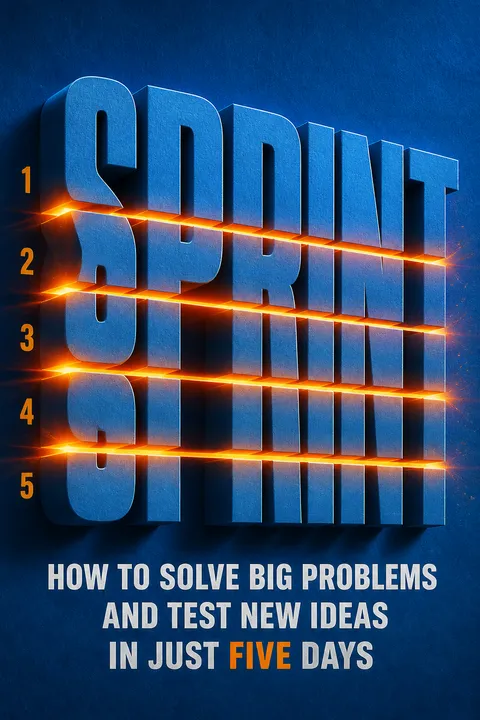
- Overview: "Sprint" by Jake Knapp, John Zeratsky, and Braden Kowitz is a guide to solving big problems and testing new ideas in just five days. It outlines a structured process developed at Google Ventures.
- Purpose: The book aims to help teams quickly move from idea to prototype, allowing them to test and learn from real-world feedback without extensive time or resource investment.
- Structure: The sprint process is broken down into five days, each with specific tasks and goals, from understanding the problem to testing a prototype with real users.
- Audience: It's designed for teams in startups, large companies, and even educational settings who need a fast, efficient way to innovate and make decisions.
Why should I read "Sprint"?
- Efficiency: The book offers a proven method to accelerate decision-making and innovation, which is valuable for anyone facing tight deadlines or resource constraints.
- Practicality: It provides a step-by-step guide that can be applied to a wide range of challenges, making it a versatile tool for problem-solving.
- Real-world Examples: The authors share numerous case studies from their experiences at Google Ventures, illustrating the effectiveness of the sprint process.
- Team Collaboration: It emphasizes the importance of diverse team input and structured collaboration, which can improve team dynamics and outcomes.
What are the key takeaways of "Sprint"?
- Structured Process: The sprint is a five-day process that includes understanding the problem, sketching solutions, deciding on the best ideas, prototyping, and testing with users.
- Focus on Prototyping: The book stresses the importance of creating a realistic prototype quickly to gather user feedback and make informed decisions.
- Team Dynamics: It highlights the value of having a diverse team and a clear decision-maker to guide the process and ensure progress.
- Learning from Users: Testing with real users is crucial to validate ideas and uncover insights that can guide future development.
How does the sprint process work in "Sprint"?
- Day 1 - Understand: The team sets a long-term goal, maps the problem, and gathers insights from experts to identify key questions.
- Day 2 - Sketch: Team members work individually to sketch solutions, drawing on existing ideas and inspiration.
- Day 3 - Decide: The team reviews sketches, votes on the best ideas, and creates a storyboard for the prototype.
- Day 4 - Prototype: A realistic prototype is built quickly, focusing on creating a façade that appears real to users.
- Day 5 - Test: The prototype is tested with real users, and the team observes and learns from their reactions to inform next steps.
What is the "prototype mindset" in "Sprint"?
- Disposable Prototypes: Prototypes should be built quickly and be disposable, focusing on learning rather than perfection.
- Realistic Appearance: The prototype must appear real to users to elicit genuine reactions and feedback.
- Focus on Learning: The goal is to learn as much as possible from user interactions, not to create a finished product.
- Optimism and Resourcefulness: Teams should believe they can prototype anything and be resourceful in finding ways to simulate the final product.
How do you decide on the best ideas in "Sprint"?
- Heat Map Voting: Team members silently review sketches and use dot stickers to vote on the most promising parts of each idea.
- Speed Critique: The team discusses the highlights of each sketch, focusing on areas with the most votes.
- Straw Poll: Each team member votes for their favorite idea, providing input for the final decision.
- Supervote: The Decider makes the final call, using their judgment and the team's input to choose the ideas to prototype.
What role do team dynamics play in "Sprint"?
- Diverse Team: A mix of skills and perspectives is crucial for generating a wide range of ideas and solutions.
- Decider's Role: The Decider is responsible for making final decisions, ensuring the team stays focused and aligned.
- Facilitator's Role: The Facilitator manages the process, keeps the team on track, and ensures productive discussions.
- Collaboration and Independence: While collaboration is key, the process also emphasizes individual work to avoid groupthink and encourage diverse solutions.
How do you test prototypes with users in "Sprint"?
- Five-Act Interview: The interview is structured into five acts: a friendly welcome, context questions, prototype introduction, tasks and nudges, and a quick debrief.
- Think Aloud: Users are encouraged to think aloud as they interact with the prototype, providing insights into their thoughts and reactions.
- Observe Patterns: The team watches the interviews together, taking notes and looking for patterns in user feedback.
- Iterate Based on Feedback: The insights gathered from user testing inform the next steps, whether it's refining the prototype or pivoting to a new idea.
What are some real-world examples from "Sprint"?
- Slack: The book details how Slack used the sprint process to refine their product explanation for non-tech customers, leading to significant improvements.
- Blue Bottle Coffee: The team used a sprint to develop an online store that effectively conveyed their brand's quality and expertise.
- Savioke: The sprint helped Savioke develop a friendly robot personality that enhanced guest experiences in hotels.
- FitStar: The process was used to clarify the value proposition of a fitness app, leading to better user understanding and engagement.
What are the best quotes from "Sprint" and what do they mean?
- "Start at the end." This quote emphasizes the importance of defining a clear long-term goal and working backward to identify the steps needed to achieve it.
- "You can prototype anything." It highlights the book's core belief that with the right mindset and tools, any idea can be quickly turned into a testable prototype.
- "Work alone together." This phrase captures the balance between individual creativity and team collaboration, which is central to the sprint process.
- "The prototype must appear real." It underscores the necessity of creating a realistic façade to gather genuine user feedback.
How can "Sprint" be applied in different contexts?
- Startups: The sprint process is ideal for startups needing to quickly validate ideas and make informed decisions with limited resources.
- Large Companies: It can help large organizations innovate and solve complex problems by fostering a focused, collaborative environment.
- Education: Educators can use sprints to teach problem-solving and design thinking, as demonstrated by examples from universities and high schools.
- Nonprofits and Government: The process can be adapted to address challenges in these sectors, helping teams develop and test solutions efficiently.
What are some common challenges when implementing "Sprint"?
- Time Commitment: Clearing five full days for a sprint can be challenging, especially in larger organizations with busy schedules.
- Decider's Involvement: Ensuring the Decider is present and engaged throughout the sprint is crucial for making effective decisions.
- Prototyping Skills: Teams may need to learn new tools and techniques to create realistic prototypes quickly.
- User Recruitment: Finding and scheduling the right users for testing can be time-consuming but is essential for meaningful feedback.
About the Author
Other books by Jake Knapp
Download PDF
Download EPUB
.epub digital book format is ideal for reading ebooks on phones, tablets, and e-readers.








