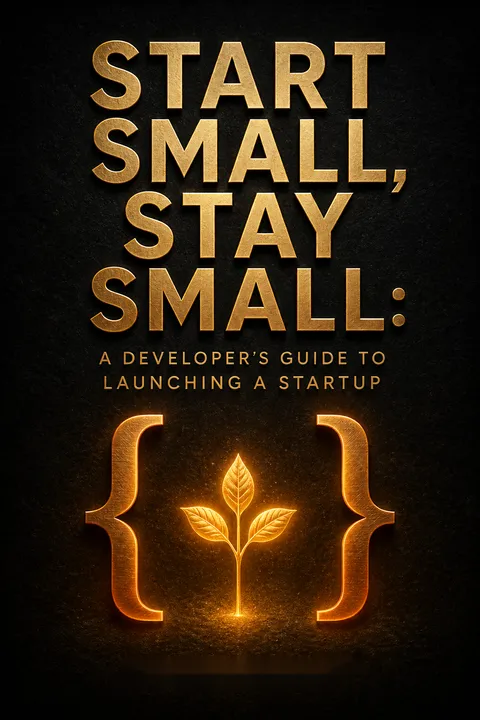


Key Takeaways
Build a small, profitable software business instead of chasing startup fame.
Choose the game deliberately. The book is for developers building without outside funding. A Micropreneur seeks a solo business and a chosen lifestyle; a bootstrapper aims to grow a small company, perhaps with a handful of employees. Both can build worthwhile businesses without pursuing the venture-funded race for explosive growth. A narrow market can support a modest company: the book argues that a tiny niche producing $10,000 a month may be enough for one or two founders, while venture funding pressures founders to pursue much larger markets.
Expect work beyond code. Walling estimates that coding is only about 30 percent of launching a product. Marketing, support, documentation, payment systems, and sales all demand time. The sensible first milestone is not riches, but proof that customers will pay, such as reaching $500 monthly profit.
The book makes an important distinction between business quality and business scale. A company can be successful by providing autonomy, reliable income, and ownership without becoming a household name. This resembles the idea of satisficing in decision theory: selecting an outcome that meets a person’s real needs rather than maximizing a public status metric. The approach is especially persuasive for founders with limited capital, but it should not turn smallness into a virtue by itself. A niche can be too narrow, and a modest revenue target may not cover a founder’s obligations. The useful move is to define the desired life and its financial floor before choosing a market.
Pick a niche with shared pains, shared language, and easy-to-find customers.
Start with a vertical. A niche is a focused group whose members have related needs and can be reached through a few concentrated channels. Instead of building generic invoicing software for every small business, a founder might serve one profession, such as landscape architects or therapists. Their workflows are easier to understand, and the product can solve a specific problem rather than accumulating features for unrelated users.
Concentration lowers the cost. The book contrasts broad travel advertising with a smaller regional audience: an ad aimed at Northwest travelers could cost far less than a national travel magazine placement. A vertical also makes referrals more plausible because members use the same forums, publications, conferences, and professional networks. Nota Bene, a specialized word processor for academics, is offered as an example of a niche product priced far above general word-processing software because it addresses specialist citation needs.
A vertical market is more than a smaller audience. It is a way to reduce uncertainty: shared routines make customer interviews more comparable, product choices more coherent, and distribution easier to repeat. This connects to the economics of specialization, where a focused producer can develop knowledge that a generalist cannot justify acquiring. Yet close-knit markets can amplify mistakes as quickly as recommendations. A founder should verify that the niche is reachable and large enough to support the business, rather than treating community visibility as proof of demand. The best niche combines meaningful pain, an identifiable buyer, and affordable access to that buyer.
Test buyer behavior before spending months building software.
Measure intent, not compliments. The Market First Approach means finding evidence of paying demand before settling on a product and writing substantial code. Walling recommends using search data to estimate how many people seek solutions and how difficult it may be to reach them. These estimates are imperfect, so they are a filter, not a verdict.
Put a small offer in front of people. A Mini Sales Site is a stripped-down sales website that presents a proposed product and asks visitors to take a realistic action, such as clicking to buy or start a trial. Targeted ads can bring roughly 100 to 200 visitors; the founder can then see which search terms attract interest and which calls to action get clicks. The test may cost about $50 to $500. Be transparent that the product is in development, and do not use this approach for products whose value depends on a large existing network.
This is a practical version of experimental design: spend a little to distinguish competing explanations before committing a large budget. A person saying a product sounds useful is weak evidence; attempting to sign up is stronger, though still not equivalent to completing a purchase. That distinction keeps the test honest about what it can prove. The approach also resembles a real option: a small experiment buys information while preserving the choice to stop. Search-based testing is less suitable when customers do not search for the problem, or when adoption depends on social density. In those cases, different forms of direct customer discovery are needed.
Decide what success means before the startup starts making decisions for you.
Write down the destination. A founder choosing between side income, self-employment, a small team, or a larger company needs different products and operating choices. Walling recommends committing goals to paper and sharing them with someone who can ask for progress reports. He cites a Dominican University study reporting stronger follow-through among participants who wrote goals, shared commitments, and provided updates.
Use a reachable first marker. The proposed early target is $500 in monthly profit. Reaching it proves more than technical skill: it requires finding customers, collecting revenue, and handling the work around the product. Goals also help founders reject opportunities that pull them toward a life they did not choose. A founder seeking more family time may reasonably turn down a growth opportunity that would require longer hours and more employees.
A written goal acts as a decision rule when a founder faces ambiguous choices, from a custom feature request to an expansion offer. This is useful because entrepreneurship rarely supplies the crisp correctness tests familiar from programming. Accountability adds a social commitment device, making intentions visible to another person. Still, goals should function as revisable constraints, not as a contract with an outdated self. Evidence from customers or changes in personal circumstances can justify a new target. The strongest practice is to record both the desired outcome and the reason it matters, then review them as the business changes.
Make software one-third of the business, not the whole business.
Balance the three sides. The Product Success Triangle is the book’s model of product, market, and execution. A useful product matters, but it cannot rescue an absent market or weak selling and support. Walling’s priority order is market first, marketing second, visual presentation third, and functionality after those. This is a deliberate challenge to a developer’s instinct to treat code quality as the main measure of progress.
Keep the first release small. The book estimates a typical first version at 200 to 400 development hours, with another 100 to 200 hours for the sales site, documentation, and launch work. More than 400 coding hours is a reason to cut scope. For a business application, hosted software is often a sensible starting point because the founder controls one deployment and can charge recurring fees. Local access, enterprise data rules, or demanding interfaces can justify other forms.
The triangle corrects a common allocation error: technical founders often invest heavily in the part they control most and underinvest in customer access. Its deeper insight is about bottlenecks. If no one wants the product, better code has little commercial value; if customers arrive but cannot understand the offer, marketing and presentation become the constraint. The proposed order is a prioritization heuristic, not a universal law. Reliability, security, accessibility, and product quality can be decisive in regulated or high-stakes settings. The practical question is not whether function matters, but which weakness currently limits customer value and business survival.
Set prices from customer value, then use real sales to refine them.
Triangulate a starting price. The book advises examining what comparable products cost, what customers can afford, what value the software creates, and what the founder would consider reasonable. For example, software saving a customer five hours a month can be compared with the economic value of those hours. These methods produce a range, not a mathematically certain answer.
Test the range. Walling argues that developers often price too low and recommends offering three tiers, with more benefit at each higher level. His rough online price ceilings range from $29 for consumer hobby software to around $400 for small-business software, except where the product solves an unusually serious problem. One-time desktop products can charge separately for annual support and upgrades. Pricing tests should compare revenue, not merely the number of purchases, and should respect the length of the customer’s buying cycle.
Pricing is a behavioral experiment as much as a calculation. A low price can reduce perceived risk, but it can also signal low value or leave the business unable to fund support. Tiering helps customers self-select according to need, while value-based reasoning shifts attention from the developer’s effort to the buyer’s outcome. The book’s ceilings are useful period-specific reference points, not timeless market laws; software categories and customer expectations change. A disciplined founder should track conversion and revenue per visitor, and interpret results alongside support costs, refunds, and customer retention. The best price is sustainable for both sides, not merely the one that generates the most clicks.
Turn brief website visits into permission to continue the conversation.
Do not count on a first-visit sale. The sales funnel describes how people move from seeing a link to becoming visitors, prospects, and finally buyers. Most leave before purchasing, and many arrive in a hurry. The website’s first job is therefore to make the next step easy, often by inviting a visitor to share an email address in exchange for something relevant, such as a useful report, short course, or product update.
Make the site easy to act on. Give each page one main purpose, a clear call to action, and an obvious route to a demo, signup, or purchase. Walling describes a mailing list of about 80 prospects that produced five sales in a day when notified of a new release, around a 6 percent conversion rate. Permission matters: send relevant messages, make unsubscribing easy, and do not sell or rent the list.
The mailing list turns a one-time visit into a relationship the business can continue to earn. In behavioral terms, it reduces the need for a buyer to make a high-commitment decision on the first encounter. The visitor can request useful information now and decide about the product later. This works only when the promised exchange is credible: irrelevant newsletters and relentless promotions spend trust faster than they build it. Email is also not automatically the right channel for every audience, as the book notes that technical readers may prefer feeds. The general principle is to offer a low-friction, permission-based next step that fits how the target group communicates.
Build lasting traffic through audience and search, not viral theater.
Prioritize repeatable channels. The book groups mailing lists, blogs or podcasts, and organic search as Top Shelf traffic strategies, meaning channels that can provide a sustainable flow of prospects. Social networks, press, forums, and paid ads can help, but are treated as supplemental rather than dependable foundations. A surge of visitors from a popular technology site may have little value if those people are not likely customers.
Measure who buys. Search optimization helps the right people discover relevant pages; audience-building develops familiarity and trust. Paid search is especially useful as a fast way to test which keywords convert, then pursue those terms organically rather than relying indefinitely on ads. Analytics should connect traffic sources to meaningful actions and sales. A thousand unqualified visitors can be less valuable than a small group of people who share the problem the product solves.
The distinction between reach and relevance is central to efficient marketing. A large audience is not an asset merely because it produces impressive traffic numbers; its value depends on fit, trust, and the ability to reach it again. This echoes customer-acquisition economics, where conversion quality and retention can matter more than raw impressions. The book’s channel hierarchy reflects its 2010 context, and the relative strength of search, social, and email changes with markets and platforms. Its durable advice is to measure outcomes by source and build channels the business can access repeatedly, rather than mistaking visibility for demand.
Replace premature code with people, then automate only proven work.
Use human effort as a prototype. A virtual assistant is a remote contractor who can handle research, support, order processing, or repetitive administration. Walling’s term drip outsourcing describes delegating small tasks as they arise, freeing founders for work with greater business value. He recommends beginning with low-risk assignments, clear instructions, and limited time budgets, then expanding responsibility as trust develops.
Automate after evidence. For a hosted version of invoicing software, the founders initially estimated 160 hours to build the necessary system. By allowing a VA to create customer accounts manually and simplifying the launch, they reduced the work to about 10 hours. The manual process could be automated only if enough customers justified it. The test is straightforward: compare the recurring human cost with the time and risk of building and maintaining software.
This approach reverses a deep engineering reflex: automate repetition before establishing that the repetition is worth supporting. A human-run process can be an inexpensive operational experiment, revealing exceptions and customer needs that a premature system would encode incorrectly. It also creates a written procedure that can guide later automation. The tradeoff is operational risk: manual work can be inconsistent, slow, or dependent on one contractor. Clear instructions, backups, access controls, and review become essential as the stakes rise. The strongest rule is not to avoid automation, but to make it respond to demonstrated volume and value.
Automate, grow, or sell according to the life you actually want.
Choose a post-launch path. Once a product has paying customers, its owner can invest in growth, reduce the workload through outsourcing and automation, or sell and move on. Walling calls the repeated process of launching, improving, and maintaining several small products Serial Micropreneurship. It allows a founder to keep earlier products operating while beginning another, but only after the first is stable enough to require limited attention.
Build a business, not a job. Small software products often sell for a multiple of monthly profit, with the book giving a rough range of 6 to 15 months for software products. Buyers also care about how much ongoing work the business requires. Track revenue, expenses, customer traffic, time spent, and licensing details. A profitable product that runs with little founder effort can be worth more to a buyer, and more useful to its owner, than a technically impressive product that demands constant labor.
The closing choice makes entrepreneurship a question of portfolio design and personal preference, not a single ladder toward scale. Automation can preserve income while restoring attention; selling can convert a stream of earnings into a lump sum; growth can be right when the market and founder both support it. The book’s emphasis on profit and owner effort is commercially clear, although valuation multiples vary with risk, growth, concentration, and buyer circumstances. Tracking the business makes these choices more informed even when no sale is planned. A founder should evaluate not only revenue, but also the attention each product consumes and the alternatives that attention could support.
Analysis
Start Small, Stay Small is best read as an operating manual for a particular founder: a technically capable person with limited capital who wants ownership without accepting the extreme growth demands of venture finance. Its argument is not that ambition is foolish, but that ambition should be matched to the resources and life the founder actually has. That shift makes the book’s choices cohere: narrow the market, verify demand cheaply, preserve cash, sell directly, outsource routine work, and decide whether the resulting business deserves further investment.
The strongest contribution is its treatment of software as only one component of a commercial system. Developers have a comparative advantage in building, so building can feel like progress even when the market remains unknown. The book repeatedly redirects effort toward evidence of demand and access to buyers. Its proposed mini sales site, paid search tests, and manual operations are all ways to buy information before buying complexity. This logic is close to experimental economics: preserve the ability to change direction until evidence makes commitment worthwhile.
Some recommendations are artifacts of the book’s 2010 setting. Search-engine tactics, named tools, advertising costs, and the relative importance of social platforms have changed substantially. The numeric estimates for pricing, conversion, development time, and product valuation should be treated as heuristics drawn from the author’s experience, not universal benchmarks. The book also risks overstating how easily an online niche can be reached, especially when customers rely on procurement systems or established vendors.
Even with those limits, the central operating discipline travels well. Ask who pays, how they can be reached, what proof would change the decision, and what ongoing labor the business demands. The title’s promise is not that smallness automatically produces freedom. It is that small scope can make learning affordable, and affordable learning gives a founder more chances to find a durable fit between product, market, and desired life.
Review Summary
Start Small, Stay Small receives mixed reviews, with an average rating of 3.96/5. Readers appreciate its practical advice for developers starting small businesses, focusing on niche markets and bootstrapping. Many find the book's principles still relevant, praising its straightforward approach to entrepreneurship. However, numerous reviewers criticize the outdated content, particularly regarding technology and marketing strategies. Some readers suggest the book needs updating to remain fully relevant in today's fast-paced tech environment. Despite its age, many still recommend it for its core insights on market research, marketing, and business fundamentals.
People Also Read









Glossary
Micropreneur
Solo software business ownerAn entrepreneur who aims to operate without employees, either through one product or a portfolio of small products. The goal is often a particular lifestyle, such as flexible location or supplemental income, rather than building a large company. The book presents Micropreneurship as a way to serve narrow markets and retain control.
Bootstrapper
Founder growing without outside fundingAn entrepreneur who builds a company without relying on external investment, while aiming for a business larger than a solo operation. The book describes a bootstrapper as someone who may grow a small team and expand through revenue reinvested in the business. Growth is generally slower and more constrained than in a venture-funded startup.
Market First Approach
Find buyers before buildingA product-selection approach that begins by identifying people willing to pay for a solution, then shapes the product around their needs. It contrasts with the Product First Approach, in which a developer invents an application and builds it before establishing demand. The method uses niche research and low-cost tests to reduce the risk of building unwanted software.
Micropreneur Methodology
Estimate niche demand affordablyA practical method for evaluating a niche before committing substantial development time or money. It uses online research, especially search-volume and competition estimates, to judge whether a group is large enough and affordable to reach. The estimates are directional rather than certain, and can be followed by a small paid-traffic test.
Product Success Triangle
Product, market, and executionA model that treats product quality, a market willing to pay, and execution as jointly necessary for commercial success. Execution includes marketing, selling, and supporting the product. The framework counters the developer tendency to treat software functionality as nearly the entire business, emphasizing that a good product can still fail without buyers or effective execution.
Mini Sales Site
Small site testing purchase intentA limited sales website that presents a proposed product and invites visitors to take an action such as buying or starting a trial. It lets a founder test interest with targeted traffic before building the complete application. Visitors should be told the product is still in development, and the approach is most suitable for software that can be evaluated without a large network already in place.
Top Shelf
Sustainable customer channelsThe book’s label for traffic sources considered capable of sustaining a small software business over time: a mailing list, a blog or podcast, and organic search. These channels are contrasted with supplemental approaches such as social networks, paid ads, forums, and press releases. The distinction is a prioritization guide, not a claim that other channels never work.
Drip outsourcing
Delegate small tasks continuouslyA practice of handing off small, repeatable tasks as they arise instead of waiting to outsource an entire department or project. It allows a founder to recover time from research, administration, design, and other work that does not require the founder’s unique judgment. The book recommends starting with low-risk tasks and gradually increasing responsibility as the working relationship develops.
Dollarizing
Assign economic value to timeA way of estimating the financial value of an entrepreneur’s working hour, using a freelance rate or salary and benefits as a starting point. The estimate helps compare the cost of hiring someone with the potential value of the founder’s freed time. It is a decision aid rather than a guarantee that each hour can immediately generate that amount.
Serial Micropreneurship
Operate products one after anotherA strategy of launching or acquiring a small product, improving it, and reducing its required maintenance through outsourcing or automation before starting another. Products can continue earning while the founder works on a new one. The strategy depends on keeping each business sufficiently stable and delegated, since launching several products at once can create damaging task switching.
Warm niche
Market known through personal tiesA potential customer group connected to the founder through personal experience, work, hobbies, friends, or family. Familiarity can make it easier to understand the group’s problems and gain access to conversations with potential buyers. A warm connection is a useful starting advantage, but does not by itself prove that the group will buy a product.
FAQ
What's "Start Small, Stay Small" about?
- Target Audience: The book is aimed at developers who want to launch a startup without outside funding, focusing on real developers solving real pain points.
- Core Focus: It emphasizes building and launching a successful software, web, or mobile startup with no external funding.
- Avoids Venture Topics: It intentionally avoids topics related to venture-backed startups, such as securing funding and investor pitches.
- Practical Approach: The book provides a step-by-step guide to getting a startup off the ground, focusing on practical advice without filler content.
Why should I read "Start Small, Stay Small"?
- Realistic Approach: It offers a realistic approach for developers who can't relocate to startup hubs or work 70-hour weeks for low pay.
- Niche Focus: The book highlights the importance of finding and targeting niche markets, which are often overlooked by larger competitors.
- Self-Funding Emphasis: It provides strategies for building a startup without relying on venture capital, which can be a distraction and limit market options.
- Actionable Advice: The book is filled with actionable advice, encouraging readers to underline, highlight, and take notes to implement the strategies effectively.
What are the key takeaways of "Start Small, Stay Small"?
- Market-First Approach: Emphasizes finding a market before building a product to ensure there is demand.
- Niche Importance: Stresses the importance of targeting niche markets to reduce competition and increase profitability.
- Self-Funding Benefits: Highlights the advantages of self-funding, such as maintaining control and focusing on modest success.
- Outsourcing and Automation: Encourages outsourcing and automating tasks to save time and focus on growth.
What is the Market-First Approach in "Start Small, Stay Small"?
- Market First: The approach prioritizes finding a market willing to pay for a product before developing it.
- Avoid Product-First: It contrasts with the Product-First Approach, where developers build a product without confirming demand.
- Sustainable Strategy: By focusing on existing demand, startups can avoid the high costs of creating demand.
- Testing Demand: The book suggests using tools like Google AdWords to test market demand before investing heavily in development.
How does "Start Small, Stay Small" define an entrepreneur?
- Visionary Role: An entrepreneur is described as a visionary who sees potential in an idea and creates a viable business.
- Micropreneurs and Bootstrappers: The book distinguishes between Micropreneurs, who prefer to remain solo, and Bootstrappers, who aim to grow a small team.
- Common Knowledge: It notes that 90% of the knowledge needed for Micropreneurship and bootstrapping is identical.
- Focus on Execution: Emphasizes the importance of execution, marketing, and finding a niche over the technical aspects of product development.
What is the Product Success Triangle in "Start Small, Stay Small"?
- Three Components: The triangle consists of product, market, and execution, each being crucial for success.
- Product as One-Third: The product is only one-third of the equation, contrary to the belief that it's the most important part.
- Market and Execution: A brilliant product with no market or execution is doomed, while a mediocre product with excellent marketing can succeed.
- Long-Term Mastery: The goal is to master all three components over time, but initial focus should be on market and execution.
Why does "Start Small, Stay Small" emphasize niches?
- Reduced Competition: Niches are often too small for large competitors, allowing startups to thrive with less competition.
- Higher Profit Margins: Niche markets allow for higher pricing due to less competition and more targeted solutions.
- Cost-Effective Marketing: Marketing to a niche is more cost-effective, as it's easier to reach a concentrated audience.
- Focused Product Development: A niche requires a narrow product focus, making it easier to create a product that perfectly fits the market's needs.
How does "Start Small, Stay Small" suggest testing a product idea?
- Mini Sales Site: The book recommends creating a mini sales site to test demand before full development.
- AdWords Campaign: Use Google AdWords to drive traffic to the site and gauge interest through clicks and sign-ups.
- Conversion Tracking: Track conversions to see how many visitors are willing to try or buy the product.
- Cost-Effective Testing: This approach allows for testing an idea for under $100, saving time and resources if the idea doesn't resonate.
What role do virtual assistants play in "Start Small, Stay Small"?
- Task Delegation: Virtual assistants (VAs) are used to handle tasks that the founder should not be doing, freeing up time for growth.
- Cost-Effective: VAs can be hired at a low hourly rate, making them a cost-effective solution for administrative and repetitive tasks.
- Proof of Concept: VAs can help in developing a proof of concept by handling manual tasks that don't need immediate automation.
- Post-Launch Support: After launch, VAs can assist with customer support, marketing, and other ongoing tasks to maintain the business.
How does "Start Small, Stay Small" view outsourcing and automation?
- Time-Saving: Outsourcing and automation are seen as crucial for saving time and focusing on growth.
- Initial Outsourcing: Tasks should be outsourced first to test processes before investing in automation.
- Cost-Effective: Hiring VAs or contractors for specific tasks can be more cost-effective than doing everything in-house.
- Focus on Core Activities: By outsourcing non-core activities, founders can focus on product development and marketing.
What are the best quotes from "Start Small, Stay Small" and what do they mean?
- "Market comes first, marketing second, aesthetic third, and functionality a distant fourth." This quote emphasizes the importance of finding a market before focusing on product features or design.
- "Product Last. Marketing First." Highlights the critical role of marketing in the success of a startup, even more than the product itself.
- "If you aren’t frantically underlining, highlighting or taking notes as you read each chapter, then I have not achieved my goal for this book." Reflects the author's intent to provide actionable, valuable content without filler.
- "The first time someone pays you for software you wrote, your head will nearly spin off its axis." Captures the excitement and validation of making a sale as a software entrepreneur.
What is the Ideal Launch plan in "Start Small, Stay Small"?
- Pre-Launch Engagement: Six months before launch, engage your audience through social media and a landing page to collect emails.
- Buzz Creation: Over the next six months, create buzz through guest blogging, social media updates, and community engagement.
- Email Notification: One week before launch, email your list with a special offer available only to them.
- Launch Day Sales: On launch day, send a final email to drive sales, leveraging the trust and anticipation built with your audience.
About the Author
Other books by Rob Walling

Download PDF
Download EPUB
.epub digital book format is ideal for reading ebooks on phones, tablets, and e-readers.








