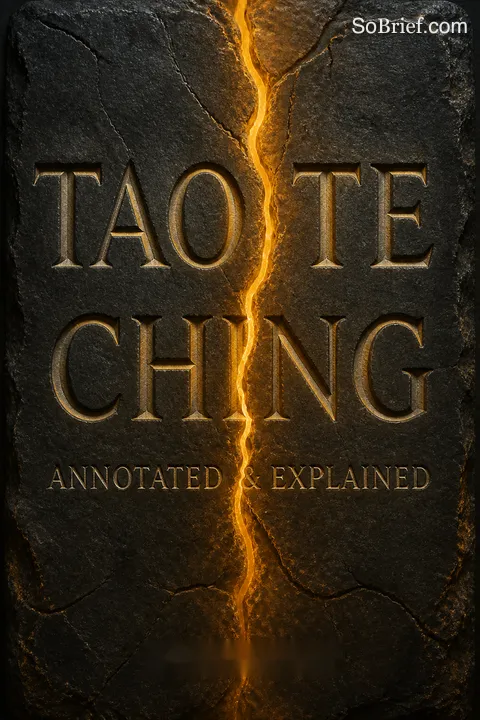


Key Takeaways
Treat the Tao as reality’s pattern, not a doctrine to defend
A way, not a creed. The Tao is the underlying way things unfold: the source and pattern of nature, human life, and change. The book does not ask readers to accept it on authority. Its central test is whether its principles help people live with greater clarity and less friction. The Tao is also too encompassing to be captured by a final definition, though words can point toward it.
A book needs a life. Taoist lore tells of Lao Tzu leaving public service amid political turmoil. At a border pass, a commander asks him to write down what he knows, and the resulting brief text becomes the Tao Te Ching. In the story, Lao Tzu warns that a manuscript remains inert unless readers put its teachings into practice. The account frames the book as a guide to living, not a relic to admire.
The distinction between a map and a territory is useful here: concepts can direct attention, but they cannot substitute for experience. That makes the text unusually practical for a spiritual classic. Its openness also permits readers with different religious or secular commitments to engage it without first adopting a creed. The risk is that an all-encompassing idea can be stretched to justify almost anything. A useful test is therefore behavioral: does a proposed reading produce less needless force, more attentiveness, and greater care for others?
Notice how naming one side of a pair creates the other
Meaning depends on contrast. The text points to pairs such as high and low, difficult and easy, and beautiful and ugly. Each term becomes intelligible through its relation to the other. Judgments can therefore shape what they seem merely to describe: declaring one person exceptional may intensify competition, while defining a task as difficult presumes some comparison with an easier one.
Distinction is not destiny. The point is not that all differences are imaginary or that harmful conduct should be ignored. It is that categories are partial views, not the whole of reality. The book presents apparent opposites as interdependent expressions of a larger unity. That perspective encourages a pause before turning a useful distinction into a rigid division between people, values, or ways of life.
This resembles a basic lesson from perception and measurement: a category helps organize experience, but it also directs attention and can make its opposite seem more real. The insight is especially strong as a check on status competitions and moral certainty. It becomes less persuasive if taken to mean that every distinction is merely relative. A difference in perspective does not erase a difference in harm. The practical value is not abandoning judgment, but holding judgments lightly enough to revise them when context changes.
Act without forcing outcomes, rather than mistaking restraint for passivity
Effort without grasping. Wu wei means action without attachment or contrivance. It does not mean refusing to act. It means responding to circumstances without trying to control every person and result. A capable person still works, teaches, leads, and solves problems, but avoids adding unnecessary pressure or claiming ownership over everything that follows.
Let the work breathe. The text describes a leader whose work is completed so unobtrusively that people feel they participated in making it happen. It also recommends stepping back after success instead of turning achievement into self-promotion. The focus shifts from commanding an outcome to doing what fits the moment, then allowing the consequences to develop without constant interference.
This is close to the distinction between control and influence in complex systems. Overcorrection can destabilize a process: a manager who revises every decision may create the confusion that more management is then required to fix. Wu wei offers a counterweight, asking whether intervention improves the situation or merely reassures the intervener. Restraint still requires judgment and responsibility. In emergencies, deliberate action may be essential; the principle is to avoid force that serves anxiety, ego, or habit rather than the actual need.
Make room for emptiness, because usefulness depends on space
Space does real work. The text asks readers to look beyond a thing’s material parts. A wheel’s solid spokes matter, but the open center lets an axle pass through. A container holds food because it has a hollow interior. A room becomes usable through the space within its walls. In each case, what appears to be absence makes the object functional.
Design for what can happen. This is also the book’s image for the Tao: an open source that is not used up by what emerges from it. Emptiness here is not mere deprivation. It is capacity, room for movement, use, and new possibilities. The lesson applies to making space in plans and attention, rather than filling every available moment or trying to specify every outcome in advance.
The idea has a natural connection to design: a tool is defined not only by what it contains, but by the actions its form makes possible. Open time can similarly support reflection, improvisation, and recovery. Yet empty space is valuable only in relation to a purpose. A missing resource can be a hardship, not a hidden gift. The text is most convincing when it challenges the assumption that more structure or more material automatically means more usefulness, rather than treating all absence as inherently beneficial.
Borrow water’s strength: adapt, serve, and avoid needless contests
Yield without vanishing. Water is the book’s recurring model of effective strength. It settles low, takes the shape of its surroundings, and benefits many forms of life without demanding recognition. When blocked, it can move around an obstacle rather than spend itself trying to smash through. Its softness does not make it powerless; persistent water can alter what appears harder and stronger.
Balance receptive and active. Yin and yang name complementary patterns, often described as receptive and active, quiet and dynamic. The teaching is to understand both rather than becoming trapped in one. Yielding is not submission to every demand. The text allows for decisive action when necessary, but rejects aggression for its own sake and counsels stopping once a necessary result is reached.
Water offers a compelling model of resilience because adaptation can preserve energy while changing the route to a goal. In negotiation, for example, listening may reveal an option that direct pressure would hide. The metaphor also corrects a common mistake: treating strength as visible domination. Its limit is that yielding can be exploited where power is unequal. Flexibility must include the ability to set boundaries and protect vulnerable people, not simply accommodate whoever applies the most pressure.
Reduce desire before success becomes another source of fear
More can make life smaller. The text links status, possessions, and sensory stimulation with restlessness. Public praise can create fear of losing approval; treasured goods invite worry about keeping them; constant indulgence can dull the senses and prompt a search for stronger stimulation. Its advice is to value basic needs over endless novelty and to stop before having enough turns into having too much.
Practice plainness. The term pu means plain wood, a natural simplicity that holds possibilities before human contrivance narrows them. The book also warns that extremes tend to turn: what grows excessively strong begins to decline, and apparent good fortune can contain the conditions of trouble. Contentment is not a claim that every need is met. It is a refusal to let appetite set an endlessly moving standard for a worthwhile life.
This account anticipates a familiar problem in consumer behavior: satisfaction can fade as people adapt to new rewards, prompting them to seek another upgrade. The Taoist response is to question the cycle itself, not just optimize the next purchase. That can protect attention from being colonized by comparison. Still, a call to contentment should not be used to romanticize poverty or excuse unjust conditions. The distinction is between enough as a personal discipline and enough as a substitute for meeting real material needs.
Lead by lowering yourself and interfering less
Authority can make room. The text compares effective leadership to a river or ocean that occupies the low ground and so receives water from many valleys. A leader who listens, serves, and does not treat authority as personal superiority can attract willing cooperation. The ideal ruler is so unobtrusive that people feel the work belongs to them, rather than seeing every achievement as the ruler’s performance.
Control can backfire. The book warns that excessive laws, restrictions, and clever schemes can make people poorer, more evasive, and harder to govern. In daily life, the same pattern appears when someone meddles in others’ affairs and creates resentment. Less interference does not mean abandoning responsibility. It means distinguishing necessary guidance from control that breeds the very disorder it claims to prevent.
This is a recognizable form of servant leadership: authority earns legitimacy through enabling others, not merely issuing instructions. It also anticipates a systems principle: rules change incentives, and people adapt to the rules, sometimes in ways their designers did not intend. The critique of interference is valuable, but its application depends on context. A light touch can support autonomy where people have adequate resources; it can also leave people exposed when protections are needed. The question is whether intervention builds capacity or dependence.
Begin small, address trouble early, and finish as carefully as you start
Small beginnings are actionable. A large tree starts as a small shoot, and a tall structure begins with a modest base. The text uses these images to show why a difficult undertaking should be approached through small, manageable parts. It also advises addressing a problem while it is still fragile and easy to change, rather than waiting until it has grown into a crisis.
Guard the final stretch. People often falter when a task is nearly complete because they relax their attention too soon. The book recommends maintaining the same care at the end as at the beginning. Its famous journey image points to the ground immediately beneath one’s feet: progress begins with the next concrete action, not with a grand declaration or a fantasy of having already arrived.
The advice aligns with project management and behavior change: smaller steps reduce the activation cost of starting, while early feedback makes correction cheaper. It also counters the tendency to celebrate a plan before the work is done. Yet not every complex problem can be solved by breaking it into pieces; relationships and institutions may have feedback loops that only appear at the whole-system level. Small steps are most useful when paired with periodic checks that the pieces still serve the larger purpose.
Know your limits well enough to change your mind
Self-knowledge is a form of strength. The text distinguishes understanding other people from understanding oneself, and treats self-mastery as deeper than defeating an opponent. Knowing when one has enough is a kind of wealth; recognizing what one does not know guards against false confidence. The ideal learner remains open to other people’s perspectives instead of treating an existing belief as untouchable.
Learn by simplifying. The book contrasts acquiring more information with reducing what is unnecessary. This is not a demand to reject study. It is a warning that knowledge can become clutter when it feeds ambition, cleverness, or argument without improving how one lives. Quiet attention to recurring patterns, motives, and consequences can reveal what abstract accumulation misses.
Modern psychology gives this passage a useful parallel in intellectual humility: awareness of the limits of one’s knowledge helps people remain receptive to correction. It also distinguishes expertise from mere confidence. The text’s suspicion of learning deserves a careful reading, since knowledge can expose injustice and help solve practical problems. Its stronger claim is that information alone does not produce wisdom. A fruitful question is whether new knowledge changes perception and conduct, or merely adds material to defend an existing identity.
Choose compassion, conservation, and humility over conquest
Three qualities guide conduct. The text names compassion, conservation, and reluctance to place oneself ahead of others as its three treasures. Compassion makes courage answerable to care; conservation means using time and energy without waste; humility makes leadership less self-centered. The qualities reinforce one another: courage without compassion can become brutality, while ambition without restraint can become exhaustion or domination.
Treat force as a last resort. Written against a background of warfare, the text contrasts horses returned to farm work with animals forced to give birth amid battle. It condemns celebrating victory as though killing were glorious. When force is unavoidable, the wise response is limited action, not conquest for its own sake. The emphasis is not helplessness, but refusing to confuse the ability to dominate with the right to do so.
The three qualities work as checks on one another: compassion supplies moral direction, conservation limits waste, and humility restrains status seeking. Together they offer a compact ethical test for personal and political power. The antiwar stance is particularly strong because it makes the cost of conflict visible rather than hiding it behind triumph. Restraint, however, does not settle every question about defense or justice. It sets a burden of justification: force should answer a real necessity and should not become an excuse for further expansion.
Analysis
The Tao Te Ching is less a linear argument than a collection of compressed reversals. It moves from cosmology to leadership, from perception to daily conduct, and repeatedly asks readers to reconsider what counts as strength, success, or usefulness. Its recurring images make an abstract outlook tangible: water models adaptability, empty space enables function, and humble low ground gathers what elevated ground cannot. The result is a philosophy that can be read as both a description of reality and a discipline for living within it.
That doubleness is the book’s power and its interpretive hazard. If the Tao describes everything, it can sound as though every action is equally aligned with it. Yet the text makes clear ethical distinctions: it favors care over greed, restraint over excess, and peace over war. Its answer is not simple relativism, but attention to consequences and patterns. Conduct that creates needless contention or damages the conditions of life is treated as a departure from wise alignment, even though it remains part of existence.
The edition also contains two layers that should not be confused. The ancient verses are famously concise and open to competing readings; Derek Lin’s translation and annotations offer a particular interpretive bridge, with strong emphasis on practical application. His introduction presents Lao Tzu’s authorship and the pass-side manuscript as traditional narrative while acknowledging the text’s complicated transmission. The book’s advice is therefore best approached neither as a single, unquestionable doctrine nor as a free-for-all of personal meanings. Read the images carefully, test the advice against lived consequences, and retain enough humility to recognize where the text’s compression leaves genuine ambiguity. Its lasting value lies in that combination of discipline and openness: it urges readers to act with care while resisting the fantasy that reality can be completely captured, controlled, or named.
Review Summary
Tao Te Ching is widely praised as a timeless classic of wisdom and philosophy. Readers appreciate its poetic language, profound insights, and teachings on harmony, humility, and simplicity. Many find it applicable to modern life, offering guidance on leadership, self-cultivation, and living in balance with nature. Some struggle with its paradoxical statements and passive approach, while others see it as a source of peace and enlightenment. Multiple translations exist, each offering a unique perspective on the ancient text's meaning and relevance.
People Also Read





Glossary
Tao
the underlying wayThe Tao is the underlying pattern or way of existence, encompassing nature, human life, and the processes through which things arise and change. The book treats it as more fundamental than any name or definition. It is not necessarily a personal deity or a belief that must be professed; its teachings are meant to be tested through practice.
Te
inherent virtue or powerTe is commonly rendered as virtue. In this book, the term includes both ethical qualities, such as compassion and patience, and the inherent efficacy or capacity of a thing. It describes the power through which something develops or acts according to its nature, rather than only a person’s moral goodness.
wu wei
action without attachmentWu wei is action without contrivance, excessive interference, or attachment to a particular outcome. It does not mean doing nothing or avoiding responsibility. It describes responding appropriately to circumstances while resisting the urge to force every process, person, or result into a preferred shape.
yin and yang
complementary forcesYin and yang are complementary patterns through which change and balance are understood. The book associates yin with qualities such as receptivity, quiet, and yielding, and yang with activity and advancement. Neither is treated as complete on its own; their interaction produces movement and harmony.
pu
plain, natural simplicityPu means plain wood and represents simplicity before elaborate shaping or contrivance. In the book’s interpretation, plain wood suggests natural potential that has not been narrowed by unnecessary desires, display, or complexity. Returning to pu means simplifying one’s approach while retaining the capacity to respond to life.
Mystic Virtue
nurturing without possessionMystic Virtue describes a way of nurturing, supporting, or guiding others without claiming ownership, boasting, or seeking domination. It reflects the Tao’s quiet efficacy: life is enabled and sustained without the source demanding recognition. The term also names the cultivated conduct of people who try to embody that quality.
Mystic Oneness
engaged, unshaken harmonyMystic Oneness is the state of remaining involved in ordinary life while not being easily pulled into vanity, hostility, or status competition. It combines participation with inward steadiness. The text associates it with people who can meet others without either seeking special favor or being controlled by praise and criticism.
FAQ
What's "Tao Te Ching: Annotated & Explained" about?
- Ancient Wisdom: The "Tao Te Ching" is an ancient Chinese text attributed to Lao Tzu, offering profound insights into the nature of existence and the art of living.
- Annotated Edition: This edition, translated and annotated by Derek Lin, provides explanations and context to help modern readers understand the text's deeper meanings.
- Philosophical and Practical: It combines philosophical teachings with practical advice on how to live harmoniously with the Tao, or the natural way of the universe.
- Spiritual Guide: The book serves as a spiritual guide, emphasizing simplicity, humility, and the interconnectedness of all things.
Why should I read "Tao Te Ching: Annotated & Explained"?
- Timeless Wisdom: The teachings of the "Tao Te Ching" have been revered for centuries for their timeless wisdom and relevance to modern life.
- Personal Growth: It offers insights into personal growth, self-awareness, and living a life of integrity and balance.
- Cultural Understanding: Reading this book provides a deeper understanding of Eastern philosophy and its influence on various spiritual and cultural traditions.
- Practical Application: The annotations by Derek Lin make it easier to apply the Taoist principles to everyday life, enhancing your spiritual practice.
What are the key takeaways of "Tao Te Ching: Annotated & Explained"?
- Wu Wei: The concept of "wu wei," or non-striving, teaches the importance of effortless action and going with the flow of life.
- Yin and Yang: The balance of opposites, such as light and dark or action and inaction, is central to understanding the Tao.
- Simplicity and Humility: Emphasizes living simply and humbly, valuing inner peace over material wealth and status.
- Interconnectedness: Highlights the interconnectedness of all things and the importance of living in harmony with nature.
What is the concept of "wu wei" in "Tao Te Ching: Annotated & Explained"?
- Effortless Action: "Wu wei" is about taking action without force or struggle, allowing things to unfold naturally.
- Harmony with Nature: It encourages aligning with the natural flow of the universe, rather than resisting it.
- Practical Application: In daily life, it means being adaptable and flexible, responding to situations with ease and grace.
- Inner Peace: Practicing "wu wei" leads to inner peace and reduces stress, as it involves letting go of the need to control everything.
How does "Tao Te Ching: Annotated & Explained" define the Tao?
- The Way: The Tao is described as "the way" or "the path," representing the fundamental nature of the universe.
- Beyond Description: It is beyond words and cannot be fully defined or understood through intellect alone.
- Source of All: The Tao is the source of all things, both the physical universe and the spiritual realm.
- Living in Accordance: The book teaches how to live in accordance with the Tao, achieving harmony and balance in life.
What are the best quotes from "Tao Te Ching: Annotated & Explained" and what do they mean?
- "The journey of a thousand miles begins beneath your feet." This emphasizes the importance of taking the first step, no matter how daunting the journey.
- "Yield and overcome, bend and be straight." It highlights the strength found in flexibility and adaptability.
- "Knowing others is intelligence; knowing yourself is true wisdom." This underscores the value of self-awareness and introspection.
- "When nothing is done, nothing is left undone." A paradoxical statement about the power of non-action and allowing things to happen naturally.
How does Derek Lin's translation differ from others?
- Original Work: Lin's translation is an entirely original work, not based on existing translations, ensuring a fresh perspective.
- Language Proficiency: He brings native fluency in both English and Chinese, addressing many issues of previous translations.
- Chinese Commentaries: Lin references traditional Chinese commentaries, providing historical context and deeper insights.
- Clear Distinction: The format clearly distinguishes between translation and interpretation, allowing readers to see the original text and Lin's explanations side by side.
What is the historical context of "Tao Te Ching"?
- Ancient China: The text was written during the decline of the Zhou Dynasty, a time of political turmoil and philosophical exploration.
- Lao Tzu's Role: Lao Tzu, the attributed author, was a philosopher and archivist who sought to distill ancient wisdom into a concise form.
- Taoist Tradition: The "Tao Te Ching" is a foundational text of Taoism, influencing both philosophical and religious Taoism.
- Cultural Impact: Its teachings have shaped Chinese culture and thought for over two millennia, extending its influence globally.
How does "Tao Te Ching: Annotated & Explained" address the concept of duality?
- Relative Nature: The text explains that values like beauty and ugliness, good and evil, exist only in relation to each other.
- Interdependence: Each half of a duality cannot exist without the other, highlighting the interconnectedness of opposites.
- Beyond Duality: The Tao encompasses both sides of any duality, suggesting a unity that transcends apparent contradictions.
- Practical Wisdom: Understanding duality helps in achieving balance and harmony in life, as taught by the Tao.
What is the significance of water as a metaphor in "Tao Te Ching: Annotated & Explained"?
- Ultimate Metaphor: Water is used as a metaphor for the Tao, representing qualities like humility, adaptability, and persistence.
- Flow and Yielding: Water flows to the lowest places, symbolizing humility, and overcomes obstacles by yielding, not resisting.
- Nurturing Force: Just as water nourishes all life, the Tao supports and sustains everything in existence.
- Timeless Wisdom: The metaphor of water teaches the power of softness and flexibility, key principles in Taoist philosophy.
How does "Tao Te Ching: Annotated & Explained" relate to other spiritual traditions?
- Interfaith Approach: The Tao is seen as a universal principle that transcends religious boundaries, applicable to all spiritual paths.
- Inclusive Nature: The text's teachings can complement other spiritual practices, such as Buddhism and Confucianism.
- Common Ground: Concepts like balance, harmony, and humility are shared across many spiritual traditions.
- Modern Relevance: The book's insights are relevant to contemporary spiritual seekers, regardless of their religious background.
What practical advice does "Tao Te Ching: Annotated & Explained" offer for daily life?
- Simplicity and Moderation: Encourages living simply and avoiding excess, leading to a more peaceful and contented life.
- Self-Awareness: Stresses the importance of knowing oneself and being mindful of one's actions and thoughts.
- Non-Contention: Advises against engaging in unnecessary conflicts, promoting harmony in relationships.
- Adaptability: Teaches the value of being flexible and open to change, allowing for growth and resilience.
Download PDF
Download EPUB
.epub digital book format is ideal for reading ebooks on phones, tablets, and e-readers.








