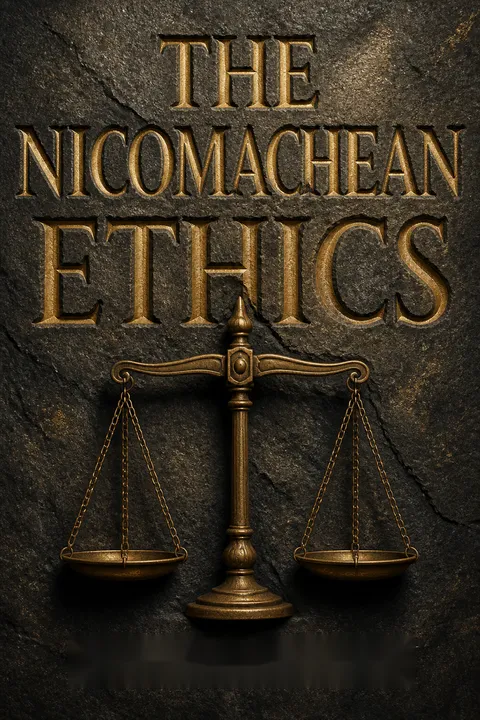


Key Takeaways
Define happiness as excellent activity sustained across a complete life
Happiness is a way of living. Aristotle’s happiness, often called flourishing, is not a passing mood or a possession. It is the sustained exercise of the human capacity for reason, performed well through virtue. His argument begins with the idea that people pursue lesser aims, such as wealth or honour, for the sake of something further. Happiness is different: it is chosen for itself and makes a life worth living. A good craftsperson performs a craft well; similarly, human flourishing depends on exercising our distinctively rational capacities well.
A life, not a moment. Virtue must be active, not merely possessed. Someone asleep cannot be flourishing through excellent action, and one impressive day does not establish a good life. Aristotle also allows that circumstances matter: severe misfortune, isolation, or lacking the means to act can damage happiness. Virtue gives life its shape, but it does not make a person invulnerable to fortune.
This definition shifts the measure of a life from how it feels to what its activities express. That distinction remains useful in a culture that often treats happiness as a private emotional score. The emphasis on a complete life also resists judging people by a single success or setback. Yet the account raises a hard question: how much external security is needed before excellent activity becomes possible? Aristotle recognizes that resources and relationships matter, but his framework can make flourishing appear too dependent on achievement. Its strongest reading treats good activity as a human possibility shaped, not guaranteed, by circumstance.
Practice the virtues until noble actions become your character
Character is trained. Aristotle distinguishes intellectual virtue, developed mainly through teaching and experience, from moral virtue, formed through habituation. People become just by repeatedly doing just actions, and temperate by practicing restraint. His analogy is practical: builders learn to build by building, and musicians by playing. The same activities can also produce poor results, so repetition alone is not enough. The quality of the practice matters.
Train desire as well as conduct. A person’s character is revealed not only by what they do, but by whether they take appropriate pleasure or pain in doing it. Good upbringing teaches people to enjoy noble actions and dislike degrading ones. Aristotle compares moral education to medical care: listening to a doctor’s instructions is no substitute for following them. Likewise, studying virtue without practicing it will not make someone virtuous.
The account makes moral development a matter of trained perception and desire, not simply memorizing rules. That connects virtue to learning by doing: repeated acts can make a response easier to recognize and perform. It also explains why education is more than information transfer. Still, practice can reinforce bad norms as readily as good ones. Aristotle acknowledges this when he says the same actions can produce virtue or vice. The practical question is therefore not merely what to repeat, but who sets the standard, what the practice rewards, and whether reflection can correct a harmful routine.
Find the fitting response, not a universal midpoint
The mean depends on the case. Aristotle defines moral virtue as a chosen state that aims at a mean between excess and deficiency. This does not mean splitting the difference or always choosing moderation. The right response depends on the person, situation, object, timing, motive, and manner. Six pounds of food might suit one person and overwhelm another; a trainer must judge what is appropriate for the individual rather than prescribe the arithmetic midpoint.
Some actions have no good middle. Aristotle does not claim every act can be made virtuous by adjusting its degree. Certain acts, including murder and theft, are wrong in themselves, not merely excessive versions of something acceptable. Finding the mean is difficult because the relevant particulars vary, and the person must learn to judge them. Aristotle’s advice is to notice one’s own habitual bias and take care not to drift toward it.
The mean is best understood as calibrated judgment, not a slogan for moderation. It resembles skilled practice in fields where identical rules cannot determine every move: the competent decision depends on context and consequences. This guards against rigid moral recipes. But context-sensitive judgment can also become an excuse for inconsistency or self-interest. Aristotle’s answer is the example of the person with good character, yet that raises the problem of who gets to define such a person. The model is most useful when paired with public reasons that make judgments open to scrutiny.
Use practical wisdom to choose well in particular situations
Good judgment joins ends to means. Practical wisdom is the reasoned ability to deliberate well about what contributes to living well. It differs from scientific knowledge, which concerns what cannot be otherwise, and from art, which makes something beyond the act itself. Practical wisdom concerns action, where circumstances can change and the action is itself part of the end. Moral virtue helps a person aim at what is good; practical wisdom helps determine what to do here and now.
Experience sees the particulars. Aristotle compares a broad medical rule with knowledge of the actual patient. Knowing that certain foods are generally healthy is less useful than knowing which food suits this person. Practical wisdom requires this kind of attention to particulars, which is why time and experience matter. It is not cleverness alone: a person can be skillful at reaching an aim that is not worth pursuing.
This distinction separates intelligence from sound judgment. A person may reason efficiently while choosing a bad end, so competence cannot be assessed only by whether a plan works. Aristotle’s emphasis on particulars also anticipates the limits of algorithmic decision-making: a general rule can guide attention, but it may miss the morally salient fact in an individual case. The framework is not a rejection of rules. It suggests that rules need interpretation by people capable of recognizing both the case and the good at stake.
Treat choices as seeds of character, especially before habits harden
Choice is more than impulse. Aristotle distinguishes choice from appetite, anger, wish, and opinion. Choice is a voluntary desire shaped by deliberation, and it concerns actions within one’s power. People may wish for an outcome they cannot control, such as another person’s success, but they choose among means they can act on. Deliberation works backward from an intended end, considering which available route can best achieve it.
Character accumulates. Aristotle argues that repeated voluntary actions help form the dispositions from which later actions flow. A person may initially have had the power to avoid a pattern, even if the pattern becomes difficult to change once established. He compares this to releasing a stone: the release is chosen, though the motion cannot then be recalled. This account makes early practice morally significant without claiming that every later action is equally easy to control.
The idea captures a familiar feature of self-formation: choices do not merely express a person, they help create the person who will make the next choice. That gives small decisions a longer horizon than immediate reward. The analogy to a released stone is powerful but needs care. Character is shaped by social conditions, limited options, and pressures that individuals do not choose. Responsibility is most defensible when it distinguishes degrees of control rather than treating every harmful habit as freely chosen in the same way.
Understand weakness as passion interrupting judgment, not simple ignorance
Knowing is not always acting. Aristotle calls weakness of will incontinence: a person recognizes the better course yet gives way to appetite or another passion. He rejects the idea that this is simply a failure to know. Someone may possess a general principle while failing to apply it to the immediate case. For example, a person may know that a certain kind of food should be avoided, but in the moment attend instead to the thought that this particular food is pleasant.
Passion can narrow attention. Aristotle compares the state to speaking knowledge without fully using it, as a drunk person might repeat a lesson but not act from it. This helps distinguish the incontinent person from the self-indulgent one. The former acts against a judgment they still hold; the latter endorses the desire as the right guide. The distinction matters because a person who regrets a lapse may be more open to correction than one who sees no reason to change.
This account treats self-control as a problem of attention and action, not merely information. A person can recite a principle while the immediate, vivid attraction of a temptation dominates decision-making. That offers a more realistic model than assuming that better advice automatically changes behavior. It also suggests why regret can matter: it shows that the person’s standards remain active, even if they failed to govern conduct. The limitation is that regret alone does not repair harm. Understanding a lapse should clarify responsibility and support change, not erase consequences.
Use equity when a general rule misfires in a particular case
Justice has a public face. Aristotle describes justice broadly as complete virtue exercised toward other people. In a narrower sense, it concerns fair distribution and the correction of unequal transactions. Distributive justice assigns shared goods in proportion to some recognized claim, though societies disagree about what counts as merit. Corrective justice addresses an injury or unfair exchange by restoring equality between the parties.
Equity repairs rigid rules. Laws speak generally, but real cases can fall outside the usual pattern. Equity is the correction of a law when its universal wording fails to fit a particular circumstance. Aristotle compares it to a flexible measuring rule that adapts to an irregular shape. Equity does not reject law; it asks what a thoughtful lawgiver would have said if the unusual case had been anticipated. This prevents literal enforcement from producing an outcome that defeats the law’s purpose.
The distinction between rule and equitable judgment remains central to legal reasoning. A general law promotes consistency, while equity recognizes that identical treatment can be unjust when relevant circumstances differ. Aristotle’s account gives discretion a principled role: correction should serve the law’s purpose, not a decision-maker’s convenience. The harder question is institutional. If equity depends on wise judgment, how can societies prevent discretion from reflecting status or bias? Fair procedures, transparent reasoning, and review can help ensure that flexibility corrects rules rather than quietly replacing them.
Choose friends for who they are, not only what they provide
Three motives create three friendships. Aristotle distinguishes friendship based on usefulness, pleasure, and the character of the people involved. Utility friends value what each contributes; pleasure friends enjoy one another’s company. Both forms can be genuine in ordinary speech, but they may fade when the benefit or enjoyment disappears. The fullest friendship occurs between good people who wish one another well for the other’s sake.
Character friendship takes time. Such friends need familiarity and trust. They enjoy sharing life and activities, and each can help the other act well. Aristotle calls a friend another self, meaning that a good friend’s actions and flourishing matter as one’s own do. This friendship is uncommon, not because it is mysterious, but because good character is rare and deep familiarity cannot be rushed. Useful and pleasant friendships still matter, but they are not the same kind of bond.
The three-part distinction helps clarify why some relationships survive changing circumstances while others do not. It avoids dismissing practical or pleasurable bonds as false; their value simply depends on what sustains them. The account also treats friendship as an activity, not a label: time together, mutual concern, and shared judgment make the relationship real. Its ideal of virtue-based friendship, however, is demanding and selective. A broad social life cannot consist entirely of intimate bonds, and ordinary care between people with different character or power still has moral importance.
Judge pleasures by the activities they strengthen or disrupt
Pleasure takes its shape from activity. Aristotle rejects both the claim that every pleasure is good and the claim that pleasure is always suspect. Pleasure completes an activity, like a quality that makes a good performance more satisfying. Different activities have different pleasures, and the pleasure associated with a worthy activity is itself worthy. A person who enjoys learning may become more attentive to learning; pleasure can deepen engagement with what is being done.
Pleasures can compete. An unrelated pleasure can interfere with an activity. Aristotle imagines someone trying to follow an argument while a flute performance captures their attention. The music does not make the argument bad; it displaces the attention needed to follow it. Bodily pleasures are not inherently wrong, but pursuing them excessively or in the wrong circumstances can obstruct other goods. The question is not simply whether something feels pleasant, but what kind of activity the pleasure serves.
This view makes pleasure informative without treating it as an infallible guide. Enjoyment can signal fit between a person and an activity, while distraction can reveal competing priorities. The account also anticipates a modern problem of attention: attractive stimuli can interrupt work even when they are not intrinsically harmful. Yet pleasure is shaped by habit and culture, so what feels satisfying is not automatically good. Aristotle’s test, whether a pleasure supports a worthy activity, demands a prior judgment about which activities deserve cultivation.
Make contemplation life's summit, supported by material and civic conditions
Contemplation is the highest activity. Aristotle gives the greatest place to sustained thought about the most valuable objects of knowledge. It is chosen for itself, can be continuous, and depends less than political action on other people’s cooperation. He regards it as the human activity most like divine life. Practical virtues remain essential to human relationships and public life, but he ranks contemplation as the fullest form of happiness.
The ideal still needs support. A human being needs health, food, and other external goods; contemplation is not possible in a life stripped of every resource. Aristotle also closes by arguing that moral theory alone does not make people good. Education, habituation, and laws shape conduct across a lifetime. The ideal life is therefore not simply private thought: it depends on the conditions that let people develop character and use their capacities.
The contemplative ideal gives intellectual activity intrinsic worth, rather than treating thought only as a tool for producing wealth or power. It also places a demanding standard on leisure: free time matters most when it enables serious attention. The tension is that Aristotle ranks a relatively solitary activity above the civic and practical work that supports shared life. His own insistence on external goods and good laws partly answers that tension. A contemporary reader can preserve the value of contemplation without assuming that every person has equal access to the time and stability it requires.
Analysis
The Nicomachean Ethics is a practical inquiry arranged as an argument: it begins by asking what human life is for, builds an account of character and action, tests it through justice, friendship, and pleasure, then closes by asking how a community can cultivate virtue. Its central move is to define happiness as excellent activity over a complete life, not as a feeling, reward, or possession. This makes the book less a catalogue of commandments than a theory of formation. People become capable of good judgment through practice, and good judgment is needed because moral situations resist exact formulas.
That structure also explains the work’s lasting tension. Aristotle presents ethics as contextual, yet anchors judgment in the exemplary virtuous person. The approach is humane about complexity, but it can seem circular: the good person identifies the right mean, while the right mean defines the good person. His response is largely developmental. Habituation educates desire, experience teaches attention to particulars, and friendship gives people a setting in which to observe and improve one another. Moral reasoning is therefore embodied and social, not merely deductive.
The political frame matters. Laws and education are not add-ons to private morality. They help form the dispositions that make responsible choice possible. This insight is powerful, though the book’s assumptions about social rank, gender, and who can participate in civic life constrain its account of human flourishing. Its ideal of contemplative happiness also sits uneasily beside the shared labor and material support on which contemplation depends.
A modern reading need not accept every hierarchy to retain the book’s strongest insight: ethical life involves learning to perceive what a situation asks, then acting from a character shaped by repeated practice. The framework is demanding because neither knowledge nor good intentions suffice. It asks whether conduct, desire, relationships, and institutions reinforce a life of good activity. That question keeps the work practical even where its answers require revision.
Review Summary
Nicomachean Ethics is widely regarded as a foundational work on virtue ethics and practical philosophy. Readers praise Aristotle's insights into human nature, happiness, and moral character. Many find the sections on friendship particularly compelling. While some struggle with the dense writing style, most agree the effort to understand Aristotle's ideas is rewarding. Critics note his views on women and slavery as problematic. Overall, the work is seen as a seminal text that continues to influence Western thought on ethics and the good life.
People Also Read







Glossary
happiness
flourishing through activityAristotle’s term for the highest human good, often understood as flourishing rather than a passing feeling. Happiness consists in activity of the soul in accordance with virtue across a complete life. It is chosen for itself, though external goods and favorable conditions help make excellent activity possible.
mean
the fitting responseThe appropriate response between excess and deficiency in a passion or action. It is not a fixed midpoint or identical amount for everyone. The mean is relative to the person and circumstances, and practical judgment determines what is fitting. Some acts, in Aristotle’s view, are wrong in themselves and have no virtuous mean.
practical wisdom
sound judgment about actionA reasoned capacity to deliberate well about human goods and act appropriately in particular situations. Unlike scientific knowledge, it concerns matters that can be otherwise; unlike craft, it guides action rather than making a separate product. It requires experience and works together with moral virtue, which directs a person toward worthy ends.
choice
deliberated voluntary desireA form of voluntary desire shaped by prior deliberation. Aristotle distinguishes choice from appetite, anger, wish, and opinion. It concerns actions within a person’s power, especially the means selected to pursue an end. Because choices express and reinforce dispositions, they contribute to the formation of character.
incontinence
acting against better judgmentA weakness in which someone gives way to appetite or passion despite judging that another course is better. Aristotle distinguishes this from self-indulgence: the incontinent person does not endorse the excessive desire as the right guide and may regret yielding to it. The failure involves not fully bringing practical knowledge to bear on the immediate case.
equity
fair correction of lawA form of justice that corrects a law when its general wording fails to fit an unusual case. Since legislation must speak broadly, it cannot anticipate every circumstance. Equity asks what the lawgiver would have prescribed if the particular situation had been foreseen, adapting the rule to its purpose rather than discarding it.
distributive justice
proportionate allocationThe form of particular justice concerned with distributing shared goods, such as money or honors, among members of a political community. Aristotle describes a just distribution as proportionate to merit, while recognizing that political groups disagree about what merit means. Unequal claims may warrant unequal shares if the relevant proportions are respected.
perfect friendship
friendship grounded in virtueThe fullest form of friendship, found between people of good character who wish one another well for each other’s sake. It includes mutual goodwill, trust, pleasure in shared life, and a desire to act well. It requires time and familiarity, so Aristotle considers it rarer and more enduring than friendships based mainly on utility or pleasure.
contemplative activity
sustained activity of thoughtThe exercise of the rational capacity in understanding and contemplating the highest objects of knowledge. Aristotle regards it as the most continuous and self-sufficient human activity, and therefore the highest form of happiness. It still depends on basic external conditions, since people need bodily care and resources to live and think.
FAQ
What's The Nicomachean Ethics by Aristotle about?
- Exploration of Ethics: The Nicomachean Ethics is a foundational text in Western philosophy that examines the nature of ethical virtue and the path to achieving a good life.
- Focus on Happiness: Aristotle argues that the ultimate goal of human life is happiness, defined as "activity of the soul in accordance with virtue," achieved through rational action.
- Types of Virtue: The book distinguishes between moral virtues, developed through habit, and intellectual virtues, cultivated through teaching and experience.
Why should I read The Nicomachean Ethics by Aristotle?
- Influential Philosophical Work: This text has significantly influenced ethical thought and moral philosophy, essential for understanding Western philosophical traditions.
- Practical Guidance: Aristotle provides practical advice on living a virtuous life, emphasizing moderation and the "Golden Mean" in ethical behavior.
- Understanding Human Nature: The book offers insights into human behavior, motivation, and the pursuit of happiness, relevant in contemporary ethical discussions.
What are the key takeaways of The Nicomachean Ethics by Aristotle?
- Happiness as the Chief Good: Happiness is the ultimate end of all human actions, achieved through virtuous living.
- The Golden Mean: Virtue lies in finding the balance between excess and deficiency, referred to as the "mean" in various aspects of life.
- Role of Community: Humans are social beings, and achieving virtue involves interactions with others and contributing to the common good.
What are the best quotes from The Nicomachean Ethics by Aristotle and what do they mean?
- "Every art and every inquiry... is thought to aim at some good.": Highlights the purposefulness of human action, aiming for some form of good.
- "Happiness is the meaning and the purpose of life, the whole aim and end of human existence.": Emphasizes that happiness is the ultimate goal of life, achieved through virtuous actions.
- "The good for man is an activity of the soul in accordance with virtue.": Stresses that true goodness and fulfillment come from living virtuously.
What is Aristotle's definition of virtue in The Nicomachean Ethics?
- State of Character: Virtue is a state of character that allows individuals to act in accordance with reason, choosing the mean between extremes.
- Moral and Intellectual Virtues: Distinguishes between moral virtues, developed through habit, and intellectual virtues, cultivated through teaching.
- Practical Application: Virtue involves practical application in daily life, guiding individuals to make choices leading to a good life.
How does Aristotle describe happiness in The Nicomachean Ethics?
- Activity of the Soul: Happiness is "activity of the soul in accordance with virtue," an active engagement in virtuous living.
- Self-Sufficiency: True happiness is self-sufficient, derived from one's actions and character, not external factors.
- Complete Life: Happiness is achieved over a complete life, requiring consistent virtuous actions and fulfillment of potential.
What is the "Golden Mean" in The Nicomachean Ethics by Aristotle?
- Balance Between Extremes: The "Golden Mean" is the desirable middle ground between excess and deficiency in various virtues.
- Examples of Virtues: Courage is the mean between recklessness and cowardice; temperance is the mean between self-indulgence and insensibility.
- Guiding Principle: The Golden Mean is a guiding principle for ethical behavior, suggesting moderation in all aspects of life.
How does Aristotle differentiate between moral and intellectual virtues in The Nicomachean Ethics?
- Moral Virtues: Developed through habit and practice, concerned with emotions and actions, such as courage and temperance.
- Intellectual Virtues: Cultivated through teaching and experience, related to reasoning and knowledge, such as wisdom and understanding.
- Interdependence: Both types of virtues are necessary for a good life; moral virtues guide actions, while intellectual virtues inform decisions.
What role does community play in The Nicomachean Ethics by Aristotle?
- Social Beings: Humans are inherently social creatures, and the pursuit of virtue involves relationships and contributing to the community.
- Political Science: Political science governs the study of all other sciences, determining how citizens should live and learn.
- Common Good: Ethical behavior aims for individual happiness and the well-being of the community, highlighting interconnectedness.
How does Aristotle address the concept of justice in The Nicomachean Ethics?
- Distributive and Rectificatory Justice: Distinguishes between fair allocation of resources and addressing wrongs to restore balance.
- Equality and Proportion: Justice seeks equality and proportion in relationships, ensuring individuals receive what they are due.
- Legal vs. Natural Justice: Differentiates between legal justice, based on laws, and natural justice, universal and inherent in human nature.
What is the significance of practical wisdom (phronesis) in The Nicomachean Ethics by Aristotle?
- Guidance for Ethical Action: Practical wisdom is essential for making sound moral decisions and navigating complex situations.
- Integration of Virtue and Intellect: Combines moral virtue and intellectual understanding, enabling effective action.
- Role in Friendship: Helps understand and respond to friends' needs, fostering deeper connections.
How does Aristotle view the relationship between pleasure and happiness in The Nicomachean Ethics?
- Pleasure as an Integral Part: Pleasure is important but not the sole component of happiness; true happiness involves virtuous activity.
- Different Types of Pleasure: Noble pleasures arise from virtuous actions, while base pleasures do not contribute to true happiness.
- Pleasure and Activity: Pleasure enhances the experience of living virtuously, with fulfilling pleasures coming from meaningful activities.
About the Author





Download PDF
Download EPUB
.epub digital book format is ideal for reading ebooks on phones, tablets, and e-readers.








