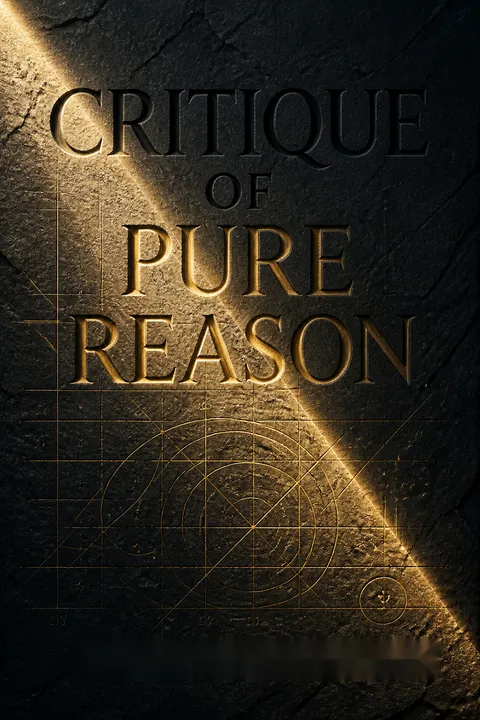


Key Takeaways
Make reason examine its own jurisdiction before trusting metaphysical claims
A crisis of confidence. Kant opens with a problem: human reason naturally asks about God, freedom, and the soul, yet those questions reach beyond what experience can test. Metaphysical schools offer confident answers, then collide without settling anything. Simply dismissing metaphysics does not work, since the questions return whenever reason reflects on itself. Kant proposes a critique: not a review of other philosophers, but an examination of reason’s sources, powers, and limits.
A tribunal, not a ban. The aim is to distinguish legitimate knowledge from claims that exceed their evidence. Reason should not be silenced, but it must not appoint itself judge and witness in disputes its methods cannot resolve. The inquiry promises a modest but essential gain: clearer boundaries for knowledge and less room for false certainty.
What's striking is that Kant treats overconfidence as a problem of jurisdiction, not merely bad judgment. The image of a tribunal suggests that intellectual authority needs procedures and limits, much as law does. That framing remains useful wherever a field's tools are mistaken for universal tools. Yet a tribunal of reason faces a difficult question: what authorizes its own standards? Kant's answer is to investigate the conditions that make experience and knowledge possible. The method is powerful, but its own claims must still be examined rather than accepted as self-certifying.
Ask how necessary knowledge is possible before extending it beyond experience
Two kinds of judgment. An analytic judgment unpacks what a concept already contains: describing a body as extended adds no new feature to the idea of a body. A synthetic judgment adds information, as when one says bodies are heavy. Kant’s central question is how a judgment can add knowledge while being known independently of experience. He calls such judgments synthetic a priori.
Construction matters. His example is arithmetic. Merely analyzing the ideas of seven and five does not reveal their sum; one must construct the addition in intuition, such as by counting units. Kant argues that mathematics and basic principles of natural science rely on necessary knowledge that experience alone cannot supply. Their possibility, and the limits of metaphysics, become the test of reason’s powers.
Kant's distinction helps separate a claim's meaning from the grounds that make it informative. It also explains why repeated observation, however extensive, does not by itself establish strict necessity. The difficult question is whether the examples he treats as necessary remain necessary under every possible conceptual scheme. His account makes mathematics a model for inquiry, but not every field can construct its objects as geometry does. The lasting lesson is methodological: identify what a claim adds, then ask what warrants that addition.
Treat space and time as conditions of human experience, not known things-in-themselves
Forms of perception. Kant argues that space is not learned by noticing relations among external objects, because we must already represent objects as outside one another to perceive those relations. Time similarly makes it possible to experience succession and change. He calls space and time pure forms of intuition: structures through which humans receive sensory appearances, rather than properties known to belong to things independently of us.
Real, but not absolute. Space and time are objectively valid for everything humans can experience, so ordinary objects are not mere fantasies. But their validity does not prove that things-in-themselves exist in space and time. This distinction, empirical reality combined with transcendental ideality, lets Kant defend everyday and scientific experience while refusing to claim access to reality as it is apart from human perception.
This account avoids a simple choice between naive realism and the claim that the world is imaginary. It distinguishes a shared, rule-governed experience from knowledge of reality independent of any observer. That distinction is especially useful when people confuse the conditions through which something is known with properties the thing must possess in itself. Still, Kant's confidence about space and time as fixed forms of human intuition is demanding. The insight is strongest as a warning about the limits of inference, not as proof that every feature of perception is universal.
Join sensory intuitions and concepts to turn impressions into experience
Receiving and organizing. Sensibility gives us intuitions, the immediate sensory presentation of objects. Understanding supplies concepts and rules for combining what is presented. Neither alone produces knowledge: without concepts, sensations are not organized as objects; without intuition, concepts have nothing to refer to. Kant calls the basic concepts of understanding categories. They include substance, causality, unity, and necessity, arranged under broader functions of thought.
One experience, one consciousness. The many elements of perception must be combinable in a unified consciousness, expressed by the thought that these representations belong to one subject. Kant calls this the transcendental unity of apperception. It is not proof that the self is a simple, immortal substance. It is a condition for recognizing perceptions as connected parts of an experience, rather than as unrelated mental fragments.
The account makes knowledge an achievement of coordination: sensory input must be organized, and that organization must be shareable across moments of experience. This resembles a general insight in psychology and cognitive science, where perception is not treated as a passive copy of incoming stimulation. The comparison should not be mistaken for a modern scientific confirmation of Kant's categories. His claim is about what must be true for experience to count as unified knowledge, not about the brain's particular mechanisms. That distinction keeps the framework illuminating without turning it into neuroscience.
Use concepts only where intuition can give them an object
Thinking is not knowing. A person can form a coherent thought about something without possessing knowledge of it. For knowledge, a concept must connect to an intuition, an object presented through sensibility. The categories acquire legitimate use when they organize possible experience. Used beyond that range, concepts such as substance or cause may still be thinkable, but they do not establish that an object answering to them exists.
A boundary, not a second world. Kant calls an object considered apart from our sensible way of perceiving it a noumenon. In the negative sense, the term marks what human knowledge cannot reach. In the positive sense, it would mean an object given through non-sensory intellectual intuition, a faculty Kant says humans do not possess. The concept limits claims about knowledge; it does not describe a hidden realm we can investigate.
The distinction between thinkability and knowability is a strong defense against treating a coherent description as evidence of an existing object. It also disciplines debates where concepts travel more easily than evidence. A useful caution is that the boundary does not make speculation worthless: it can still clarify what is being assumed and what remains unanswered. Kant's point is narrower and sharper. Without an appropriate way for an object to be given, conceptual consistency alone cannot turn a possibility into knowledge.
Read reason's cosmic contradictions as evidence that its starting point needs repair
Four unavoidable clashes. Reason seeks a complete account of the conditions behind the world and generates opposing arguments: the world must have a beginning, or stretch endlessly backward; matter must reduce to simple parts, or divide without end; freedom must begin actions, or nature must determine every event; an absolutely necessary being must exist, or none can. Kant calls these conflicts antinomies of pure reason.
Different conflicts need different answers. In the first two, reason wrongly treats the world as a complete object existing independently of experience. Neither a finished finite totality nor a finished infinite one is available to us. The last two are different: natural causality can govern actions as appearances, while freedom can be thought from another standpoint; an intelligible necessary ground is also not ruled out by the empirical regress. These possibilities resolve contradictions, but do not provide speculative knowledge of what lies beyond experience.
The antinomies dramatize a valuable diagnostic idea: equally forceful arguments may share an assumption that makes both conclusions misguided. Kant does not give every dispute the same cure. Questions about total size are treated differently from questions about causation, freedom, and necessity, where distinct standpoints can coexist. That care matters because apparent contradictions do not always show that both claims are false. The framework is most useful when it prompts a search for hidden assumptions, while leaving open whether Kant's own distinctions fully settle each modern version of these disputes.
Use reason's big ideas to guide inquiry, not certify invisible objects
Seek unity without pretending to possess it. Reason naturally pushes understanding to connect findings into a coherent whole. Kant calls ideas such as the soul, the world as a totality, and God transcendental ideas: reason's concepts of completeness, not objects that experience can present in full. Treated as descriptions of existing objects, they generate unjustified claims. Treated as regulative ideas, they guide inquiry toward greater unity and wider explanation.
A guide, not a stopping point. A scientist may search for common principles behind diverse natural processes, or interpret nature as if its order were unified by intelligence. Such approaches can orient investigation, but they do not prove a single hidden cause or authorize researchers to stop seeking natural explanations. An idea earns its scientific value by directing inquiry, not by masquerading as a discovery.
This distinction captures how ideals can be intellectually productive without being literal descriptions. A complete theory may be unattainable yet still guide researchers toward simpler, more connected explanations. The same distinction helps separate a fruitful research program from a claim that has already been established. Kant's caution is particularly important when appeals to design end empirical investigation rather than guide it. The qualification is that a regulative ideal can still bias inquiry: a demand for unity may encourage elegant explanations even where nature is messier than the framework expects.
Let moral duty guide hope where speculative reason cannot prove God or immortality
Obligation is not prediction. Kant argues that speculative reason cannot prove the soul's immortality, God's existence, or freedom as facts about objects beyond experience. But practical reason confronts a different question: what must a person do? Moral laws command action independently of the promise of reward. Freedom matters because obligation presupposes that a person can act in response to reason, even though theoretical knowledge cannot show how this freedom works beyond appearances.
Hope has a practical role. Kant connects morality with the highest good, a condition in which happiness is proportionate to virtue. Since the experienced world does not guarantee this harmony, practical reason supports belief in God and a future life as postulates that make the highest good conceivable. These are grounds for moral hope, not speculative demonstrations or permission to act morally for payment.
Kant's separation of duty from reward protects morality from becoming a bargain: right action is required even when it brings no advantage. The postulates address a different concern, the hope that virtue and happiness can ultimately belong together. That move preserves a role for religious belief after theoretical proof has failed, while keeping belief distinct from knowledge. Its limit is equally important: practical necessity for a moral outlook does not function as public evidence that its objects exist. The account is strongest when treated as an argument about rational hope, not as a disguised proof.
Analysis
The Critique of Pure Reason is both a theory of knowledge and a manual for intellectual restraint. Its central maneuver is not to deny reality, but to distinguish reality as it can be experienced from reality considered independently of the conditions of human experience. Space and time organize perception; the categories organize thought; their joint operation makes objective experience possible. Kant's boundary is therefore productive. It explains why mathematics and natural science can achieve necessity within experience, while warning that the same certainty cannot be carried automatically into claims about the soul, the universe as a completed whole, or God.
The book's narrative is a rescue operation. Metaphysics has not failed because its questions are trivial, but because reason mistakes the need to ask for completeness for the power to know a completed answer. The antinomies make that mistake visible: reason can argue convincingly for opposed conclusions because it treats experience as if it were a fully given object. Critical philosophy changes the question from what lies beyond experience to what our faculties are entitled to claim. That shift is the book's lasting methodological contribution.
There is a productive tension in the system. Kant says categories apply only to possible experience, yet relies on substantive claims about the conditions of experience and about practical reason. He sees this as a difference in legitimate use, not a contradiction. Readers must decide whether the boundary is convincingly established or partly stipulated by the very framework it protects. A second tension concerns his examples. His account of geometry and natural law reflects the scientific standards available to him; later developments in physics and mathematics complicate the idea that their specific forms are timeless necessities. That does not erase his broader point: knowledge depends on organizing principles, and those principles deserve scrutiny. The book is best read not as a final inventory of human cognition, but as a demand to separate evidence, conceptual conditions, and moral commitment before treating any of them as certainty.
Review Summary
Critique of Pure Reason is widely regarded as a seminal work in Western philosophy, though challenging to read. Kant attempts to reconcile rationalism and empiricism, exploring the limits of human knowledge and reason. The book critiques traditional metaphysics and presents Kant's transcendental idealism. Readers appreciate its profound insights but struggle with its dense prose and complex arguments. Many consider it essential for understanding subsequent philosophical developments, though some find Kant's system ultimately unconvincing or overly complicated.
People Also Read



Glossary
a priori
independent of experienceKnowledge is a priori when its justification does not depend on particular sensory experiences. Kant distinguishes it from knowledge merely learned before a specific observation: a claim inferred from past experience is not a priori in the strict sense. Pure a priori knowledge contains no empirical element.
synthetical judgements a priori
necessary knowledge that addsThese judgments extend knowledge by connecting a subject with a predicate not already contained in its concept, while claiming necessity independently of experience. Kant asks how they are possible because mathematics and fundamental principles of natural science appear to depend on them. Their validity, he argues, rests on conditions that make experience possible.
Transcendental Aesthetic
forms of sensory intuitionKant's inquiry into the a priori conditions of sensibility, the faculty through which objects are given to human beings. It identifies space as the form of external intuition and time as the form of internal intuition, and argues that both apply to objects as experienced, not to things considered apart from experience.
categories
rules for thinking objectsThe categories are basic concepts of the understanding, such as unity, substance, causality, and necessity. They organize the manifold of intuition into experienceable objects and events. Kant argues that they have objective validity for possible experience, but cannot by themselves establish knowledge of objects beyond it.
transcendental unity of apperception
unity across representationsThis is the condition that allows diverse representations to belong together in one consciousness. The thought that representations are mine requires that they be connectable within a unified perspective. Kant treats this unity as necessary for objective experience, not as proof that the self is a simple or immortal substance.
Transcendental Idealism
appearances depend on our formsKant's position that objects in space and time are real as objects of possible experience, while space and time are forms of human sensibility rather than known properties of things-in-themselves. The position is not the claim that external objects are illusions. It limits what can be known about reality independently of experience.
noumenon
object beyond sensible knowledgeA noumenon is an object considered apart from the conditions of human sensibility. In its negative use, the term marks the limit of sensible knowledge. A positive noumenon would require intellectual intuition, a mode of directly receiving objects that Kant says humans do not possess. The term therefore does not provide knowledge of a hidden world.
Antinomy of Pure Reason
reason's opposing conclusionsAn antinomy is a conflict in which reason can develop persuasive arguments for opposing claims about the world as a whole. Kant identifies four: about the world's limits, simple parts, freedom, and necessary existence. He traces these conflicts to reason's demand for completeness and argues that their resolution depends on distinguishing appearances from things-in-themselves.
regulative principle of reason
guide toward systematic unityA regulative principle directs inquiry toward greater order and completeness without asserting that the ideal it sets is an object already known to exist. Kant contrasts this use with a constitutive claim, which determines an object. Ideas of totality, including the world as a whole, can guide investigation but cannot establish their own objects.
Summum Bonum
virtue joined with deserved happinessThe highest good is the ideal in which happiness accords with moral worth. Kant argues that morality does not make right action a means to personal reward. Practical reason nevertheless connects moral striving with hope that virtue and happiness can ultimately be harmonized, supporting its postulates of God and a future life.
FAQ
What's Critique of Pure Reason about?
- Philosophical Inquiry: Critique of Pure Reason by Immanuel Kant explores the foundations of human knowledge, focusing on how we understand the world through a priori concepts and intuitions.
- Transcendental Idealism: Kant argues that our experiences are shaped by the mind's structures, specifically through the forms of space and time, which are conditions of our perception rather than properties of things themselves.
- Synthesis of Knowledge: The book emphasizes the synthesis of sensory experiences and pure concepts, concluding that knowledge is a combination of empirical and a priori elements.
Why should I read Critique of Pure Reason?
- Foundational Text: This work is a cornerstone of modern philosophy, influencing fields such as metaphysics, epistemology, and ethics.
- Understanding Human Cognition: It provides insights into how we acquire knowledge and the limits of our understanding, crucial for anyone interested in philosophy or cognitive science.
- Engagement with Key Concepts: The book introduces essential concepts like the categories of understanding and the nature of metaphysics.
What are the key takeaways of Critique of Pure Reason?
- A Priori Knowledge: Kant distinguishes between a priori knowledge (independent of experience) and empirical knowledge (derived from experience), asserting both are essential for understanding.
- Categories of Understanding: The book outlines pure concepts that structure our experiences, allowing us to make sense of the manifold of intuition.
- Limits of Reason: Kant emphasizes that reason must remain within the bounds of possible experience to avoid contradictions and illusions.
What are the best quotes from Critique of Pure Reason and what do they mean?
- "Human reason... is called upon to consider questions... which it cannot answer.": Highlights the limitations of human reason in metaphysical questions beyond empirical experience.
- "All our knowledge begins with experience.": Asserts that while knowledge starts with sensory experience, a priori concepts also play a crucial role.
- "The categories are conditions of the possibility of experience.": Emphasizes that the categories of understanding are essential for structuring our experiences.
What is transcendental idealism in Critique of Pure Reason?
- Mind's Role: Transcendental idealism posits that the mind actively shapes our experiences through innate structures of understanding.
- Limits of Knowledge: We can only know phenomena, not noumena, meaning we understand the world as it appears, not as it is in itself.
- Empirical Basis: All knowledge must be grounded in experience, contrasting with metaphysical claims of knowledge beyond experience.
How does Kant define the categories of understanding in Critique of Pure Reason?
- Pure Conceptions: The categories are pure concepts necessary for the synthesis of experiences.
- Systematic Table: Kant provides a table of categories, including concepts like quantity, quality, relation, and modality.
- Objective Validity: These categories are conditions that make empirical knowledge possible, having objective validity.
What is the difference between phenomena and noumena in Critique of Pure Reason?
- Phenomena Explained: Phenomena are objects of experience, shaped by perceptions and categories of understanding.
- Noumena Defined: Noumena refer to things in themselves, independent of perception, which we cannot know.
- Implications for Knowledge: This distinction highlights the limits of human cognition, suggesting we can know phenomena but not noumena.
How does Kant differentiate between analytical and synthetical judgments in Critique of Pure Reason?
- Analytical Judgments: Judgments where the predicate is contained within the subject, true by definition.
- Synthetical Judgments: Add new information not contained in the subject, requiring empirical verification.
- Importance for Knowledge: Synthetical judgments a priori are crucial for scientific knowledge, allowing necessary claims about the world.
What is the significance of the transcendental unity of apperception in Critique of Pure Reason?
- Self-Consciousness: Refers to the necessary unity of consciousness that allows recognition of the manifold of intuition as belonging to one self.
- Cognition Foundation: Essential for cognition, enabling the synthesis of diverse representations into a coherent experience.
- A Priori Condition: An a priori condition for all knowledge, underpinning self-consciousness and understanding of objects.
How does Kant address the concept of freedom in Critique of Pure Reason?
- Freedom and Determinism: Explores the relationship, arguing that moral responsibility requires a notion of freedom.
- Practical Reason: Distinguishes between theoretical and practical reason, allowing for free will within a deterministic framework.
- Moral Imperatives: True freedom is acting according to moral laws we give ourselves, foundational for his ethical theory.
How does Critique of Pure Reason influence modern philosophy?
- Foundation for Epistemology: Lays the groundwork for modern epistemology, influencing exploration of knowledge and perception.
- Impact on Metaphysics: Reshapes metaphysical inquiries, prompting reconsideration of reality and our access to it.
- Ethical Implications: Influences ethical theory, shaping discussions around autonomy, duty, and moral law.
What is the ultimate aim of pure reason according to Kant?
- Unity of Knowledge: Achieving a systematic unity of knowledge that integrates empirical and moral dimensions.
- Moral and Practical Ends: Highest ends of reason are moral, focusing on the pursuit of the good and ethical obligations.
- Connection to Happiness: Ideal of the supreme good, combining morality and happiness, guiding human action and moral development.
About the Author


Download PDF
Download EPUB
.epub digital book format is ideal for reading ebooks on phones, tablets, and e-readers.








