

Key Takeaways
Remember that the known world is representation, not reality-in-itself
Knowing has a standpoint. Schopenhauer begins with a claim about experience: anything known appears as an object to a subject. The sun, a tree, and even the body are known through perception, not encountered as reality entirely independent of a knower. He calls this world as it appears to consciousness representation. That does not mean it is imaginary. It means that whatever we experience is already shaped by the conditions of experiencing it.
Appearance is still real. Space, time, and causality organize the world of experience. They let events appear as separate, located, and connected, but they do not reveal what reality is in itself. Schopenhauer compares waking life and dreams: waking experience is more continuous, but continuity alone does not settle the deeper question of what lies beyond appearance.
This opening move is powerful because it shifts philosophy from asking what the world is made of to asking how anything becomes knowable. Contemporary theories of perception likewise emphasize that seeing is an active process shaped by sensory systems, rather than a simple copy of the outside world. That connection supports the modest claim that experience has a structure. It does not, by itself, prove Schopenhauer's stronger metaphysical conclusion that reality beyond experience has a single underlying nature. The distinction between what perception constructs and what exists independently remains a live philosophical problem.
Read bodily willing as the clue to nature's hidden interior
The body is known twice. Schopenhauer argues that a person knows their body both as an object in the world and from within, as willing. Reaching for something, for instance, is not first a mental event that then causes a separate bodily movement. The willing and the movement are one event, encountered in two different ways. He treats this inner access as a clue unavailable in the same form for other objects.
Will means more than choice. Schopenhauer extends the term to the persistent striving he sees throughout nature: animal appetite, plant growth, and forces such as gravity. A stone does not consciously desire to fall. Rather, its regular activity is interpreted as a blind, non-conscious expression of the same underlying will that becomes conscious in human beings.
The bodily starting point gives Schopenhauer a distinctive alternative to theories that treat mind as detached from physical life. It anticipates a broad modern interest in embodied cognition, where thinking and action are understood as deeply connected. The leap from knowing one's own willing to interpreting every natural force as will is more speculative. A critic can accept that bodily agency is known differently from external objects without accepting that gravity has an inner life like human striving. The argument is strongest as a unifying interpretation, not as a scientific discovery.
Stop expecting fulfilled desires to end the business of wanting
Wanting begins in lack. For Schopenhauer, desire is felt as need or discomfort. Getting what was wanted removes that particular discomfort, but rarely creates a lasting state of fulfilment. The object loses its appeal, or another want takes its place. His image is a life swinging between pain when desire is frustrated and boredom when there is nothing immediate to pursue.
Pleasure is temporary relief. Food answers hunger, but not permanently; success can satisfy an ambition, then expose a new one. Schopenhauer therefore treats happiness less as a positive possession than as a pause in suffering. He does not claim that every moment is equally painful. He argues that lasting satisfaction is structurally elusive while the will continues to strive, and that intense desire can make the eventual disappointment sharper.
The account captures a familiar pattern in behavioral economics: people adapt to gains, and a once-exciting improvement can become the new baseline. That helps explain why achievement often fails to deliver the permanent contentment it seemed to promise. But Schopenhauer turns a recurrent human pattern into a universal metaphysical law. Relationships, creative work, and long-term commitments can offer forms of meaning that are not reducible to repeated relief from lack. His analysis is most useful as a warning against treating the next acquisition as a final cure.
Let science explain relations without mistaking explanation for ultimate understanding
Explanations have a boundary. Schopenhauer sees science as discovering how one event or condition relates to another. Physics can explain when a stone falls; biology can trace processes in a living body. Such explanations organize experience through causes, rules, and measurable relations. They do not, in his view, disclose why the underlying forces have the nature they do.
A map is not its subject. The principle of sufficient reason is his name for the rule that things in the experienced world stand in relations of cause, logic, space, time, or motive. Science works within those relations. It can become more complete without answering what existence is in itself. Schopenhauer is not rejecting scientific explanation; he is arguing that explaining a phenomenon through other phenomena does not settle metaphysics.
This distinction remains valuable wherever a successful model risks being mistaken for a complete account of reality. Scientific explanations answer defined questions, and their power does not depend on resolving every metaphysical question. Still, the boundary can be overstated. Discoveries about matter, life, and cognition can change what counts as a sensible philosophical question, even if they do not deliver an ultimate explanation. Schopenhauer's strongest point is methodological: be clear about what a theory explains. His weakest is treating the limits of current explanation as evidence for his own particular metaphysics.
Use art to step outside utility and see enduring forms
Attention can stop serving desire. In ordinary perception, people notice things largely through their usefulness, danger, or relevance to personal aims. Schopenhauer calls aesthetic contemplation a temporary release from that practical stance. The viewer attends to an object for its own sake, rather than asking what to do with it. The object then seems to disclose an enduring form, which he calls a Platonic Idea, rather than merely one particular thing.
Art makes this easier. A painting or poem isolates what matters in a subject and helps others see it with unusual clarity. Schopenhauer gives music a special place: unlike painting or poetry, which present forms of the world, music directly expresses the world's underlying striving. His account of beauty and the sublime also differs: beauty draws attention without a struggle, while the sublime involves contemplating something threatening without surrendering to fear.
The emphasis on attention connects aesthetics to practices of looking closely, from natural history to mindful observation. Art can interrupt habitual categorization and let familiar subjects become newly visible. Schopenhauer's distinction between music and the other arts is evocative, but it is a metaphysical interpretation rather than a testable property of sound. Art also does more than suspend practical concern: it can sharpen political judgment, preserve memory, or prompt action. His theory illuminates one genuine artistic power without exhausting the many ways art matters.
See another's suffering as kin to your own, not remote
Separation can become less absolute. Schopenhauer calls time and space the principium individuationis, the conditions through which one underlying reality appears as many separate individuals. When those boundaries dominate, another person's pain can seem entirely foreign. He argues that justice and compassion become possible as this sense of separation weakens and a person recognizes something shared beneath individual differences.
Compassion changes conduct. Justice means not overriding another's will for the sake of one's own advantage. A more active goodness tries to relieve suffering, even at some cost to the helper. Schopenhauer finds this insight echoed in the Indian teaching Tat tvam asi, meaning that the other is, at a deep level, not wholly separate from oneself. He presents compassion as the source of genuine ethical action, not merely obedience to a rule.
This view gives compassion a deeper basis than social convention: another's pain matters because the boundary between self and other is not ultimate. Modern psychology distinguishes empathy, feeling with another, from compassion, the motivation to help; that distinction can make the ethical step more precise. Shared human vulnerability does not automatically produce concern, and a metaphysical claim about unity cannot settle every conflict of competing needs. Still, Schopenhauer offers a potent test of moral imagination: can another's suffering register as real even when it brings no advantage to the observer?
Build laws to restrain egoism, not to manufacture virtue
Wrong crosses a boundary. Schopenhauer defines wrongdoing as extending one's own will in a way that denies another person's. Violence is the clearest case, but he also includes deception and taking another's property when it embodies their work. Justice, in his account, begins as restraint: each person limits their pursuit so that others are not made to serve it.
Law serves a different purpose. The State arises because people have reason to protect themselves from the harms produced by unchecked egoism. Laws and penalties deter violations and protect public security. They cannot make people compassionate, and punishment is justified by preventing future wrongdoing, not by satisfying a desire for revenge. Schopenhauer thus separates moral goodness from political order: a society can restrain harm without transforming the motives of its citizens.
The separation between law and virtue remains useful in political theory. Institutions can limit harmful conduct without requiring citizens to share a moral creed, while personal ethics can demand more than law can enforce. The distinction also clarifies why punishment should be assessed by its public purpose rather than by the satisfaction of retaliation. Schopenhauer's account, however, gives less attention to how laws can encode unequal power or define whose interests count as protected. A legal order may restrain egoism in some directions while institutionalizing it in others.
Learn your character's limits before planning a life around them
Character is not chosen at will. Schopenhauer distinguishes the underlying character from the actions through which it appears. Motives and new knowledge can change how a person pursues an aim, but he argues they do not remake the person's fundamental willing. That is why a resolution may fail when it asks someone to become a different person rather than to understand their actual tendencies.
Self-knowledge improves choices. He calls acquired character the practical understanding of one's stable dispositions, strengths, and limits, gained through experience. This knowledge can help a person choose fitting pursuits and stop imitating lives that do not suit them. It does not provide metaphysical free will. For Schopenhauer, actions follow necessarily from character and motives, while the will itself, considered beyond the world of appearances, is free from those causal rules.
The distinction between stable dispositions and changing behavior can help people make realistic plans instead of relying on self-reinvention alone. It also raises a serious tension: if character is fixed, what sense remains in praise, blame, or effort? Schopenhauer's answer is that knowledge can alter the route by which a person acts, even if it does not alter the underlying will. Contemporary accounts of behavior often give more weight to learning and changing environments. His model is therefore illuminating about constraints, but less persuasive if treated as a complete theory of personal change.
Do not mistake escape from painful conditions for freedom from willing
Suicide rejects a situation, not life itself. Schopenhauer distinguishes suicide from what he calls denial of the will-to-live. In his interpretation, the person who ends their life is refusing the conditions they find unbearable, while still willing a different, less painful existence. The underlying drive to live is not thereby extinguished. This is a claim within his metaphysical system, not practical advice about a person in crisis.
Resignation is a different idea. Schopenhauer describes denial as a profound quieting of desire, not the destruction of one particular body. He argues that suffering can sometimes contribute to such a change in outlook, but it does not do so automatically. The distinction matters because he does not treat death itself as salvation. His question is whether willing continues, not merely whether an individual life ends.
The distinction between escaping a circumstance and changing one's relation to desire is philosophically important, but the passage can be dangerous if detached from its historical context. Schopenhauer's account should not be used to judge people in suicidal distress or to deny the reality of their pain. Contemporary mental-health practice treats suicidal thinking as a crisis requiring care and support, not as a metaphysical argument. The conceptual point can still be considered safely: removing one source of suffering and transforming the pattern that generates suffering are not the same achievement.
Treat renunciation as a radical response to suffering, not a shortcut
Knowledge can quiet the will. Schopenhauer's final ethical movement is from compassion to renunciation. A person who sees suffering as pervasive and recognizes a shared inner nature may cease to pursue satisfaction as life's highest aim. He calls this denial of the will-to-live. Its visible forms include restraint, voluntary simplicity, chastity, and acceptance of hardship rather than retaliation or renewed grasping.
The endpoint remains elusive. Schopenhauer finds versions of renunciation in Christian mysticism and Indian religious traditions, despite their different beliefs. He distinguishes it from mere deprivation: hardship alone does not guarantee wisdom, and he describes the change as arising from a profound alteration in knowledge. He ends by admitting that what remains after the will is denied cannot be positively described from the standpoint of those who still desire; it appears as nothing to them.
The account links ethical transformation to a change in what seems worth wanting, rather than to a checklist of good behavior. That helps explain why religious traditions often treat disciplined simplicity as more than self-control. Yet renunciation can be confused with self-neglect, and suffering can narrow a person's choices rather than deepen insight. The distinction between freely chosen restraint and deprivation imposed by poverty or coercion is crucial. Schopenhauer's strongest contribution is not a universal prescription to withdraw, but the challenge to ask whether endless acquisition is actually making life more livable.
Analysis
The book's architecture is unusually tight for a work of this scale. Its four movements repeatedly turn one claim over: the world appears as representation, its inner nature is will, art offers a temporary release from willing, and ethics culminates in compassion and renunciation. The sequence matters. Schopenhauer does not begin with a moral rule and then decorate it with metaphysics. He tries to derive ethical concern from a change in how reality is seen, namely from treating separate individuals as expressions of one underlying will.
The most compelling bridge is the body. A person encounters their own action both as a visible event and as willing, then uses that double access to interpret nature. This is philosophically imaginative, but not conclusive. Immediate access to one's own agency does not demonstrate that physical forces share its inner nature. The system's strength is unity; its cost is that a suggestive analogy carries more weight than an argument can securely bear.
Schopenhauer is also more nuanced than the label pessimism suggests. He does not deny that art, compassion, or serenity can matter. He explains them as interruptions or transformations of ordinary striving, not as evidence that life is steadily improving. Yet his universal account of suffering risks flattening differences between unavoidable pain, remediable injustice, and deprivation produced by institutions. Those distinctions matter ethically even if desire remains difficult to satisfy.
The work is best read as a powerful diagnosis, not a settled description of the cosmos. Its account of perception, motivation, and the limits of explanation still provokes useful questions. Its metaphysical identification of the world's inner reality with will remains an interpretation. The lasting challenge is practical as well as theoretical: what changes when other beings are no longer treated as background to one's own striving?
Review Summary
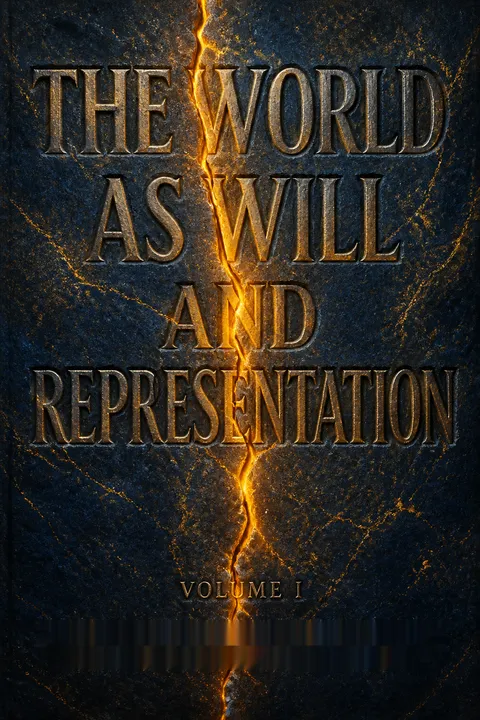
The World as Will and Representation is a challenging philosophical work that explores metaphysics, epistemology, and ethics. Readers find Schopenhauer's prose clear and engaging compared to other philosophers, though his pessimistic worldview can be off-putting. The book presents a unified theory of reality based on Will and representation, drawing on Kant and Eastern philosophy. While some struggle with its length and dense arguments, many appreciate Schopenhauer's unique insights into human nature, art, and the human condition. Overall, it's considered an important and influential philosophical text, albeit one that requires careful study.
People Also Read






Glossary
representation
known world for a subjectSchopenhauer's term for anything that exists as an object of knowledge for a subject. The experienced world, including one's own body as perceived, is representation because it appears through the conditions of knowing. This does not mean the world is imaginary; it means that experience does not disclose reality wholly independent of a knower.
will
inner striving of realitySchopenhauer's name for the inner nature of reality, known most directly in oneself as willing and extended by him to the forces and living processes of nature. It is broader than conscious choice: in plants and inorganic nature it operates blindly, while in animals and people it can be guided by perception or thought.
principle of sufficient reason
rule linking representationsThe general principle that every object of knowledge is connected to others by a ground or reason. Schopenhauer distinguishes its forms: causation among events, grounds for judgements, relations in space and time, and motives for actions. It explains how appearances relate, but does not, in his account, explain reality in itself.
principium individuationis
forms that divide individualsA term Schopenhauer uses for time and space as the forms through which the one underlying will appears as many distinct individuals and events. It names the basis of apparent separation, not a property of the will itself. Seeing through this principle means recognizing that the boundary between oneself and others is not ultimate.
Idea
enduring form of willSchopenhauer uses Idea in the Platonic sense for a stable grade or form in which the will becomes objectively knowable. Individual things are changing appearances of these Ideas. Unlike an abstract concept, an Idea is apprehended through perception in aesthetic contemplation, rather than built by collecting verbal definitions.
pure subject of knowledge
observer released from willingThe subject's temporary state in aesthetic contemplation, when attention is no longer directed by personal needs, motives, or practical relations. The observer attends to an object without treating it as useful or threatening. Schopenhauer describes this as a release from individuality and the ordinary service of knowledge to the will.
acquired character
practical self-knowledgeSchopenhauer's term for the understanding of one's own stable tendencies, abilities, and limits, gained through experience and reflection. It does not mean that a person has changed their fundamental character. Rather, knowing what one can reliably do helps guide choices and reduces the confusion caused by unrealistic ambitions or passing moods.
denial of the will-to-live
renunciation of strivingSchopenhauer's term for a profound quieting or rejection of the will's ordinary drive to pursue satisfaction. He associates it with a knowledge of suffering and the shared nature of living beings, and describes it through voluntary restraint, compassion, and asceticism. He distinguishes it sharply from suicide, which he interprets as rejecting painful conditions rather than willing itself.
FAQ
What's The World as Will and Representation about?
- Philosophical Exploration: The book presents Arthur Schopenhauer's philosophy, which posits that the world is fundamentally a representation shaped by our perceptions and consciousness.
- Will as Central Concept: Schopenhauer argues that the essence of reality is the "will," which is the driving force behind all phenomena, contrasting with mere representation.
- Dual Nature of Existence: The text explores the duality of existence, where the world is both representation (how we perceive it) and will (the underlying reality).
Why should I read The World as Will and Representation?
- Influential Philosophy: Schopenhauer's work has significantly influenced existentialism, psychology, and the arts, making it essential for understanding modern thought.
- Deep Insights: The book offers profound insights into human existence, suffering, and the nature of reality, encouraging readers to reflect on their own lives.
- Unique Perspective: Schopenhauer's perspective on the will as the essence of life provides a unique lens through which to view human motivation and behavior.
What are the key takeaways of The World as Will and Representation?
- Representation vs. Will: The distinction between the world as representation and the world as will is central, emphasizing that our perceptions shape our understanding of reality.
- Suffering and Desire: Schopenhauer discusses how human suffering arises from unfulfilled desires, linking this to the nature of the will.
- Art and Aesthetics: The book highlights the role of art as a means to transcend the suffering of existence, offering a glimpse of the will's true nature.
What are the best quotes from The World as Will and Representation and what do they mean?
- "The world is my representation": This quote encapsulates the idea that our understanding of the world is subjective and shaped by our perceptions.
- "The will is the thing-in-itself": This statement asserts that the will is the true essence of reality, beyond mere appearances and representations.
- "Life is a dream": Schopenhauer suggests that our experiences may be illusory, emphasizing the transient nature of existence and the importance of seeking deeper truths.
How does Schopenhauer define the concept of will in The World as Will and Representation?
- Inner Essence: Schopenhauer defines will as the fundamental driving force behind all existence, representing the true nature of reality beyond mere appearances.
- Objectification of Will: The will manifests itself in various forms, including human actions and natural phenomena, which are seen as expressions of this underlying force.
- Groundlessness of Will: The will is described as "groundless," meaning it does not require external justification or cause, existing independently of the principle of sufficient reason.
What is the principle of sufficient reason in The World as Will and Representation?
- Foundation of Knowledge: The principle of sufficient reason states that everything must have a reason or cause, forming the basis for understanding phenomena.
- Four Aspects: Schopenhauer identifies four forms of this principle: becoming (causality), knowing (knowledge), being (existence), and acting (motivation).
- Relation to Representation: This principle governs how we perceive and understand the world, linking our experiences to the underlying will.
How does Schopenhauer view suffering in The World as Will and Representation?
- Suffering from Desire: Schopenhauer posits that suffering arises from unfulfilled desires, which are driven by the will, leading to a cycle of wanting and dissatisfaction.
- Existential Perspective: He suggests that life is inherently filled with suffering, and understanding this can lead to a more profound acceptance of existence.
- Transcendence through Art: Schopenhauer believes that art can provide a temporary escape from suffering, allowing individuals to experience a glimpse of the will's true nature.
What role does aesthetics play in The World as Will and Representation?
- Art as Escape: Schopenhauer views art as a means to transcend the suffering of existence, offering a temporary reprieve from the will's demands.
- Reflection of Will: He argues that great art reflects the essence of the will, allowing viewers to connect with deeper truths about existence.
- Aesthetic Experience: The experience of beauty in art can lead to a momentary suspension of the will, providing insight into the nature of reality.
How does The World as Will and Representation relate to Kant's philosophy?
- Continuation of Kantian Thought: Schopenhauer considers his philosophy a continuation of Kant's ideas, particularly regarding the distinction between phenomena and noumena (thing-in-itself).
- Critique of Kant: While he acknowledges Kant's contributions, Schopenhauer critiques certain aspects, particularly the notion of the thing-in-itself, which he identifies with the will.
- Sufficient Reason: Schopenhauer builds on Kant's principle of sufficient reason, expanding it to explore the implications of will as the essence of reality.
How does Schopenhauer differentiate between beauty and the sublime in The World as Will and Representation?
- Beauty as Harmony: Beauty is associated with objects that facilitate pure contemplation, allowing the observer to experience pleasure without the interference of the will.
- Sublime as Exaltation: The sublime arises when the observer consciously elevates themselves above the hostile relations of the object to the will, experiencing a profound sense of awe and transcendence.
- Emotional Contrast: While beauty brings peace and joy, the sublime involves a struggle against the overwhelming power of nature or existence, leading to a complex emotional response.
What is the significance of the Platonic Ideas in Schopenhauer's philosophy?
- Eternal Forms: Platonic Ideas represent the eternal, unchanging forms that underlie the transient phenomena of the world, serving as the true essence of things.
- Grades of Objectification: Schopenhauer uses the concept of Ideas to categorize the different grades of the will's objectification, from the lowest (inorganic matter) to the highest (human beings).
- Knowledge and Art: The Ideas are essential for understanding both the nature of reality and the purpose of art, as they provide the framework for comprehending the world beyond mere appearances.
How does Schopenhauer's philosophy relate to ethics in The World as Will and Representation?
- Compassion as Foundation: Schopenhauer posits that true ethics arise from compassion, which stems from recognizing the shared will in all beings. This understanding fosters a sense of moral responsibility towards others.
- Denial of the Will: Ethical behavior involves denying one's own will for the sake of alleviating the suffering of others, leading to a more harmonious existence and a deeper connection with humanity.
- Critique of Traditional Morality: He critiques conventional moral systems that rely on duty or abstract principles, advocating instead for a morality rooted in empathy and the recognition of shared suffering.
Sämtliche Werke in fünf Bänden (Arthur Schopenhauer) Series

About the Author




Download PDF
Download EPUB
.epub digital book format is ideal for reading ebooks on phones, tablets, and e-readers.








