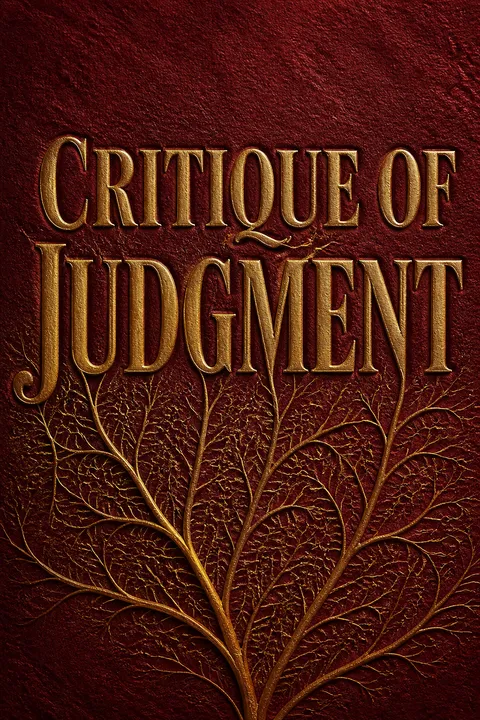


Key Takeaways
Let judgment connect nature's laws to freedom without pretending they are one
Three powers, one problem. Kant distinguishes understanding, which explains nature through laws, from reason, which directs action through freedom. Judgment occupies the middle: it helps relate our experience of nature to the possibility of acting freely, without turning either domain into the other. Its central concept is purposiveness, the idea that nature is organized in ways our minds can investigate and understand.
A bridge, not a discovery. Reflective judgment begins with particular observations and looks for a general rule; determining judgment applies a rule already known. The bridge judgment provides is not proof that nature was made for human purposes, or that freedom is part of the natural causal order. It is a way of making the two perspectives coherent for finite human thinkers.
What's striking is the restraint built into this account of connection. Kant does not resolve the tension between causal explanation and freedom by declaring one unreal; he asks what kind of judgment lets both remain intelligible. That is a useful model for fields where different explanatory vocabularies address the same world, such as biology and ethics. The caution matters too: a bridge between perspectives is not evidence that they share a single hidden mechanism. Confusing practical compatibility with theoretical proof is precisely the kind of overreach this framework is designed to prevent.
Judge beauty apart from appetite, utility, and moral approval
Three kinds of liking. Kant separates the agreeable, which gratifies the senses, from the good, which is judged through a concept or moral principle. Beauty is different from both: it pleases through contemplation, without requiring desire for the object's existence or a verdict about its usefulness. He imagines someone asked whether a palace is beautiful. The palace's cost, purpose, or comfort may matter politically or practically, but none decides the aesthetic question.
Disinterest is not indifference. A judgment of beauty still involves a response to the object; it simply does not depend on wanting to own, consume, or use it. This distinction explains why a flower can please without a botanist's knowledge of its reproductive role, while calling a tool good usually requires knowing what it is for.
The distinction helps separate appreciation from consumption. A person can attend to a landscape, melody, or building without reducing it to a commodity or a means to an end. That separation is especially valuable in a culture where attention is often recruited by advertising and utility. Still, the boundary is not always clean: viewers bring histories, social meanings, and bodily responses to what they see. Kant's account is strongest as a discipline for asking what kind of judgment is being made, not as a claim that any actual experience can be purified of every interest.
Treat a taste claim as shareable, not provable by rules
A universal voice without proof. When someone calls a thing beautiful, the claim reaches beyond personal preference: the speaker expects others to be able to share the pleasure. Yet the claim is not based on a concept that could settle disagreement by demonstration. Kant calls the assumed common basis of this response common sense, not popular opinion but a shared human capacity for judging how imagination and understanding work together.
Why argument has limits. Someone may dislike a wine because of its taste, and no rule can require another person to enjoy it. A dispute about beauty is different: people argue as though agreement should be possible, but reasons and authorities cannot force it. Examples can train judgment, but the individual still has to look and judge for themselves.
This account explains why aesthetic disagreement feels different from disagreement about dessert. A taste claim seeks recognition from others while lacking the proof structure of a factual claim. That makes discussion meaningful without making consensus guaranteed. The difficult question is whose responses count as the shared human standard. Kant grounds the expectation in common mental capacities, but cultures and histories shape what people learn to notice. His model is most useful when it invites comparison and reflection, not when a majority treats its own taste as universal law.
Find the sublime in reason's response, not nature's size
Nature overwhelms imagination. Kant distinguishes the mathematical sublime, prompted by vast magnitude, from the dynamically sublime, prompted by apparent natural power. A traveler near the pyramids may struggle to take in the whole structure at once; a storm-tossed sea can make human physical strength seem trivial. In both cases, the sensible imagination reaches a limit, while reason demands that the mind think beyond what can be pictured.
The elevation is inward. The ocean or mountain is not literally sublime in itself. The experience becomes sublime when the mind recognizes that its rational and moral capacities are not measured by bodily size or strength. This response requires a position of safety: actual terror overwhelms the reflective distance needed to judge the scene. The sublime therefore mixes discomfort at limitation with respect for a capacity that exceeds it.
The sublime turns spectacle into a test of perspective. Scale can expose the limits of perception without proving that the human observer is physically powerful or cosmically central. Kant's distinction between danger and observed danger is important: reflection requires enough distance to keep fear from swallowing judgment. A modern reader can also ask whether every encounter with vastness should end in confidence about human reason. The experience might instead sharpen humility. Either way, the scene matters less as a monument than as an occasion for noticing what the mind can and cannot represent.
Let genius invent forms, while taste keeps invention intelligible
Genius gives art new rules. Kant uses genius for the natural creative capacity that produces fine art without following a fully teachable recipe. Its works are original, but not every novelty qualifies: successful works also become examples that other artists can learn from without simply copying them. Kant contrasts scientific achievement, whose reasoning can be demonstrated, with poetry, whose creator cannot give a complete rule for producing the same work again.
Taste disciplines invention. An aesthetic idea is an imaginative presentation that prompts more thought than any precise concept can contain. Art gains spirit from such ideas, but taste shapes their expression so that the work remains intelligible rather than becoming arbitrary or obscure. Genius supplies fertile material; judgment gives it form. Kant's point is not that artists should ignore craft, but that craft alone cannot generate original fine art.
Kant offers a productive account of creativity as neither rule-following nor rulelessness. A powerful work can open possibilities that its maker could not reduce to instructions, while still requiring judgment and technique to communicate. This helps explain why imitation can teach a craft but cannot guarantee invention. The account also leaves a live tension: if standards emerge from exemplary works, artistic institutions and audiences help decide which examples become authoritative. Genius is therefore not merely a private gift; its public force depends on whether others can find new possibilities in what it makes.
Read organisms as self-making wholes, not elaborate machines
Parts depend on the whole. Kant calls an organism a natural end: a living being whose parts both contribute to the whole and depend on it for their roles. A tree produces another tree, grows by transforming material into its own structure, and relies on its leaves to sustain its life. A watch, by contrast, has parts that serve a purpose but do not produce or repair one another.
Two lenses, not rival discoveries. Mechanistic explanation traces physical causes and remains essential to natural science. Teleological judgment treats an organism as if its organized relations were directed toward an end, because this helps investigators study its structure. Kant does not claim that nature's intention has been observed. He argues that our way of understanding organisms requires this purposive lens, while the ultimate basis of their organization remains unknown.
The whole-part account captures something a parts list can miss: the role of a component depends on the organized life it helps sustain. This makes purposive language useful in biology without requiring every process to be treated as consciously designed. The distinction between a watch and a tree is memorable because repair and self-maintenance matter, not because organisms escape physical explanation. The framework should not become an excuse to stop investigating mechanisms. Its strength is methodological: it identifies what a purely component-by-component account may fail to organize, while leaving causal research in play.
Use apparent design to guide inquiry, not prove a designer
Teleology is a research guide. Teleological judgment interprets an organism or natural arrangement through the idea of an end. Kant treats this as a regulative principle: it guides investigation by helping researchers search for systematic relations, but it does not establish that a conscious designer caused them. His example is the blade of grass. We may need to consider its organized structure in terms of natural ends, even though this does not prove that mechanical explanations are impossible in principle.
Do not turn a method into metaphysics. Nature contains features that appear to serve human purposes, but other features frustrate them, and apparent usefulness does not demonstrate why anything exists. Physical teleology can direct thought toward an intelligent cause, but it cannot establish that cause's existence, attributes, or final purpose. The method supports inquiry into organisms; it does not deliver a theoretical proof of God.
This is a precise warning against a familiar inference: because a system is intelligible through purpose-language, it must have been purposefully designed. Kant separates the usefulness of a model from a claim about ultimate reality. That separation is broadly valuable in science, where models can organize evidence without serving as photographs of the world's deepest structure. Yet the regulative approach also has a risk: if investigators treat purposive descriptions as unquestionable, they may protect assumptions from testing. The discipline is to let the model guide questions while keeping its metaphysical status open.
Make moral freedom, not happiness, humanity's final measure
Happiness cannot define our worth. Kant distinguishes nature's ultimate end for human beings, culture, from creation's final end, the moral freedom of rational beings. Culture develops skills and disciplines impulses, preparing people to choose ends for themselves. Happiness, by contrast, varies with individual desires and depends on conditions nature cannot reliably guarantee. A good will gives human existence a worth that enjoyment alone cannot supply.
Theology follows a practical path. Nature's apparent design cannot prove a divine author or tell us the purpose of creation. Kant's moral argument is narrower: if people are obliged to pursue a highest good that joins happiness with moral worth, practical reason permits faith in the conditions needed to make that end possible. This is not theoretical knowledge of God. It is a practical commitment, grounded in moral life rather than evidence from nature.
Kant's distinction prevents two different claims from collapsing: nature can prepare human capacities, while morality gives human action its distinctive standard. It also resists measuring a life solely by comfort, status, or successful outcomes, many of which depend on luck. The argument's limit is important: a moral need for hope does not establish a metaphysical fact for every observer. Kant presents faith as practical rather than scientific knowledge. That restraint preserves the moral argument's purpose, though readers may still question whether its account of human moral vocation should be treated as universal.
Analysis
The Critique of Judgment is Kant's attempt to explain how one human mind can inhabit two apparently divided orders. Understanding experiences nature through causal laws. Practical reason conceives freedom and moral obligation. Judgment supplies neither a new body of facts nor a new moral code. It supplies a way of reflecting on particulars so that nature can be investigated as coherent and human freedom can be thought as capable of acting within the sensible world.
Aesthetic judgment is the book's most distinctive test case. Beauty is subjective because it concerns the response of a perceiver, yet it speaks as if others ought to be able to share it. Kant refuses both easy answers: beauty is not an objective feature demonstrable by concepts, and it is not merely private pleasure. The idea of a shared common sense explains the claim, though it does not resolve who gets to define that shared standard or how cultural learning shapes taste.
The sublime shifts the focus from an object's form to the mind's encounter with its own limits. Nature can overwhelm the imagination, but reason can think beyond what imagination presents. Kant interprets that contrast through moral vocation. The move is powerful, but it also reveals the book's anthropocentric tendency: nature's significance is repeatedly framed through what it means for human capacities.
The teleological section makes a parallel methodological distinction. Organisms invite explanation through relations of means and ends, yet that perspective is a guide for reflective inquiry, not proof that nature was designed. Kant insists on pursuing mechanical explanation while acknowledging that human understanding may need teleological concepts to organize biological study. His argument therefore concerns the conditions of judgment more than the hidden structure of life itself.
The work's lasting value lies in its disciplined separation of kinds of claim. Aesthetic response is not scientific proof, purposive interpretation is not evidence of a designer, and moral faith is not theoretical knowledge. The system is ambitious, but its strongest insight is modest: human beings need different forms of judgment to make experience, nature, and moral responsibility intelligible without pretending that one form can replace all the others.
Review Summary
The Critique of Judgment receives mixed reviews, with some praising its profound insights into aesthetics and teleology, while others find Kant's writing style challenging. Readers appreciate Kant's exploration of beauty, the sublime, and purposiveness in nature, but some struggle with the dense philosophical language. Many consider it a crucial work in Kant's philosophical system, bridging his earlier critiques. The book's discussions on aesthetics, judgment, and teleology are seen as influential, though some find the teleological sections less engaging than the aesthetic parts.
Glossary
Reflective judgement
Finds rules for particularsA mode of judgment that begins with particular observations and seeks a general rule or concept under which to organize them. It differs from determining judgment, which begins with an already known rule and applies it to a case. Kant uses reflective judgment to explain how people investigate nature when its particular laws are not already known.
Purposiveness
Apparent fitness for an endThe perceived or assumed suitability of a form or arrangement for an end. In aesthetic judgment, purposiveness can be felt in an object's form without representing any specific purpose. In teleological judgment, purposiveness helps us interpret organisms as organized through relations of parts and whole. Kant treats these judgments as ways of reflecting, not direct proof of design.
Common sense
Shared basis for tasteKant's name for the presumed shared capacity that lets people expect others to respond to beauty as they do. It is not popular opinion or an ordinary practical understanding. It refers to a common disposition of imagination and understanding, which makes an aesthetic response communicable even though no concept or proof can compel agreement.
Free play
Unconstrained harmony of facultiesThe mutually enlivening activity of imagination and understanding when no specific concept or rule forces the mind toward a determinate conclusion. In judging beauty, imagination presents a form while understanding remains engaged without settling on a particular concept. Kant takes awareness of this harmonious activity to ground the distinctive pleasure of aesthetic judgment.
The sublime
Reason surpasses sensible presentationAn aesthetic response prompted by something whose magnitude or power overwhelms the imagination. Kant distinguishes the mathematically sublime, associated with vastness, from the dynamically sublime, associated with natural might. The object itself is not literally sublime; the experience reveals the mind's awareness of rational and moral capacities that exceed sensible representation.
Aesthetic ideas
Imaginative presentations beyond conceptsRepresentations of the imagination that prompt extensive thought without being adequately captured by a definite concept. They can give sensible form to ideas or experiences that resist complete verbal or conceptual expression. Kant sees the ability to create such representations as central to fine art and as a key source of its power to animate thought.
Genius
Original capacity that gives art rulesThe natural creative capacity through which fine art produces original and exemplary work without following a fully specifiable recipe. Genius does not make technique or judgment unnecessary. It supplies original material and models that can inspire other artists, while taste shapes and disciplines the work so that its originality does not become arbitrary.
Natural end
Self-organizing natural beingA natural product, especially an organism, whose parts are understood as reciprocally supporting the whole and depending on it. An organism can be considered both cause and effect of its own organization: it sustains its structure and produces beings of its kind. Kant uses the concept to guide biological judgment, not to prove intentional creation.
Technic of nature
Nature judged as purposively organizedKant's term for judging nature's forms as if they were produced through an artlike ordering. The concept helps the power of judgment organize empirical laws and investigate purposive structures, especially in organisms. It does not claim that nature consciously plans, nor does it replace mechanical explanation with a proven supernatural cause.
Final end
Unconditioned end of creationAn end that does not depend on another end as a condition of its possibility. Kant distinguishes a final end from nature's ultimate end, which he identifies with the cultivation of human capacities. The final end is humanity considered as moral and free, since moral agency gives human existence a worth not reducible to happiness or natural usefulness.
FAQ
What's Critique of Judgment about?
- Philosophical Exploration: Immanuel Kant's Critique of Judgment explores the nature of aesthetic and teleological judgments, examining how we perceive beauty and purpose in both art and nature.
- Two Main Parts: The book is divided into two sections: the critique of aesthetic judgment, focusing on beauty and the sublime, and the critique of teleological judgment, addressing purposefulness in nature.
- Connection to Reason: Kant argues that judgments of taste and purpose are grounded in a priori principles, connecting our cognitive faculties to the world.
Why should I read Critique of Judgment by Immanuel Kant?
- Foundational Philosophy: This work is essential for understanding Kant's ideas on aesthetics and teleology, influencing fields like art, ethics, and science.
- Influence on Modern Thought: Kant's exploration of aesthetic judgment has significantly impacted contemporary philosophy, art criticism, and psychology.
- Critical Thinking Development: Engaging with Kant's arguments encourages reflection on subjective versus objective judgments and the principles underlying them.
What are the key takeaways of Critique of Judgment?
- Judgment of Taste: Aesthetic judgments are subjective but claim universal validity, based on a feeling of pleasure or displeasure from the harmony of cognitive faculties.
- Purposiveness in Nature: Kant discusses "purposiveness" in nature, suggesting that natural products can be understood as ends when recognized for their intrinsic organization.
- Moral Connection: The book emphasizes the link between aesthetic experiences and moral law, suggesting that beauty appreciation can deepen moral understanding.
What are the best quotes from Critique of Judgment and what do they mean?
- "Taste is the faculty...": This quote defines taste as the ability to judge beauty in a way that resonates universally, transcending individual preferences.
- "The beautiful is the symbol...": Kant suggests that beauty reflects moral values, elevating our perception of art and nature.
- "The beautiful is that which pleases...": This highlights that beauty is a universal experience of pleasure, not tied to specific concepts.
What is Kant's definition of aesthetic judgment in Critique of Judgment?
- Subjective Experience: Aesthetic judgment arises from pleasure or displeasure in response to an object, based on harmony between imagination and understanding.
- Universal Validity: Despite being subjective, aesthetic judgments claim universal acceptance by all rational beings.
- Disinterested Pleasure: These judgments are characterized by "disinterested pleasure," free from personal gain or desire.
How does Kant differentiate between the beautiful and the sublime in Critique of Judgment?
- Nature of Experience: The beautiful is associated with harmony and pleasure, while the sublime evokes awe and respect, often linked to vastness or power.
- Judgment Characteristics: Beauty judgments are calm and satisfying, whereas sublime judgments involve complex emotions, including pleasure and pain.
- Moral Implications: The sublime is connected to moral ideas, inspiring duty and respect for greater forces.
What is the role of teleological judgment in Critique of Judgment?
- Purposefulness in Nature: Teleological judgment perceives purpose and design in nature, essential for understanding the natural world.
- Reflective Nature: These judgments are reflective, seeking to understand the purposes of natural phenomena.
- Connection to Ethics: Recognizing purpose in nature informs moral reasoning, appreciating ethical responsibilities toward the natural world.
How does Critique of Judgment relate to ethics?
- Beauty and Morality: Kant links beauty appreciation to moral sensibilities, suggesting beauty symbolizes moral goodness.
- Moral Law: Aesthetic judgments can deepen understanding of moral law, encouraging reflection on values and principles.
- Cultural Development: Engaging with beauty enhances moral character and contributes to cultural development.
What is the significance of the concept of "purposiveness without purpose" in Critique of Judgment?
- Aesthetic Experience: This concept allows for pure aesthetic experiences, appreciating beauty without practical considerations.
- Subjective Purposiveness: It highlights the personal nature of aesthetic judgment, claiming universal validity.
- Connection to Nature: Suggests nature's beauty is independent of human use, deepening appreciation of the natural world.
How does Kant address the idea of common sense in Critique of Judgment?
- Common Sense as Principle: Kant introduces common sense as a subjective principle underlying aesthetic judgment, shared among individuals.
- Universality of Aesthetic Judgment: Aesthetic judgments rely on common sense for universal validity, resonating with others.
- Distinction from Understanding: Common sense pertains to pleasure and judgment conditions, emphasizing emotional aspects of aesthetic appreciation.
What is the relationship between art and nature in Critique of Judgment?
- Art as Reflection: Art reflects nature's beauty and purposiveness, engaging aesthetic sensibilities and highlighting human creativity.
- Aesthetic Experience: Both art and nature provide aesthetic experiences, enriching understanding of beauty.
- Moral Implications: Appreciation of beauty in art and nature enhances moral character, emphasizing responsibility toward both realms.
How does Kant's Critique of Judgment relate to modern philosophy?
- Influence on Aesthetics: Kant's work has profoundly influenced contemporary discussions on art, beauty, and taste.
- Moral Philosophy: The connection between aesthetics and ethics inspires exploration of how aesthetic experiences inform moral beliefs.
- Critical Theory: Kant's critique encourages examination of subjective experiences in broader social and political contexts.
About the Author


Download PDF
Download EPUB
.epub digital book format is ideal for reading ebooks on phones, tablets, and e-readers.








