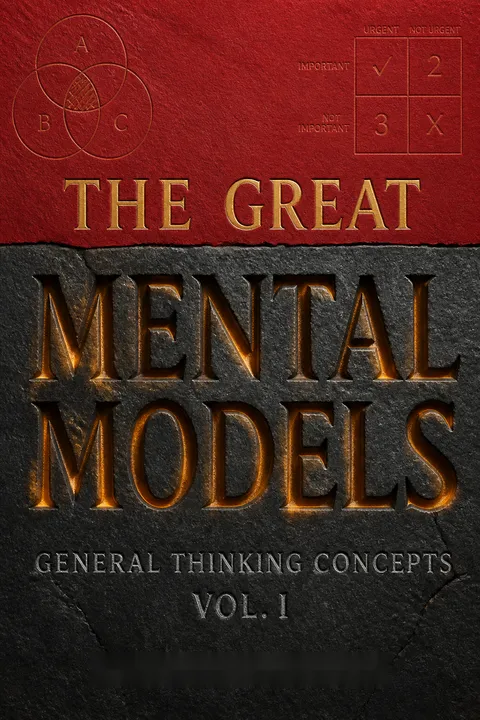


Key Takeaways
Build a latticework of models, then test it against the world
Think through several lenses. A mental model is a simplified representation of how something works. It lets people reason without holding every detail of a complicated situation in mind. A collection of connected models, drawn from fields such as biology, physics, economics, and psychology, can reveal factors that any single specialty misses. An engineer may notice system design, while a psychologist spots incentives. Each view can be useful and incomplete.
Keep the models grounded. A model is valuable only when it helps explain or anticipate real outcomes. The book urges readers to apply models, notice where they fail, and record the results. A decision journal can reveal patterns that memory and ego obscure. The aim is not to memorize isolated facts, but to connect them well enough to guide action.
What's powerful here is the shift from expertise as a silo to expertise as a network. Complex problems often cross institutional boundaries, so a medical decision, for example, may depend on biology, incentives, and human behavior at once. The method also resembles scientific model-building: explanations earn trust through contact with evidence, not elegant phrasing. Still, more models do not automatically mean better judgment. A crowded toolkit can encourage overanalysis or invite a person to apply a familiar idea where it does not fit. The practical skill is selection, followed by honest feedback.
Treat every map as a useful sketch, never as the territory
Abstraction leaves things out. A map, model, policy, or statistic compresses reality for a particular purpose. The London Underground map helps passengers choose a route, but it does not show what a station feels like or guide a train driver. Treating the sketch as the whole world creates blind spots, especially when conditions change.
Ask who drew the map. Maps reflect their makers’ aims and assumptions. The book contrasts Elinor Ostrom’s caution about turning a commons model into universal policy with Jane Jacobs’s criticism of city plans imposed without attention to how streets actually function. A map can even reshape the place it describes. Use it as a guide, check it against lived conditions, and revise it when the terrain disagrees.
This principle has a close cousin in statistics: a measure is not the thing measured. A city’s average income, for instance, can hide neighborhood-level deprivation, while a single performance score can conceal distinct strengths and weaknesses. The map metaphor helps expose such omissions before they harden into policy. It also warns against a subtler error: assuming that a model’s apparent objectivity makes its choices neutral. Yet constant skepticism can make coordination impossible. The goal is not to discard maps, but to understand what question each map answers and what evidence would show it has stopped helping.
Know where your expertise ends before the stakes expose it
Depth beats quick familiarity. A circle of competence is an area where a person has enough experience to understand important details, limits, and unknowns. The book contrasts a town’s long-time resident, who knows its history and relationships, with a newcomer who mistakes a few introductions for deep knowledge. Surface familiarity can produce confidence without the ability to spot hidden risks.
Build evidence, not bravado. Sherpa Tenzing Norgay developed his mountaineering knowledge through years of work and repeated climbs before reaching Everest’s summit in 1953. The book reports that roughly 200 climbers’ bodies remain on the mountain, a stark reminder of the cost of misjudging expertise. Track performance, seek candid feedback, and consult people with deeper knowledge when a decision falls outside your own range.
Competence is more than accumulated facts. It includes calibration: knowing what is uncertain, what evidence is missing, and when another person is better placed to decide. That resembles the idea of metacognition, the ability to monitor one’s own thinking. Deliberate practice and coaching can sharpen this awareness, as the book’s example of surgeon Atul Gawande suggests. A limitation is that expertise can become outdated, or remain too narrow for unfamiliar conditions. A reliable boundary is therefore provisional. Track records and outside scrutiny help determine whether a circle still deserves confidence.
Strip assumptions away until you reach what the problem requires
Separate fact from convention. First principles thinking breaks a problem into its most basic, non-reducible elements in that situation. It does not promise eternal truths. Instead, it asks which assumptions can be tested and which constraints genuinely apply. The book offers two practical tools: disciplined questioning, associated with Socrates, and the Five Whys, which repeatedly asks what explains a claim until it reaches a testable cause or an unsupported assumption.
A medical belief fell apart. Doctors long assumed bacteria could not survive in the stomach’s acidic environment. Pathologist Robin Warren noticed bacteria in stomach samples and worked with physician Barry Marshall to investigate. Their research connected H. pylori bacteria to ulcers, challenging the assumption and changing treatment. Antibiotics could address many ulcers that had previously been explained through other causes.
The strength of first-principles reasoning is that it separates a constraint from a habit that merely looks like one. That distinction is central to innovation, but also to science: a claim becomes useful when observations can challenge it. The ulcer example shows how an established belief can block researchers from noticing evidence already present. There is a caution, however. Breaking a problem down requires judgment about where to stop. A component that seems fundamental to one task may be reducible in another. The method works best when assumptions are made explicit, then tested against the relevant evidence.
Ask what happens next, and what happens after that
Trace the consequences. Second-order thinking examines not only an action’s immediate result, but the effects that follow from that result. A British colonial government offered rewards for dead cobras in Delhi to reduce the snake population. People began breeding cobras to collect the rewards, worsening the problem the policy was meant to solve. The incentive changed behavior in a way the policy’s designers had not accounted for.
Look beyond the first payoff. The book’s livestock example shows the same pattern: antibiotics can make animals gain weight more efficiently, but repeated exposure also favors drug-resistant bacteria. Before acting, ask who will respond, how the system may adapt, and whether the long-term result is worth the short-term gain. The goal is not to predict every possible consequence, but to examine the plausible ones.
This kind of reasoning is essential wherever people adapt to rules. In economics, a policy changes incentives; in ecology, an intervention can alter a network of species; in organizations, a metric can redirect effort toward whatever is easiest to count. The cobra story captures how a well-meant reward can produce the opposite behavior. Still, consequence chains can be extended without limit, and imagined risks can become an excuse for inaction. Useful analysis distinguishes likely effects from merely imaginable ones, then revisits the decision as new information arrives.
Update odds with base rates, and respect extreme outcomes
Start with what is common. Bayesian thinking updates a probability by combining prior knowledge with new evidence. If a city’s stabbing risk was one in 10,000 and a report says the rate doubled, the new figure is two in 10,000. The increase matters, but the base rate keeps it in perspective. The book contrasts this with diabetes diagnoses in the United States, which rose from 0.93% in 1958 to 7.4% in 2015, a sustained trend rather than a brief spike.
Do not assume every risk is bell-shaped. Fat-tailed distributions allow rare events to be much more extreme than ordinary outcomes suggest. Wealth is an example: some fortunes greatly exceed the average. When estimates are uncertain, avoid risks that could remove you from the game, and seek arrangements where uncertainty may create opportunities rather than ruin.
Base rates counter the human tendency to let a vivid headline overwhelm background information. That is a crucial corrective in medicine, finance, and public policy. The distinction between ordinary variation and fat-tailed risk is equally important: a forecast based on typical outcomes can badly understate a rare but catastrophic event. Probability estimates themselves, however, can be poorly calibrated, especially when the data are sparse or the system is changing. The practical response is not false precision. It is to state uncertainty, check assumptions, and protect against outcomes whose downside is disproportionate.
Run disciplined mental simulations before real life charges tuition
Imagine, then test the logic. A thought experiment uses a deliberately constructed scenario to investigate a question that may be difficult, dangerous, or impossible to test directly. Comparing LeBron James with filmmaker Woody Allen makes a basketball outcome easy to picture; comparing James with fellow NBA champion Kevin Durant is far less certain. The contrast shows that imagination can clarify obvious cases while exposing uncertainty in close ones.
Vary the conditions. Einstein used an imagined elevator to examine whether the effects of gravity and acceleration could be distinguished, helping him develop ideas about relativity. John Rawls proposed designing society behind a veil of ignorance, without knowing one’s own place in it, to examine fairness. Such simulations are useful when their assumptions are explicit. Historical counterfactuals require extra caution because small changes can redirect complex events.
Mental simulation is a form of low-cost experimentation. It lets people inspect consequences before committing resources, and it can reveal which assumptions carry the conclusion. In decision science, this connects to scenario analysis and pre-mortems, where a team imagines a plan failing and searches for plausible causes. But a vivid imagined world is not evidence that the world would behave that way. Simulations inherit the designer’s blind spots, and historical alternatives are particularly underdetermined. The strongest use is comparative: change one condition at a time, identify what shifts, and seek real-world data where possible.
Solve backward from failure to expose the obstacles success hides
Turn the question around. Inversion starts at the opposite end of a problem. Instead of asking only how to succeed, ask what would reliably produce failure, then avoid those conditions. Sherlock Holmes uses this style of reasoning in the story of a missing photograph: if the owner needs to retrieve it quickly, it is likely kept somewhere accessible. Creating a false alarm prompts her to reveal its location.
Prevent before repairing. Florence Nightingale collected hospital data during the Crimean War and identified poor sanitation as a major contributor to soldiers’ deaths. The book reports that the death rate fell from 23% in one winter to 2.5% the next, alongside improved sanitary conditions. Inversion can also focus on obstacles to change: remove the forces blocking a desired result, rather than only adding new supports.
Inversion is useful because people often plan for the visible route to success while overlooking preventable failure modes. Safety engineering applies a similar logic by asking how a system could break before deployment. This is not pessimism for its own sake; it is a way to discover neglected constraints. Prevention can also be cheaper than repair, as the hospital example suggests. Still, a list of everything that might go wrong can become paralyzing. The analysis should prioritize credible failure paths and distinguish hazards that can be prevented from risks that must simply be managed.
Prefer the simplest explanation that still fits the evidence
Avoid multiplying assumptions. Occam’s Razor is a rule for comparing explanations: when competing accounts explain the evidence equally well, favor the one requiring fewer unsupported moving parts. It is a practical preference, not proof that reality is always simple. A reservoir in Los Angeles faced a risk of a carcinogenic byproduct forming when sunlight reached treated water. Rather than build a vast cover, the city used millions of inexpensive floating balls to shade the surface.
Keep simplicity honest. A simple account is useful only if it explains the observations accurately. The book uses astronomer Vera Rubin’s work on galaxy rotation to show how dark matter became a comparatively economical explanation for motion that visible matter did not account for. If future evidence challenges that explanation, science must revise it. Simplicity should help focus inquiry, not end it.
Parsimony is valuable because every added assumption creates another place for an explanation to fail. It also helps conserve attention, which is a limited resource. Yet simplicity is not the same as truth: complicated systems can have complicated causes, and an explanation that omits crucial variables may feel clean while predicting poorly. The useful test is comparative performance. Which account explains more observations with fewer unsupported commitments, and what evidence could disconfirm it? That framing preserves Occam’s Razor as a disciplined starting point rather than a license to dismiss complexity.
Check for error before deciding someone meant harm
Do not invent an enemy too quickly. Hanlon’s Razor advises considering mistake, ignorance, or poor execution before assuming malice. A driver who cuts someone off may simply have failed to see them. The distinction matters because an accusation of intent tends to invite retaliation, while a diagnosis of error leaves room to solve the actual problem.
Stay alert without becoming paranoid. The book recounts how Soviet naval officer Vasili Arkhipov resisted launching a nuclear torpedo during the Cuban Missile Crisis. The submarine crew had interpreted American depth charges as hostile action, but Arkhipov favored surfacing to check with headquarters. His restraint helped prevent escalation. The principle is not to ignore evidence of deliberate harm. It is to avoid treating every damaging outcome as proof of hostile intent.
This rule counters a common attribution error: people often explain their own mistakes through circumstances but explain others’ mistakes through character. Suspending judgment can reduce needless conflict and keep attention on repair. The nuclear-submarine example also illustrates how a pause and a request for clarification can interrupt escalation under pressure. A limit is essential: repeated negligence, coercion, or incentives that predictably harm others cannot be excused as mere error. The best reading is neither suspicion nor naïveté. It is to distinguish evidence of intent from the emotional force of a bad outcome.
Analysis
The book’s central argument is that good judgment depends less on brilliance than on the quality and organization of the ideas used to interpret a situation. Its models are portable tools: maps expose the limits of abstraction, circles of competence discipline confidence, first-principles reasoning separates constraints from convention, and second-order thinking makes consequences visible. Probability, inversion, and Occam’s Razor add distinct ways to handle uncertainty, failure, and competing explanations.
The volume’s narrative method matters. Stories of Sherpas, ulcer researchers, Nightingale, and Arkhipov turn abstract principles into memorable cases where a mistaken assumption or missing perspective carries tangible costs. This gives the models practical force, while also presenting a risk: historical stories can make complex outcomes appear cleaner and more causally certain than they were. The book is strongest when its examples are treated as illustrations of reasoning, not as definitive proof that one mental tool alone produced a result.
Its deeper contribution is a discipline of intellectual humility. A model is useful because it reduces complexity, but that same reduction can hide relevant facts. The answer is not to seek a perfect model, which would be unusable, but to compare multiple models, identify their boundaries, and update them through feedback. This is a sound approach to decision-making in domains where complete information is unavailable.
The models also operate at different levels. Some improve description, such as distinguishing correlation from causation. Others improve choice, such as inversion or second-order analysis. Still others regulate confidence, including probabilistic reasoning and competence boundaries. Keeping those functions distinct prevents a toolkit from becoming a collection of slogans. Readers gain most when they ask which uncertainty they face, select the model suited to it, and later inspect whether the result supports the original reasoning. The book offers no universal algorithm. Its more durable lesson is a repeatable habit: see through more than one lens, act with awareness of limits, and let reality correct the picture.
Review Summary
The Great Mental Models receives mixed reviews. Many praise its introduction to mental models for decision-making and problem-solving, with some considering it essential reading. Readers appreciate the concise explanations and real-world examples. However, critics find the content basic, lacking depth, and poorly organized. Some feel the audiobook narration is subpar. Despite criticisms, many readers value the book's approach to improving thinking and look forward to future volumes in the series. Overall, it's seen as a good starting point for understanding mental models, albeit with room for improvement.
People Also Read







Glossary
Mental model
Simplified representation of realityA mental model is a simplified representation of how something works. It allows a person to reason about a complex world without retaining every detail. Models influence which facts seem relevant, how causes are inferred, and what outcomes are expected. They are useful only within limits and should be updated when evidence conflicts with them.
Latticework of mental models
Connected ideas across disciplinesA latticework is an interconnected collection of mental models drawn from different fields. Instead of relying on one specialty to interpret every problem, a person uses several relevant perspectives and notices how they interact. The goal is not encyclopedic knowledge, but a flexible structure that helps connect facts, anticipate effects, and reduce blind spots.
The Map is not the Territory
A model is not realityThis principle distinguishes a description or model from the real situation it represents. Maps necessarily simplify, reflect a purpose, and may omit details or become outdated. They remain useful when they explain or predict well, but should not be treated as complete or permanent accounts of reality.
Circle of Competence
Area of reliable expertiseA circle of competence is a domain in which a person has enough deep experience to make informed judgments, recognize what remains unknown, and understand the limits of available information. It develops through learning and practice, not quick exposure, and requires monitoring and feedback because knowledge and circumstances change.
First principles thinking
Reasoning from basic constraintsFirst principles thinking breaks a problem into the most basic elements that cannot be reduced further for the task at hand. It separates evidence and genuine constraints from assumptions, convention, or inherited methods. The identified principles depend on the problem and may change as knowledge improves.
Thought experiment
Reasoning through an imagined scenarioA thought experiment uses a carefully constructed imaginary situation to examine a question that may be difficult, dangerous, or impossible to test directly. It can clarify assumptions, compare possible outcomes, or reveal implications. It is most useful when its conditions are explicit and its conclusions are not mistaken for empirical proof.
Second-order thinking
Tracing consequences beyond the firstSecond-order thinking considers the consequences of an action and the effects that follow from those consequences. It asks how people or systems may respond, rather than judging an intervention only by its immediate result. The method focuses on plausible downstream effects, since tracing every imaginable consequence can lead to paralysis.
Bayesian thinking
Updating beliefs with new evidenceBayesian thinking updates an estimate by combining prior knowledge with new evidence. A person begins with relevant background information, then adjusts confidence according to how strongly the new evidence supports or challenges that starting view. Priors are estimates, not certainties, and should themselves change when evidence warrants it.
Fat-tailed curves
Distributions allowing extreme outcomesA fat-tailed distribution gives extreme outcomes a greater role than a familiar bell-shaped distribution would suggest. Rare events can be far larger than ordinary outcomes, so averages and recent experience may badly understate possible variation. In such domains, risk management should account for severe outcomes even when their timing is hard to predict.
Inversion
Reasoning backward from an outcomeInversion approaches a problem from the opposite direction of the obvious question. Rather than asking only how to reach a desired result, it asks what conditions would cause failure, or what would need to be true if a claim were correct. This can reveal obstacles and preventable errors that forward planning misses.
Occam’s Razor
Prefer fewer unsupported assumptionsOccam’s Razor is a principle for comparing explanations. When two accounts explain the evidence equally well, it favors the one requiring fewer assumptions or moving parts. It is a practical guide rather than a guarantee that the simplest account is true. Simplicity must not come at the cost of explanatory accuracy.
Hanlon’s Razor
Check error before maliceHanlon’s Razor is a reasoning principle that cautions against attributing harmful outcomes to deliberate ill intent when mistake, ignorance, or poor execution could explain them. It encourages people to test alternative explanations before reacting. It does not require ignoring evidence of repeated, intentional, or incentive-driven harm.
Falsifiability
Capacity to be tested and refutedFalsifiability is the quality of a claim that could be shown wrong by some possible observation or test. A theory that risks failing a clear test can be evaluated against evidence. If no conceivable result could challenge a claim, confirming examples alone cannot establish it as an empirical explanation.
Anti-fragility
Benefiting from volatilityAnti-fragility describes a quality of systems or arrangements that can benefit from some degree of uncertainty, stress, or volatility, rather than merely resisting or enduring it. The book connects this idea to preserving opportunities for upside while avoiding risks that could cause irreversible failure. It emphasizes preparation over confident prediction.
FAQ
What's "The Great Mental Models: General Thinking Concepts, Vol. I" about?
- Purpose and Scope: The book, authored by Shane Parrish, aims to help readers develop a better understanding of how the world works by introducing them to mental models that enhance decision-making and problem-solving.
- Content Focus: It covers a range of topics including decision-making, learning, and the art of living, drawing on ideas from both science and the humanities.
- Project Ambition: This volume is part of a larger project to create a multidisciplinary education resource that is accessible to everyone, with plans for additional volumes covering various disciplines.
Why should I read "The Great Mental Models: General Thinking Concepts, Vol. I"?
- Improved Decision-Making: The book provides tools to help you make better decisions by understanding and applying mental models.
- Multidisciplinary Approach: It encourages thinking across different fields, helping you connect ideas and think in a more integrated way.
- Practical Application: The models discussed are not just theoretical; they are meant to be applied in everyday life to improve understanding and outcomes.
What are the key takeaways of "The Great Mental Models: General Thinking Concepts, Vol. I"?
- Mental Models: Understanding and using mental models can significantly improve your thinking and decision-making processes.
- Latticework of Models: Building a network of interconnected models from various disciplines helps in understanding complex problems.
- Continuous Learning: The book emphasizes the importance of updating your knowledge and models as you gain new information and experiences.
What is a mental model according to Shane Parrish?
- Definition: A mental model is a representation of how something works, simplifying complex realities into understandable concepts.
- Utility: They help in decision-making by allowing you to see problems from multiple perspectives and identify relevant information.
- Application: The book focuses on models with broad utility, which can be applied across different areas of life and disciplines.
How does "The Great Mental Models" suggest using first principles thinking?
- Core Idea: First principles thinking involves breaking down complex problems into their fundamental parts and building up from there.
- Technique: It encourages questioning assumptions and focusing on the basic truths of a situation to innovate or solve problems.
- Example: The book uses examples like the discovery of bacteria causing stomach ulcers to illustrate how challenging assumptions can lead to breakthroughs.
What is the "Circle of Competence" concept in the book?
- Definition: Your circle of competence is the area where you have deep knowledge and understanding, allowing you to make informed decisions.
- Importance: Knowing your circle helps you identify where you have an edge and where you need to seek help or learn more.
- Application: The book advises staying within your circle for decision-making and expanding it through continuous learning and feedback.
How does "The Great Mental Models" explain second-order thinking?
- Concept: Second-order thinking involves considering the long-term consequences of actions, not just the immediate effects.
- Importance: It helps in avoiding unintended consequences by thinking through the ripple effects of decisions.
- Application: The book provides historical examples to show how failing to consider second-order effects can lead to disaster.
What is the significance of Occam's Razor in the book?
- Principle: Occam's Razor suggests that the simplest explanation is often the most likely to be correct.
- Application: It helps in decision-making by encouraging you to avoid unnecessary complexity and focus on the most straightforward solutions.
- Examples: The book uses examples from science and everyday life to illustrate how this principle can lead to more efficient problem-solving.
How does "The Great Mental Models" address probabilistic thinking?
- Definition: Probabilistic thinking involves estimating the likelihood of various outcomes to make better decisions.
- Tools: The book discusses tools like Bayesian thinking and fat-tailed curves to help understand and apply probabilities.
- Application: It emphasizes the importance of considering probabilities in complex, uncertain situations to improve decision accuracy.
What role does inversion play in problem-solving according to the book?
- Concept: Inversion involves approaching a problem from the opposite end, such as thinking about what to avoid rather than what to achieve.
- Utility: It helps in identifying obstacles and simplifying complex problems by considering them from different angles.
- Examples: The book provides examples of how inversion has been used in various fields to achieve innovative solutions.
What are some of the best quotes from "The Great Mental Models" and what do they mean?
- "The quality of your thinking depends on the models that are in your head." This emphasizes the importance of having a diverse set of mental models to improve decision-making.
- "Understanding only becomes useful when we adjust our behavior and actions accordingly." This highlights the need to apply knowledge practically to effect positive change.
- "Avoiding stupidity is easier than seeking brilliance." This suggests that focusing on avoiding mistakes can be a more effective strategy than trying to achieve perfection.
How does "The Great Mental Models" suggest dealing with complexity?
- Simplification: The book advises using mental models to break down complex problems into simpler, more manageable parts.
- Interconnected Models: It encourages building a latticework of models to see problems from multiple perspectives and understand their interconnections.
- Continuous Update: It stresses the importance of continuously updating your models and knowledge as you gain new information and experiences.
About the Author



Download PDF
Download EPUB
.epub digital book format is ideal for reading ebooks on phones, tablets, and e-readers.








