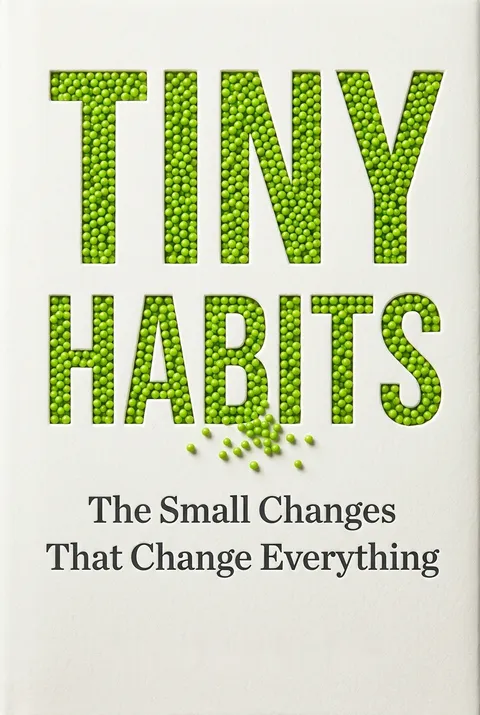


Key Takeaways
Start so small that motivation cannot veto the first step
Tiny is a design choice. Tiny Habits turns a desired change into an action so small it is easy to begin, often in less than thirty seconds. The action follows something already in your day, then you mark the success with a positive feeling. The goal is not to prove you can endure a demanding routine. It is to make starting reliable, even when you are busy, tired, or unmotivated. Fogg reports testing and refining the method with more than 40,000 people.
Small starts lower the stakes. Sarika, who struggled to maintain routines while managing bipolar disorder, began with three breaths on a meditation cushion, a brief stretch, and turning on the stove. These actions gave her a foothold, not a full routine imposed all at once. Small steps made it easier to resume after setbacks and build confidence without treating a missed day as a verdict on her character.
The method’s most useful reframing is that a failed routine may be a design problem rather than a defect in the person attempting it. A tiny baseline also separates consistency from intensity: someone can preserve the cue and the act of beginning without demanding a full workout or elaborate meal. That distinction is humane and practical. Still, smallness is not a universal cure. Limited time, illness, unsafe conditions, or financial constraints can block even a tiny action, so compassionate diagnosis should include circumstances, not only personal habit design.
Debug behavior before you diagnose character
Three ingredients converge. The Fogg Behavior Model says an action occurs when motivation, ability, and a prompt meet at the same moment. Motivation is the desire to act, ability is how easy the action feels, and a prompt is the cue to act. If one is missing or too weak, the behavior may not happen. The model’s Action Line represents the point where motivation and ability are sufficient for action when a prompt arrives.
Map the actual behavior. Katie tidied her desk reliably because the task was manageable and attached to the end of her workday. Her phone scrolling was also easy, highly appealing, and triggered by her alarm. She moved the phone out of the bedroom and used a separate alarm clock. For troubleshooting, check for a prompt first, then ease, then motivation. This order can reveal a missing reminder or an obstacle before anyone reaches for blame.
The model gives people a compact diagnostic vocabulary. Instead of saying someone is lazy, a manager or family member can ask whether the task was clear, feasible, and cued at the right time. Katie’s example shows why intention alone is a poor guide: the same person can be dependable in one setting and pulled off course in another. The model works best as a first-pass map, not a complete theory of behavior. Complex actions can have many interacting causes, and the model’s simplicity should invite investigation rather than end it.
Turn aspirations into actions you want and can actually do
Separate the destination from the step. An aspiration is a broad desire, such as feeling less stressed. An outcome is a result reached over time, such as building a particular amount of savings. A behavior is a specific action someone can do at a particular moment. Confusing these categories leaves people motivated by a destination but unsure what to do next.
Match before committing. Fogg’s Behavior Matching process searches for actions that are useful, appealing to the person, and feasible in their real circumstances. First, generate many options in a Swarm of Behaviors. Then use Focus Mapping: sort each option by likely impact, and by whether you can get yourself to do it. A bank team seeking to help customers build an emergency fund shifted from the impossible instruction to save a fixed sum immediately to concrete possibilities, including changing a cable plan or setting aside spare change. The best candidates are called Golden Behaviors.
This approach combines ambition with respect for individual preference. A broad goal can have many routes, so the most obvious route is not necessarily the best one for a particular person. Exploring alternatives before choosing also reduces the tendency to copy a friend’s successful routine without checking whether it fits. A useful test is whether the behavior remains plausible on a difficult day, not merely in an optimistic plan. Impact still needs honest scrutiny: a comfortable action can feel promising while doing little to advance the aspiration.
Make the behavior easier before demanding more discipline
Find the weak link. The Ability Chain names five reasons an action may feel difficult: it takes too much time or money, requires too much physical or mental effort, or does not fit an existing routine. The weakest factor can be enough to stop a behavior, even when everything else seems easy. Ask what is making the action hard, then adjust that specific obstacle.
Use skills, tools, or a smaller action. Fogg’s examples include learning a useful technique, acquiring equipment that reduces hassle, or shrinking the action. He struggled to floss until he found a floss that worked with his tightly spaced teeth and made the baseline action just one tooth. The tiny version made beginning manageable; doing more could remain optional. A person who wants to cook breakfast might begin by turning on the stove rather than tackling a full meal and a messy kitchen at once.
This is a strong alternative to exhortation because it treats friction as something that can be inspected and redesigned. A missing tool, unclear instruction, or inconvenient setup can masquerade as weak motivation. The approach also directs attention toward the person’s actual bottleneck: more instruction will not solve a time shortage, and a smaller goal may not help if the necessary equipment is absent. The key is to avoid mistaking ease for triviality. A small action is valuable when it establishes a repeatable path toward something the person cares about.
Attach new actions to routines that already happen
Let an existing action cue the new one. Fogg calls a reliable routine used as a cue an Anchor. A Tiny Habit Recipe pairs it with a small new behavior: after the anchor, do the new action. For example, Amy used the moment after dropping her daughter at school to write one important task on a note. Because the school drop-off already happened, she did not need to remember a separate reminder or rely on a notification.
Choose a precise fit. A good Anchor happens reliably, in the right place, and at a frequency that suits the new behavior. “After breakfast” may be vague; a clear final moment, such as putting away the dishes, gives the sequence a sharper cue. Fogg calls the final action in a routine its Trailing Edge. If a pairing repeatedly fails, revise the cue or the behavior rather than concluding that change is impossible.
Anchoring turns habit design into a question of sequence: what already happens just before the desired action? This can be more dependable than adding another alarm to a life already crowded with reminders. The emphasis on place and timing is practical because a cue that occurs in one room may not help with an action elsewhere. The approach also makes room for experimentation. A weak pairing is information about the routine, not evidence that the person lacks commitment. Still, existing routines may be irregular, so some people need a flexible cue or a simple backup plan.
Celebrate immediately to make small successes emotionally memorable
Feeling good is part of the method. After performing a new tiny behavior, create a genuine positive feeling right away. Fogg calls this feeling Shine and treats celebration as a way to help the brain associate the action with success. It can be quiet or expressive: a smile, a private thought, or a small gesture. The right celebration is the one that feels real to the person, not the one that looks impressive.
Make success easy to notice. Fogg describes flossing one tooth and celebrating the small win during a stressful period. He also recommends rehearsing an Anchor and its new behavior several times, celebrating each repetition, to make the sequence easier to remember. His account emphasizes emotion over a fixed number of days: there is no universal timetable for habit formation. If celebration feels forced, the person should find a more authentic version rather than perform enthusiasm for its own sake.
Celebration gives the method an emotional counterweight to self-criticism. It asks people to notice successful behavior at the moment it occurs, rather than waiting for a distant result such as weight loss or a completed project. That shift can make progress more visible and the next attempt more inviting. The book’s neurochemical account offers a rationale, but the practical recommendation does not depend on treating every small success as a guaranteed instant habit. Positive feedback may support repetition, while context, competing demands, and the behavior’s complexity still shape whether it becomes automatic.
Keep a tiny baseline, then let meaningful habits expand
Habits can grow or spread. Some habits expand in size, such as a brief exercise action growing into a longer workout. Others multiply into related actions without changing their original form. A morning phrase might remain brief while prompting other useful routines. Fogg advises keeping the smallest version as a valid baseline, while allowing extra effort when it feels welcome. There is no fixed number of days after which every habit is complete; the person, action, and context all matter.
Success can reshape self-image. Sukumar began with two push-ups and a short plank after brushing his teeth. Over time, he built a much larger exercise routine, lost twenty pounds, and reduced his waist measurement by five inches. Fogg describes change as a set of learnable skills: selecting behaviors, understanding personal motives, adjusting the process, redesigning surroundings, and adopting a more flexible mindset. Repeated small wins can support a new identity, but the tiny baseline remains available on hard days.
The distinction between growth and multiplication helps explain why one modest action can lead to broader change without assuming every habit must become longer or more intense. The baseline is especially important: it protects continuity when energy or circumstances shift, while optional expansion preserves room for ambition. Identity can reinforce this process, since actions provide evidence about what a person can do. It is wise, though, to treat identity as both a consequence and a possible support for behavior. A new label alone cannot substitute for accessible routines and conditions.
Untangle bad habits one specific behavior at a time
Start with the knot you can reach. A broad unwanted pattern, such as eating too much junk food, may consist of many specific actions with different cues and payoffs. The Behavior Change Masterplan begins by building positive habits and change skills, then targets specific unwanted behaviors. Try changing the prompt first, then make the behavior harder, and only then work directly on motivation. If those steps do not work, scale the behavior back or design a more appealing replacement.
Understand what the behavior is doing. Juni connected frequent sugar eating with fatigue and unprocessed grief after her mother’s death. She experimented with changing access to sweets and with journaling or contacting friends when grief surfaced. She tracked smaller stretches without sugar and celebrated progress rather than treating a lapse as proof of failure. Fogg distinguishes manageable unwanted habits from serious addictions, which may require professional support; Tiny Habits is not presented as treatment for severe addiction.
The knot metaphor discourages an all-or-nothing campaign in which one lapse supposedly erases all progress. Breaking a broad label into distinct moments makes it easier to identify what actually sustains the behavior: a cue, convenience, emotion, or social setting. Juni’s experience also shows why a replacement snack alone may miss the function of a habit that is serving as comfort. This analysis should not imply that every unwanted behavior has a single hidden cause. Some patterns have medical, social, or addictive dimensions that need expertise beyond self-directed habit design.
Help others change by lowering friction and recognizing progress
Design with people, not against them. When Mike repeatedly argued with his adult son Chris about cleaning a coffee filter, he changed the request. Instead of demanding the whole cleanup, he asked for one manageable step, then thanked Chris when he did it. Later, the task expanded and the conflict eased. The shift came from making the action clearer and easier, while noticing progress instead of leading with criticism.
Respect the other person’s aims. Fogg’s two guiding principles are to help people do what they already want and to help them feel successful. A family or team can choose shared behaviors together, or someone can make a supportive change quietly, but neither approach should depend on shame. In a hospital training project, nurses created tiny cues for actions such as drinking water and taking calming breaths. Follow-up questionnaires showed improvements in reported stress-management and resilience practices, though the book gives no effect sizes.
The coffee-filter story shows how a behavior intervention can change a relationship as well as a task: fewer confrontations made room for trust and cooperation. That is a valuable reminder that the social environment is part of behavior design, not merely background. The ethical test is whether the person’s own aims and dignity remain central. Quiet design can be helpful, but it can also become manipulation if used to impose someone else’s agenda. Shared goals, transparent requests, and sincere recognition make the approach more respectful and more likely to last.
Analysis
Tiny Habits is a practical behavior-change system told through personal experiments and stories of people dealing with work pressure, family conflict, grief, and health challenges. Its central contribution is not simply the advice to take small steps. It offers a way to diagnose why an action happens or fails, select a behavior that suits the person, place it into an existing routine, and reinforce the attempt with an immediate sense of success. The arc moves from individual habits to difficult behavior patterns and finally to families and workplaces, making the method both personal and social.
The Fogg Behavior Model is powerful because it directs attention away from moral judgment and toward conditions that can be changed. Its focus on ability and prompts complements approaches that emphasize intentions: wanting a result does not provide a usable action or make that action easy. The method also resonates with choice architecture, the study of how arrangements and defaults influence decisions, and with self-determination theory, which emphasizes autonomy and personal relevance. Matching behavior to what someone wants is not merely a motivational trick; it protects agency.
The book’s boldest claims deserve careful calibration. Fogg presents celebration and positive emotion as central to habit formation, but stories and coaching experience do not establish that celebration alone reliably produces automatic habits for every person. The model is also deliberately compact. It can illuminate a morning phone habit, but it does not fully capture structural pressures such as shift work, poverty, disability, or unsafe environments. The account of the hospital project reports improved questionnaire responses but supplies no comparison group or effect sizes in the text. These limits do not erase the method’s usefulness. They clarify its proper role: a practical design toolkit, not a complete science of behavior or a substitute for clinical care and social change.
Review Summary
Tiny Habits receives overwhelmingly positive reviews, with readers praising its practical, science-based approach to behavior change. Many appreciate the book's step-by-step instructions, real-life examples, and emphasis on small, manageable changes. Readers find the method effective and easy to implement, noting improvements in various aspects of their lives. Some criticize the book's length and repetitiveness, but most consider it a valuable resource for personal development. The timing of its release, near New Year's, is seen as perfect for those seeking to make lasting changes.
People Also Read







Glossary
Fogg Behavior Model
Three conditions for actionA model stating that behavior occurs when motivation, ability, and a prompt converge at the same time. Motivation is the desire to act, ability is how easy the action is, and a prompt is the cue. The model helps explain a behavior without treating it as a direct measure of character.
B=MAP
Behavior equals MAPThe shorthand formula for the Fogg Behavior Model: Behavior equals Motivation, Ability, and Prompt. It emphasizes that all three elements must be sufficiently present together for an action to occur. If a behavior fails, the formula directs attention to changing one or more elements rather than assuming the person needs more willpower.
Action Line
Threshold for prompted actionThe curved boundary in the Fogg Behavior Model that represents the relationship between motivation and ability. When a person’s motivation and ability place a behavior above this line, a prompt can lead to action. If the behavior sits below it, increasing motivation, making the action easier, or both can move it toward action.
Motivation Wave
Temporary surge in motivationA short-lived rise in desire that can make demanding actions seem feasible. People may use this surge to begin a major project or make ambitious plans, then find that their motivation fades. The concept warns against designing long-term routines that only work while enthusiasm is unusually high.
PAC Person
Sources of motivation and promptsA model organized around Person, Action, and Context. Fogg uses it to describe sources of motivation and types of prompts. Motivation may come from what a person already wants, consequences attached to an action, or the surrounding context. Prompts may arise within the person, from the environment, or from an action already being performed.
Swarm of Behaviors
Many routes to an aspirationA brainstorming tool for turning a broad aspiration into a range of specific actions that might help achieve it. The aspiration is written at the center, with possible behaviors surrounding it. Generating many options helps people avoid committing too quickly to the first idea that comes to mind.
Focus Mapping
Rank impact and feasibilityA method for comparing possible behaviors on two dimensions. First, place each behavior according to its likely impact on the aspiration. Then assess whether the person can realistically get themselves to do it. Behaviors that combine meaningful impact with practical feasibility become the strongest candidates for action.
Behavior Matching
Fit action to personThe process of finding behaviors that are useful for an aspiration, appealing to the person, and feasible in their actual life. Rather than selecting a standard routine and trying to manufacture motivation afterward, Behavior Matching starts with options and identifies the ones that suit the individual.
Golden Behaviors
Effective, wanted, feasible actionsBehaviors identified through Behavior Matching as having impact, fitting the person’s motivation, and being feasible to perform. A Golden Behavior may be a habit or a one-time action. The term highlights that the best action is not simply the most ambitious one, but one the person can and wants to do.
Ability Chain
Five sources of difficultyA diagnostic model for identifying what makes a behavior hard. Its links are time, money, physical effort, mental effort, and fit with existing routines. The weakest link may be enough to prevent action. Strengthening that link can make a behavior easier without relying on a surge in motivation.
Anchor
Existing routine used as cueA reliable action or moment already present in someone’s life that prompts a new behavior. An Anchor might be a routine such as putting away breakfast dishes. The new action is attached to what happens immediately after the Anchor, so the person does not need to remember it independently.
Action Prompt
Routine cues another actionA prompt created by a behavior already happening. In Tiny Habits, an existing action can remind someone to do a new behavior. An Action Prompt differs from a Person Prompt, which relies on memory, and a Context Prompt, which relies on an environmental reminder such as an alert or note.
Tiny Habit Recipe
Anchor plus tiny behaviorA written plan that links an existing Anchor to a new, very small behavior, usually in the form: after the Anchor, do the behavior. The recipe may also specify an immediate celebration. It gives the new action a clear place in the day and can be revised if the pairing does not work.
Shine
Feeling of successFogg’s term for the positive feeling of success that a person can create or notice after an action. In the Tiny Habits method, an immediate celebration aims to produce Shine so the person experiences the action as a small success. The feeling is meant to be genuine and can be expressed privately or outwardly.
Pearl Habits
Positive response to irritationHabits that use an irritating or difficult event as a prompt for a constructive response. For example, someone might use a recurring noise as a cue to relax, or a hurtful interaction as a reminder to care for themselves. The approach changes the person’s response without requiring control over the original irritation.
Behavior Change Masterplan
Sequence for unwanted habitsFogg’s staged approach to disrupting an unwanted behavior. It begins with creating positive habits and building change skills, then targets specific instances of the unwanted behavior by adjusting prompts, ability, or motivation. If those changes are insufficient, the person can scale the behavior back or design a more appealing replacement.
Uphill Habits, Downhill Habits, and Freefall Habits
Three levels of stopping difficultyA classification of habits by how difficult they are to maintain or stop. Uphill Habits require ongoing effort and are relatively easy to stop. Downhill Habits are easy to continue and harder to stop. Freefall Habits, such as serious substance-related problems, may require professional support beyond self-directed habit methods.
Skills of Change
Capabilities for behavior designA set of learnable abilities for designing and sustaining change. The book groups them into behavior crafting, self-insight, process, context, and mindset. These include choosing useful actions, understanding personal preferences, troubleshooting, redesigning environments, celebrating success, and adapting when circumstances change.
FAQ
What's Tiny Habits about?
- Focus on Small Changes: Tiny Habits by B.J. Fogg emphasizes that small, incremental changes can lead to significant transformations in behavior and habits.
- Behavior Design Framework: The book introduces the Fogg Behavior Model, which states that behavior occurs when Motivation, Ability, and Prompt converge at the same moment.
- Empowerment Through Simplicity: Fogg argues that by simplifying the process of habit formation, individuals can overcome the common barriers of motivation and willpower.
Why should I read Tiny Habits?
- Practical Approach: The book provides a practical, research-backed method for creating lasting change without relying on willpower or motivation.
- Real-Life Success Stories: Fogg shares numerous success stories from individuals who have implemented the Tiny Habits method, demonstrating its effectiveness.
- Empowerment and Self-Compassion: Readers will learn to approach behavior change with self-compassion, reducing self-criticism and fostering a positive mindset.
What are the key takeaways of Tiny Habits?
- Start Small: The essence of the Tiny Habits method is to break down aspirations into tiny, manageable behaviors that can be easily integrated into daily life.
- Celebrate Success: Celebrating small wins is crucial for reinforcing new habits and creating positive emotions associated with behavior change.
- Design for Simplicity: Fogg emphasizes that making behaviors easy to do is more effective than relying on motivation, which can fluctuate.
What is the Fogg Behavior Model?
- Three Elements: The Fogg Behavior Model consists of Motivation, Ability, and Prompt (MAP). A behavior occurs when these three elements converge.
- Behavior Analysis: By analyzing behaviors through this model, individuals can identify why certain habits succeed or fail and adjust accordingly.
- Universal Application: This model applies to all human behavior, making it a versatile tool for understanding and designing habits.
How do I create a Tiny Habit according to B.J. Fogg?
- Identify an Anchor: Choose an existing routine in your life that can serve as a prompt for your new habit.
- Define the Tiny Behavior: Scale down the desired behavior to its smallest form, making it easy to accomplish.
- Celebrate Immediately: After completing the tiny behavior, celebrate to create a positive feeling that reinforces the habit.
What is the importance of celebration in the Tiny Habits method?
- Creates Positive Emotions: Celebrating immediately after performing a new habit generates feelings of success, which helps wire the habit into your brain.
- Reinforces Behavior: The act of celebrating taps into the brain's reward system, making it more likely that the behavior will be repeated in the future.
- Builds Confidence: Regularly celebrating small successes fosters a sense of accomplishment and encourages further attempts at behavior change.
How can I make a behavior easier to do according to Tiny Habits?
- Increase Skills: Improve your skills related to the behavior through practice or education, making it easier to perform.
- Get Tools: Acquire tools or resources that simplify the behavior, such as using a mandoline for meal prep.
- Scale Back: Reduce the behavior to its tiniest version, ensuring it remains manageable and achievable.
What are Action Prompts in the context of Tiny Habits?
- Definition of Action Prompts: Action Prompts are cues that remind you to perform a new habit based on existing routines in your life.
- Anchoring New Habits: By linking a new habit to an established routine (e.g., after brushing teeth), you create a reliable prompt for action.
- Simplicity and Effectiveness: Action Prompts are effective because they leverage behaviors you already do, making it easier to remember and perform the new habit.
How does the concept of emotions relate to habit formation in Tiny Habits?
- Emotions Create Habits: Positive emotions associated with a behavior increase the likelihood of that behavior becoming a habit.
- Dopamine Release: Celebrating and feeling good after completing a behavior triggers dopamine release, reinforcing the habit in the brain.
- Shift from Self-Criticism: Focusing on positive feelings rather than shortcomings helps individuals cultivate habits more effectively and with greater self-compassion.
How can I troubleshoot a habit that isn’t sticking according to B.J. Fogg?
- Analyze the Prompt: Start by examining the prompt associated with the habit. If the prompt isn’t effective, consider changing it or making it more noticeable.
- Evaluate Ability: Assess whether the behavior is too difficult or requires too much effort. If so, scale it back to make it easier to accomplish.
- Adjust Motivation: If the habit still isn’t sticking, consider ways to increase your motivation. This could involve reminding yourself of the benefits of the habit or finding ways to make it more enjoyable.
How does the Tiny Habits method apply to group change?
- Shared Aspirations: The Tiny Habits method can be used to align a group around a common aspiration. By clarifying what everyone wants to achieve, the group can work together more effectively.
- Collaborative Behavior Options: Groups can brainstorm behavior options that will help them reach their shared goals. This collaborative approach fosters teamwork and accountability.
- Celebration and Support: Encouraging group members to celebrate each other’s successes reinforces positive behaviors and builds a supportive environment. This collective reinforcement can lead to lasting change within the group.
What are the best quotes from Tiny Habits and what do they mean?
- “You change best by feeling good, not by feeling bad.” This quote emphasizes the importance of positive reinforcement in behavior change. It suggests that focusing on successes rather than failures leads to more effective and sustainable change.
- “Help people do what they already want to do.” This quote highlights the importance of aligning new habits with existing desires and motivations. It suggests that change is more likely to occur when it is connected to what individuals already want to achieve.
- “Start where you want to go.” This quote encourages individuals to begin their change journey with the behaviors that resonate most with them. It reinforces the idea that starting with what feels right can lead to greater success in the long run.
Download PDF
Download EPUB
.epub digital book format is ideal for reading ebooks on phones, tablets, and e-readers.








