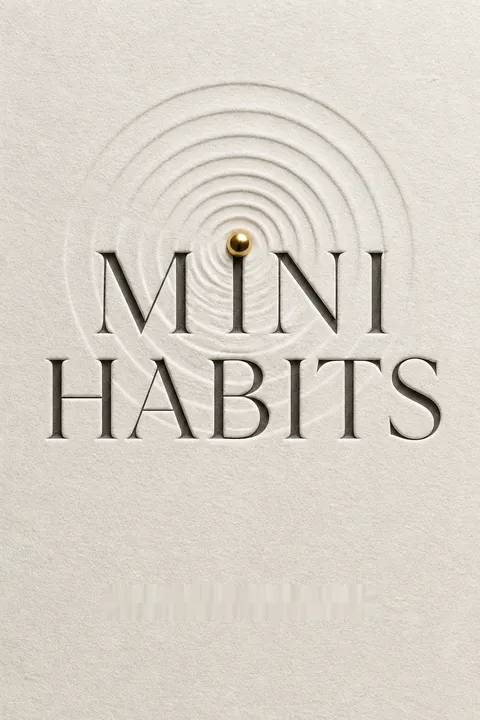


Key Takeaways
Shrink the habit until starting feels almost embarrassingly easy
The breakthrough began small. In late 2012, Stephen Guise wanted to exercise but could not make himself begin the half-hour workout he had planned. After a decade of short-lived attempts, he chose one push-up instead. Once he was already on the floor, he kept going, exercised for about 20 minutes, and chose to add more. The turning point was not a burst of discipline. It was making the first commitment small enough to begin.
Define success at the floor. A mini habit is a very small positive action required regularly, such as one push-up or a few words of writing. Doing more is welcome, but never necessary for the day to count. The tiny requirement is the safety net; any extra effort is a bonus.
The story isolates a powerful behavioral distinction: starting a task and completing its full imagined workload are separate demands. A tiny first action reduces anticipatory friction and gives a person real information about how the task feels, rather than leaving the mind to forecast an intimidating ordeal. This resembles graded exposure, where manageable contact with a feared activity can weaken avoidance. The important limit is that an easy first step does not guarantee a full workout or other outcome. Its value is reliable entry, not a magical promise of effortless continuation.
Use a tiny commitment to act before motivation shows up
Feelings fluctuate; commitments can remain. Guise argues that motivation is a poor foundation for consistency because it shifts with mood, energy, stress, and temptation. A calendar cannot depend on whether a person happens to feel inspired at the appointed hour. Instead, a small act of will can get behavior underway, and the desired activity may feel easier once it has begun. Motivation is not useless in this account; it is treated as a welcome result rather than a prerequisite.
Expect enthusiasm to fade. Guise calls the declining excitement that often accompanies repetition the “law of decreasing enthusiasm.” It is his label, not a formal scientific law. Habitual actions can become emotionally ordinary. Losing the initial thrill does not necessarily mean the plan has failed; lower resistance and greater regularity may be the more useful signs.
The practical insight aligns with behavioral activation, an approach used in psychology in which scheduled, meaningful activity can precede a change in mood rather than wait for one. This helps explain why “feel ready first” can trap people in avoidance. Yet the argument should not be read as a demand to ignore every feeling. Pain, illness, and severe exhaustion can be meaningful signals, not mere excuses. A tiny commitment works best as a flexible entry point, not as proof that every limit should be overridden.
Measure habit formation by shrinking resistance, not counting to 21
Automaticity takes different amounts of time. The book describes habits as repeated behaviors that become easier and less dependent on conscious decisions. It presents the prefrontal cortex as a deliberate “manager” and the basal ganglia as involved in learned patterns, while acknowledging that this is a simplified account of a complex brain. The practical aim is to repeat a behavior until it takes less effort to begin.
There is no universal countdown. A 2009 study discussed in the book found an average of 66 days for a behavior to become habitual, with a wide range from 18 to 254 days. The behavior and the person both matter. The study also found that missing one day did not erase habit formation, though a missed day can become discouraging if treated as proof of failure.
The duration study is more useful as a warning against arbitrary deadlines than as a personal forecast. Its wide range undercuts the familiar idea that habit change follows a fixed three-week schedule. Neuroscience also supports caution about dividing the brain into a single conscious controller and a single habit machine: habitual behavior involves interacting systems, not one isolated switch. Still, the simplified model earns its place as a practical metaphor. Repetition can make a chosen action less effortful, even when no precise day can be predicted.
Cross the starting line with one step, then decide again
Resistance has two moments. The first is before action, when a large plan feels daunting. The second can arrive after starting, when the brain resists doing more than the minimum. Guise’s one-push-up story illustrates both: the first repetition bypassed the resistance to a full workout, but continuing still required smaller decisions. When a larger next step felt unacceptable, he chose an easier action, such as setting up the exercise mat, and reconsidered from there.
Keep continuation voluntary. Mini habits require the first small action, not an expanding chain of obligations. If the next step feels too difficult, reduce it again or stop after meeting the minimum. The book connects this design to research on effort and self-control, arguing that a modest starting demand helps preserve the capacity to act.
Breaking work into successive choices is more than motivational theater. It limits how much of the task must be represented at once, a principle shared by project planning and cognitive load management. It also protects autonomy: the person can continue because the next step feels acceptable, not because a hidden rule has taken over. The book’s account of willpower as a limited resource is influential but scientifically contested. The method remains plausible without that theory: smaller requests usually feel less intimidating than a large, vague commitment.
Keep the minimum tiny even when your best days get ambitious
Do not turn extra effort into a new quota. Guise’s writing habit required a small daily minimum, but he often wrote far more. That overachievement became dangerous only if he began to believe that the larger amount was now required. The minimum must remain the measure of success, even on days when the work comes easily. Otherwise, a safety net quietly becomes another intimidating target.
Success builds self-efficacy. Self-efficacy means a person’s belief that they can influence an outcome. Meeting a small, chosen commitment supplies evidence for that belief, especially after a history of abandoned plans. The book’s design joins strictness and freedom: the minimum is firm, while everything beyond it remains optional. That makes it easier to act without feeling controlled by an oversized demand.
The distinction between a floor and a ceiling is the architecture’s most useful protection against perfectionism. It allows effort to vary without making a low-energy day a moral failure. In learning theory, repeated mastery experiences can strengthen confidence more convincingly than reassurance alone, which supports the emphasis on attainable wins. There is a tradeoff, however: if the minimum never grows, a person may maintain a ritual without reaching a larger practical outcome. The method works best when the tiny action is understood as an entry point, not the whole destination.
Choose a habit you value, then define its smallest observable version
Start with a real reason. Guise’s “why drill” means asking why a desired habit matters, then asking again until the answer reaches a personal value. Wanting to wake early because admired people do so may reveal social pressure; wanting to write because it feels meaningful points to a more personal motive. The exercise helps distinguish a chosen habit from one adopted to satisfy someone else.
Make the action concrete. A habit can be tied to a time, an activity, or a flexible daily deadline. For example, someone can choose to read at a set hour, after a routine activity, or at any point before bed. Guise recommends beginning with one habit and generally keeping the total to two or three, with four as an upper limit. A “hybrid mini habit” offers either of two small options when one activity is not always practical.
Connecting behavior to personal values resembles self-determination theory, which distinguishes self-endorsed goals from actions driven mainly by pressure. That distinction can matter for persistence: a small task is easier to repeat when its purpose belongs to the person doing it. Cues add useful structure, but flexibility is not automatically superior. A precise time or event can reduce the need to decide, while a loose deadline suits irregular schedules. The best cue is the one that removes friction without making ordinary disruptions feel like failure.
Make the small win visible and give your brain a reason to repeat it
Record completion where it can be seen. Guise recommends writing habits down and tracking completed days, often with a large calendar and a physical check mark. He describes this visible record as a reminder of both the commitment and accumulated success. A specific action, such as reading a set number of pages, is easier to track than a vague aim like “read more.”
Pair effort with encouragement. Some beneficial behaviors provide delayed rewards: exercise may improve health over time, while writing may eventually produce a finished project. Early on, a small enjoyable reward or an intentional celebration can make completion feel satisfying now. Guise argues that the immediate sense of progress helps reinforce repetition. He also cautions against treating tracking as the point; the mark records the behavior, it does not replace it.
Visible progress makes an abstract intention concrete, much as feedback dashboards help people monitor performance in work or training. A check mark can also serve as a cue to remember the behavior, not merely a trophy after the fact. Rewards deserve a little care: supportive celebration can reinforce competence, while controlling or overly transactional rewards may make an activity feel like a chore. The most durable feedback may be evidence of improvement itself. A calendar is useful when it encourages attention and recovery after a lapse, not shame over an imperfect streak.
Scale the habit only after the small version feels normal
Look for changed behavior, not fireworks. Guise suggests watching for reduced resistance, more automatic action, a sense that the behavior fits one’s identity, and less anxiety about whether it will happen. The behavior may even feel ordinary or boring. Those signs matter more than reaching a particular day count. Once the small version is dependable, a person can consider expanding it gradually, while keeping the original minimum available as a fallback.
Respect the method’s scope. Mini habits are designed chiefly to add positive behaviors. The book distinguishes these from active addictions, which may require a different process and professional support. A tiny exercise commitment can help establish regularity, but it is not equivalent to a complete fitness program. Small starts are especially useful for beginning; meaningful long-term goals may still require progression, support, and suitable adjustments.
This is the necessary bridge between consistency and results. A tiny action can establish contact with a behavior, but the appropriate dose depends on the goal: one repetition is not a complete strength program, and a few words do not finish a manuscript. Gradual progression can preserve confidence while increasing useful work. The book’s warning about active addiction is equally important, since habit advice is not a substitute for clinical care. The strongest use of the method is modest and precise: make entry easy, then evaluate honestly whether the resulting behavior meets the need.
Analysis
Mini Habits is best understood as a design for reliable beginnings. Its central move is to separate a guaranteed minimum from whatever a person may accomplish beyond it. That division answers a familiar problem: ambitious plans often make success depend on having unusually high energy, favorable moods, and an uninterrupted schedule. Guise’s opening push-up story gives this argument narrative force. A single repetition did not itself deliver his fitness goals; it changed the immediate decision from “complete a workout” to “begin one small action.” The method’s promise is therefore less about tiny quantities producing large results by magic than about repetition creating access to work that avoidance had blocked.
The book’s most transferable ideas are the small floor, optional continuation, personal reasons, concrete tracking, and patience with habit formation. Its own account of the evidence is more mixed than its confident tone sometimes suggests. The cited habit study reports a broad formation range, not a guarantee that mini-sized actions become habits rapidly. The book also relies on the ego-depletion model of willpower, which subsequent research has debated, so that explanation should not be treated as settled fact. Fortunately, the practical case does not require a literal, measurable willpower tank. Lowering perceived difficulty and making a task easy to start can be useful even if the underlying mechanism is different.
A mini habit can also become an inadequate endpoint if success is defined only as checking a box. The method works best when the minimum preserves continuity while optional progress or later scaling serves the larger aim. Fitness, recovery, creative work, and complex skills have different requirements; one universal minimum cannot meet them all. Nor should a missed day become evidence of personal failure, particularly when circumstances require rest or support. The book offers a compelling antidote to all-or-nothing planning, not a universal treatment for addiction, illness, or every barrier to change. Its lasting lesson is practical: make the first action small enough to repeat, and remain honest about what the larger goal demands.
Review Summary
Mini Habits by Stephen Guise receives mostly positive reviews for its simple yet effective approach to habit formation. Readers appreciate the concept of starting with "stupid small" goals to build lasting habits without relying on motivation. Many report success in implementing mini habits in various areas of life, from exercise to reading. Some criticize the book for being repetitive, but most find the core idea valuable. The book's scientific basis and practical advice are praised, though a few reviewers felt the concept could have been explained more concisely.
People Also Read




Glossary
Mini Habits
Tiny repeated actionsA Mini Habit is a deliberately small positive behavior that a person commits to performing regularly, such as one push-up or a few words of writing. The requirement is kept easy enough to complete even on a difficult day. Doing more is optional, so the minimum creates consistency without turning ambitious output into a daily obligation.
The One Push-up Challenge
One required daily repetitionThe One Push-up Challenge was Guise’s initial experiment in making exercise habitual. He required himself to do one push-up each day, rather than demanding a full workout. The tiny commitment often led him to continue exercising, but its central purpose was to make daily success easy and establish a dependable beginning.
Bonus reps
Optional work beyond minimumBonus reps are any extra actions performed after a Mini Habit’s required minimum has been met. They may be additional push-ups, more writing, or further reading. They are encouraged when they arise naturally, but they must remain optional. Making yesterday’s extra effort today’s requirement removes the protective value of the small minimum.
law of decreasing enthusiasm
Excitement fades with repetitionGuise’s informal label for the tendency for emotional excitement about a behavior to decline as it becomes routine. He uses the phrase to challenge the expectation that a growing habit should remain thrilling. A behavior becoming ordinary may indicate that it requires less emotional drama, not that it has stopped being useful.
Why drill
Repeated questions reveal valuesThe Why drill is a planning exercise in which someone repeatedly asks why a desired habit matters. The questions continue until the answers reach a personal value or become circular. Its purpose is to distinguish habits chosen for personally meaningful reasons from habits pursued mainly to meet social expectations or avoid judgment.
Hybrid mini habit
One of two small optionsA hybrid mini habit gives a person a choice between two actions that serve a related purpose. For example, on a day when getting to a gym is impractical, a brief home activity may serve as the alternative. The choice can make a commitment more flexible, though deciding between options adds some effort.
Self-efficacy
Belief in personal influenceSelf-efficacy is a person’s belief that they can take actions that influence an outcome. In the book’s approach, repeatedly meeting a small commitment supplies concrete evidence of capability, especially for someone discouraged by earlier failures. It is not simply positive thinking: the belief is strengthened by successfully performing the action.
Ego depletion
Proposed self-control fatigueEgo depletion is the idea, discussed in the book through self-control research, that effortful choices and actions can temporarily reduce a person’s capacity for further self-control. Guise uses this model to explain why small commitments may be easier to sustain. The model’s scientific standing has been debated, so it is best treated as one proposed account rather than settled fact.
FAQ
What's "Mini Habits: Smaller Habits, Bigger Results" about?
- Core Concept: "Mini Habits" by Stephen Guise is about forming small, manageable habits that lead to significant personal growth and change. The book emphasizes the power of taking tiny steps consistently.
- Personal Experience: The author shares his personal journey of discovering mini habits, starting with the "One Push-up Challenge," which led to lasting changes in his life.
- Scientific Backing: The book discusses the science behind habit formation, willpower, and motivation, explaining why mini habits are more effective than traditional methods.
- Structure: It is structured into seven parts, covering topics from understanding the brain to applying mini habits in daily life.
Why should I read "Mini Habits: Smaller Habits, Bigger Results"?
- Practical Approach: The book offers a practical, easy-to-implement strategy for personal development that doesn't rely on motivation, which is often unreliable.
- Overcoming Challenges: It provides insights into overcoming common obstacles in habit formation, such as willpower depletion and resistance to change.
- Long-term Success: By focusing on small, consistent actions, the book helps readers achieve long-term success and build lasting habits.
- Empowerment: It empowers readers to take control of their lives by making habit formation accessible and achievable for everyone.
What are the key takeaways of "Mini Habits: Smaller Habits, Bigger Results"?
- Small Steps Matter: Small, consistent actions can lead to significant changes over time, making it easier to form habits.
- Willpower Over Motivation: Relying on willpower, rather than motivation, is more effective for habit formation because willpower can be strengthened and is more reliable.
- Flexibility and Autonomy: Mini habits allow for flexibility and autonomy, reducing the pressure and guilt often associated with larger goals.
- Mindset Shift: The book encourages a mindset shift from focusing on big goals to celebrating small successes, which builds self-efficacy and confidence.
How does the "Mini Habits" strategy work?
- Stupid Small Steps: The strategy involves setting "stupid small" goals that are too easy to fail, such as doing one push-up or writing 50 words a day.
- Daily Consistency: The focus is on daily consistency, which helps in gradually building habits without overwhelming the individual.
- Willpower Management: By requiring minimal willpower, mini habits prevent burnout and make it easier to maintain the behavior over time.
- Bonus Reps: Often, starting with a mini habit leads to doing more than the minimum, as taking the first step reduces resistance.
What is the "One Push-up Challenge" mentioned in "Mini Habits"?
- Origin Story: The "One Push-up Challenge" is how Stephen Guise accidentally discovered the power of mini habits. It started with the simple goal of doing one push-up a day.
- Unexpected Results: This small action led to a full workout and eventually became a consistent exercise habit, demonstrating the effectiveness of starting small.
- Psychological Impact: The challenge showed that starting with a tiny, non-intimidating step can overcome initial resistance and lead to greater achievements.
- Foundation for the Book: This experience was the catalyst for the development of the mini habits strategy and the writing of the book.
How does "Mini Habits" address willpower and motivation?
- Willpower as a Resource: The book explains that willpower is a limited resource that can be depleted, but it can also be strengthened with practice.
- Motivation's Unreliability: Motivation is described as unreliable because it fluctuates based on emotions and external factors, making it a poor foundation for habit formation.
- Willpower Strategy: Mini habits leverage willpower by requiring minimal effort, making it easier to take action consistently without depleting willpower reserves.
- Building Willpower: By consistently completing mini habits, individuals can gradually strengthen their willpower, making it easier to tackle larger challenges over time.
What are the "Eight Mini Habit Rules" in "Mini Habits"?
- Never Cheat: Stick to the mini habit requirement without secretly expecting more, as this ensures success and prevents burnout.
- Celebrate Progress: Be happy with all progress, no matter how small, to build confidence and maintain motivation.
- Reward Yourself: Use rewards to reinforce the habit and make the process enjoyable, which can also help restore willpower.
- Stay Level-headed: Maintain a calm mindset and trust the process, avoiding reliance on fluctuating emotions or motivation.
How does "Mini Habits" suggest handling resistance to change?
- Break It Down: If you feel strong resistance, break the task into even smaller steps until it feels manageable.
- Focus on Starting: Emphasize the importance of starting, as taking the first step often reduces resistance and leads to further action.
- Use Willpower Wisely: Avoid pushing through resistance with brute force; instead, use small steps to coax your brain into action.
- Celebrate Small Wins: Recognize and celebrate small achievements to build momentum and reduce future resistance.
What is the role of the brain in habit formation according to "Mini Habits"?
- Basal Ganglia and Prefrontal Cortex: The book explains the roles of the basal ganglia (habit formation) and the prefrontal cortex (decision-making) in the brain.
- Repetition and Reward: Habits are formed through repetition and reward, as the brain automates repeated behaviors to conserve energy.
- Stress and Habits: Stress can increase reliance on habitual behavior, making it crucial to develop positive habits that can be relied upon during stressful times.
- Neural Pathways: Habits are represented by neural pathways in the brain, which become stronger with repetition, making the behavior easier to perform over time.
How does "Mini Habits" propose tracking progress?
- Big Calendar Method: Use a large calendar to mark each day you complete your mini habits, creating a visual chain of success.
- Digital Tracking: Apps like Lift for iOS and Habit Streak Plan for Android can help track progress and provide reminders.
- Daily Check-ins: Check off your mini habits before bed to reinforce the habit and ensure consistency.
- Celebrate Consistency: Focus on maintaining an unbroken chain of success, which builds self-efficacy and encourages continued progress.
What are some practical examples of mini habits from the book?
- Exercise: Doing one push-up a day as a starting point for building a fitness habit.
- Writing: Writing 50 words a day to develop a consistent writing practice.
- Reading: Reading two pages a day to cultivate a reading habit.
- Mindfulness: Thinking two positive thoughts a day to foster a positive mindset.
What are the best quotes from "Mini Habits" and what do they mean?
- "The journey of a thousand miles begins with one step." This quote emphasizes the power of starting small and taking the first step toward a larger goal.
- "Be happy, but never satisfied." It encourages celebrating progress while maintaining a drive for continuous improvement.
- "It's not what we do once in a while that shapes our lives. It's what we do consistently." This highlights the importance of consistency in forming habits and achieving lasting change.
- "Success begets success." This suggests that small wins build momentum and confidence, leading to further achievements.
About the Author
Other books by Stephen Guise

Download PDF
Download EPUB
.epub digital book format is ideal for reading ebooks on phones, tablets, and e-readers.








