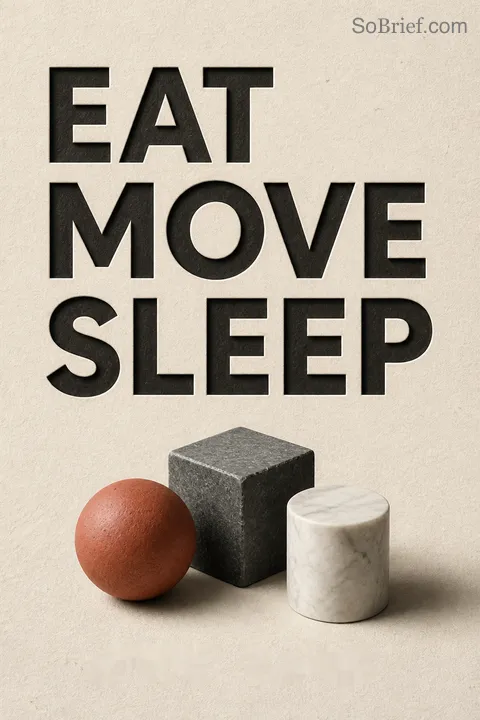


Key Takeaways
Treat food, movement, and sleep as one connected health system
Choices change the odds. At 16, Tom Rath learned he had a rare genetic condition that sharply increased his risk of tumors. Regular scans helped doctors find growths early, while he focused on the choices still within his control. His story gives the book its central premise: habits cannot guarantee health, but they can influence risk and daily energy.
The three reinforce each other. A nourishing breakfast can support an active day; activity can help sleep; and good sleep can make better food choices easier. The reverse can also happen: a poor night can set off a day of low energy, skipped movement, and impulsive eating. Rath argues that improving all three together is more useful than treating diet, exercise, or sleep as isolated projects.
The system view makes the advice more realistic than treating health as a contest of willpower. Each behavior changes the conditions for the next one, so a modest improvement in one area can make another less difficult. Rath’s personal history also distinguishes influence from control: habits may shift probabilities, not erase genetic risk or promise a particular outcome. That distinction matters in health writing, where confident prevention claims can accidentally sound like blame when illness occurs.
Choose food quality over temporary diets and calorie-only thinking
A diet needs an endpoint; eating does not. Rath describes how dietary fashions often fixate on one variable. Low-fat products can replace fat with sugar, while low-carbohydrate approaches can encourage heavy reliance on meat and cheese. The result may be a short-term rule that misses the overall quality of the food.
Look at the pattern. The book cites a Harvard study following more than 100,000 people for two decades, in which food choices were more strongly related to long-term weight change than total calorie intake alone. Rath’s practical direction is to favor less-refined foods, vegetables, fruit, nuts, and other nourishing options, rather than chasing a branded plan. He also advises patience: body weight may respond slowly, so the next meal is a more useful unit of action than a deadline to lose pounds.
This argument usefully shifts attention from diet identity to the food that actually makes up a routine. It also resists the false comfort of a single number: calories matter, but they do not describe fiber, added sugar, or how filling a meal is. The caution is that observational studies cannot prove that one food pattern alone caused a particular outcome. Food quality is a practical compass, not a complete nutritional prescription for every person.
Prefer whole foods to sweetened drinks, juices, and health halos
Sweetness hides in plain sight. Rath urges readers to watch added sugar in packaged foods and drinks, including products marketed as natural, organic, or healthy. He recounts discovering that a seemingly wholesome granola bar contained far more sugar and carbohydrate than protein. His broader point is to inspect the ingredient list and nutrition panel instead of trusting the front of a package.
Keep fruit whole when possible. A whole apple provides fiber that apple juice lacks, and juice makes it easy to consume the sugar from several pieces of fruit quickly. Dried fruit can also concentrate sugar: Rath compares a cup of dried mango with a candy bar to show how misleading the word fruit can be. He recommends water, unsweetened tea, or coffee in place of sweetened beverages.
Packaging works as a shortcut for the shopper, but its cues often serve the seller. Looking past labels and claims is a small act of consumer skepticism with immediate practical value. The whole-food rule also has a sound behavioral logic: chewing and fiber slow consumption, while liquid calories are easy to overlook. Rath’s broader warning about every sweet-tasting substitute driving later cravings is less certain as a universal claim, so the strongest advice is to check what a product contains and how it fits an individual’s habits.
Make healthy choices visible and tempting foods inconvenient
Your surroundings make suggestions. Rath applies the logic of grocery-store product placement at home. When chips occupied the most visible pantry shelf, they became his default snack; moving healthier choices into view made them easier to choose. He recommends putting produce at eye level or on the counter, and storing less nourishing snacks out of sight or not buying them.
Shop before temptation peaks. A hungry shopper is more likely to fill a cart with impulsive choices, so planning a list and shopping after a meal can help. Rath’s own example is blunt: if he brings a box of crackers home, he is likely to eat it, so he keeps it out of the house. The key is to make the easy option more likely to be the one that supports health.
This is behavioral design at household scale. Visibility, convenience, and availability shape choices before deliberation begins, which helps explain why relying on resolve at the moment of temptation often fails. Changing the setting can protect autonomy rather than diminish it: the person still chooses, but faces fewer cues engineered to prompt mindless consumption. The approach is not equally available to everyone, since budgets, food access, and shared kitchens constrain what can be changed. Small adjustments still matter where control exists.
Interrupt sitting throughout the day, not just during workouts
Movement is more than exercise. Rath argues that a workout does not cancel out a day spent mostly seated. He cites a decade-long study of 240,000 adults: even among people who exercised substantially, the most sedentary had higher mortality and heart-disease risk than the least sedentary. These findings point to the importance of everyday movement, not just scheduled workouts.
Build movement into the day. Rath describes walking while working at a treadmill desk and finding that regular movement improved his energy and eased his back discomfort. For people who must sit, he highlights an experiment in which two minutes of easy walking every 20 minutes helped stabilize blood sugar. Walking to a colleague, taking stairs, or standing during a call are small ways to break up long seated stretches.
The distinction between exercise and sedentary time is valuable because it reveals a hidden category in the daily schedule. A person can meet a workout target and still spend most waking hours inactive. The practical response is not to condemn desk work, which is often unavoidable, but to add movement in repeatable intervals. The study associations Rath cites do not mean every seated hour causes the same harm for every person. They do make prolonged stillness worth treating as a design problem.
Protect sleep to improve tomorrow’s appetite, focus, and mood
Lost sleep carries forward. After a storm woke Rath’s dog and cut short his night, he postponed exercise, rushed through work, and became irritable with his family. His example shows how sleep loss can shape a whole day, not just the first groggy morning. The book also cites research linking short sleep with poorer alertness and higher susceptibility to a common cold after exposure to a virus.
Make sleep regular and restorative. Rath reports that most people need seven to nine hours, with about eight a useful target. He also distinguishes time in bed from sleep efficiency, the proportion of time in bed actually spent asleep. A consistent wake time, a dimmer and darker evening environment, and a calmer final hour can help protect both sleep duration and quality.
Sleep is presented here as a foundation for self-regulation, not a reward for finishing everything else. That framing matters because fatigue can weaken attention, appetite control, and emotional patience at once. The book’s practical emphasis on regular schedules and reducing late-night stimulation turns a broad biological need into household choices. Individual sleep needs and medical causes of poor sleep vary, however. Persistent insomnia or breathing problems call for professional assessment, not simply a stricter bedtime routine.
Design meals to resist hunger, speed, and social pressure
The setting shapes the meal. Rath cites an experiment in which people who had fasted were more than twice as likely to begin eating with a roll or fries rather than vegetables. Carrying a healthy snack, such as nuts or fruit, can prevent the rushed choices that follow extreme hunger. He also recommends slowing meals: when eating takes only five minutes, fullness signals may arrive too late, encouraging people to continue past comfort.
Use small environmental cues. Smaller plates, serving dishes left in the kitchen, and a preselected snack portion can make overeating less automatic. Group dining matters too: the first person to order can set a norm for the table. Rath suggests ordering a nourishing choice first, and starting a meal with vegetables so the earliest bites are not all starch or bread.
This section brings together physiology and social psychology: decisions change when people are hungry, distracted, or watching what others order. That makes advance planning a form of self-protection rather than a test of discipline. The same principle extends beyond food: defaults and visible norms can guide group behavior without a lecture. Still, a 20-minute meal or a particular plate size is a heuristic, not a universal rule. Eating needs, schedules, and cultural meal patterns differ.
Track personal risks and progress instead of relying on vague intentions
A number can make a pattern visible. Rath began wearing a step counter when he realized he walked only about two miles a day. Tracking helped him increase that amount over time. The book cites research in which people assigned to use pedometers walked about a mile more per day on average. Rath offers 10,000 steps as a practical target, while suggesting a weekly total can make room for uneven days.
Measure what matters to you. He also urges readers to know blood pressure and cholesterol, and to consider personal and family health risks. His own genetic condition made prevention and monitoring especially salient. The point is not to monitor everything, but to choose a useful measure, try a change, and observe whether it fits. Rath’s 30-day challenge invites readers to test small actions and keep the ones that work.
Measurement helps convert an abstract aim into feedback. It can reveal that a supposedly active routine contains long inactive stretches, or that a small change is becoming consistent. Yet numbers are instruments, not verdicts. Step counts do not capture every kind of movement, and a target such as 10,000 is a memorable benchmark rather than a medically necessary threshold for everyone. The most useful metric is one that informs a safe, personally relevant next step.
Make healthier habits a shared norm, not a solo test of willpower
Other people shape defaults. Rath describes buying sweets for guests despite knowing he would not consider them a healthy choice for himself. He argues that hosts can show care by offering nourishing options instead. The same social influence can help someone trying to change: encouraging a friend who passes on dessert is more useful than teasing them or urging them to take a bite.
Use accountability lightly. In a year-long study described in the book, participants who received regular calls from a person encouraging their exercise increased activity more than those receiving automated messages or no regular calls. Rath recommends sharing a specific goal with a friend, joining a class, or arranging periodic check-ins. At home, shared routines around food, activity, and bedtime can make healthy choices ordinary rather than exceptional.
Health behavior is social even when it appears private. What a household stocks, what colleagues praise, and what a group orders can all make a choice feel normal or awkward. Social support can provide reminders and belonging, both of which make persistence easier. There is a boundary: encouragement becomes counterproductive when it turns into surveillance, shame, or policing someone else’s body. The strongest shared norm is one that makes good options available without demanding public explanations.
Analysis
Eat, Move, Sleep is a practical health guide organized around an unusually useful premise: ordinary behaviors are interdependent, and their effects accumulate. Rather than presenting a single diet or workout as the answer, Rath collects small experiments in food selection, daily movement, sleep, and the environments that shape them. The book’s most memorable evidence is often behavioral: visible fruit is chosen more readily, serving bowls left at the table invite second helpings, and brief movement breaks interrupt long periods of sitting. These examples translate research into choices a reader can make today.
Rath’s personal story gives the advice emotional weight without claiming that lifestyle can defeat every illness. His VHL diagnosis makes the distinction between controlling risk and controlling outcomes especially important. The book is strongest when it makes that distinction and encourages readers to improve the conditions they can influence. It is less reliable when individual findings are presented as broad rules. Much of the cited evidence is observational, studies may concern specific populations, and some claims about sugar, sweeteners, sitting, or precise targets are more categorical than the evidence warrants. The text dates to 2013, so readers should not treat every recommendation as current clinical guidance.
The enduring value is therefore less a list of exact prescriptions than a method: notice a recurring choice, reduce friction around a better alternative, measure a relevant outcome, and keep changes that are sustainable. This method accommodates differences in health, resources, work, and family life. A reader does not need to adopt all thirty chapters. The practical challenge is to find a few changes that improve energy now while supporting health over time, without mistaking personal responsibility for total control.
Review Summary
Eat Move Sleep receives mostly positive reviews for its practical, easy-to-implement advice on health and wellness. Readers appreciate the author's personal experience and research-based approach. The book's concise chapters and actionable tips make it accessible for beginners. Some criticize it as repetitive or guilt-inducing, but many find it motivating. Reviewers highlight the book's emphasis on small, daily changes in eating, moving, and sleeping habits as key to improving overall health and longevity.
People Also Read




Glossary
Eat, Move, Sleep Equation
interacting daily habitsRath’s model of how eating, physical activity, and sleep influence one another. Nourishing food can support activity, movement can support sleep, and adequate sleep can make better food choices easier. Poor performance in one area can also undermine the others, creating a downward cycle. The model argues for improving the three together rather than treating them as separate projects.
net gain or net loss
food choice accountingRath’s quick way to assess whether the whole of a food or drink is likely to support health or work against it. A nutritious-sounding dish may include sugary sauces or other less helpful additions. The idea is to consider the ingredients together, rather than judging a meal by its name or one positive component.
sleep efficiency
time asleep in bedThe proportion of time spent in bed that a person actually spends asleep. It accounts for time needed to fall asleep, nighttime awakenings, and periods awake before getting up. Rath discusses it alongside total time in bed to emphasize that a long night in bed may still provide poor-quality sleep.
circadian rhythm
body’s daily timing systemThe body’s roughly 24-hour timing system that helps regulate sleep and waking, among other daily processes. Rath explains that shifting sleep and wake times can disrupt this rhythm. Keeping a fairly consistent wake time is offered as a practical way to support a steadier schedule.
microactivities
small bouts of movementRath’s term for brief, ordinary movements that contribute to activity without constituting a full workout. Examples include taking stairs, walking farther to a destination, or making an extra trip around the home or workplace. The concept encourages people to count routine movement and to add small opportunities for activity throughout the day.
First 30 Days Challenge
month-long habit experimentA practical program that pairs the book’s daily lessons with small actions to try over a month. Readers are encouraged to test at least one change each day, write it down, and keep the strategies that fit their lives. The challenge treats habit formation as experimentation rather than requiring every reader to adopt every recommendation.
FAQ
What's "Eat Move Sleep" about?
- Holistic Health Approach: "Eat Move Sleep" by Tom Rath focuses on how small daily choices in eating, moving, and sleeping can significantly impact overall health and longevity.
- Preventive Health: The book emphasizes the importance of preventive measures to avoid chronic diseases like heart disease, cancer, and diabetes, which are largely preventable through lifestyle changes.
- Personal Experience: Rath shares his personal journey with a rare genetic disorder, Von Hippel-Lindau (VHL), to illustrate the power of lifestyle choices in managing health risks.
- Practical Advice: The book provides actionable strategies and insights to help readers make better decisions in their daily lives to improve their health and well-being.
Why should I read "Eat Move Sleep"?
- Comprehensive Guidance: The book offers a comprehensive guide to improving health through simple, actionable steps in diet, exercise, and sleep.
- Evidence-Based: Rath backs his advice with scientific research, making the recommendations credible and reliable.
- Personal Motivation: Rath's personal story of managing a genetic disorder provides motivation and a real-life example of the book's principles in action.
- Long-Term Benefits: By following the book's advice, readers can potentially increase their lifespan and improve their quality of life.
What are the key takeaways of "Eat Move Sleep"?
- Interconnected Health Elements: Eating, moving, and sleeping are interconnected, and improving one can positively affect the others.
- Small Changes Matter: Small, consistent changes in daily habits can lead to significant health improvements over time.
- Preventive Focus: Prioritizing preventive health measures can reduce the risk of chronic diseases and improve longevity.
- Personal Responsibility: Individuals have the power to influence their health outcomes through informed lifestyle choices.
How does Tom Rath suggest improving sleep in "Eat Move Sleep"?
- Prioritize Sleep: Rath emphasizes the importance of prioritizing sleep as a fundamental component of health, not a luxury.
- Consistent Routine: Establishing a consistent sleep schedule helps regulate the body's internal clock and improve sleep quality.
- Environment Control: Creating a sleep-friendly environment by reducing light and noise can enhance sleep quality.
- Avoid Stimulants: Limiting caffeine and electronic device use before bedtime can prevent sleep disruption.
What are the best quotes from "Eat Move Sleep" and what do they mean?
- "Choices count. You can make decisions today that will give you more energy tomorrow." This quote highlights the power of daily choices in shaping future health and energy levels.
- "Small decisions — about how you eat, move, and sleep each day — count more than you think." It emphasizes the cumulative impact of small, everyday decisions on overall health.
- "The quality of what you eat matters far more than the overall quantity." This underscores the importance of focusing on nutrient-rich foods rather than just calorie counting.
- "Sleep is not a luxury. It is a basic necessity." This quote stresses the critical role of sleep in maintaining health and well-being.
How does "Eat Move Sleep" address diet and nutrition?
- Quality Over Quantity: Rath advises focusing on the quality of food rather than just calorie counting, emphasizing nutrient-dense foods.
- Balanced Diet: He suggests a balanced intake of proteins, carbohydrates, and fats, with an emphasis on plant-based proteins and whole foods.
- Avoid Processed Foods: The book warns against processed foods high in sugars and refined carbohydrates, which can lead to health issues.
- Mindful Eating: Rath encourages mindful eating practices, such as starting meals with the healthiest options and avoiding eating on an empty stomach to prevent poor choices.
What exercise recommendations does Tom Rath make in "Eat Move Sleep"?
- Daily Activity: Rath emphasizes the importance of incorporating movement throughout the day, not just during designated exercise times.
- Vigorous Exercise: He suggests engaging in vigorous exercise to boost metabolism and improve cardiovascular health.
- Breaking Sedentary Habits: Rath advises breaking up long periods of sitting with short bursts of activity to counteract the negative effects of a sedentary lifestyle.
- Enjoyable Activities: Finding enjoyable forms of exercise can increase the likelihood of maintaining a regular fitness routine.
How does "Eat Move Sleep" suggest managing stress?
- Preventive Measures: Rath highlights the importance of structuring days to prevent stressors before they occur, rather than just managing stress after it arises.
- Mindful Practices: Incorporating mindfulness and relaxation techniques can help manage stress levels effectively.
- Physical Activity: Regular exercise is recommended as a natural way to reduce stress and improve mood.
- Sleep and Stress: Ensuring adequate sleep is crucial for managing stress, as poor sleep can exacerbate stress levels.
What is the "First 30 Days Challenge" in "Eat Move Sleep"?
- Daily Actions: The challenge provides a structured plan with daily actions to improve eating, moving, and sleeping habits over 30 days.
- Incremental Changes: It focuses on making small, manageable changes each day to build sustainable habits.
- Holistic Approach: The challenge addresses all three areas—diet, exercise, and sleep—simultaneously to maximize health benefits.
- Accountability: By following the challenge, readers can track their progress and stay motivated to continue making healthy choices.
How does Tom Rath use his personal experience in "Eat Move Sleep"?
- Genetic Disorder: Rath shares his experience with Von Hippel-Lindau (VHL), a rare genetic disorder, to illustrate the impact of lifestyle choices on health.
- Proactive Management: He discusses how proactive health management and regular monitoring have helped him manage his condition.
- Motivation: Rath's story serves as motivation for readers to take control of their health, regardless of genetic predispositions.
- Real-Life Application: His personal journey provides a real-life example of the book's principles in action, demonstrating their effectiveness.
What role does technology play in "Eat Move Sleep"?
- Tracking Tools: Rath suggests using technology, such as pedometers and fitness apps, to track physical activity and encourage movement.
- Sleep Monitoring: He recommends sleep-tracking devices to help improve sleep quality by identifying patterns and disruptions.
- Nutritional Information: Technology can provide easy access to nutritional information, helping individuals make informed dietary choices.
- Accountability: Online tools and social media can be used to set goals, track progress, and share achievements with others for added motivation.
What are the long-term benefits of following the advice in "Eat Move Sleep"?
- Improved Longevity: Consistently making healthy choices can increase lifespan and reduce the risk of chronic diseases.
- Enhanced Well-Being: Better eating, moving, and sleeping habits contribute to overall well-being and quality of life.
- Disease Prevention: The book's strategies focus on preventing diseases like heart disease, cancer, and diabetes through lifestyle changes.
- Sustainable Habits: By adopting the book's recommendations, readers can develop sustainable habits that support long-term health and vitality.
About the Author




Download PDF
Download EPUB
.epub digital book format is ideal for reading ebooks on phones, tablets, and e-readers.








