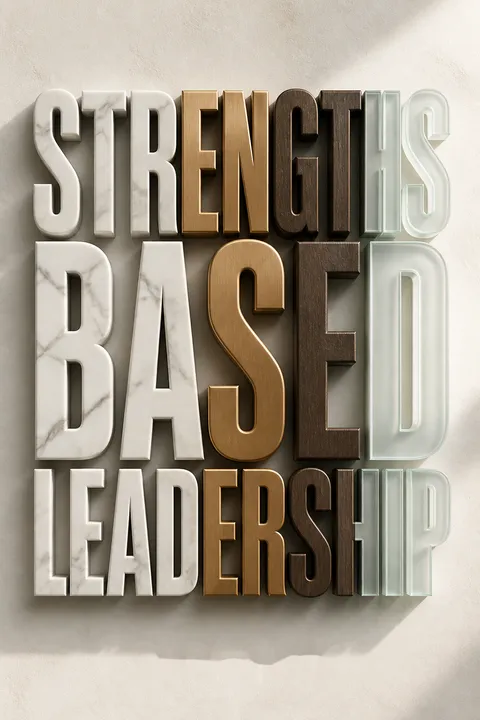


Key Takeaways
Stop copying admired leaders; build your own strengths into a leadership style
Imitation blurs your advantage. The book opens with Sarah, whose boss Bob returns from leadership courses with a new prescription each month. First, everyone should communicate like a great historical leader; next, everyone should become more humble; then everyone must champion change. His team gets a parade of borrowed styles, while Bob overlooks the most relevant person he could study: himself.
The contrast is not between good and bad leaders, but between different ways of leading. Winston Churchill's forceful wartime approach and Mahatma Gandhi's disciplined nonviolence worked in different circumstances. Gallup's research found no single list of traits shared by all effective leaders. The practical task is to recognize what comes naturally, understand its limits, and choose when that strength fits the work.
The anti-imitation argument is a useful correction to leadership advice that treats charisma as a costume. It also connects with person-environment fit: performance often improves when a person's way of working matches the task, rather than when everyone adopts one ideal style. The caution is that authenticity alone does not make a leader effective. A preferred style still needs feedback, skill, and adjustment to the people affected by it. Bob's mistake is not learning from others, but turning each lesson into a universal rule without testing whether it suits his team.
Put people where their best work becomes ordinary, not exceptional
Develop what is natural. The book distinguishes talent from strength. Talent is a recurring pattern of thought, feeling, or behavior that can be put to productive use. A strength is that talent made dependable through practice, knowledge, and skill. Leaders should identify these patterns, then help people apply and refine them rather than spending all their development effort repairing weaknesses.
Gallup reported that employee engagement was 9% when leaders did not focus on employees' strengths, compared with 73% when they did. A 25-year study following 7,660 people also found that people with higher self-confidence as young adults had higher income and career satisfaction later. In a preliminary analysis, those who had early opportunities to use their strengths also had higher later job satisfaction and income. These findings support investment, though they do not prove that strengths focus alone caused the outcomes.
This approach shifts development from a deficit inventory to an asset strategy. That resembles positive psychology's emphasis on building capacities, while also offering a practical management question: which parts of a role let this person contribute at a high level? The evidence is promising but should not be oversold. Engagement and income are shaped by compensation, opportunity, discrimination, health, and economic conditions, too. Strengths language is most useful as a way to open a conversation about work design, not as a label that explains every success or justifies ignoring skills a role genuinely requires.
Make the team well-rounded by combining four different leadership contributions
Teams need a wider range. Gallup grouped its 34 StrengthsFinder themes into four broad domains, which describe different contributions rather than four types of person:
1. Executing: turning plans into completed work.
2. Influencing: advocating, persuading, and making a team's voice heard.
3. Relationship Building: creating connection and cohesion among people.
4. Strategic Thinking: absorbing information and helping the group see possibilities.
A person may contribute across several domains, but the book argues that a team needs access to all four. Its leaders do not need to be individually well-rounded. A team that consists only of implementers may miss relationships or future options; a team of strategists may generate plans without carrying them out. The four-domain map helps leaders notice what the group can do, and what its current mix may leave unattended.
The model is valuable because it makes complementarity discussable. Teams often mistake similarity for cohesion, then discover that shared blind spots can be more damaging than disagreement. The four domains also resemble a basic operating cycle: decide what matters, bring people along, coordinate, and deliver. Still, categories can become boxes if treated as fixed identities. They work best as prompts for examining actual behavior and team needs, not as a reason to exclude someone whose assessment profile appears to lack a particular contribution.
Recruit for missing strengths, not merely impressive résumés
Design the team deliberately. The book observes that executives are often promoted for technical expertise: the strongest salesperson becomes sales manager, or the best finance specialist becomes CFO. That may fill a job title while leaving the team short of other contributions. Leaders can also unconsciously choose people who resemble them, reinforcing the same habits and assumptions.
At Hampton, a hotel chain with more than 1,500 locations, team members were talented and loyal, but they repeatedly took problems to president Phil Cordell instead of resolving them together. This made him a bottleneck and weakened trust among colleagues. The team discussed its strengths, clarified expectations, and assigned people to help build relationships, surface ideas, and develop others. Within six months, members could keep meeting and making decisions when Cordell was absent, freeing him to focus on expansion.
Hampton's problem illustrates that talent at the individual level does not automatically produce capability at the collective level. The remedy combines role clarity with relational trust, two conditions associated with effective coordination in organizational research. It also reframes delegation: handing off tasks is not enough if people still depend on the leader to settle every disagreement. Complementary recruitment matters, but so do shared decision rules and permission to challenge one another. Without those, a diverse roster can remain a collection of specialists rather than a functioning team.
Turn a clear strength into public value through disciplined execution
A mission needs machinery. As a Princeton senior, Wendy Kopp became concerned about unequal educational opportunity and the difficulty of recruiting graduates to teach in underserved schools. She proposed a national teacher corps, then decided to build one herself. Drawing inspiration from the Peace Corps, she set an ambitious first-year target of 500 teachers and estimated that she needed $2.5 million to begin.
Kopp assembled a small team, raised the money, and recruited and screened more than 2,500 applicants. Teach For America's first 500 members gathered for training about a year after she graduated. Her Achiever and Responsibility themes helped her sustain effort and treat the problem as something that required action. The story's point is not that one person can do everything. Kopp's execution depended on recruiting talented people to handle the work she could not do alone.
Kopp's example shows how a strength becomes consequential when attached to a defined problem and converted into repeatable work. In entrepreneurship, the initial idea is rarely the scarce resource; execution, hiring, fundraising, and persistence determine whether it becomes an institution. The account also invites a humane qualification: relentless achievement can look inspiring while obscuring its personal cost. Strength-based leadership should not romanticize overwork or assume that every mission justifies it. Effective execution includes building an organization that can sustain its purpose without depending indefinitely on one person's stamina.
Judge leadership by what followers receive, not what leaders claim
Ask the people who follow. Gallup surveyed 10,004 U.S. adults and asked them to name the leader with the most positive influence in their daily life, then describe what that person contributed. Rather than offering a menu of leadership virtues, researchers let people answer in their own words. Four recurring needs emerged: Trust, Compassion, Stability, and Hope.
Most respondents named someone close to everyday life, such as a family member, friend, coworker, teacher, or manager. More than three-quarters had known that person for at least six years. This shifts the unit of analysis from a leader's self-image or public reputation to the experience of followers. A leader's title is not proof of influence. The relevant question is whether people experience the relationship as dependable, humane, steady, and oriented toward a better future.
This follower-centered method is one of the book's strongest choices. It resembles user research: instead of guessing what customers value, ask them what they actually receive. It also corrects the tendency to study leaders as isolated personalities, detached from the relationships that make leadership possible. Yet the survey captures perceptions, not a full causal account of influence, and its initial sample was U.S. adults. Needs and expressions of authority can vary across cultures and settings. The framework is best read as a starting set of questions, not a universal ranking of what every follower must want.
Earn trust through dependable conduct, then make care unmistakable
Trust and care are practical. In the follower survey, people described influential leaders with words related to honesty, integrity, and respect, as well as caring, friendship, happiness, and love. The book presents trust as a foundation: without it, people hesitate to rely on one another or work together efficiently. In one Gallup poll, employees who did not trust company leadership had a 1-in-12 chance of being engaged; among those who did trust leadership, the chance was greater than 1 in 2.
Compassion matters in everyday management, too. Gallup found that employees who felt someone at work cared about them as people were more likely to stay, more engaged with customers, and more productive. Mervyn Davies, then CEO of Standard Chartered, modeled openness about personal difficulty and encouraged employees to put family first. Care is not a substitute for performance; it changes whether people feel respected while doing the work.
Trust reduces the need for defensive monitoring, while care signals that a person is more than a resource to be extracted. Together they support cooperation, candid feedback, and willingness to ask for help. This is close to psychological safety, the shared sense that interpersonal risk is acceptable, although the book emphasizes the follower's experience more than the team's climate. There is a useful boundary: compassion is not indulgence, and transparency is not unrestricted disclosure. Leaders need judgment about privacy and fairness. The strongest signal of care is consistent behavior, not a warm message that conflicts with employees' daily reality.
Give people security now and a credible reason to hope
Steadiness and direction coexist. Followers described Stability through ideas such as security, support, and strength. They also wanted Hope: direction, guidance, and confidence that the future could improve. The book treats these needs as complementary. People need some predictability in the present, but merely preserving the status quo does not give them a future to work toward.
Gallup reported that employees who strongly agreed their company's leadership made them enthusiastic about the future were far more likely to be engaged: 69%, compared with 1% among those who disagreed or strongly disagreed. Leaders can create hope by initiating plans instead of only reacting to immediate problems. The book describes one executive who responded to an economic downturn by announcing plans to hire and pursue new business rather than defaulting to cuts. The important signal was agency, not a guarantee that conditions would be easy.
The pairing of stability and hope captures a real leadership tension. Change without a reliable base feels threatening; stability without a credible direction can feel like stagnation. This resembles resilience research, where people benefit from both a sense of control and a meaningful path through uncertainty. The caution is that optimism loses credibility when it outruns evidence. A leader should distinguish an achievable plan from a motivational promise, name the risks, and show what remains within the group's control. Hope is strongest when it has an operational form: priorities, decisions, and visible next steps.
Measure your leadership by the people who can lead without you
Influence should reproduce itself. The book argues that lasting leadership means developing other people, not simply achieving results while holding the central position. Mervyn Davies challenged leaders to identify the people they had helped grow. He invested time in coaching, delegated decisions to people suited to them, and encouraged his reports to develop others in turn.
Teach For America's possible legacy, in the book's account, includes alumni who later became community leaders, businesspeople, and school officials. That kind of reach depends on more than one founder's effort. The practical test is whether people gain the capability, judgment, and responsibility to carry meaningful work forward. A leader who makes every important decision personally may be indispensable today, but has not built a durable source of leadership for tomorrow.
This is a shift from leadership as personal performance to leadership as capacity building. It aligns with succession planning and the idea that institutions become resilient when knowledge and authority are distributed. The challenge is that mentorship alone cannot guarantee a healthy legacy. People also need fair access to opportunity, transparent systems, and room to disagree with the person who developed them. Otherwise, succession can reproduce a founder's preferences rather than widen the organization's capability. A strong test is not whether successors behave like the leader, but whether they can make sound decisions under conditions the leader never faced.
Analysis
The book's central move is to change the question from which traits define a great leader to how leaders can make their distinct talents useful to other people. That shift links three levels often separated in management advice: self-knowledge, team design, and the follower's lived experience. A leader who knows where they contribute best can avoid imitation, recruit complementary colleagues, and direct attention toward the needs followers actually name.
Its most durable ideas are the rejection of the all-purpose leader and the insistence that a team, unlike an individual, needs breadth. The four domains give teams a usable vocabulary for discussing contributions, while the Hampton example shows that strengths alone do not solve coordination problems. Trust, clear expectations, and willingness to work through disagreement convert individual differences into collective performance.
The evidence deserves careful reading. Gallup draws on large surveys, team data, interviews, and a long-running study of confidence, but many reported associations do not establish that strengths-focused leadership caused engagement, income, or health outcomes. The assessment is also intended for development, not selection or mental-health diagnosis. Its results should therefore generate hypotheses for discussion, not serve as fixed verdicts about a person.
A further tension is that strengths language can liberate people from impossible demands for universal competence, but it can also become a flattering label that excuses avoidable weaknesses. A leader still needs baseline competence, ethical judgment, and the ability to adapt when a strength is poorly matched to the situation. The framework works best when paired with honest feedback and attention to power, workload, and opportunity. Its most useful promise is not that every person can do only what comes naturally, but that organizations can stop wasting talent by treating difference as a defect.
Review Summary
Strengths Based Leadership receives mixed reviews. Some readers find it insightful for understanding leadership strengths, while others criticize its brevity and reliance on the StrengthsFinder assessment. Positive reviews praise its focus on developing individual strengths rather than fixing weaknesses. Critics argue the book lacks substantial content and serves mainly as marketing for the online test. Many readers appreciate the accuracy of their assessment results but question the book's overall value. The leadership concepts of trust, compassion, stability, and hope are highlighted as key takeaways.
People Also Read





Glossary
Clifton StrengthsFinder
Talent-pattern assessmentAn online assessment developed by Gallup to identify a person's recurring talent patterns, reported as themes. In this book, it is used as a starting point for leadership development and understanding team contributions. The research appendix states that it is intended for development, not employee selection or mental-health screening.
Talent
Recurring personal patternA naturally recurring pattern of thought, feeling, or behavior that can be applied productively. In the book's model, talent is the raw material for a strength. Identifying talent helps a person see where practice and relevant knowledge may produce reliable performance.
Strength
Developed talentA capability produced when a person's talents are refined through practice and combined with relevant skills and knowledge. The book treats strengths as sources of consistent, high-quality contribution, rather than as traits that require no effort or development.
Four Domains of Leadership Strength
Team contribution mapGallup's grouping of the 34 StrengthsFinder themes into Executing, Influencing, Relationship Building, and Strategic Thinking. The domains describe broad ways people contribute to a team: completing work, advocating ideas, connecting people, and interpreting information or possibilities. A person may contribute in more than one domain.
Trust, Compassion, Stability, and Hope
Four follower needsThe four recurring contributions identified in Gallup's survey of followers asked what a positively influential leader adds to their lives. Trust includes honesty and respect; Compassion includes care and concern; Stability includes security and support; Hope includes direction and confidence in the future.
Cumulative advantage
Benefits that compound over timeThe process by which an early advantage, such as self-confidence or an opportunity to use one's strengths, is associated with further gains over time. The book uses a 25-year study of self-evaluations and later outcomes to illustrate the possibility of compounding benefits, while presenting Gallup's own strengths-opportunity analysis as preliminary.
FAQ
What's "Strengths Based Leadership" about?
- Focus on strengths: "Strengths Based Leadership" by Tom Rath and Barry Conchie explores how leaders can be more effective by focusing on their strengths and the strengths of their team members.
- Research-backed insights: The book is based on decades of Gallup research, including studies of over 1 million work teams and interviews with thousands of leaders and followers.
- Three key leadership principles: It identifies three keys to effective leadership: knowing and investing in your strengths, building a team with complementary strengths, and meeting the basic needs of followers.
- Practical application: The book includes access to a leadership version of Gallup's StrengthsFinder assessment, providing strategies for leading with your top strengths.
Why should I read "Strengths Based Leadership"?
- Enhance leadership skills: The book provides actionable insights and strategies to become a more effective leader by leveraging your strengths.
- Improve team dynamics: It offers guidance on building a well-rounded team by understanding and utilizing the diverse strengths of team members.
- Meet followers' needs: Understanding the basic needs of followers—trust, compassion, stability, and hope—can help leaders foster a more engaged and productive team.
- Research-based approach: The book is grounded in extensive research, making its recommendations credible and reliable.
What are the key takeaways of "Strengths Based Leadership"?
- Invest in strengths: Effective leaders focus on their strengths and those of their team members, leading to higher engagement and productivity.
- Build complementary teams: Successful teams are well-rounded, with members whose strengths complement each other across four domains: Executing, Influencing, Relationship Building, and Strategic Thinking.
- Understand followers' needs: Leaders should meet the four basic needs of followers: trust, compassion, stability, and hope, to inspire and engage them.
- Use StrengthsFinder: The book emphasizes the use of the StrengthsFinder assessment to identify and leverage individual and team strengths.
How does the StrengthsFinder assessment work in "Strengths Based Leadership"?
- Identify top strengths: The StrengthsFinder assessment helps individuals discover their top five strengths, which are key to their leadership style.
- Customized strategies: The assessment provides specific strategies for leading with these strengths, tailored to the individual's unique profile.
- Team mapping: Leaders can use the assessment to map the strengths of their team members across the four domains of leadership strength.
- Ongoing development: The assessment is a starting point for continuous personal and team development, encouraging leaders to focus on strengths rather than weaknesses.
What are the four domains of leadership strength in "Strengths Based Leadership"?
- Executing: Leaders with strengths in this domain know how to make things happen and turn ideas into reality.
- Influencing: These leaders help their team reach a broader audience and ensure their ideas are heard and considered.
- Relationship Building: Leaders in this domain are the glue that holds a team together, creating a cohesive and supportive environment.
- Strategic Thinking: These leaders focus on what could be, analyzing information to help the team make informed decisions and plan for the future.
What are the four basic needs of followers according to "Strengths Based Leadership"?
- Trust: Followers need to trust their leaders, which is built through honesty, integrity, and respect.
- Compassion: Leaders should show genuine care and concern for their followers, fostering a supportive environment.
- Stability: Providing a sense of security and consistency helps followers feel safe and confident in their roles.
- Hope: Leaders should inspire and motivate followers by providing a vision for the future and showing confidence in achieving it.
How can leaders build trust according to "Strengths Based Leadership"?
- Consistency and integrity: Leaders should consistently demonstrate honesty and integrity in their actions and decisions.
- Open communication: Being transparent and open in communication helps build trust with followers.
- Deliver on promises: Leaders should follow through on commitments and promises to establish reliability.
- Respect and fairness: Treating all team members with respect and fairness fosters a trusting environment.
What role does compassion play in leadership as per "Strengths Based Leadership"?
- Caring relationships: Compassionate leaders build strong, caring relationships with their followers, which enhances engagement and loyalty.
- Supportive environment: By showing empathy and understanding, leaders create a supportive environment where followers feel valued.
- Encouragement and recognition: Compassionate leaders encourage and recognize their followers' efforts and achievements, boosting morale.
- Positive energy: Leaders who exude positive energy and compassion can inspire and motivate their team to achieve their best.
How does "Strengths Based Leadership" suggest leaders provide stability?
- Clear expectations: Leaders should set clear expectations and provide consistent guidance to create a stable environment.
- Reliable support: Being a dependable source of support and guidance helps followers feel secure.
- Transparent communication: Keeping followers informed about changes and decisions reduces uncertainty and anxiety.
- Consistent values: Leaders should uphold consistent values and principles, providing a stable foundation for decision-making.
How can leaders create hope according to "Strengths Based Leadership"?
- Vision for the future: Leaders should articulate a clear and inspiring vision for the future that followers can rally behind.
- Confidence in success: Demonstrating confidence in the team's ability to achieve goals instills hope and motivation.
- Encouragement and optimism: Leaders should encourage followers and maintain an optimistic outlook, even in challenging times.
- Empowerment: Empowering followers to take initiative and contribute to the vision fosters a sense of ownership and hope.
What are some of the best quotes from "Strengths Based Leadership" and what do they mean?
- "The best leaders get to live on." This quote emphasizes the lasting impact of effective leadership, where a leader's influence continues even after they are gone.
- "If you spend your life trying to be good at everything, you will never be great at anything." It highlights the importance of focusing on strengths rather than trying to be well-rounded.
- "A leader needs to know his strengths as a carpenter knows his tools." This underscores the necessity for leaders to understand and leverage their strengths effectively.
- "People create memories, not things." This quote from Simon Cooper of The Ritz-Carlton emphasizes the importance of human interactions and experiences in creating lasting impressions.
How can "Strengths Based Leadership" be applied in real-world leadership scenarios?
- Team building: Use the StrengthsFinder assessment to identify and leverage the diverse strengths of team members for optimal performance.
- Leadership development: Focus on developing strengths rather than fixing weaknesses to enhance leadership effectiveness.
- Engagement strategies: Implement strategies to meet followers' basic needs of trust, compassion, stability, and hope to boost engagement.
- Organizational culture: Foster a strengths-based culture that encourages continuous development and leverages individual and team strengths for success.
About the Author




Download PDF
Download EPUB
.epub digital book format is ideal for reading ebooks on phones, tablets, and e-readers.








