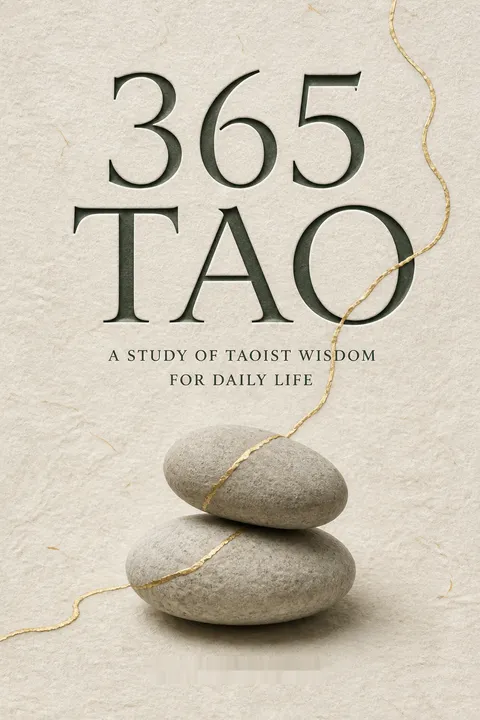


Key Takeaways
Make Tao a daily practice, not an exotic belief system.
Bring the Way close. Deng presents Tao not as a remote doctrine reserved for ancient China, but as a way to meet life as it happens. The book is an invitation to notice, practice, and test ideas directly rather than treating scripture as a substitute for experience. Washing, walking, eating, working, and tending to the world can all become occasions for attention.
Start with yourself. When faced with difficulty, the first response is self-cultivation: strengthen perception, character, and steadiness before deciding what the outside world requires. This does not mean refusing to build a bridge or defend oneself. It means asking what the action will change, and whether it fits the situation. The daily meditations make this practical by returning the reader to ordinary scenes and choices.
What's striking is the book's refusal to make spirituality depend on exotic credentials. Its claim is democratic: the sacred is available in daily attention, not only in temples or inherited texts. That resembles the practical turn in contemporary mindfulness, where ordinary activities become occasions for training attention. Yet inward work has limits. Self-cultivation can improve judgment, but it cannot replace collective action when a problem is institutional or material. The strongest reading holds both ideas together: examine one's own contribution, then respond to the conditions that genuinely require change.
Use stillness to see clearly, then act when the moment calls.
Stillness is receptive. Deng compares a quiet mind to undisturbed water: when agitation settles, it can reflect what is present more accurately. Solitude and meditation are not meant to manufacture a special state by force. They create room for attention to become less dominated by worry, impulse, and self-importance.
Stillness can move. A heron waits in the water, alert rather than asleep, and strikes when an opportunity arrives. Deng uses this image to join patience with decisiveness. The practical question is not simply whether to act, but whether the place and timing are right. A person who is attentive can let an opportunity pass deliberately, or take it without being paralyzed by second thoughts.
This pairing of calm attention and timely action has a close counterpart in skilled performance. Musicians, athletes, and emergency responders often rely on practiced awareness that lets them notice relevant cues without deliberating over every movement. The heron image captures that kind of readiness well. Still, the claim that a prepared person makes no mistakes is too strong. Attention can improve decisions, but uncertainty and incomplete information remain. A useful application is not perfect certainty, but better odds: pause long enough to perceive, then commit when delay becomes its own risk.
Prepare patiently, but do not force what conditions cannot support.
Work with the season. Deng's woodcutter does not treat labor as a constant burst of effort. He stores wood before winter, then does the work the season allows. The axe succeeds because it follows the grain rather than fighting it. A fisherman, likewise, repairs his nets and studies water conditions before setting out. Preparation often makes visible effort look smaller, not less important.
Action can yield. Deng calls this kind of responsiveness nonaction: not doing nothing, but acting without imposing unnecessary force on the situation. His kite example makes the distinction concrete. A flyer can direct the kite by using the wind, but cannot command the wind itself. Good effort borrows the available force instead of wasting energy against it.
The book's model resembles systems thinking: outcomes depend not only on effort, but on timing, constraints, and the structure of the environment. A gardener cannot hurry a seed by tugging at it, but can prepare soil and water. This is a useful corrective to the idea that intensity alone produces progress. The caution is that accepting conditions can be confused with tolerating avoidable harm. The distinction lies in what can be changed. Work with genuine constraints, but do not mistake a changeable obstacle for an unchangeable law of nature.
Meet hardship as changeable weather, not cosmic punishment.
Do not invent a verdict. Deng treats disasters as outcomes of interacting forces, not proof that the gods have singled someone out. A fire, illness, or sudden loss can alter a life without carrying a moral message. That distinction matters because the question “Why me?” can turn suffering into an imagined sentence imposed by the universe.
Acceptance still acts. The book does not equate acceptance with surrender. In a drought, a sensible response is to conserve water and avoid planting what cannot survive. In personal trouble, a person can distinguish a puzzle that needs patient analysis, an obstacle that needs effort, and an entanglement that requires escape. Breaking a large problem into smaller parts makes response more possible, even when the whole situation cannot be controlled.
This view can reduce the extra suffering created by interpreting bad luck as cosmic blame. It also resembles a useful distinction in coping: some conditions call for acceptance, while others call for problem-solving. The challenge is to avoid labeling human-made injustice as simply natural weather. A disaster may have natural causes and still be worsened by social choices. The book's emphasis on examining one's own actions works best when paired with an honest account of other people's power and responsibility. Acceptance clarifies the response; it should not erase accountability.
Treat meaning as something shaped by attention, not built into objects.
Separate event from interpretation. Deng asks readers to distinguish an object from the meaning attached to it. A rock remains a rock, whether it is ignored or made sacred through years of devotion. A home matters not only as a building, but through the memories and values people connect to it. Human perception does not merely record the world; it interprets it.
Stay answerable to reality. This does not mean that nothing matters or that consequences are imaginary. The book's point is that meanings are partly made through interaction, so people should notice the judgments they project onto events. Deng also treats gods less as an external bureaucracy dispensing rewards than as symbols of inward capacities and ideals. The invitation is to investigate experience rather than outsource every answer to authority.
The distinction between an event and its interpretation is useful across psychology, where appraisal can shape emotional response without changing the event itself. It also helps explain why the same place can feel comforting to one person and threatening to another. But subjective meaning does not make the world wholly subjective. A storm can destroy a house regardless of how its owner interprets it, and some meanings are shared through culture and relationships. The balanced lesson is to question one's interpretation without confusing interpretation with control over the facts.
Train the body and mind together; insight is more than information.
Practice is embodied. Deng rejects the idea that spiritual development is purely intellectual. He describes cultivation through the body, breath, attention, and daily habits, and presents these as connected rather than separate projects. His model of the “three treasures” names essence, breath, and spirit: bodily vitality, the breath or life energy, and the inward capacity for awareness. These are elements of his Taoist framework, not medical measurements.
Study, then test. Books and teachers can provide useful direction, but understanding must be examined in lived experience. The book recommends steady practice, including meditation, movement, and attention to diet, while acknowledging that some days feel dull or discouraging. Repeating a practice even when it feels unremarkable can build continuity. The aim is not to collect spiritual information, but to become more capable of living with clarity.
The book's insistence on embodied practice connects with modern accounts of embodied cognition, the idea that thought is shaped by bodily states and action, not just abstract reasoning. Sleep, movement, and breathing can influence attention and mood, so treating the body as irrelevant to insight is a mistake. At the same time, the text's language of internal energy should not be confused with established physiological mechanisms. Its practical value can be retained without taking every metaphysical description literally: disciplined attention to the body is real practice, even when the explanation remains symbolic.
Stay independent without withdrawing from people who need you.
Do not surrender your judgment. Deng warns that parents, teachers, and leaders can help shape a person, but can also make mistakes or misuse authority. He argues for guidance that develops independence rather than permanent dependence. Disagreement is not automatically disloyalty, and a living teacher should not become an unquestionable substitute for experience.
Independence includes care. The book also values friendship, shared meals, and mutual support. A story of two musicians who meet by chance and sustain a lasting bond shows how companionship can enrich life without becoming ownership. Helping others is part of the path, but it need not mean destroying oneself. The ideal is to walk alongside people, share what is useful, and accept that each person remains responsible for their own journey.
The balance here is more sophisticated than either rugged individualism or obedience to a group. Autonomy helps people resist manipulation, while relationships provide support, correction, and belonging. Social science on interdependence broadly supports the idea that healthy agency can coexist with mutual reliance. Deng's caution about leaders is especially valuable in spiritual settings, where claims of special insight can discourage scrutiny. The nuance is that self-sufficiency should not become a badge of isolation. People sometimes need care that cannot be replaced by inward discipline.
Use discipline to become flexible, not obedient to forms forever.
Forms are a beginning. Deng does not dismiss ritual, study, or repetition. Beginners need structure because it gives practice a shape and helps them continue when inspiration is absent. A daily commitment may feel mechanical on a difficult day, yet keeping it can preserve momentum and attention.
Do not confuse the tool with the goal. As experience deepens, a person should be able to respond creatively rather than cling to a method simply because it is familiar. Deng compares spiritual practice to skilled craft: fundamentals matter, but mastery involves knowing how to use them without being trapped by them. He also advises against meditating for promised rewards. Expectations can turn practice into a transaction and distract from the experience itself.
This is a recognizable pattern in expertise: instruction and repetition establish reliable skills, while flexible judgment allows those skills to adapt to unfamiliar situations. The book's warning against ritual becoming an empty substitute for experience is therefore persuasive. Yet improvisation without foundations can be mere impulse dressed up as freedom. A practice should be revised when it stops serving its purpose, not simply because repetition feels boring. The strongest standard is functional: does the form support attention, ethical action, and learning, or has maintaining the form become the entire project?
Let mortality sharpen your choices, then finish what matters.
Time gives choices weight. The book repeatedly returns to cycles: dawn and dusk, growth and decline, beginnings and endings. Human plans are temporary, but that does not make them pointless. A limited life gives decisions consequence. Deng urges readers to pursue meaningful aims, complete what they begin, and avoid postponing every important act until circumstances are perfect.
Endings are part of practice. The year's final meditation frames completion not as a dead end but as the beginning of another cycle. The same idea applies to a project, a relationship, or a stage of life: recognize when it is finished, take stock, rest, and continue with clearer understanding. Death is not treated as something anyone can explain with certainty. It is a limit that can help a person live more deliberately now.
Mortality can clarify priorities by making time feel finite, a theme explored in philosophy from the ancient Stoics to contemporary existential thought. The book's emphasis is less on maximizing output than on living without needless regret. That distinction matters: constant urgency can become another form of anxiety, not wisdom. Completion also need not mean finishing every task at any cost. Some commitments should be ended rather than carried forward. A useful measure is whether an action is worth the time it consumes and whether its ending leaves room for renewal.
Analysis
365 Tao is a practical spiritual companion arranged as 365 short meditations, not a linear argument or a systematic account of Taoist history. Its form is part of its method: each entry takes an image from weather, animals, work, relationships, or ordinary routine and uses it to prompt reflection. Across the year, the book moves between stillness and action, solitude and community, acceptance and initiative, bodily discipline and inward inquiry. Repetition supplies continuity, while the changing images keep the teaching from becoming a single rigid formula.
Its central ambition is translation. Deng wants Tao to be available to contemporary readers without requiring them to adopt Chinese terminology, inherited ritual, or an academic account of ancient texts. That accessibility is a strength, especially when the book makes attention practical: prepare before acting, adapt to conditions, question authority, and return to daily cultivation. Its most durable insight is that wisdom is not merely a collection of correct ideas. It is a trained capacity to notice what a situation asks for and respond without unnecessary force.
The book also contains tensions that deserve a careful reading. It promotes engagement with ordinary life, yet sometimes idealizes withdrawal and rustic simplicity. It praises flexible judgment, yet makes broad claims about absolute truth, death, inner energy, and spiritual perception that cannot be treated as established facts. Its claims about the limits of urban life are particularly sweeping. These tensions are not reasons to discard the work, but reminders to distinguish its practical counsel from its metaphysical assertions.
Read as an invitation to experiment rather than a doctrine to obey, 365 Tao offers a useful discipline: attend closely, cultivate steadiness, act with care, and stay open to the possibility that the ordinary scene already contains what abstract striving seeks.
Review Summary
365 Tao receives mostly positive reviews, with readers praising its accessible wisdom and daily meditation format. Many find it helpful for personal growth and understanding Taoist principles. Some appreciate its secular approach, while others value its spiritual insights. Critics note occasional contradictions or lack of depth. The book is often described as a go-to source for daily reflection, with readers reporting improved self-awareness and ability to navigate life's challenges. Some have read it multiple times, finding new insights with each revisit.
People Also Read

Glossary
Tao
the underlying WayThe book's name for the underlying order and movement of existence. Tao is both present in ordinary life and beyond complete description. Deng treats it less as a doctrine to accept than as something to encounter through self-cultivation, attention, and direct experience. The term can refer to nature's processes, a person's way through life, and the larger reality connecting them.
nonaction
responsive, unforced actionA way of acting that does not impose unnecessary force or interfere with the conditions of a situation. In the book, nonaction is not passivity: it can include decisive action, as long as that action fits the timing and circumstances. The skilled person remains alert, uses available forces, and does not confuse effort with control.
three treasures
essence, breath, and spiritDeng's grouping of three aspects cultivated in the body: essence, breath, and spirit. Essence refers to bodily vitality and its physical foundations; breath concerns the sustaining life force and its regulation; spirit refers to inward awareness and consciousness. The book presents these as an integrated spiritual model, not as a clinical or experimentally established system.
essence
bodily vitalityIn Deng's framework, essence is the physical and biochemical basis of vitality, shaped by the body, food, and sexual energy. It is treated as a resource that can be conserved and cultivated in support of spiritual practice. The book's account reflects its Taoist model of the person and should not be mistaken for a modern medical definition.
reddust
the world's entanglementsA metaphor for involvement in worldly concerns, distractions, conflicts, and sensory stimulation. Deng uses it to describe the conditions that can unsettle attention and make inner stillness difficult. The term does not require rejecting ordinary life: it points to the clutter of involvement that practitioners try to meet without being controlled by it.
FAQ
What's 365 Tao: Daily Meditations about?
- Daily Reflections on Taoism: 365 Tao offers a meditation for each day of the year, focusing on Taoist principles to encourage reflection on personal experiences and the world.
- Practical Application: The book demystifies Taoism, presenting it as a practical guide for modern life rather than an esoteric philosophy.
- Inner Growth Focus: It emphasizes self-cultivation and personal growth, aligning with the Taoist belief that understanding oneself leads to harmony.
Why should I read 365 Tao: Daily Meditations?
- Accessible Wisdom: The book provides a straightforward introduction to Taoism, suitable for both beginners and those familiar with the philosophy.
- Daily Inspiration: Each meditation serves as a prompt for reflection, helping integrate Taoist principles into daily life and fostering mindfulness.
- Encourages Self-Exploration: Readers are invited to explore their own experiences and interpretations, leading to profound insights and a fulfilling spiritual journey.
What are the key takeaways of 365 Tao: Daily Meditations?
- Inner Cultivation: Personal growth and understanding of Tao begin with self-reflection and inner work, emphasizing self-cultivation as the basis for knowing Tao.
- Balance and Harmony: The meditations stress finding balance in life, echoing the Taoist principle of harmony with nature and oneself.
- Acceptance of Change: Embracing change as a natural part of life leads to growth, with life seen as a series of cycles.
What are the best quotes from 365 Tao: Daily Meditations and what do they mean?
- "The trunk is hollow, but the branches live.": This illustrates that while the physical form may be transient, the essence of life continues, emphasizing nurturing one's inner self.
- "To know Tao is to enter a state of consciousness.": Understanding Tao requires deep, experiential awareness beyond intellectual knowledge, suggesting true insight comes from direct experience.
- "Life's moments are not cheapened by death.": This reassures that life's value is not diminished by impermanence, encouraging full embrace of each moment.
How does 365 Tao: Daily Meditations encourage meditation?
- Daily Meditations: Each entry serves as a meditation prompt, guiding readers to reflect on specific themes and concepts, encouraging consistent mindfulness practice.
- Inner Stillness Focus: The book emphasizes finding stillness within to connect with Tao, highlighting the need for quiet reflection.
- Exploration Encouragement: Readers are invited to explore their understanding of Tao through meditation, fostering a personal connection to the teachings.
What is the significance of nature in 365 Tao: Daily Meditations?
- Nature as a Teacher: The book draws parallels between natural phenomena and Taoist principles, suggesting nature embodies the essence of Tao.
- Cycles of Life: It emphasizes the cyclical nature of existence, encouraging alignment with these cycles for greater harmony.
- Connection to the Universe: The meditations highlight interconnectedness, urging recognition of one's place within the larger tapestry of life.
How does 365 Tao: Daily Meditations address the concept of duality?
- Understanding Opposites: The book discusses recognizing and embracing duality, such as light and dark, joy and sorrow, as interconnected forces.
- Balance in Life: It emphasizes the need for balance between opposing forces, suggesting true understanding comes from integrating dualities.
- Transcending Duality: Ultimately, it suggests transcending duality leads to a deeper understanding of Tao, encouraging unity beyond life's contradictions.
What practices does 365 Tao: Daily Meditations recommend for self-cultivation?
- Daily Reflection: Advocates for daily meditation and reflection as essential practices for self-cultivation, emphasizing personal engagement with the teachings.
- Mindfulness in Action: Urges applying Taoist principles in daily activities, fostering mindfulness in every action and highlighting the importance of being present.
- Embracing Simplicity: Promotes a simple, uncluttered approach to life, encouraging letting go of unnecessary complexities to understand Tao.
How does 365 Tao: Daily Meditations define the concept of Tao?
- Tao as the Way: Defined as the fundamental principle underlying all existence, often referred to as "the Way," emphasizing natural order.
- Tao as a Living Force: Presented as a dynamic, living force flowing through all things, encouraging connection with this energy.
- Tao Beyond Words: Acknowledges that Tao cannot be fully captured in words, urging direct experience and personal exploration.
How can I apply the teachings of 365 Tao: Daily Meditations in my life?
- Daily Practice: Incorporate meditations into daily routines to foster mindfulness and reflection, helping stay grounded and aware.
- Embrace Nature: Spend time in nature to connect with Tao principles, enhancing peace and well-being.
- Cultivate Relationships: Use teachings to improve relationships, focusing on compassion and understanding.
What challenges does 365 Tao: Daily Meditations address?
- Facing Adversity: Acknowledges life's challenges and encourages embracing them as opportunities for growth and perfection.
- Overcoming Isolation: Discusses feelings of alienation in modern society, offering insights on finding connection and community.
- Navigating Complexity: Addresses modern life's complexities, advocating for simplicity and clarity to navigate effectively.
What specific methods or advice does 365 Tao: Daily Meditations offer?
- Daily Reflection: Encourages reflection on thoughts and actions, fostering self-awareness and personal growth.
- Connection to the Body: Emphasizes awareness of one's body and energy centers, particularly the navel area, for vitality.
- Embracing Nature: Advises connecting with nature as a source of inspiration and grounding, recognizing its role in life.
About the Author
Download PDF
Download EPUB
.epub digital book format is ideal for reading ebooks on phones, tablets, and e-readers.








